Kansas: Emergency vehicles and work zones — Part 1 Practice Test
Questions in this part include: “What color are work zone signs?” · “What happens to fines for speeding in a work zone?”
Independent educational site · not affiliated with any government agency or DMV
Ready? Test yourself
- Instant feedback with an explanation
- Every answer cites its source in the manual
- Your best score is saved on this device
Questions are original and based on the official manual "Kansas Driving Handbook" (Revised February 2022), Kansas Department of Revenue, Division of Vehicles.
All 17 questions in this practice test
Take the test above first, then use this list to study. Tap “Show answer” to see the correct answer and explanation.
Show the questions and answersHide the questions
-
What must you do when an emergency vehicle coming toward you or from behind is displaying flashing red lights or sounding a siren?
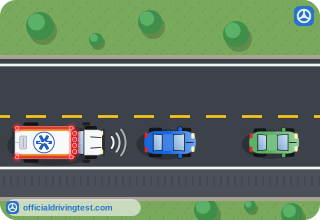
- Pull to the left side of the road and stop as soon as it is safe
- Speed up to clear the intersection, then pull over and stop
- Stop where you are, even in the middle of an intersection
- Drive to the right at once and stop, keeping intersections clear
Show answer
Correct answer: Drive to the right at once and stop, keeping intersections clear
You must immediately drive to the right and stop without blocking any intersection.
Source: Kansas Driving Handbook (Revised February 2022), page 18
-
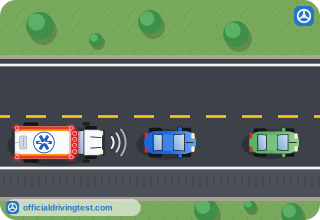
When do emergency vehicles such as police cars, fire engines and ambulances have the right-of-way?
- Only when both a red light and a siren are used together
- Only on divided highways and on one-way streets
- When they show a red light in front or sound a siren or bell
- Only when they are traveling faster than the posted limit
Show answer
Correct answer: When they show a red light in front or sound a siren or bell
Emergency vehicles have the right-of-way when displaying a red light in front or when they signal with a siren or bell.
Source: Kansas Driving Handbook (Revised February 2022), page 18
-
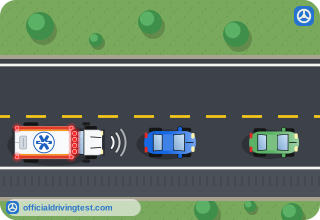
After an emergency vehicle has passed you, what does the manual say you must NEVER do?
- Follow such vehicles
- Move to the right
- Use your turn signal
- Wait at the curb
Show answer
Correct answer: Follow such vehicles
After drivers pull right and stop for emergency vehicles, the manual says never to follow such vehicles.
Source: Kansas Driving Handbook (Revised February 2022), page 18
-
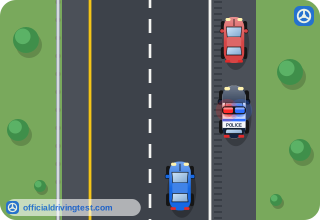
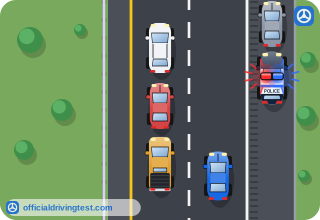
What must you do when approaching from the rear a stationary emergency vehicle that is using flashing warning lights, on a street or highway with two or more lanes in each direction?
- Stop behind the emergency vehicle and wait until it has left
- Stay in your lane, speed up and pass the stopped vehicle quickly
- Move into the lane next to the emergency vehicle and stop
- Proceed with due caution and move to a lane not next to the stopped vehicle
Show answer
Correct answer: Proceed with due caution and move to a lane not next to the stopped vehicle
You must proceed with due caution and move to a lane that is not next to the stopped emergency vehicle.
Source: Kansas Driving Handbook (Revised February 2022), page 18
-
If you cannot change lanes when approaching a stationary emergency vehicle using flashing warning lights, what must you do?
- Stop behind the emergency vehicle
- Reduce speed and proceed with due caution
- Keep your speed and sound your horn
- Move onto the shoulder and pass
Show answer
Correct answer: Reduce speed and proceed with due caution
If it is not possible to change lanes, the driver must reduce speed and proceed with due caution.
Source: Kansas Driving Handbook (Revised February 2022), page 18
-
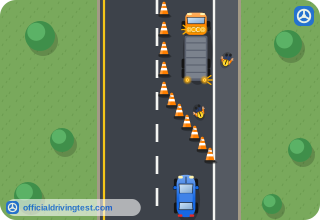
What must you do when you encounter construction vehicles and workers that are actually engaged in work on the roadway?
- Slow down and keep driving in the lane right next to the workers
- Stop and wait until the work on the roadway is finished
- Yield, and move into a lane that is not next to the construction vehicles
- Sound your horn and drive past the work area quickly
Show answer
Correct answer: Yield, and move into a lane that is not next to the construction vehicles
You must yield to construction vehicles and workers actually engaged in work and move into a lane that is not next to them.
Source: Kansas Driving Handbook (Revised February 2022), page 18
-
What color are work zone signs?
- Yellow with black letters or symbols
- Orange with black letters or symbols
- Fluorescent pink with black letters
- Red with white letters
Show answer
Correct answer: Orange with black letters or symbols
Work zone signs are generally diamond or rectangular shaped and orange with black letters or symbols.
Source: Kansas Driving Handbook (Revised February 2022), page 38
-
Which of these do work zone signs warn you about?
- An animal crossing the road ahead
- A railroad crossing on the road ahead
- A school zone on the road ahead
- Poor or suddenly changing road surfaces
Show answer
Correct answer: Poor or suddenly changing road surfaces
Work zone signs warn of workers ahead, reduced speed, detours, slow moving construction equipment and poor or suddenly changing road surfaces.
Source: Kansas Driving Handbook (Revised February 2022), page 38
-
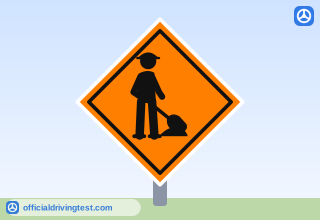
An orange diamond-shaped sign shows a black figure shoveling. What does it warn of?
- Workers ahead
- A detour ahead
- Tar ahead
- A one lane road ahead
Show answer
Correct answer: Workers ahead
An orange diamond showing a shoveling figure is the Workers Ahead work zone sign.
Source: Kansas Driving Handbook (Revised February 2022), page 38
-
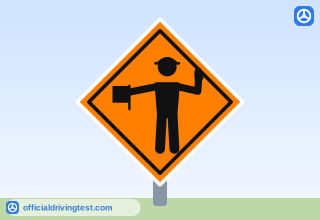
An orange diamond-shaped sign shows a black human figure with one arm held out. What does it warn of?
- A survey crew ahead
- Road construction ahead
- A flagger ahead
- A detour ahead
Show answer
Correct answer: A flagger ahead
An orange diamond showing a human figure with an outstretched arm is the Flagger Ahead work zone sign.
Source: Kansas Driving Handbook (Revised February 2022), page 38
-
A person in a work zone holds a sign or flag to tell traffic which way to go, slow down or stop. What must you do?
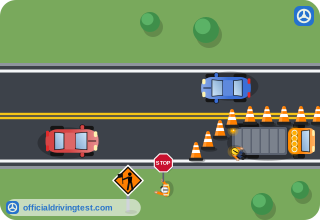
- Follow their instructions
- Follow them only if no cones are present
- Follow the posted signs instead of the person
- Follow them only if other drivers do
Show answer
Correct answer: Follow their instructions
Traffic in a work zone may be controlled by a person with a sign or flag, and drivers must follow those instructions.
Source: Kansas Driving Handbook (Revised February 2022), page 39
-
What are drums, cones and tubes (panels) used for in work zones?
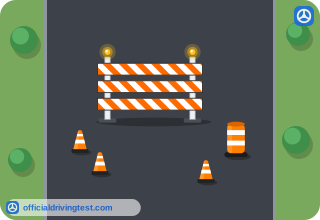
- To show where workers may park their vehicles
- To mark where the speed limit changes
- To keep traffic out of hazardous work zones
- To show which way a detour turns
Show answer
Correct answer: To keep traffic out of hazardous work zones
Barriers such as drums, cones and tubes are used to keep traffic out of hazardous work zones and, with signs and markings, guide drivers through safely.
Source: Kansas Driving Handbook (Revised February 2022), page 39
-
You reach a temporary traffic signal in a work zone and there is a white line on the road. Where should you stop for a red signal?
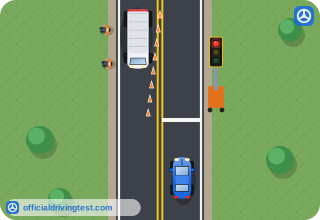
- Just past the signal
- At the white line
- At the nearest cone
- Once the front of your vehicle is level with the signal
Show answer
Correct answer: At the white line
At a temporary traffic signal in a work zone, you stop at the white line if one is present.
Source: Kansas Driving Handbook (Revised February 2022), page 39
-
What happens to fines for speeding in a work zone?
- They are tripled
- They are the same as elsewhere
- They are waived for a first offense
- They are doubled
Show answer
Correct answer: They are doubled
The manual states that fines for speeding in a work zone are doubled.
Source: Kansas Driving Handbook (Revised February 2022), page 39
-
How should you drive when you approach and pass through a work zone?
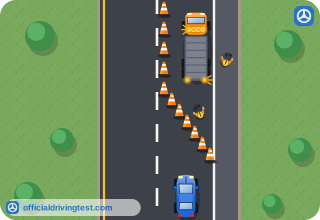
- Reduce your speed and be prepared to stop suddenly
- Keep your speed and move to the left lane
- Speed up to clear the work zone quickly
- Slow down only if workers are within sight
Show answer
Correct answer: Reduce your speed and be prepared to stop suddenly
Drivers are asked to give workers a "brake" by reducing speed and being ready to stop suddenly.
Source: Kansas Driving Handbook (Revised February 2022), page 39
-
Which of these does the manual tell you NOT to do in a work zone?
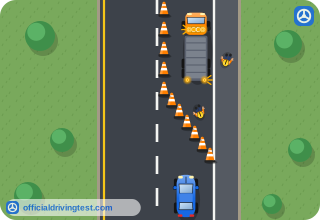
- Reduce your speed
- Be prepared to stop suddenly
- Tailgate
- Follow a flagger’s instructions
Show answer
Correct answer: Tailgate
The manual tells drivers not to tailgate in work zones.
Source: Kansas Driving Handbook (Revised February 2022), page 39
-
Under emergency conditions, which of these may a driver of an emergency vehicle do?
- Go through a red light or stop sign after slowing down
- Drive through a crosswalk without regard to pedestrians
- Ignore every traffic law once the siren is on
- Pass other vehicles with the lights and siren turned off
Show answer
Correct answer: Go through a red light or stop sign after slowing down
Under emergency conditions, drivers of emergency vehicles may be exempt from traffic control laws, for example going through a red light or stop sign after slowing down.
Source: Kansas Driving Handbook (Revised February 2022), page 84