Kansas: Emergency vehicles and work zones — Part 2 Practice Test
Questions in this part include: “Even when an emergency vehicle driver is exempt from some traffic laws, what must that driver still do?” · “During an emergency, whose direction must you obey at the scene?”
Independent educational site · not affiliated with any government agency or DMV
Ready? Test yourself
- Instant feedback with an explanation
- Every answer cites its source in the manual
- Your best score is saved on this device
Questions are original and based on the official manual "Kansas Driving Handbook" (Revised February 2022), Kansas Department of Revenue, Division of Vehicles.
All 16 questions in this practice test
Take the test above first, then use this list to study. Tap “Show answer” to see the correct answer and explanation.
Show the questions and answersHide the questions
-
Even when an emergency vehicle driver is exempt from some traffic laws, what must that driver still do?
- Keep to the posted speed limit at all times, with no exceptions
- Stop at every intersection before entering it, even on green
- Drive with regard for the safety of other roadway users
- Stay in the right lane for the whole length of the trip
Show answer
Correct answer: Drive with regard for the safety of other roadway users
Drivers of emergency vehicles must drive with regard for the safety of other roadway users.
Source: Kansas Driving Handbook (Revised February 2022), page 84
-
Which of these is named as an example of an emergency vehicle?
- A mail delivery truck
- A blood delivery vehicle
- A taxi
- A garbage truck
Show answer
Correct answer: A blood delivery vehicle
Emergency vehicles include fire department equipment, police vehicles, ambulances and specialty-equipped vehicles such as blood delivery vehicles, river rescue vehicles and hazmat response vehicles.
Source: Kansas Driving Handbook (Revised February 2022), page 84
-
What should you do when you hear a siren or see a vehicle approaching with flashing lights?
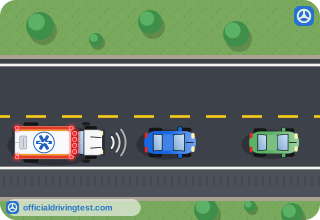
- Keep your speed and stay in your lane until the vehicle has passed
- Move into the right lane and drive slowly until the vehicle has passed
- Speed up to get out of the way of the emergency vehicle behind you
- Move to the right, pull over to the curb or edge of the road, and stop
Show answer
Correct answer: Move to the right, pull over to the curb or edge of the road, and stop
You must move to the right, pull over to the curb or edge of the road, and stop for an approaching siren or flashing lights.
Source: Kansas Driving Handbook (Revised February 2022), page 85
-
How should you position your vehicle when you pull over for an emergency vehicle?
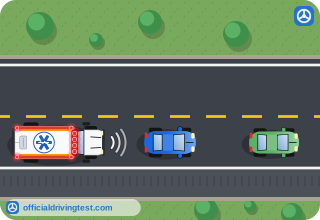
- Parallel and as near to the curb as possible
- At an angle, with the front wheels turned toward the road
- Straddling the lane line so the vehicle can pass on either side
- At least one lane away from the curb
Show answer
Correct answer: Parallel and as near to the curb as possible
Position yourself parallel and as near to the curb as possible when you pull over for an emergency vehicle.
Source: Kansas Driving Handbook (Revised February 2022), page 85
-
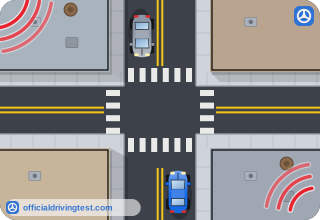
When you pull over for an emergency vehicle, what must you always do about intersections?
- Stop in them to see both directions
- Stop in the middle of them to block cross traffic
- Keep them clear
- Pull over at the nearest one
Show answer
Correct answer: Keep them clear
When pulling over for an emergency vehicle you must always keep intersections clear.
Source: Kansas Driving Handbook (Revised February 2022), page 85
-
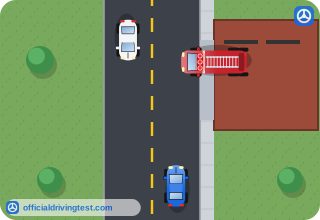
An emergency vehicle is leaving or returning to its garage with its emergency lights still flashing. What must you do?
- Pass it carefully on the left
- Slow down but keep moving beside it
- Continue if no siren is sounding
- Stop until it is safely out of your path
Show answer
Correct answer: Stop until it is safely out of your path
If an emergency vehicle is leaving or returning to its garage and the emergency lights are still flashing, you must stop until it is safely out of your path.
Source: Kansas Driving Handbook (Revised February 2022), page 85
-
During an emergency, whose direction must you obey at the scene?
- Law enforcement or emergency services personnel
- Any other driver who stopped there first
- Only the traffic signals and signs at the scene
- Bystanders who are helping at the scene
Show answer
Correct answer: Law enforcement or emergency services personnel
During an emergency you must obey the direction of law enforcement or emergency services personnel on the scene.
Source: Kansas Driving Handbook (Revised February 2022), page 85
-
If law enforcement pulls you over, where should you stop?
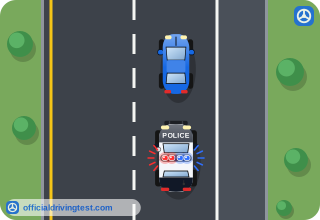
- In your current lane so that the officer can see you from behind
- On the left side of the roadway, as close to the center as possible
- On the right side of the roadway, as far out of the way of traffic as possible
- In the next intersection, where the officer can easily find you
Show answer
Correct answer: On the right side of the roadway, as far out of the way of traffic as possible
When pulled over, move to the right side of the roadway and position your vehicle as far out of the way of traffic as possible, where it is safe for you and the officer.
Source: Kansas Driving Handbook (Revised February 2022), page 85
-
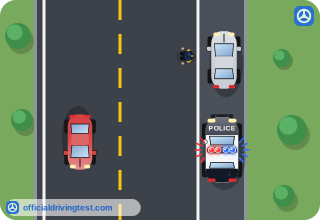
When you are pulled over by law enforcement, what should you turn off?
- Your headlights and hazard flashers so you do not distract the officer
- Your engine, radio and any device that might interfere with communicating
- Your seat belt, so you can reach your documents more easily
- Only your engine, while the radio stays on to keep you calm
Show answer
Correct answer: Your engine, radio and any device that might interfere with communicating
Turn off your engine, radio, CD player or any other device that might interfere with communicating with the officer.
Source: Kansas Driving Handbook (Revised February 2022), page 85
-
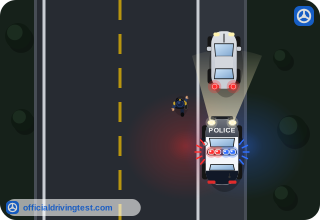
At night during a traffic stop, which lights should you turn on so that the officer can see inside your vehicle?
- Your high beam headlights
- Your fog lights
- Your parking lights only
- Your interior lights
Show answer
Correct answer: Your interior lights
Turn on your hazard flashers and, if it is night, your interior lights to help the officer see that everything is in order inside the vehicle.
Source: Kansas Driving Handbook (Revised February 2022), page 85
-
What should you do with your window when an officer has pulled you over?
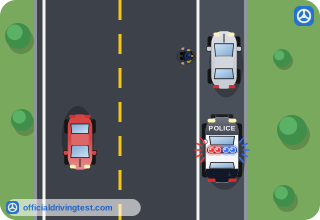
- Roll it down so you and the officer can communicate
- Keep it closed and speak through the door instead
- Keep it closed and hold your license against the glass
- Open it only after the officer asks you to step out
Show answer
Correct answer: Roll it down so you and the officer can communicate
Roll down your window so that you and the officer can communicate.
Source: Kansas Driving Handbook (Revised February 2022), page 85
-
During a traffic stop, what should you do with your safety belt?
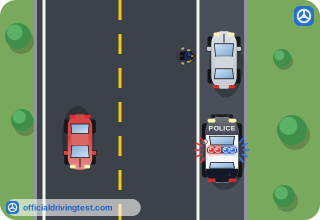
- Unfasten it so that you can reach your documents more easily
- Unfasten it and ask your passengers to unfasten theirs
- Keep it fastened and ask your passengers to do the same
- Unfasten it only after the officer reaches your window
Show answer
Correct answer: Keep it fastened and ask your passengers to do the same
Remain calm and keep your safety belt fastened, and ask your passengers to do so as well.
Source: Kansas Driving Handbook (Revised February 2022), page 85
-
During a traffic stop, where should you keep your hands?
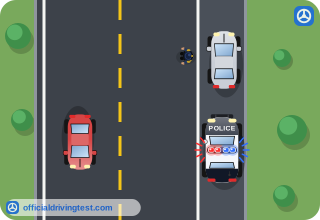
- On the top of the dashboard
- On the steering wheel
- Behind your head
- Out of the window
Show answer
Correct answer: On the steering wheel
Keep your hands on the steering wheel and limit movements so the officer does not think you are hiding or searching for something.
Source: Kansas Driving Handbook (Revised February 2022), page 85
-
An officer asks for your license, proof of insurance or registration. How should you reach for them?
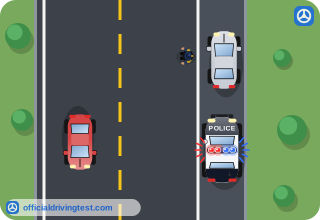
- Quickly, using both hands so that the officer can see them at once
- With both hands off the wheel while you are turned toward the officer
- After getting out of the vehicle to open the glove box yourself
- Slowly, with one hand on the wheel, after telling the officer where they are
Show answer
Correct answer: Slowly, with one hand on the wheel, after telling the officer where they are
Tell the officer where the documents are located and reach for them slowly with one hand on the wheel.
Source: Kansas Driving Handbook (Revised February 2022), page 85
-
During a traffic stop, when should you get out of your vehicle?
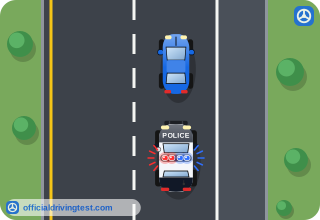
- Only when the officer requests it
- As soon as the officer's vehicle stops behind you
- Whenever you need to find your documents
- When you see the officer walking up in your mirror
Show answer
Correct answer: Only when the officer requests it
Remain in the vehicle unless requested to get out.
Source: Kansas Driving Handbook (Revised February 2022), page 85
-
How do the consequences of running from law enforcement compare with the initial traffic citation?
- They are about the same as the citation
- They are less severe if you stop soon afterward
- They are more severe than the initial citation
- They are limited to a warning if no one is hurt
Show answer
Correct answer: They are more severe than the initial citation
Running from law enforcement is very dangerous, and the consequences are more severe than the initial traffic citation.
Source: Kansas Driving Handbook (Revised February 2022), page 85