Indiana: Signals and vehicle controls
Turn and hand signals, lane changes, headlights, tires, brakes, fuel economy and the equipment your vehicle must have. Split into 2 shorter tests so you're not stuck in one long quiz.
Independent educational site · not affiliated with any government agency or DMV
All 38 Signals and vehicle controls questions with answers
Choose a part above to take a practice test, or study every question and answer here.
Show the questions and answersHide the questions
-
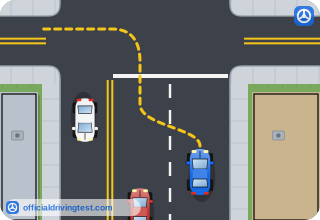
When changing lanes to prepare for a turn, what must you do before turning or changing lanes?
- Sound your horn
- Come to a complete stop
- Give a proper signal
- Turn on your hazard lights
Show answer
Correct answer: Give a proper signal
The manual says you must give a proper signal before turning or changing lanes.
Source: Indiana Driver’s Manual (July 2026), page 37 · Open this page in the manual (Manual page 37)
-
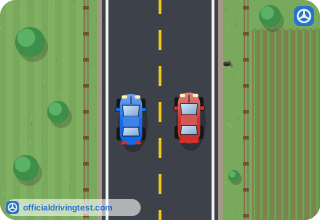
Before returning to the lane in which you were originally driving after passing, what should you do?
- Tap your horn twice
- Flash your headlights
- Use the appropriate turn signal
- Slow down below the other vehicle
Show answer
Correct answer: Use the appropriate turn signal
The manual says to use the appropriate turn signal before returning to your original lane.
Source: Indiana Driver’s Manual (July 2026), page 38 · Open this page in the manual (Manual page 38)
-
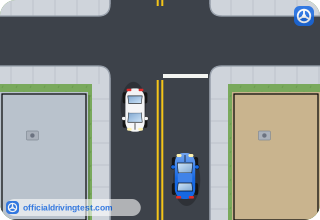
When must you give a proper turn signal?
- Only when another vehicle is close behind you
- Only when you turn at an intersection
- Before turning or changing lanes
- Only when you turn left
Show answer
Correct answer: Before turning or changing lanes
The manual says you must give a proper turn signal before turning or changing lanes.
Source: Indiana Driver’s Manual (July 2026), page 39 · Open this page in the manual (Manual page 39)
-
What is the safest type of signal to use?
- A hand signal given from the window
- The lighted signals used in most vehicles
- A short tap on the horn
- A flash of the headlights
Show answer
Correct answer: The lighted signals used in most vehicles
The manual says the safest type of signal is the lighted signals used in most vehicles.
Source: Indiana Driver’s Manual (July 2026), page 39 · Open this page in the manual (Manual page 39)
-
When may you use hand signals instead of lighted signals?
- When you are driving at night or in poor weather conditions
- When you are driving below 25 miles per hour in a town
- When you want to be seen more easily by pedestrians
- When one or more of the lighted signals is malfunctioning
Show answer
Correct answer: When one or more of the lighted signals is malfunctioning
The manual says hand signals may be used if one or more lighted signals is malfunctioning.
Source: Indiana Driver’s Manual (July 2026), page 39 · Open this page in the manual (Manual page 39)
-
What does the manual say about hand signals on a driving skills exam?
- You may not use them
- You may use them only for right turns
- You may use them only when the weather is bad
- You must use them for every turn
Show answer
Correct answer: You may not use them
The manual says you may not use hand signals on a driving skills exam.
Source: Indiana Driver’s Manual (July 2026), page 39 · Open this page in the manual (Manual page 39)
-
A driver’s arm extended downward out of the window is the hand signal for what?
- Pull over to the curb
- The driver is backing up
- Stop or slow
- The driver is changing lanes
Show answer
Correct answer: Stop or slow
A driver's arm extended downward out of the window is the hand signal for "Stop or slow".
Source: Indiana Driver’s Manual (July 2026), page 39 · Open this page in the manual (Manual page 39)
-
A driver’s left arm bent upward at the elbow out of the window is the hand signal for what?
- Stop or slow
- Right turn
- The driver is backing up
- The driver is changing lanes
Show answer
Correct answer: Right turn
A driver's left arm bent upward at the elbow out of the window is the hand signal for "Right turn".
Source: Indiana Driver’s Manual (July 2026), page 39 · Open this page in the manual (Manual page 39)
-
A driver’s left arm extended straight out of the window is the hand signal for what?
- Stop or slow
- Pull over to the curb
- The driver is changing lanes
- Left turn
Show answer
Correct answer: Left turn
A driver's left arm extended straight out of the window is the hand signal for "Left turn".
Source: Indiana Driver’s Manual (July 2026), page 39 · Open this page in the manual (Manual page 39)
-
Above what speed does fuel consumption increase steadily?
- 30 miles per hour
- 55 miles per hour
- 45 miles per hour
- 65 miles per hour
Show answer
Correct answer: 45 miles per hour
The manual says fuel consumption increases steadily above 45 miles per hour.
Source: Indiana Driver’s Manual (July 2026), page 42 · Open this page in the manual (Manual page 42)
-
About how much more fuel do passenger cars and light trucks use at 75 miles per hour than at 55 miles per hour?
- About 10 percent more
- About 50 percent more
- About 25 percent more
- About 100 percent more
Show answer
Correct answer: About 50 percent more
Passenger cars and light trucks use approximately 50 percent more fuel at 75 miles per hour than at 55.
Source: Indiana Driver’s Manual (July 2026), page 42 · Open this page in the manual (Manual page 42)
-
Which of these helps maximize your fuel economy?
- Hauling cargo on your roof
- Accelerating rapidly
- Taking several short trips from a cold start
- Removing excess weight from your vehicle
Show answer
Correct answer: Removing excess weight from your vehicle
The manual advises removing excess weight, avoiding roof cargo and avoiding rapid acceleration or sudden stops.
Source: Indiana Driver’s Manual (July 2026), page 42 · Open this page in the manual (Manual page 42)
-
Compared with one longer, multipurpose trip of the same distance, how much fuel can several short trips from a cold start use?
- Twice as much
- Half as much
- The same amount
- About 10 percent less
Show answer
Correct answer: Twice as much
Several short trips taken from a cold start can use twice as much fuel as a longer, multipurpose trip covering the same distance.
Source: Indiana Driver’s Manual (July 2026), page 42 · Open this page in the manual (Manual page 42)
-
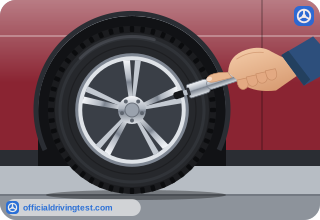
About how much tire pressure have tires been known to lose each month?
- Up to 5 psi
- Up to 10 psi
- Up to 1 psi
- Up to 20 psi
Show answer
Correct answer: Up to 1 psi
The manual says tires have been known to lose up to 1 psi every month.
Source: Indiana Driver’s Manual (July 2026), page 43 · Open this page in the manual (Manual page 43)
-
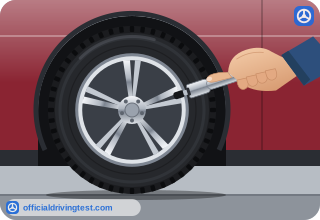
How often should you check the pressure of all your tires, including the spare?
- Once a year, before winter starts
- Once a month or before a long trip
- Every six months, no more often
- Only when a tire looks flat
Show answer
Correct answer: Once a month or before a long trip
The manual says to check all tires, including your spare, once a month or before a long trip.
Source: Indiana Driver’s Manual (July 2026), page 43 · Open this page in the manual (Manual page 43)
-
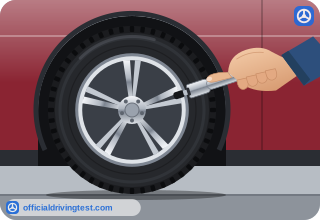
Where should you look for your vehicle's recommended tire pressure?
- On the tire sidewall next to the tire size
- On the cap of the valve stem
- On the dashboard warning light
- On the door jamb sticker or in the owner's manual
Show answer
Correct answer: On the door jamb sticker or in the owner's manual
The recommended psi is on the sticker in the door jamb or in the owner's manual, and you should not compare to the psi on the tire sidewall.
Source: Indiana Driver’s Manual (July 2026), page 43 · Open this page in the manual (Manual page 43)
-
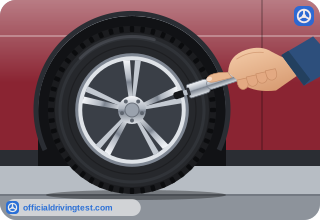
When should you check your tires “cold”?
- Before you have driven or at least three hours after
- Right after a long drive, while the tires are warm
- At least thirty minutes after you stop driving
- Only after the engine has fully warmed up
Show answer
Correct answer: Before you have driven or at least three hours after
The manual says to check tires before you have driven or at least three hours after you have driven.
Source: Indiana Driver’s Manual (July 2026), page 43 · Open this page in the manual (Manual page 43)
-
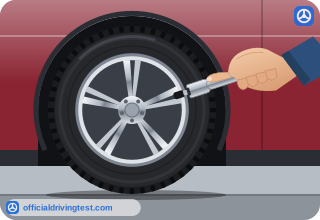
If the measured tire pressure is above the recommended number, what should you do?
- Drive until the tires cool, then leave it
- Add air until it matches the sidewall number
- Let air out until it matches
- Leave it, because higher pressure is safer
Show answer
Correct answer: Let air out until it matches
The manual says if your psi is above the number, let air out until it matches.
Source: Indiana Driver’s Manual (July 2026), page 43 · Open this page in the manual (Manual page 43)
-
In the penny test for tread depth, what shows that you are driving with a legal and safe amount of tread?
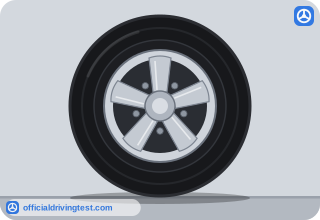
- All of Lincoln's head is visible above the tread
- Part of Lincoln's head is covered by the tread
- The penny cannot fit into the groove at all
- Only Lincoln's body is hidden by the tread
Show answer
Correct answer: Part of Lincoln's head is covered by the tread
If any part of Lincoln's head is covered by the tread, you are driving with the legal and safe amount of tread.
Source: Indiana Driver’s Manual (July 2026), page 43 · Open this page in the manual (Manual page 43)
-
Below approximately what tread depth is a car's ability to grip the road in adverse conditions greatly reduced?
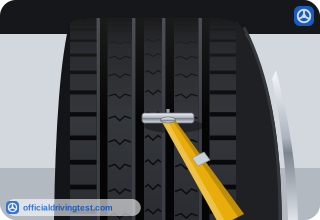
- 1/4 of an inch
- 1/8 of an inch
- 1/2 of an inch
- 1/16 of an inch
Show answer
Correct answer: 1/16 of an inch
The manual says that below approximately 1/16 of an inch your car's ability to grip the road in adverse conditions is greatly reduced.
Source: Indiana Driver’s Manual (July 2026), page 43 · Open this page in the manual (Manual page 43)
-
How often should you check your tires for wear and damage?
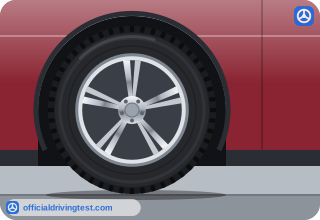
- Once every month, or before a long road trip
- Once every year, before winter begins
- Once every six months, at the very least
- Only when you buy new tires for your car
Show answer
Correct answer: Once every month, or before a long road trip
The manual says to check your tires for wear and damage once every month or before a long road trip.
Source: Indiana Driver’s Manual (July 2026), page 43 · Open this page in the manual (Manual page 43)
-
Which headlight beams should you use in fog?
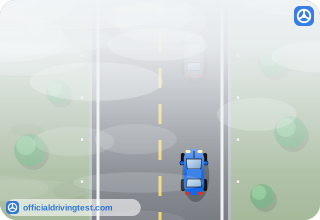
- High beams, because they reach farther down the road
- Parking lights only, to avoid glare from the fog
- Low beams, which better illuminate the road ahead
- Brake lights only, to make other drivers slow down
Show answer
Correct answer: Low beams, which better illuminate the road ahead
The manual says not to use high beams in fog because low beams better illuminate the road and objects ahead.
Source: Indiana Driver’s Manual (July 2026), page 44 · Open this page in the manual (Manual page 44)
-
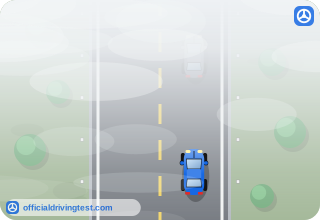
Which lights should be used while driving in fog?
- High beams and parking lights together
- Parking lights and turn signals only
- Turn signals and brake lights only
- Headlights and flashing emergency signals
Show answer
Correct answer: Headlights and flashing emergency signals
The manual says headlights and flashing emergency signals should be used while driving in fog.
Source: Indiana Driver’s Manual (July 2026), page 44 · Open this page in the manual (Manual page 44)
-
When must drivers use headlights, according to the manual?
- Between 9 p.m. and 5 a.m.
- Only when it is completely dark
- Between sunset and sunrise
- Only when it is raining or snowing
Show answer
Correct answer: Between sunset and sunrise
The manual says drivers must use headlights between sunset and sunrise, and any other time visibility is less than 500 feet.
Source: Indiana Driver’s Manual (July 2026), page 44 · Open this page in the manual (Manual page 44)
-
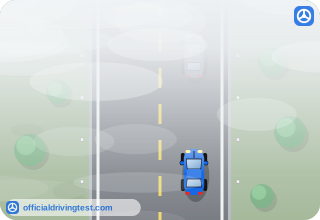
Besides between sunset and sunrise, drivers must use headlights whenever visibility is less than what distance?
- 100 feet
- 500 feet
- 300 feet
- 1,000 feet
Show answer
Correct answer: 500 feet
The manual says headlights must be used whenever visibility is less than 500 feet.
Source: Indiana Driver’s Manual (July 2026), page 44 · Open this page in the manual (Manual page 44)
-
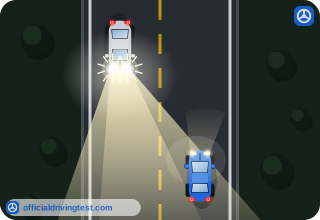
At what distance from an oncoming vehicle must lower headlight beams be used?
- Within 100 feet
- Within 300 feet
- Within 1,000 feet
- Within 500 feet
Show answer
Correct answer: Within 500 feet
Lower headlight beams must be used when approaching within 500 feet of an oncoming vehicle.
Source: Indiana Driver’s Manual (July 2026), page 44 · Open this page in the manual (Manual page 44)
-
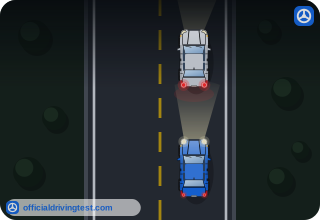
At what distance behind another vehicle must you use lower headlight beams?
- Within 200 feet
- Within 100 feet
- Within 400 feet
- Within 750 feet
Show answer
Correct answer: Within 200 feet
Lower headlight beams must be used when following within 200 feet of the rear of another vehicle.
Source: Indiana Driver’s Manual (July 2026), page 44 · Open this page in the manual (Manual page 44)
-
How many red tail lamps are required on any truck or bus?
- One
- Three
- Four
- Two
Show answer
Correct answer: Two
The lighting requirements for any truck or bus include two red tail lamps.
Source: Indiana Driver’s Manual (July 2026), page 57 · Open this page in the manual (Manual page 57)
-
What color is the rear license plate lamp required on any truck or bus?
- White
- Red
- Amber
- Green
Show answer
Correct answer: White
The manual lists one rear white license plate lamp as a lighting requirement for any truck or bus.
Source: Indiana Driver’s Manual (July 2026), page 57 · Open this page in the manual (Manual page 57)
-
What is the minimum number of red stop-lamps required on any truck or bus?
- Two
- Three
- One
- Four
Show answer
Correct answer: One
The manual requires at least one red stop-lamp on any truck or bus.
Source: Indiana Driver’s Manual (July 2026), page 57 · Open this page in the manual (Manual page 57)
-
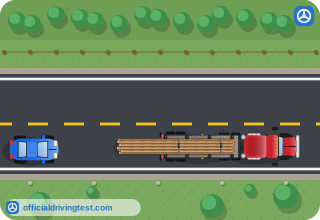
A load that extends farther than how far beyond the rear of the motor vehicle must have projections marked with a lamp or flag?
- Four feet
- Two feet
- Six feet
- Eight feet
Show answer
Correct answer: Four feet
The manual says loads extending farther than four feet beyond the rear must have the projections visible with a red lamp or flag.
Source: Indiana Driver’s Manual (July 2026), page 57 · Open this page in the manual (Manual page 57)
-
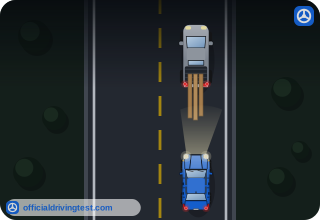
Between sunset and sunrise, what must be mounted at the extreme rear end of a load that extends more than four feet beyond the vehicle?
- One white lamp
- One red flag
- One red lamp
- Two amber lamps
Show answer
Correct answer: One red lamp
The manual says one red lamp must be mounted at the extreme rear end of the load between sunset and sunrise.
Source: Indiana Driver’s Manual (July 2026), page 57 · Open this page in the manual (Manual page 57)
-
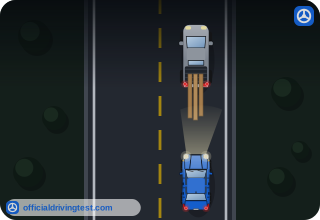
At what distance must the red lamp on a projecting load be visible from both sides and the rear?
- 250 feet
- 500 feet
- 300 feet
- 1,000 feet
Show answer
Correct answer: 500 feet
The manual says the red lamp must be visible from both sides and the rear at a distance of 500 feet.
Source: Indiana Driver’s Manual (July 2026), page 57 · Open this page in the manual (Manual page 57)
-
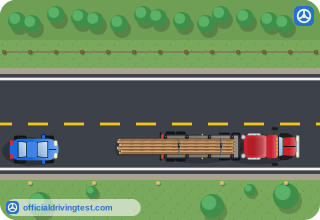
Between sunrise and sunset, what must be mounted at the extreme rear end of a load that extends more than four feet beyond the vehicle?
- One red lamp
- One white flag
- One orange pennant
- One red flag
Show answer
Correct answer: One red flag
The manual says one red flag must be mounted at the extreme rear end of the load between sunrise and sunset.
Source: Indiana Driver’s Manual (July 2026), page 57 · Open this page in the manual (Manual page 57)
-
What is the minimum size of the red flag mounted on the end of a projecting load?
- 6 square inches
- 12 square inches
- 24 square inches
- 144 square inches
Show answer
Correct answer: 12 square inches
The manual says the red flag must be not less than 12 square inches.
Source: Indiana Driver’s Manual (July 2026), page 57 · Open this page in the manual (Manual page 57)
-
Besides signaling turns, what must the signaling system on every bus, truck, and tractor-trailer be able to do?
- Flash only the two rear signals together
- Flash the brake lights while the vehicle is moving
- Flash the headlights and the horn at the same time
- Flash the two front and two rear signals at the same time
Show answer
Correct answer: Flash the two front and two rear signals at the same time
The manual says these vehicles must have a switch that makes the two front turn signals and the two rear signals flash simultaneously.
Source: Indiana Driver’s Manual (July 2026), page 57 · Open this page in the manual (Manual page 57)
-
Under what condition must the hazard warning flashing signal on a bus, truck, or tractor-trailer be able to flash?
- With the ignition on or off
- Only with the ignition on
- Only with the engine running
- Only while the parking brake is set
Show answer
Correct answer: With the ignition on or off
The manual says the signal must be capable of flashing simultaneously with the ignition on or off.
Source: Indiana Driver’s Manual (July 2026), page 57 · Open this page in the manual (Manual page 57)
-
When should a teen driver adjust the seats and mirrors?
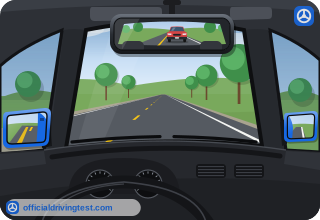
- Only when the vehicle is first purchased
- Once the vehicle reaches highway speed
- At the first red light of each trip
- Before starting each drive
Show answer
Correct answer: Before starting each drive
The tips say to adjust seats and mirrors for the best visibility before starting each drive.
Source: Indiana Driver’s Manual (July 2026), page 71 · Open this page in the manual (Manual page 71)