Indiana: Signals and vehicle controls — Part 2 Practice Test
Questions in this part include: “When must drivers use headlights, according to the manual?” · “What is the minimum number of red stop-lamps required on any truck or bus?”
Independent educational site · not affiliated with any government agency or DMV
Ready? Test yourself
- Instant feedback with an explanation
- Every answer cites its source in the manual
- Your best score is saved on this device
Questions are original and based on the official manual "Indiana Driver’s Manual" (July 2026), Indiana Bureau of Motor Vehicles.
All 19 questions in this practice test
Take the test above first, then use this list to study. Tap “Show answer” to see the correct answer and explanation.
Show the questions and answersHide the questions
-
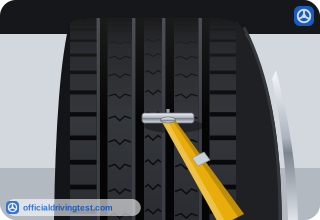
Below approximately what tread depth is a car's ability to grip the road in adverse conditions greatly reduced?
- 1/4 of an inch
- 1/8 of an inch
- 1/2 of an inch
- 1/16 of an inch
Show answer
Correct answer: 1/16 of an inch
The manual says that below approximately 1/16 of an inch your car's ability to grip the road in adverse conditions is greatly reduced.
Source: Indiana Driver’s Manual (July 2026), page 43 · Open this page in the manual (Manual page 43)
-
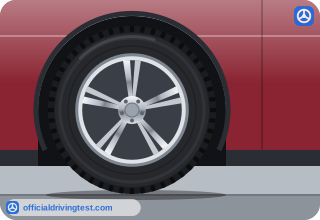
How often should you check your tires for wear and damage?
- Once every month, or before a long road trip
- Once every year, before winter begins
- Once every six months, at the very least
- Only when you buy new tires for your car
Show answer
Correct answer: Once every month, or before a long road trip
The manual says to check your tires for wear and damage once every month or before a long road trip.
Source: Indiana Driver’s Manual (July 2026), page 43 · Open this page in the manual (Manual page 43)
-
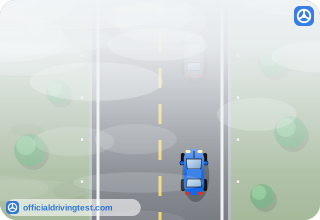
Which headlight beams should you use in fog?
- High beams, because they reach farther down the road
- Parking lights only, to avoid glare from the fog
- Low beams, which better illuminate the road ahead
- Brake lights only, to make other drivers slow down
Show answer
Correct answer: Low beams, which better illuminate the road ahead
The manual says not to use high beams in fog because low beams better illuminate the road and objects ahead.
Source: Indiana Driver’s Manual (July 2026), page 44 · Open this page in the manual (Manual page 44)
-
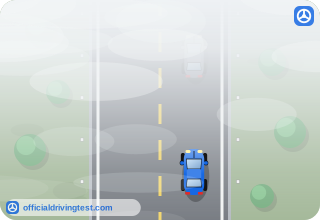
Which lights should be used while driving in fog?
- High beams and parking lights together
- Parking lights and turn signals only
- Turn signals and brake lights only
- Headlights and flashing emergency signals
Show answer
Correct answer: Headlights and flashing emergency signals
The manual says headlights and flashing emergency signals should be used while driving in fog.
Source: Indiana Driver’s Manual (July 2026), page 44 · Open this page in the manual (Manual page 44)
-
When must drivers use headlights, according to the manual?
- Between 9 p.m. and 5 a.m.
- Only when it is completely dark
- Between sunset and sunrise
- Only when it is raining or snowing
Show answer
Correct answer: Between sunset and sunrise
The manual says drivers must use headlights between sunset and sunrise, and any other time visibility is less than 500 feet.
Source: Indiana Driver’s Manual (July 2026), page 44 · Open this page in the manual (Manual page 44)
-
Besides between sunset and sunrise, drivers must use headlights whenever visibility is less than what distance?
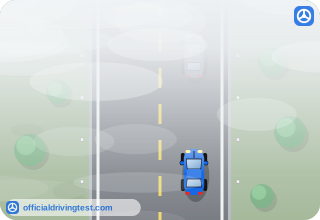
- 100 feet
- 500 feet
- 300 feet
- 1,000 feet
Show answer
Correct answer: 500 feet
The manual says headlights must be used whenever visibility is less than 500 feet.
Source: Indiana Driver’s Manual (July 2026), page 44 · Open this page in the manual (Manual page 44)
-
At what distance from an oncoming vehicle must lower headlight beams be used?
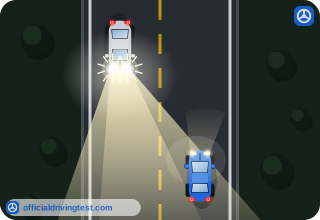
- Within 100 feet
- Within 300 feet
- Within 1,000 feet
- Within 500 feet
Show answer
Correct answer: Within 500 feet
Lower headlight beams must be used when approaching within 500 feet of an oncoming vehicle.
Source: Indiana Driver’s Manual (July 2026), page 44 · Open this page in the manual (Manual page 44)
-
At what distance behind another vehicle must you use lower headlight beams?
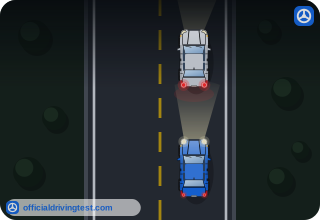
- Within 200 feet
- Within 100 feet
- Within 400 feet
- Within 750 feet
Show answer
Correct answer: Within 200 feet
Lower headlight beams must be used when following within 200 feet of the rear of another vehicle.
Source: Indiana Driver’s Manual (July 2026), page 44 · Open this page in the manual (Manual page 44)
-
How many red tail lamps are required on any truck or bus?
- One
- Three
- Four
- Two
Show answer
Correct answer: Two
The lighting requirements for any truck or bus include two red tail lamps.
Source: Indiana Driver’s Manual (July 2026), page 57 · Open this page in the manual (Manual page 57)
-
What color is the rear license plate lamp required on any truck or bus?
- White
- Red
- Amber
- Green
Show answer
Correct answer: White
The manual lists one rear white license plate lamp as a lighting requirement for any truck or bus.
Source: Indiana Driver’s Manual (July 2026), page 57 · Open this page in the manual (Manual page 57)
-
What is the minimum number of red stop-lamps required on any truck or bus?
- Two
- Three
- One
- Four
Show answer
Correct answer: One
The manual requires at least one red stop-lamp on any truck or bus.
Source: Indiana Driver’s Manual (July 2026), page 57 · Open this page in the manual (Manual page 57)
-
A load that extends farther than how far beyond the rear of the motor vehicle must have projections marked with a lamp or flag?
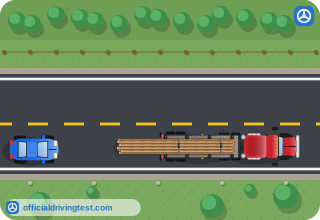
- Four feet
- Two feet
- Six feet
- Eight feet
Show answer
Correct answer: Four feet
The manual says loads extending farther than four feet beyond the rear must have the projections visible with a red lamp or flag.
Source: Indiana Driver’s Manual (July 2026), page 57 · Open this page in the manual (Manual page 57)
-
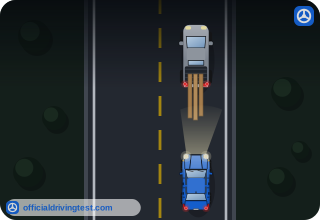
Between sunset and sunrise, what must be mounted at the extreme rear end of a load that extends more than four feet beyond the vehicle?
- One white lamp
- One red flag
- One red lamp
- Two amber lamps
Show answer
Correct answer: One red lamp
The manual says one red lamp must be mounted at the extreme rear end of the load between sunset and sunrise.
Source: Indiana Driver’s Manual (July 2026), page 57 · Open this page in the manual (Manual page 57)
-
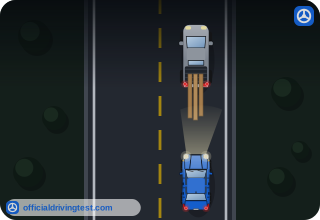
At what distance must the red lamp on a projecting load be visible from both sides and the rear?
- 250 feet
- 500 feet
- 300 feet
- 1,000 feet
Show answer
Correct answer: 500 feet
The manual says the red lamp must be visible from both sides and the rear at a distance of 500 feet.
Source: Indiana Driver’s Manual (July 2026), page 57 · Open this page in the manual (Manual page 57)
-
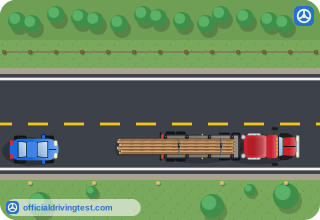
Between sunrise and sunset, what must be mounted at the extreme rear end of a load that extends more than four feet beyond the vehicle?
- One red lamp
- One white flag
- One orange pennant
- One red flag
Show answer
Correct answer: One red flag
The manual says one red flag must be mounted at the extreme rear end of the load between sunrise and sunset.
Source: Indiana Driver’s Manual (July 2026), page 57 · Open this page in the manual (Manual page 57)
-
What is the minimum size of the red flag mounted on the end of a projecting load?
- 6 square inches
- 12 square inches
- 24 square inches
- 144 square inches
Show answer
Correct answer: 12 square inches
The manual says the red flag must be not less than 12 square inches.
Source: Indiana Driver’s Manual (July 2026), page 57 · Open this page in the manual (Manual page 57)
-
Besides signaling turns, what must the signaling system on every bus, truck, and tractor-trailer be able to do?
- Flash only the two rear signals together
- Flash the brake lights while the vehicle is moving
- Flash the headlights and the horn at the same time
- Flash the two front and two rear signals at the same time
Show answer
Correct answer: Flash the two front and two rear signals at the same time
The manual says these vehicles must have a switch that makes the two front turn signals and the two rear signals flash simultaneously.
Source: Indiana Driver’s Manual (July 2026), page 57 · Open this page in the manual (Manual page 57)
-
Under what condition must the hazard warning flashing signal on a bus, truck, or tractor-trailer be able to flash?
- With the ignition on or off
- Only with the ignition on
- Only with the engine running
- Only while the parking brake is set
Show answer
Correct answer: With the ignition on or off
The manual says the signal must be capable of flashing simultaneously with the ignition on or off.
Source: Indiana Driver’s Manual (July 2026), page 57 · Open this page in the manual (Manual page 57)
-
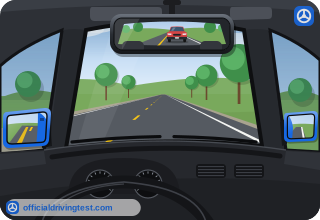
When should a teen driver adjust the seats and mirrors?
- Only when the vehicle is first purchased
- Once the vehicle reaches highway speed
- At the first red light of each trip
- Before starting each drive
Show answer
Correct answer: Before starting each drive
The tips say to adjust seats and mirrors for the best visibility before starting each drive.
Source: Indiana Driver’s Manual (July 2026), page 71 · Open this page in the manual (Manual page 71)