Indiana: Signals and vehicle controls — Part 1 Practice Test
Questions in this part include: “What is the safest type of signal to use?” · “A driver’s left arm bent upward at the elbow out of the window is the hand signal for what?”
Independent educational site · not affiliated with any government agency or DMV
Ready? Test yourself
- Instant feedback with an explanation
- Every answer cites its source in the manual
- Your best score is saved on this device
Questions are original and based on the official manual "Indiana Driver’s Manual" (July 2026), Indiana Bureau of Motor Vehicles.
All 19 questions in this practice test
Take the test above first, then use this list to study. Tap “Show answer” to see the correct answer and explanation.
Show the questions and answersHide the questions
-
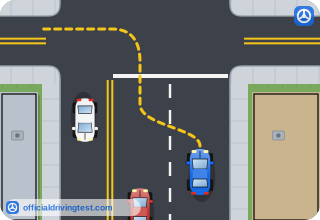
When changing lanes to prepare for a turn, what must you do before turning or changing lanes?
- Sound your horn
- Come to a complete stop
- Give a proper signal
- Turn on your hazard lights
Show answer
Correct answer: Give a proper signal
The manual says you must give a proper signal before turning or changing lanes.
Source: Indiana Driver’s Manual (July 2026), page 37 · Open this page in the manual (Manual page 37)
-
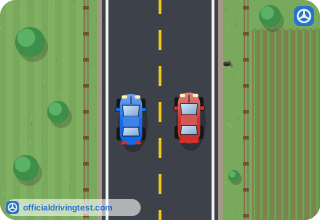
Before returning to the lane in which you were originally driving after passing, what should you do?
- Tap your horn twice
- Flash your headlights
- Use the appropriate turn signal
- Slow down below the other vehicle
Show answer
Correct answer: Use the appropriate turn signal
The manual says to use the appropriate turn signal before returning to your original lane.
Source: Indiana Driver’s Manual (July 2026), page 38 · Open this page in the manual (Manual page 38)
-
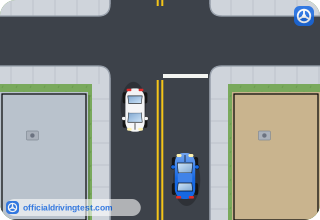
When must you give a proper turn signal?
- Only when another vehicle is close behind you
- Only when you turn at an intersection
- Before turning or changing lanes
- Only when you turn left
Show answer
Correct answer: Before turning or changing lanes
The manual says you must give a proper turn signal before turning or changing lanes.
Source: Indiana Driver’s Manual (July 2026), page 39 · Open this page in the manual (Manual page 39)
-
What is the safest type of signal to use?
- A hand signal given from the window
- The lighted signals used in most vehicles
- A short tap on the horn
- A flash of the headlights
Show answer
Correct answer: The lighted signals used in most vehicles
The manual says the safest type of signal is the lighted signals used in most vehicles.
Source: Indiana Driver’s Manual (July 2026), page 39 · Open this page in the manual (Manual page 39)
-
When may you use hand signals instead of lighted signals?
- When you are driving at night or in poor weather conditions
- When you are driving below 25 miles per hour in a town
- When you want to be seen more easily by pedestrians
- When one or more of the lighted signals is malfunctioning
Show answer
Correct answer: When one or more of the lighted signals is malfunctioning
The manual says hand signals may be used if one or more lighted signals is malfunctioning.
Source: Indiana Driver’s Manual (July 2026), page 39 · Open this page in the manual (Manual page 39)
-
What does the manual say about hand signals on a driving skills exam?
- You may not use them
- You may use them only for right turns
- You may use them only when the weather is bad
- You must use them for every turn
Show answer
Correct answer: You may not use them
The manual says you may not use hand signals on a driving skills exam.
Source: Indiana Driver’s Manual (July 2026), page 39 · Open this page in the manual (Manual page 39)
-
A driver’s arm extended downward out of the window is the hand signal for what?
- Pull over to the curb
- The driver is backing up
- Stop or slow
- The driver is changing lanes
Show answer
Correct answer: Stop or slow
A driver's arm extended downward out of the window is the hand signal for "Stop or slow".
Source: Indiana Driver’s Manual (July 2026), page 39 · Open this page in the manual (Manual page 39)
-
A driver’s left arm bent upward at the elbow out of the window is the hand signal for what?
- Stop or slow
- Right turn
- The driver is backing up
- The driver is changing lanes
Show answer
Correct answer: Right turn
A driver's left arm bent upward at the elbow out of the window is the hand signal for "Right turn".
Source: Indiana Driver’s Manual (July 2026), page 39 · Open this page in the manual (Manual page 39)
-
A driver’s left arm extended straight out of the window is the hand signal for what?
- Stop or slow
- Pull over to the curb
- The driver is changing lanes
- Left turn
Show answer
Correct answer: Left turn
A driver's left arm extended straight out of the window is the hand signal for "Left turn".
Source: Indiana Driver’s Manual (July 2026), page 39 · Open this page in the manual (Manual page 39)
-
Above what speed does fuel consumption increase steadily?
- 30 miles per hour
- 55 miles per hour
- 45 miles per hour
- 65 miles per hour
Show answer
Correct answer: 45 miles per hour
The manual says fuel consumption increases steadily above 45 miles per hour.
Source: Indiana Driver’s Manual (July 2026), page 42 · Open this page in the manual (Manual page 42)
-
About how much more fuel do passenger cars and light trucks use at 75 miles per hour than at 55 miles per hour?
- About 10 percent more
- About 50 percent more
- About 25 percent more
- About 100 percent more
Show answer
Correct answer: About 50 percent more
Passenger cars and light trucks use approximately 50 percent more fuel at 75 miles per hour than at 55.
Source: Indiana Driver’s Manual (July 2026), page 42 · Open this page in the manual (Manual page 42)
-
Which of these helps maximize your fuel economy?
- Hauling cargo on your roof
- Accelerating rapidly
- Taking several short trips from a cold start
- Removing excess weight from your vehicle
Show answer
Correct answer: Removing excess weight from your vehicle
The manual advises removing excess weight, avoiding roof cargo and avoiding rapid acceleration or sudden stops.
Source: Indiana Driver’s Manual (July 2026), page 42 · Open this page in the manual (Manual page 42)
-
Compared with one longer, multipurpose trip of the same distance, how much fuel can several short trips from a cold start use?
- Twice as much
- Half as much
- The same amount
- About 10 percent less
Show answer
Correct answer: Twice as much
Several short trips taken from a cold start can use twice as much fuel as a longer, multipurpose trip covering the same distance.
Source: Indiana Driver’s Manual (July 2026), page 42 · Open this page in the manual (Manual page 42)
-
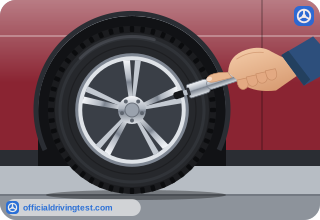
About how much tire pressure have tires been known to lose each month?
- Up to 5 psi
- Up to 10 psi
- Up to 1 psi
- Up to 20 psi
Show answer
Correct answer: Up to 1 psi
The manual says tires have been known to lose up to 1 psi every month.
Source: Indiana Driver’s Manual (July 2026), page 43 · Open this page in the manual (Manual page 43)
-
How often should you check the pressure of all your tires, including the spare?
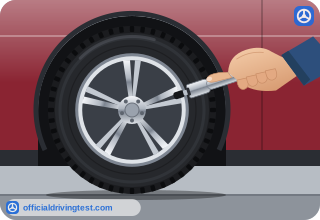
- Once a year, before winter starts
- Once a month or before a long trip
- Every six months, no more often
- Only when a tire looks flat
Show answer
Correct answer: Once a month or before a long trip
The manual says to check all tires, including your spare, once a month or before a long trip.
Source: Indiana Driver’s Manual (July 2026), page 43 · Open this page in the manual (Manual page 43)
-
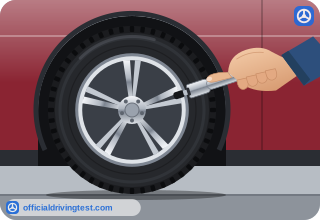
Where should you look for your vehicle's recommended tire pressure?
- On the tire sidewall next to the tire size
- On the cap of the valve stem
- On the dashboard warning light
- On the door jamb sticker or in the owner's manual
Show answer
Correct answer: On the door jamb sticker or in the owner's manual
The recommended psi is on the sticker in the door jamb or in the owner's manual, and you should not compare to the psi on the tire sidewall.
Source: Indiana Driver’s Manual (July 2026), page 43 · Open this page in the manual (Manual page 43)
-
When should you check your tires “cold”?
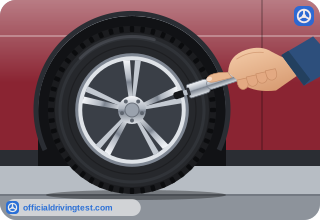
- Before you have driven or at least three hours after
- Right after a long drive, while the tires are warm
- At least thirty minutes after you stop driving
- Only after the engine has fully warmed up
Show answer
Correct answer: Before you have driven or at least three hours after
The manual says to check tires before you have driven or at least three hours after you have driven.
Source: Indiana Driver’s Manual (July 2026), page 43 · Open this page in the manual (Manual page 43)
-
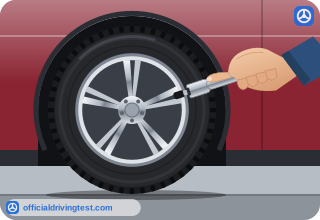
If the measured tire pressure is above the recommended number, what should you do?
- Drive until the tires cool, then leave it
- Add air until it matches the sidewall number
- Let air out until it matches
- Leave it, because higher pressure is safer
Show answer
Correct answer: Let air out until it matches
The manual says if your psi is above the number, let air out until it matches.
Source: Indiana Driver’s Manual (July 2026), page 43 · Open this page in the manual (Manual page 43)
-
In the penny test for tread depth, what shows that you are driving with a legal and safe amount of tread?
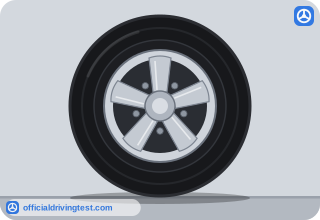
- All of Lincoln's head is visible above the tread
- Part of Lincoln's head is covered by the tread
- The penny cannot fit into the groove at all
- Only Lincoln's body is hidden by the tread
Show answer
Correct answer: Part of Lincoln's head is covered by the tread
If any part of Lincoln's head is covered by the tread, you are driving with the legal and safe amount of tread.
Source: Indiana Driver’s Manual (July 2026), page 43 · Open this page in the manual (Manual page 43)