Illinois: Signals & vehicle controls
Turn and hand signals, headlights, brakes and the equipment Illinois requires. Split into 3 shorter tests so you're not stuck in one long quiz.
Independent educational site · not affiliated with any government agency or DMV
Choose a part
Signals & vehicle controls — Part 1
Questions in this part include: “When may you back up on a roadway that is not a controlled-access roadway?”
StartSignals & vehicle controls — Part 2
Questions in this part include: “The emergency or parking brake must be able to stop a vehicle traveling 20 mph within what distance?”
StartSignals & vehicle controls — Part 3
Questions in this part include: “Which changes to a vehicle's exhaust system are illegal?”
StartAll 62 Signals & vehicle controls questions with answers
Choose a part above to take a practice test, or study every question and answer here.
Show the questions and answersHide the questions
-
When may you back up on a roadway that is not a controlled-access roadway?
- Only when a police officer directs you to do so
- When it is safe and does not interfere with traffic
- Only on streets with a posted speed of 30 mph or less
- Never; backing up on any roadway is illegal
Show answer
Correct answer: When it is safe and does not interfere with traffic
On roadways other than controlled-access roadways, backing up is allowed only when it is done safely and does not interfere with other vehicles.
Source: Illinois Rules of the Road (2026), page 30
-
In a business or residential area, how far before turning must you give a continuous turn signal?
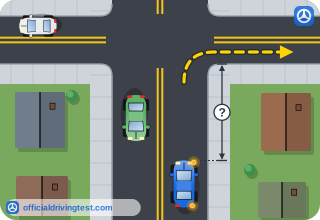
- At least 50 feet
- At least 100 feet
- At least 75 feet
- At least 200 feet
Show answer
Correct answer: At least 100 feet
In business or residential areas, a continuous turn signal must be given for at least 100 feet before turning.
Source: Illinois Rules of the Road (2026), page 30
-
Outside business and residential areas, how far before turning must you signal?
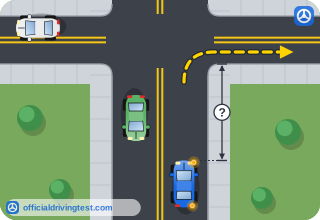
- At least 100 feet
- At least 300 feet
- At least 500 feet
- At least 200 feet
Show answer
Correct answer: At least 200 feet
Outside business or residential areas, the turn signal must be given at least 200 feet before turning.
Source: Illinois Rules of the Road (2026), page 30
-
Which arm should a driver use to give hand and arm signals?
- The left arm
- The right arm
- Either arm
- Both arms
Show answer
Correct answer: The left arm
The manual says hand and arm signals should be given using the left arm.
Source: Illinois Rules of the Road (2026), page 30
-
What is the hand and arm signal for a right turn?
- Hand and arm extended straight out
- Hand and arm extended downward
- Hand and arm extended straight up
- Hand and arm waved forward and back
Show answer
Correct answer: Hand and arm extended straight up
For a right turn, the hand and arm are extended straight up.
Source: Illinois Rules of the Road (2026), page 30
-
What is the hand and arm signal for a left turn?
- Hand and arm extended straight up
- Hand and arm extended straight out to the left
- Hand and arm extended down
- Hand and arm waved in a circle out the window
Show answer
Correct answer: Hand and arm extended straight out to the left
For a left turn, the hand and arm are extended straight out to the left.
Source: Illinois Rules of the Road (2026), page 30
-
What is the hand and arm signal to slow down or stop?
- Hand and arm extended straight up
- Hand and arm extended straight out
- Hand and arm waved up and down twice
- Hand and arm extended down
Show answer
Correct answer: Hand and arm extended down
To slow down or stop, the hand and arm are extended down.
Source: Illinois Rules of the Road (2026), page 30
-
Before moving from the right-hand lane to the left-hand lane, how should you check for traffic?
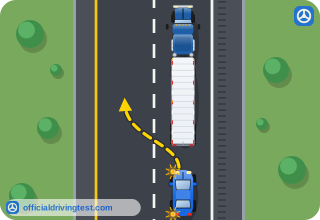
- Rely on your inside rearview mirror only
- Check the right-side mirror and blind spot
- Sound your horn and watch for a response
- Turn your head to check behind and to the left
Show answer
Correct answer: Turn your head to check behind and to the left
Before moving left, check for traffic behind your vehicle and to the left by turning your head and visually assessing the area.
Source: Illinois Rules of the Road (2026), page 31
-
When moving from the left-hand lane to the right-hand lane and the area is clear, which signal should you give?
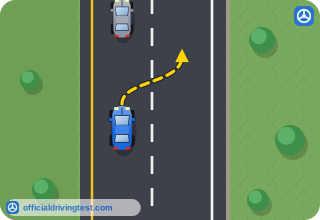
- The right-turn signal
- The left-turn signal
- The hazard signal
- No signal is needed
Show answer
Correct answer: The right-turn signal
After checking behind and to the right, give the right-turn signal and carefully move into the right lane.
Source: Illinois Rules of the Road (2026), page 32
-
What does flashing both turn signals at the same time indicate?
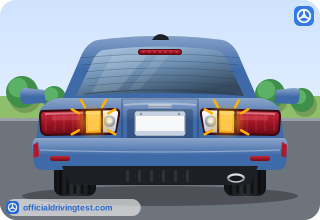
- A vehicle about to make a U-turn
- A vehicle about to change lanes
- A driver thanking another driver
- A disabled or parked vehicle
Show answer
Correct answer: A disabled or parked vehicle
The hazard signal, both turn signals flashing at once, may be used to indicate a disabled or parked vehicle.
Source: Illinois Rules of the Road (2026), page 32
-
Is it legal to flash your turn signals as a courtesy "do pass" signal to other drivers?
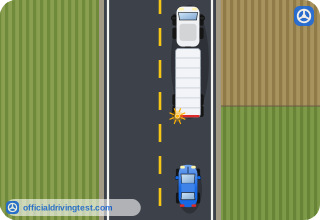
- Yes, on two-lane highways
- Yes, but only at night
- Yes, if a truck is behind
- No, it is against the law
Show answer
Correct answer: No, it is against the law
It is against the law to flash turn signals as a courtesy or "do pass" signal to other drivers.
Source: Illinois Rules of the Road (2026), page 28
-
How should your headlights be set when driving in fog?

- On high beam to see farther
- On dim, or use fog lights
- Turned off completely
- Flashing on and off
Show answer
Correct answer: On dim, or use fog lights
In fog, drive with your headlights set on dim or use fog lights.
Source: Illinois Rules of the Road (2026), page 84
-
When should you use your turn signals when driving in fog?

- Only after starting the turn
- Only if other vehicles are visible
- Not at all; use hand signals
- Long before making a turn
Show answer
Correct answer: Long before making a turn
In fog, use turn signals long before making a turn.
Source: Illinois Rules of the Road (2026), page 84
-
Illinois law requires you to use your headlights when:
- Driving in a school zone
- Operating your windshield wipers
- Driving on any expressway
- Parked on a residential street
Show answer
Correct answer: Operating your windshield wipers
Illinois law requires you to use your headlights when operating your windshield wipers.
Source: Illinois Rules of the Road (2026), page 85
-
In winter, after removing snow and ice from your vehicle, when may you start driving?
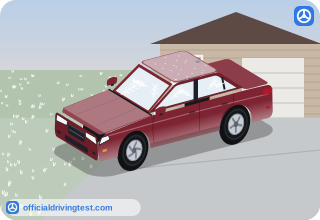
- As soon as the engine has been started
- Once the windshield is defrosted and clear
- After driving one block to warm up the engine
- As soon as the side windows are clear
Show answer
Correct answer: Once the windshield is defrosted and clear
Clear all windows and do not start driving until the windshield is defrosted and clear.
Source: Illinois Rules of the Road (2026), page 85
-
What kind of windshield washer liquid should you have for winter driving?
- Plain water
- Soapy water
- Nonfreezing liquid
- Hot water
Show answer
Correct answer: Nonfreezing liquid
For winter driving, be sure you have nonfreezing windshield washer liquid.
Source: Illinois Rules of the Road (2026), page 85
-
What does the manual say to do with your headlights for night driving?
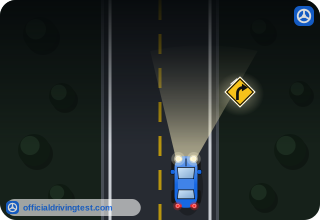
- Keep high beams on the whole time
- Aim them slightly upward for range
- Dim them only when driving in cities
- Keep them clean and properly aimed
Show answer
Correct answer: Keep them clean and properly aimed
Never overdrive your headlights, and always keep them clean and aimed properly.
Source: Illinois Rules of the Road (2026), page 87
-
When driving at night, what does the manual advise about the lights inside the vehicle?
- Turn on the dome light
- Dim the dashboard lights
- Use a reading light to check maps
- Brighten the dashboard lights
Show answer
Correct answer: Dim the dashboard lights
At night, dim the dashboard lights, use the sun visor to avoid glare, and avoid using any other light inside the vehicle.
Source: Illinois Rules of the Road (2026), page 87
-
What does the manual say about driving a vehicle that may be a hazard to any person or property?
- It is allowed with a warning sign
- It is allowed during daylight
- It is illegal
- It is allowed on rural roads
Show answer
Correct answer: It is illegal
It is illegal to drive a vehicle that may be a hazard to any person or property.
Source: Illinois Rules of the Road (2026), page 92
-
How many brake systems must a motor vehicle have?
- Two
- One
- Three
- Four
Show answer
Correct answer: Two
Vehicles must have two brake systems and brakes on all wheels.
Source: Illinois Rules of the Road (2026), page 92
-
A vehicle's foot brake must be strong enough to stop it from 20 mph within what distance?
- 55 feet
- 50 feet
- 20 feet
- 30 feet
Show answer
Correct answer: 30 feet
The foot brake must be able to stop a vehicle traveling 20 mph within 30 feet.
Source: Illinois Rules of the Road (2026), page 92
-
The emergency or parking brake must be able to stop a vehicle traveling 20 mph within what distance?
- 30 feet
- 55 feet
- 100 feet
- 75 feet
Show answer
Correct answer: 55 feet
The emergency or parking brake must stop the vehicle in 55 feet at 20 mph.
Source: Illinois Rules of the Road (2026), page 92
-
Besides stopping the vehicle, what else must the emergency brake be able to do?
- Stop the vehicle from 55 mph
- Work only when the engine runs
- Hold the vehicle on a grade or hill
- Replace the foot brake entirely
Show answer
Correct answer: Hold the vehicle on a grade or hill
The emergency brake must also be able to hold the vehicle on a grade or hill.
Source: Illinois Rules of the Road (2026), page 92
-
How many brakes do motor-driven cycles need?
- One
- Two
- Three
- One on each wheel
Show answer
Correct answer: One
Motor-driven cycles need only one brake.
Source: Illinois Rules of the Road (2026), page 92
-
How many headlights must a vehicle have, and when must they be on?
- One; only after dark in rural areas
- Two; only when it is raining
- Four; at all times while driving
- Two; from sunset to sunrise
Show answer
Correct answer: Two; from sunset to sunrise
Vehicles must have two headlights, which must be on from sunset to sunrise (and when conditions require windshield wipers).
Source: Illinois Rules of the Road (2026), page 92
-
Headlights should also be used when objects how far away cannot be seen?
- 500 feet
- 1,000 feet
- 200 feet
- 2,000 feet
Show answer
Correct answer: 1,000 feet
Headlights should also be used when objects 1,000 feet away cannot be seen.
Source: Illinois Rules of the Road (2026), page 92
-
Bright lights must be dimmed how far before meeting an oncoming vehicle?
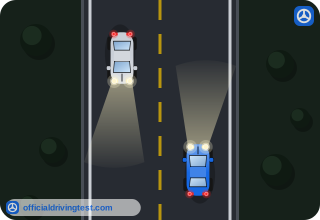
- 200 feet
- 300 feet
- 500 feet
- 1,000 feet
Show answer
Correct answer: 500 feet
Bright lights must be dimmed 500 feet before meeting an oncoming vehicle.
Source: Illinois Rules of the Road (2026), page 92
-
How far before passing a vehicle must you dim your bright lights?
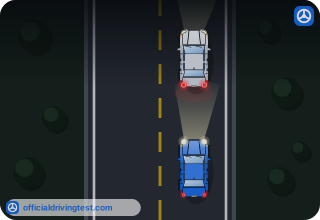
- 300 feet
- 500 feet
- 100 feet
- 1,000 feet
Show answer
Correct answer: 300 feet
Bright lights must be dimmed 300 feet before passing a vehicle.
Source: Illinois Rules of the Road (2026), page 92
-
A motorcycle or moped headlight must show objects how far ahead?
- 100 feet
- 200 feet
- 1,000 feet
- 500 feet
Show answer
Correct answer: 500 feet
Motorcycles and mopeds require a headlight that shows objects 500 feet ahead.
Source: Illinois Rules of the Road (2026), page 92
-
When must a motorcycle headlight be turned on?
- Only from sunset to sunrise
- Whenever the vehicle is driven
- Only in rain or fog
- Only on highways
Show answer
Correct answer: Whenever the vehicle is driven
A motorcycle headlight must be turned on whenever the vehicle is driven.
Source: Illinois Rules of the Road (2026), page 92
-
What does the manual say about tinted or smoked lenses on vehicle lights?
- Allowed on motorcycles only
- Allowed if lightly tinted
- Not allowed on any vehicle
- Allowed on rear lights only
Show answer
Correct answer: Not allowed on any vehicle
No tinted or smoked lenses are allowed on any vehicle.
Source: Illinois Rules of the Road (2026), page 92
-
A vehicle's two red taillights must be visible from how far behind?
- 500 feet
- 100 feet
- 200 feet
- 1,000 feet
Show answer
Correct answer: 500 feet
Vehicles must have two red taillights visible for 500 feet from behind.
Source: Illinois Rules of the Road (2026), page 92
-
How many taillights are needed on mopeds and motorcycles?
- Two
- Three
- None
- One
Show answer
Correct answer: One
Only one taillight is needed for mopeds and motorcycles.
Source: Illinois Rules of the Road (2026), page 92
-
Front and rear turn signals must be visible from how far away?
- 100 feet
- 300 feet
- 500 feet
- 50 feet
Show answer
Correct answer: 300 feet
Required front and rear turn signals must be visible from 300 feet.
Source: Illinois Rules of the Road (2026), page 92
-
Which vehicles are exempt from the requirement to have front and rear turn signals?
- Pickup trucks, vans, and school buses
- Cars and trucks built before the year 1965
- Motorcycles, trailers, and semitrailers
- Mopeds, farm tractors, and golf carts
Show answer
Correct answer: Motorcycles, trailers, and semitrailers
All vehicles except motorcycles, trailers, and semitrailers must have front and rear turn signals.
Source: Illinois Rules of the Road (2026), page 92
-
The license plate light must make the plate readable from how far away?
- 50 feet
- 100 feet
- 200 feet
- 25 feet
Show answer
Correct answer: 50 feet
Vehicles must have a white light making the license plate readable from 50 feet away.
Source: Illinois Rules of the Road (2026), page 92
-
What color must the license plate light be, and when must it be on?
- Red; whenever you brake
- Amber; at all times driven
- Blue; from sunset to sunrise
- White; when headlights are on
Show answer
Correct answer: White; when headlights are on
The license plate light must be white and must be on when the headlights are on.
Source: Illinois Rules of the Road (2026), page 92
-
The required rearview mirror must let you see at least how far behind your car?
- 50 feet
- 100 feet
- 500 feet
- 200 feet
Show answer
Correct answer: 200 feet
One rearview mirror is required so you can see at least 200 feet behind your car.
Source: Illinois Rules of the Road (2026), page 92
-
What type of glass must all vehicle windows have?
- Any tinted glass
- Approved safety glass
- Clear plastic panels
- Double-pane window glass
Show answer
Correct answer: Approved safety glass
All window glass must be approved safety glass.
Source: Illinois Rules of the Road (2026), page 92
-
What tinting is allowed on the front windshield?
- Tint over the whole windshield
- A 12-inch strip along the bottom
- A 6-inch strip along the top
- Tint on the passenger half only
Show answer
Correct answer: A 6-inch strip along the top
Tinted windows are not allowed on the front windshield, but a 6-inch strip of tinting is allowed along the entire length at the top.
Source: Illinois Rules of the Road (2026), page 92
-
A vehicle's horn must be able to be heard from how far away?
- 200 feet
- 50 feet
- 100 feet
- 500 feet
Show answer
Correct answer: 200 feet
Vehicles must have a horn that can be heard from 200 feet.
Source: Illinois Rules of the Road (2026), page 92
-
Which vehicles are allowed to have sirens, whistles, and bells?
- Any vehicle with a local permit
- School buses and tow trucks
- Farm and construction vehicles
- Authorized emergency vehicles only
Show answer
Correct answer: Authorized emergency vehicles only
Sirens, whistles and bells are allowed only on authorized emergency vehicles.
Source: Illinois Rules of the Road (2026), page 92
-
Which changes to a vehicle's exhaust system are illegal?
- Replacing a worn-out muffler with a new one
- Cutouts and bypasses that add noise
- Adding a chrome tip to the tailpipe
- Installing a new, factory exhaust pipe
Show answer
Correct answer: Cutouts and bypasses that add noise
Cutouts, bypasses, and changes to the exhaust system to increase noise are illegal.
Source: Illinois Rules of the Road (2026), page 92
-
Which vehicles must have both a front and a rear bumper?
- Only vehicles weighing over 9,000 pounds
- Only commercial trucks and buses
- Vehicles of 9,000 pounds or less and all RVs
- Only motorcycles and mopeds
Show answer
Correct answer: Vehicles of 9,000 pounds or less and all RVs
Vehicles weighing 9,000 pounds or less and all recreational vehicles must have a front and rear bumper.
Source: Illinois Rules of the Road (2026), page 92
-
By law, the horizontal line of a vehicle from front to rear may not vary by more than:
- 3 inches
- 6 inches
- 1 inch
- 12 inches
Show answer
Correct answer: 3 inches
The horizontal line from the front to the rear of a vehicle may not vary over 3 inches.
Source: Illinois Rules of the Road (2026), page 93
-
A load extends 4 feet or more past the rear of your vehicle. How must it be marked during the day?
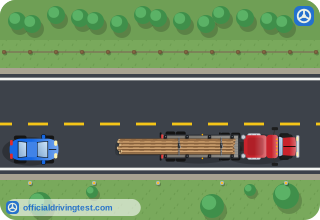
- With a white flag
- With an orange cone
- With a yellow light
- With a red flag
Show answer
Correct answer: With a red flag
Loads extending 4 feet or more to the rear must be marked with a red flag during the day.
Source: Illinois Rules of the Road (2026), page 93
-
At night or when visibility is poor, what must a vehicle with a load projecting 4 feet or more to the rear have?
- A white light visible for 200 feet
- A red light visible for 500 feet
- Two amber reflectors on the load
- A red flag and nothing more
Show answer
Correct answer: A red light visible for 500 feet
At night or when visibility is poor, the vehicle must have a red light visible for 500 feet.
Source: Illinois Rules of the Road (2026), page 93
-
What color light may back-up lights emit?
- Red or amber
- Blue or white
- White or amber
- Red only
Show answer
Correct answer: White or amber
Back-up lights must emit a white or amber light without glare.
Source: Illinois Rules of the Road (2026), page 93
-
When may back-up lights NOT be on?
- When the vehicle is moving forward
- When the vehicle is backing up
- When the vehicle is in reverse
- When the driver is parking in reverse
Show answer
Correct answer: When the vehicle is moving forward
Back-up lights may not be on when the vehicle is moving forward.
Source: Illinois Rules of the Road (2026), page 93
-
How many spotlights are allowed on a vehicle?
- Two
- Four
- None
- One
Show answer
Correct answer: One
Only one spotlight is allowed on a vehicle.
Source: Illinois Rules of the Road (2026), page 93
-
At most, how many 300 candlepower lights may a vehicle have burning?
- Two
- Four
- Six
- Eight
Show answer
Correct answer: Four
A vehicle may not have more than four 300 candlepower lights burning.
Source: Illinois Rules of the Road (2026), page 93
-
When approaching another vehicle, how must a spotlight be directed?
- Toward the other vehicle's windshield
- Up and to the left of the road
- Not left, and not over 100 feet ahead
- At least 500 feet down the road
Show answer
Correct answer: Not left, and not over 100 feet ahead
When approaching another vehicle, a spotlight must be directed neither to the left nor more than 100 feet ahead.
Source: Illinois Rules of the Road (2026), page 93
-
Other than turn signals and hazard indicators, which vehicles may have flashing or moving lights?
- Police or designated emergency vehicles
- Any commercial vehicle on a highway
- Tow trucks and delivery vans at work
- Private vehicles with a city permit
Show answer
Correct answer: Police or designated emergency vehicles
Flashing or moving lights are prohibited except for police or designated emergency vehicles, including fire protection district vehicles.
Source: Illinois Rules of the Road (2026), page 93
-
Which vehicles may show red lights visible from the front?
- Any passenger car
- Motorcycles
- Farm tractors
- Police vehicles
Show answer
Correct answer: Police vehicles
Red lights visible from the front are prohibited, except for police or designated emergency vehicles.
Source: Illinois Rules of the Road (2026), page 93
-
How many running board lights are allowed on each side of a vehicle?
- Two
- One
- Three
- Four
Show answer
Correct answer: One
Running board lights are limited to one on each side and must be non-glare white or amber lights.
Source: Illinois Rules of the Road (2026), page 93
-
How many cowl or fender lamps are allowed on a vehicle?
- One
- Four
- Two
- Six
Show answer
Correct answer: Two
Only two cowl or fender lamps are allowed, and they must be non-glare white or amber lights.
Source: Illinois Rules of the Road (2026), page 93
-
Mail carriers in rural areas may use pneumatic tires with metal studs during which period?
- November 15 to April 1
- October 1 to May 1
- December 1 to March 1
- November 1 to April 15
Show answer
Correct answer: November 15 to April 1
Studded tires are illegal except, among others, for vehicles used by rural mail carriers between November 15 and April 1.
Source: Illinois Rules of the Road (2026), page 93
-
Studded tires are allowed on road-building machinery operated at what speed?
- Less than 25 mph
- Less than 35 mph
- Less than 45 mph
- Less than 10 mph
Show answer
Correct answer: Less than 10 mph
Road-building machinery operated at a speed of less than 10 mph is one of the exceptions to the studded tire ban.
Source: Illinois Rules of the Road (2026), page 93
-
Vehicles with Persons with Disabilities or Disabled Veteran plates may use studded tires between November 15 and April 1 only if the owner lives where?
- Inside the limits of an incorporated city or village
- On a county or township road in an unincorporated area
- On a state highway outside of any city limits
- Within walking distance of a veterans’ hospital
Show answer
Correct answer: On a county or township road in an unincorporated area
For these plates, owners must live on a county or township road in an unincorporated area.
Source: Illinois Rules of the Road (2026), page 93
-
Special rules for lamps, brakes, lights, and turn signals apply to antique vehicles more than how many years old?
- 15 years
- 20 years
- 30 years
- 25 years
Show answer
Correct answer: 25 years
Special equipment rules apply to vehicles more than 25 years old.
Source: Illinois Rules of the Road (2026), page 93
-
What does the manual say about radar jamming devices?
- Allowed in private cars
- Prohibited in all vehicles
- Legal to own but not use
- Allowed outside of cities
Show answer
Correct answer: Prohibited in all vehicles
Possession and use of radar jamming devices is prohibited in all vehicles.
Source: Illinois Rules of the Road (2026), page 93
-
Why must a muffler be on a vehicle's exhaust system?
- To increase the power of the engine
- To help cool the engine down quickly
- To prevent excessive noise and smoke
- To improve the fuel mileage greatly
Show answer
Correct answer: To prevent excessive noise and smoke
A muffler must be on the exhaust system to prevent excessive noise and smoke.
Source: Illinois Rules of the Road (2026), page 92