Illinois: Signals & vehicle controls — Part 1 Practice Test
Questions in this part include: “When may you back up on a roadway that is not a controlled-access roadway?” · “What kind of windshield washer liquid should you have for winter driving?”
Independent educational site · not affiliated with any government agency or DMV
Ready? Test yourself
- Instant feedback with an explanation
- Every answer cites its source in the manual
- Your best score is saved on this device
Questions are original and based on the official manual "Illinois Rules of the Road" (2026), Illinois Secretary of State.
All 21 questions in this practice test
Take the test above first, then use this list to study. Tap “Show answer” to see the correct answer and explanation.
Show the questions and answersHide the questions
-
When may you back up on a roadway that is not a controlled-access roadway?
- Only when a police officer directs you to do so
- When it is safe and does not interfere with traffic
- Only on streets with a posted speed of 30 mph or less
- Never; backing up on any roadway is illegal
Show answer
Correct answer: When it is safe and does not interfere with traffic
On roadways other than controlled-access roadways, backing up is allowed only when it is done safely and does not interfere with other vehicles.
Source: Illinois Rules of the Road (2026), page 30
-
In a business or residential area, how far before turning must you give a continuous turn signal?
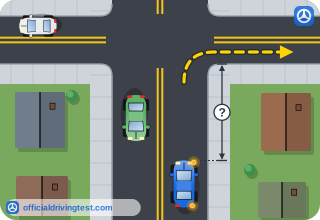
- At least 50 feet
- At least 100 feet
- At least 75 feet
- At least 200 feet
Show answer
Correct answer: At least 100 feet
In business or residential areas, a continuous turn signal must be given for at least 100 feet before turning.
Source: Illinois Rules of the Road (2026), page 30
-
Outside business and residential areas, how far before turning must you signal?
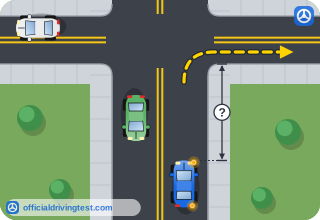
- At least 100 feet
- At least 300 feet
- At least 500 feet
- At least 200 feet
Show answer
Correct answer: At least 200 feet
Outside business or residential areas, the turn signal must be given at least 200 feet before turning.
Source: Illinois Rules of the Road (2026), page 30
-
Which arm should a driver use to give hand and arm signals?
- The left arm
- The right arm
- Either arm
- Both arms
Show answer
Correct answer: The left arm
The manual says hand and arm signals should be given using the left arm.
Source: Illinois Rules of the Road (2026), page 30
-
What is the hand and arm signal for a right turn?
- Hand and arm extended straight out
- Hand and arm extended downward
- Hand and arm extended straight up
- Hand and arm waved forward and back
Show answer
Correct answer: Hand and arm extended straight up
For a right turn, the hand and arm are extended straight up.
Source: Illinois Rules of the Road (2026), page 30
-
What is the hand and arm signal for a left turn?
- Hand and arm extended straight up
- Hand and arm extended straight out to the left
- Hand and arm extended down
- Hand and arm waved in a circle out the window
Show answer
Correct answer: Hand and arm extended straight out to the left
For a left turn, the hand and arm are extended straight out to the left.
Source: Illinois Rules of the Road (2026), page 30
-
What is the hand and arm signal to slow down or stop?
- Hand and arm extended straight up
- Hand and arm extended straight out
- Hand and arm waved up and down twice
- Hand and arm extended down
Show answer
Correct answer: Hand and arm extended down
To slow down or stop, the hand and arm are extended down.
Source: Illinois Rules of the Road (2026), page 30
-
Before moving from the right-hand lane to the left-hand lane, how should you check for traffic?
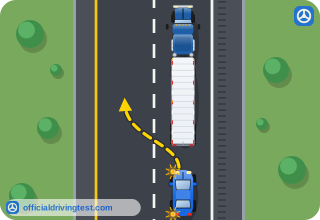
- Rely on your inside rearview mirror only
- Check the right-side mirror and blind spot
- Sound your horn and watch for a response
- Turn your head to check behind and to the left
Show answer
Correct answer: Turn your head to check behind and to the left
Before moving left, check for traffic behind your vehicle and to the left by turning your head and visually assessing the area.
Source: Illinois Rules of the Road (2026), page 31
-
When moving from the left-hand lane to the right-hand lane and the area is clear, which signal should you give?
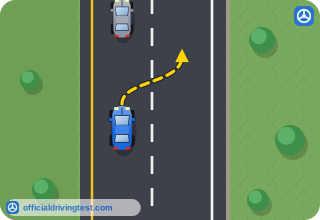
- The right-turn signal
- The left-turn signal
- The hazard signal
- No signal is needed
Show answer
Correct answer: The right-turn signal
After checking behind and to the right, give the right-turn signal and carefully move into the right lane.
Source: Illinois Rules of the Road (2026), page 32
-
What does flashing both turn signals at the same time indicate?
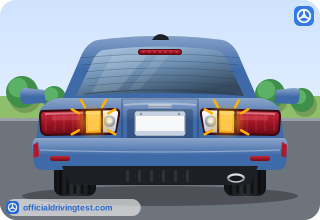
- A vehicle about to make a U-turn
- A vehicle about to change lanes
- A driver thanking another driver
- A disabled or parked vehicle
Show answer
Correct answer: A disabled or parked vehicle
The hazard signal, both turn signals flashing at once, may be used to indicate a disabled or parked vehicle.
Source: Illinois Rules of the Road (2026), page 32
-
Is it legal to flash your turn signals as a courtesy "do pass" signal to other drivers?
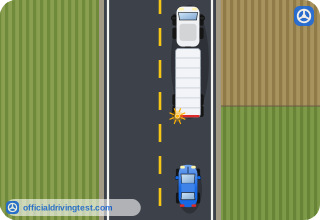
- Yes, on two-lane highways
- Yes, but only at night
- Yes, if a truck is behind
- No, it is against the law
Show answer
Correct answer: No, it is against the law
It is against the law to flash turn signals as a courtesy or "do pass" signal to other drivers.
Source: Illinois Rules of the Road (2026), page 28
-
How should your headlights be set when driving in fog?

- On high beam to see farther
- On dim, or use fog lights
- Turned off completely
- Flashing on and off
Show answer
Correct answer: On dim, or use fog lights
In fog, drive with your headlights set on dim or use fog lights.
Source: Illinois Rules of the Road (2026), page 84
-
When should you use your turn signals when driving in fog?

- Only after starting the turn
- Only if other vehicles are visible
- Not at all; use hand signals
- Long before making a turn
Show answer
Correct answer: Long before making a turn
In fog, use turn signals long before making a turn.
Source: Illinois Rules of the Road (2026), page 84
-
Illinois law requires you to use your headlights when:
- Driving in a school zone
- Operating your windshield wipers
- Driving on any expressway
- Parked on a residential street
Show answer
Correct answer: Operating your windshield wipers
Illinois law requires you to use your headlights when operating your windshield wipers.
Source: Illinois Rules of the Road (2026), page 85
-
In winter, after removing snow and ice from your vehicle, when may you start driving?
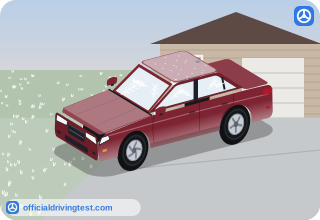
- As soon as the engine has been started
- Once the windshield is defrosted and clear
- After driving one block to warm up the engine
- As soon as the side windows are clear
Show answer
Correct answer: Once the windshield is defrosted and clear
Clear all windows and do not start driving until the windshield is defrosted and clear.
Source: Illinois Rules of the Road (2026), page 85
-
What kind of windshield washer liquid should you have for winter driving?
- Plain water
- Soapy water
- Nonfreezing liquid
- Hot water
Show answer
Correct answer: Nonfreezing liquid
For winter driving, be sure you have nonfreezing windshield washer liquid.
Source: Illinois Rules of the Road (2026), page 85
-
What does the manual say to do with your headlights for night driving?
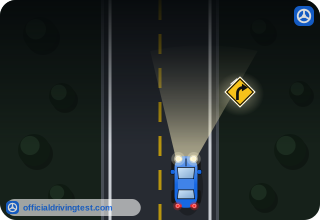
- Keep high beams on the whole time
- Aim them slightly upward for range
- Dim them only when driving in cities
- Keep them clean and properly aimed
Show answer
Correct answer: Keep them clean and properly aimed
Never overdrive your headlights, and always keep them clean and aimed properly.
Source: Illinois Rules of the Road (2026), page 87
-
When driving at night, what does the manual advise about the lights inside the vehicle?
- Turn on the dome light
- Dim the dashboard lights
- Use a reading light to check maps
- Brighten the dashboard lights
Show answer
Correct answer: Dim the dashboard lights
At night, dim the dashboard lights, use the sun visor to avoid glare, and avoid using any other light inside the vehicle.
Source: Illinois Rules of the Road (2026), page 87
-
What does the manual say about driving a vehicle that may be a hazard to any person or property?
- It is allowed with a warning sign
- It is allowed during daylight
- It is illegal
- It is allowed on rural roads
Show answer
Correct answer: It is illegal
It is illegal to drive a vehicle that may be a hazard to any person or property.
Source: Illinois Rules of the Road (2026), page 92
-
How many brake systems must a motor vehicle have?
- Two
- One
- Three
- Four
Show answer
Correct answer: Two
Vehicles must have two brake systems and brakes on all wheels.
Source: Illinois Rules of the Road (2026), page 92
-
A vehicle's foot brake must be strong enough to stop it from 20 mph within what distance?
- 55 feet
- 50 feet
- 20 feet
- 30 feet
Show answer
Correct answer: 30 feet
The foot brake must be able to stop a vehicle traveling 20 mph within 30 feet.
Source: Illinois Rules of the Road (2026), page 92