Illinois: Signals & vehicle controls — Part 2 Practice Test
Questions in this part include: “The emergency or parking brake must be able to stop a vehicle traveling 20 mph within what distance?” · “How many taillights are needed on mopeds and motorcycles?”
Independent educational site · not affiliated with any government agency or DMV
Ready? Test yourself
- Instant feedback with an explanation
- Every answer cites its source in the manual
- Your best score is saved on this device
Questions are original and based on the official manual "Illinois Rules of the Road" (2026), Illinois Secretary of State.
All 21 questions in this practice test
Take the test above first, then use this list to study. Tap “Show answer” to see the correct answer and explanation.
Show the questions and answersHide the questions
-
The emergency or parking brake must be able to stop a vehicle traveling 20 mph within what distance?
- 30 feet
- 55 feet
- 100 feet
- 75 feet
Show answer
Correct answer: 55 feet
The emergency or parking brake must stop the vehicle in 55 feet at 20 mph.
Source: Illinois Rules of the Road (2026), page 92
-
Besides stopping the vehicle, what else must the emergency brake be able to do?
- Stop the vehicle from 55 mph
- Work only when the engine runs
- Hold the vehicle on a grade or hill
- Replace the foot brake entirely
Show answer
Correct answer: Hold the vehicle on a grade or hill
The emergency brake must also be able to hold the vehicle on a grade or hill.
Source: Illinois Rules of the Road (2026), page 92
-
How many brakes do motor-driven cycles need?
- One
- Two
- Three
- One on each wheel
Show answer
Correct answer: One
Motor-driven cycles need only one brake.
Source: Illinois Rules of the Road (2026), page 92
-
How many headlights must a vehicle have, and when must they be on?
- One; only after dark in rural areas
- Two; only when it is raining
- Four; at all times while driving
- Two; from sunset to sunrise
Show answer
Correct answer: Two; from sunset to sunrise
Vehicles must have two headlights, which must be on from sunset to sunrise (and when conditions require windshield wipers).
Source: Illinois Rules of the Road (2026), page 92
-
Headlights should also be used when objects how far away cannot be seen?
- 500 feet
- 1,000 feet
- 200 feet
- 2,000 feet
Show answer
Correct answer: 1,000 feet
Headlights should also be used when objects 1,000 feet away cannot be seen.
Source: Illinois Rules of the Road (2026), page 92
-
Bright lights must be dimmed how far before meeting an oncoming vehicle?
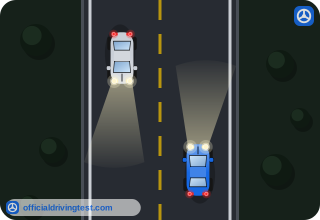
- 200 feet
- 300 feet
- 500 feet
- 1,000 feet
Show answer
Correct answer: 500 feet
Bright lights must be dimmed 500 feet before meeting an oncoming vehicle.
Source: Illinois Rules of the Road (2026), page 92
-
How far before passing a vehicle must you dim your bright lights?
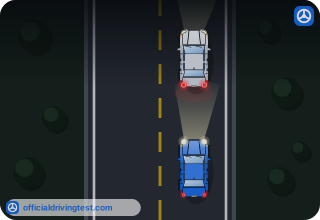
- 300 feet
- 500 feet
- 100 feet
- 1,000 feet
Show answer
Correct answer: 300 feet
Bright lights must be dimmed 300 feet before passing a vehicle.
Source: Illinois Rules of the Road (2026), page 92
-
A motorcycle or moped headlight must show objects how far ahead?
- 100 feet
- 200 feet
- 1,000 feet
- 500 feet
Show answer
Correct answer: 500 feet
Motorcycles and mopeds require a headlight that shows objects 500 feet ahead.
Source: Illinois Rules of the Road (2026), page 92
-
When must a motorcycle headlight be turned on?
- Only from sunset to sunrise
- Whenever the vehicle is driven
- Only in rain or fog
- Only on highways
Show answer
Correct answer: Whenever the vehicle is driven
A motorcycle headlight must be turned on whenever the vehicle is driven.
Source: Illinois Rules of the Road (2026), page 92
-
What does the manual say about tinted or smoked lenses on vehicle lights?
- Allowed on motorcycles only
- Allowed if lightly tinted
- Not allowed on any vehicle
- Allowed on rear lights only
Show answer
Correct answer: Not allowed on any vehicle
No tinted or smoked lenses are allowed on any vehicle.
Source: Illinois Rules of the Road (2026), page 92
-
A vehicle's two red taillights must be visible from how far behind?
- 500 feet
- 100 feet
- 200 feet
- 1,000 feet
Show answer
Correct answer: 500 feet
Vehicles must have two red taillights visible for 500 feet from behind.
Source: Illinois Rules of the Road (2026), page 92
-
How many taillights are needed on mopeds and motorcycles?
- Two
- Three
- None
- One
Show answer
Correct answer: One
Only one taillight is needed for mopeds and motorcycles.
Source: Illinois Rules of the Road (2026), page 92
-
Front and rear turn signals must be visible from how far away?
- 100 feet
- 300 feet
- 500 feet
- 50 feet
Show answer
Correct answer: 300 feet
Required front and rear turn signals must be visible from 300 feet.
Source: Illinois Rules of the Road (2026), page 92
-
Which vehicles are exempt from the requirement to have front and rear turn signals?
- Pickup trucks, vans, and school buses
- Cars and trucks built before the year 1965
- Motorcycles, trailers, and semitrailers
- Mopeds, farm tractors, and golf carts
Show answer
Correct answer: Motorcycles, trailers, and semitrailers
All vehicles except motorcycles, trailers, and semitrailers must have front and rear turn signals.
Source: Illinois Rules of the Road (2026), page 92
-
The license plate light must make the plate readable from how far away?
- 50 feet
- 100 feet
- 200 feet
- 25 feet
Show answer
Correct answer: 50 feet
Vehicles must have a white light making the license plate readable from 50 feet away.
Source: Illinois Rules of the Road (2026), page 92
-
What color must the license plate light be, and when must it be on?
- Red; whenever you brake
- Amber; at all times driven
- Blue; from sunset to sunrise
- White; when headlights are on
Show answer
Correct answer: White; when headlights are on
The license plate light must be white and must be on when the headlights are on.
Source: Illinois Rules of the Road (2026), page 92
-
The required rearview mirror must let you see at least how far behind your car?
- 50 feet
- 100 feet
- 500 feet
- 200 feet
Show answer
Correct answer: 200 feet
One rearview mirror is required so you can see at least 200 feet behind your car.
Source: Illinois Rules of the Road (2026), page 92
-
What type of glass must all vehicle windows have?
- Any tinted glass
- Approved safety glass
- Clear plastic panels
- Double-pane window glass
Show answer
Correct answer: Approved safety glass
All window glass must be approved safety glass.
Source: Illinois Rules of the Road (2026), page 92
-
What tinting is allowed on the front windshield?
- Tint over the whole windshield
- A 12-inch strip along the bottom
- A 6-inch strip along the top
- Tint on the passenger half only
Show answer
Correct answer: A 6-inch strip along the top
Tinted windows are not allowed on the front windshield, but a 6-inch strip of tinting is allowed along the entire length at the top.
Source: Illinois Rules of the Road (2026), page 92
-
A vehicle's horn must be able to be heard from how far away?
- 200 feet
- 50 feet
- 100 feet
- 500 feet
Show answer
Correct answer: 200 feet
Vehicles must have a horn that can be heard from 200 feet.
Source: Illinois Rules of the Road (2026), page 92
-
Which vehicles are allowed to have sirens, whistles, and bells?
- Any vehicle with a local permit
- School buses and tow trucks
- Farm and construction vehicles
- Authorized emergency vehicles only
Show answer
Correct answer: Authorized emergency vehicles only
Sirens, whistles and bells are allowed only on authorized emergency vehicles.
Source: Illinois Rules of the Road (2026), page 92