Illinois: Signals & vehicle controls — Part 3 Practice Test
Questions in this part include: “Which changes to a vehicle's exhaust system are illegal?” · “Other than turn signals and hazard indicators, which vehicles may have flashing or moving lights?”
Independent educational site · not affiliated with any government agency or DMV
Ready? Test yourself
- Instant feedback with an explanation
- Every answer cites its source in the manual
- Your best score is saved on this device
Questions are original and based on the official manual "Illinois Rules of the Road" (2026), Illinois Secretary of State.
All 20 questions in this practice test
Take the test above first, then use this list to study. Tap “Show answer” to see the correct answer and explanation.
Show the questions and answersHide the questions
-
Which changes to a vehicle's exhaust system are illegal?
- Replacing a worn-out muffler with a new one
- Cutouts and bypasses that add noise
- Adding a chrome tip to the tailpipe
- Installing a new, factory exhaust pipe
Show answer
Correct answer: Cutouts and bypasses that add noise
Cutouts, bypasses, and changes to the exhaust system to increase noise are illegal.
Source: Illinois Rules of the Road (2026), page 92
-
Which vehicles must have both a front and a rear bumper?
- Only vehicles weighing over 9,000 pounds
- Only commercial trucks and buses
- Vehicles of 9,000 pounds or less and all RVs
- Only motorcycles and mopeds
Show answer
Correct answer: Vehicles of 9,000 pounds or less and all RVs
Vehicles weighing 9,000 pounds or less and all recreational vehicles must have a front and rear bumper.
Source: Illinois Rules of the Road (2026), page 92
-
By law, the horizontal line of a vehicle from front to rear may not vary by more than:
- 3 inches
- 6 inches
- 1 inch
- 12 inches
Show answer
Correct answer: 3 inches
The horizontal line from the front to the rear of a vehicle may not vary over 3 inches.
Source: Illinois Rules of the Road (2026), page 93
-
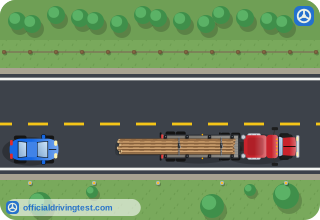
A load extends 4 feet or more past the rear of your vehicle. How must it be marked during the day?
- With a white flag
- With an orange cone
- With a yellow light
- With a red flag
Show answer
Correct answer: With a red flag
Loads extending 4 feet or more to the rear must be marked with a red flag during the day.
Source: Illinois Rules of the Road (2026), page 93
-
At night or when visibility is poor, what must a vehicle with a load projecting 4 feet or more to the rear have?
- A white light visible for 200 feet
- A red light visible for 500 feet
- Two amber reflectors on the load
- A red flag and nothing more
Show answer
Correct answer: A red light visible for 500 feet
At night or when visibility is poor, the vehicle must have a red light visible for 500 feet.
Source: Illinois Rules of the Road (2026), page 93
-
What color light may back-up lights emit?
- Red or amber
- Blue or white
- White or amber
- Red only
Show answer
Correct answer: White or amber
Back-up lights must emit a white or amber light without glare.
Source: Illinois Rules of the Road (2026), page 93
-
When may back-up lights NOT be on?
- When the vehicle is moving forward
- When the vehicle is backing up
- When the vehicle is in reverse
- When the driver is parking in reverse
Show answer
Correct answer: When the vehicle is moving forward
Back-up lights may not be on when the vehicle is moving forward.
Source: Illinois Rules of the Road (2026), page 93
-
How many spotlights are allowed on a vehicle?
- Two
- Four
- None
- One
Show answer
Correct answer: One
Only one spotlight is allowed on a vehicle.
Source: Illinois Rules of the Road (2026), page 93
-
At most, how many 300 candlepower lights may a vehicle have burning?
- Two
- Four
- Six
- Eight
Show answer
Correct answer: Four
A vehicle may not have more than four 300 candlepower lights burning.
Source: Illinois Rules of the Road (2026), page 93
-
When approaching another vehicle, how must a spotlight be directed?
- Toward the other vehicle's windshield
- Up and to the left of the road
- Not left, and not over 100 feet ahead
- At least 500 feet down the road
Show answer
Correct answer: Not left, and not over 100 feet ahead
When approaching another vehicle, a spotlight must be directed neither to the left nor more than 100 feet ahead.
Source: Illinois Rules of the Road (2026), page 93
-
Other than turn signals and hazard indicators, which vehicles may have flashing or moving lights?
- Police or designated emergency vehicles
- Any commercial vehicle on a highway
- Tow trucks and delivery vans at work
- Private vehicles with a city permit
Show answer
Correct answer: Police or designated emergency vehicles
Flashing or moving lights are prohibited except for police or designated emergency vehicles, including fire protection district vehicles.
Source: Illinois Rules of the Road (2026), page 93
-
Which vehicles may show red lights visible from the front?
- Any passenger car
- Motorcycles
- Farm tractors
- Police vehicles
Show answer
Correct answer: Police vehicles
Red lights visible from the front are prohibited, except for police or designated emergency vehicles.
Source: Illinois Rules of the Road (2026), page 93
-
How many running board lights are allowed on each side of a vehicle?
- Two
- One
- Three
- Four
Show answer
Correct answer: One
Running board lights are limited to one on each side and must be non-glare white or amber lights.
Source: Illinois Rules of the Road (2026), page 93
-
How many cowl or fender lamps are allowed on a vehicle?
- One
- Four
- Two
- Six
Show answer
Correct answer: Two
Only two cowl or fender lamps are allowed, and they must be non-glare white or amber lights.
Source: Illinois Rules of the Road (2026), page 93
-
Mail carriers in rural areas may use pneumatic tires with metal studs during which period?
- November 15 to April 1
- October 1 to May 1
- December 1 to March 1
- November 1 to April 15
Show answer
Correct answer: November 15 to April 1
Studded tires are illegal except, among others, for vehicles used by rural mail carriers between November 15 and April 1.
Source: Illinois Rules of the Road (2026), page 93
-
Studded tires are allowed on road-building machinery operated at what speed?
- Less than 25 mph
- Less than 35 mph
- Less than 45 mph
- Less than 10 mph
Show answer
Correct answer: Less than 10 mph
Road-building machinery operated at a speed of less than 10 mph is one of the exceptions to the studded tire ban.
Source: Illinois Rules of the Road (2026), page 93
-
Vehicles with Persons with Disabilities or Disabled Veteran plates may use studded tires between November 15 and April 1 only if the owner lives where?
- Inside the limits of an incorporated city or village
- On a county or township road in an unincorporated area
- On a state highway outside of any city limits
- Within walking distance of a veterans’ hospital
Show answer
Correct answer: On a county or township road in an unincorporated area
For these plates, owners must live on a county or township road in an unincorporated area.
Source: Illinois Rules of the Road (2026), page 93
-
Special rules for lamps, brakes, lights, and turn signals apply to antique vehicles more than how many years old?
- 15 years
- 20 years
- 30 years
- 25 years
Show answer
Correct answer: 25 years
Special equipment rules apply to vehicles more than 25 years old.
Source: Illinois Rules of the Road (2026), page 93
-
What does the manual say about radar jamming devices?
- Allowed in private cars
- Prohibited in all vehicles
- Legal to own but not use
- Allowed outside of cities
Show answer
Correct answer: Prohibited in all vehicles
Possession and use of radar jamming devices is prohibited in all vehicles.
Source: Illinois Rules of the Road (2026), page 93
-
Why must a muffler be on a vehicle's exhaust system?
- To increase the power of the engine
- To help cool the engine down quickly
- To prevent excessive noise and smoke
- To improve the fuel mileage greatly
Show answer
Correct answer: To prevent excessive noise and smoke
A muffler must be on the exhaust system to prevent excessive noise and smoke.
Source: Illinois Rules of the Road (2026), page 92