Illinois: Emergencies and special situations
Skids, brake failure, breakdowns, bad weather, crashes and towing. Split into 4 shorter tests so you're not stuck in one long quiz.
Independent educational site · not affiliated with any government agency or DMV
Choose a part
Emergencies and special situations — Part 1
Questions in this part include: “Under Illinois law, when may you push a disabled vehicle on a rural highway?”
StartEmergencies and special situations — Part 2
Questions in this part include: “After being near a hazardous materials crash, why should you seek medical aid if you feel ill later?”
StartEmergencies and special situations — Part 3
Questions in this part include: “How are the symptoms of carbon monoxide poisoning often described?”
StartEmergencies and special situations — Part 4
Questions in this part include: “If you suddenly have no control of the steering wheel, what should you do?”
StartAll 68 Emergencies and special situations questions with answers
Choose a part above to take a practice test, or study every question and answer here.
Show the questions and answersHide the questions
-
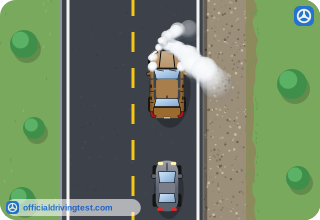
In an emergency on a paved highway outside a business or residential district, you may stop only if you have a clear view of how far in each direction?
- 200 feet
- 100 feet
- 500 feet
- 50 feet
Show answer
Correct answer: 200 feet
In an emergency, drivers may stop and park only if there is a clear view of 200 feet in each direction.
Source: Illinois Rules of the Road (2026), page 35
-
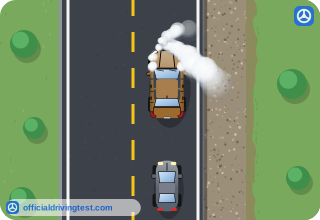
When you must stop on a paved highway outside a business or residential district in an emergency, what should you do?
- Leave your headlights on high beam to warn other drivers
- Park close to the center line so others can see you
- Turn on your emergency flashers and leave room to pass
- Stop partly in the lane so you are easier to notice
Show answer
Correct answer: Turn on your emergency flashers and leave room to pass
The driver should turn on the emergency flashers and make sure there is enough space for other vehicles to pass.
Source: Illinois Rules of the Road (2026), page 35
-
Under Illinois law, when may you push a disabled vehicle on a rural highway?
- At any time, if hazard lights are on
- Only during daylight hours, with care
- Only in an emergency, to remove a hazard
- Only with a police escort present
Show answer
Correct answer: Only in an emergency, to remove a hazard
A person may not push a disabled vehicle on a rural highway unless there is an emergency and it should be removed to avoid a hazard.
Source: Illinois Rules of the Road (2026), page 45
-
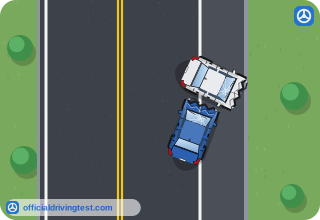
Before removing a wrecked or damaged vehicle from the roadway, what must be done?
- Photograph the whole scene
- Remove all glass and other debris
- Wait for a tow truck to arrive
- Mark the vehicle with flares
Show answer
Correct answer: Remove all glass and other debris
Illinois law states a person may not remove a wrecked or damaged vehicle from the roadway without removing all glass and other debris.
Source: Illinois Rules of the Road (2026), page 45
-
When one vehicle tows another, what must connect them, and how far apart should they be in most cases?
- A rope, no more than 25 feet apart
- A drawbar, no more than 15 feet apart
- A drawbar, no more than 30 feet apart
- A strap, no more than 10 feet apart
Show answer
Correct answer: A drawbar, no more than 15 feet apart
You may not tow one vehicle with another except by a drawbar, and in most cases the distance between the two cars should not exceed 15 feet.
Source: Illinois Rules of the Road (2026), page 45
-
How should a towed vehicle be coupled to the towing vehicle?
- With one tow rope
- With a single tow strap
- With a bungee cord
- With two chains or cables
Show answer
Correct answer: With two chains or cables
A towed vehicle should be coupled to the towing vehicle with two chains or cables.
Source: Illinois Rules of the Road (2026), page 45
-
A vehicle left along an interstate, expressway, or toll highway may be towed at the owner's expense after:
- Two hours
- Ten hours
- 24 hours
- 48 hours
Show answer
Correct answer: Two hours
Law enforcement may have a vehicle towed at the owner's expense if left on an interstate, expressway, or toll highway for two hours.
Source: Illinois Rules of the Road (2026), page 45
-
A disabled vehicle left along a highway in an urban area may be towed at the owner's expense after:
- Two hours
- 24 hours
- 10 hours
- Six hours
Show answer
Correct answer: 10 hours
On a highway in an urban area, a vehicle may be towed at the owner's expense after 10 hours.
Source: Illinois Rules of the Road (2026), page 45
-
A disabled vehicle left along a highway in a non-urban area may be towed at the owner's expense after:
- Two hours
- 10 hours
- 72 hours
- 24 hours
Show answer
Correct answer: 24 hours
On a highway in a non-urban area, a vehicle may be towed at the owner's expense after 24 hours.
Source: Illinois Rules of the Road (2026), page 45
-
If you are involved in or come upon a traffic crash, where should you stop your vehicle, if able to do so?
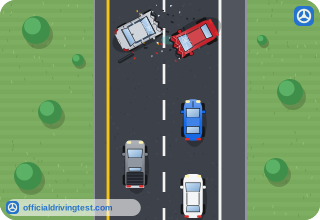
- In a safe, well-lit public place that does not obstruct traffic
- In the traffic lane right beside the damaged vehicles
- On the shoulder at least 500 feet past the crash scene
- Only at the nearest police station or sheriff’s office
Show answer
Correct answer: In a safe, well-lit public place that does not obstruct traffic
The manual says to stop in a safe, well-lit public place that does not obstruct traffic, if you are able to do so.
Source: Illinois Rules of the Road (2026), page 54
-
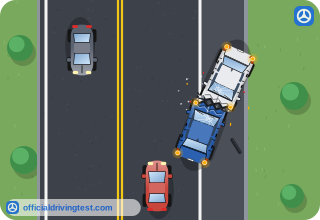
When you are involved in or come upon a traffic crash, when should you call 911?
- Only if a vehicle is on fire
- After you finish exchanging details
- Immediately
- Only if the damage exceeds $1,500
Show answer
Correct answer: Immediately
The crash checklist tells drivers to call 911 immediately.
Source: Illinois Rules of the Road (2026), page 54
-
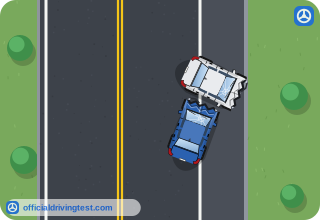
At a traffic crash, how should you warn other drivers?
- Stand in the travel lane and wave your arms
- Use emergency flashers and flares if available
- Sound your horn continuously until police arrive
- Flash your high beams at every oncoming car
Show answer
Correct answer: Use emergency flashers and flares if available
The manual says to warn other drivers by using emergency flashers and flares if available.
Source: Illinois Rules of the Road (2026), page 54
-
After a traffic crash, what information should you ask all those involved for?
- Only their names and the make, model and color of their vehicles
- Their insurance premium amounts, employer names and job titles
- Only their license plate numbers and the time the crash happened
- Names, addresses, phone numbers, license numbers and plate numbers
Show answer
Correct answer: Names, addresses, phone numbers, license numbers and plate numbers
You should ask everyone involved for their names, addresses, phone numbers, driver’s license numbers and license plate numbers.
Source: Illinois Rules of the Road (2026), page 54
-
You damage a parked vehicle and cannot find its owner. What must you leave on the vehicle?
- Only a note saying that you are sorry for the damage
- Your name, address, phone number and license plate number
- Your insurance card and the keys to your own vehicle
- Nothing, as long as you drive away slowly and safely
Show answer
Correct answer: Your name, address, phone number and license plate number
If the owner cannot be found, leave your name, address, phone number and license plate number on the vehicle or property, notify police and complete the required crash reports.
Source: Illinois Rules of the Road (2026), page 55
-
After a crash that damages an unattended vehicle or other property, which step is required besides leaving your information?
- Notify police and complete all required crash reports
- Wait at the scene for at least 24 hours for the owner
- Tow the damaged vehicle to the nearest repair shop
- Pay the owner in cash before leaving the scene
Show answer
Correct answer: Notify police and complete all required crash reports
For a crash with an unattended vehicle or property, you must stop away from traffic, leave your information, notify police and complete all required crash reports.
Source: Illinois Rules of the Road (2026), page 55
-
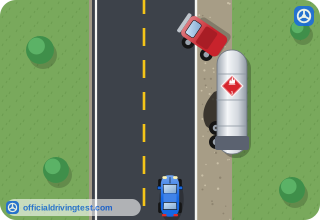
What does a hazardous materials placard indicate?
- That the vehicle is an authorized emergency vehicle
- That the vehicle may not use the expressway
- The presence and type of hazardous material being transported
- That the driver holds a commercial driver's license
Show answer
Correct answer: The presence and type of hazardous material being transported
A hazardous materials placard is a sign that indicates the presence and type of hazardous material being transported on roadways.
Source: Illinois Rules of the Road (2026), page 75
-
Which agency requires hazardous materials placards?
- The Secretary of State
- The Department of Transportation
- The local police department
- The Federal Railroad Administration
Show answer
Correct answer: The Department of Transportation
Placards are required by the Department of Transportation and are useful to emergency responders and other motorists in case of an accident.
Source: Illinois Rules of the Road (2026), page 75
-
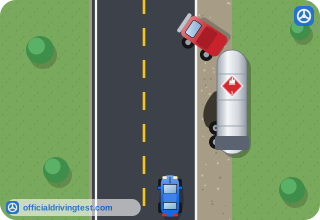
When approaching a crashed vehicle with a hazardous materials placard, what should you do?
- Move closer to read the placard's details
- Pull the driver out before responders arrive
- Drive through quickly without stopping
- Evacuate as best you can, following responders
Show answer
Correct answer: Evacuate as best you can, following responders
When approaching a crash involving a vehicle with a hazardous materials placard, evacuate as best you can by following the directions of emergency responders.
Source: Illinois Rules of the Road (2026), page 75
-
At a crash involving a hazardous materials vehicle, what should you do if no emergency vehicles are present?
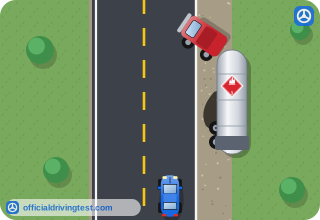
- Avoid the area and report it from a safe location
- Direct traffic around the crash yourself
- Try to stop any leak with water from your car
- Wait next to the vehicle until help arrives
Show answer
Correct answer: Avoid the area and report it from a safe location
If no emergency vehicles are present, avoid the crash area and report the accident to emergency responders in a safe location.
Source: Illinois Rules of the Road (2026), page 75
-
After being near a hazardous materials crash, why should you seek medical aid if you feel ill later?
- State law requires a checkup after every crash
- Your insurance will not pay without an exam
- Toxic exposure can show up in a delayed manner
- Police must record every witness's health
Show answer
Correct answer: Toxic exposure can show up in a delayed manner
Toxic environment exposure can manifest in a delayed manner, so seek medical aid if feeling ill.
Source: Illinois Rules of the Road (2026), page 75
-
If you cannot avoid a crash, what does the manual say to do?
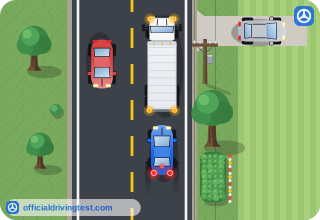
- Remain calm and choose the least dangerous situation
- Brake as hard as possible and close your eyes
- Let go of the steering wheel and brace yourself
- Speed up to get past the danger quickly
Show answer
Correct answer: Remain calm and choose the least dangerous situation
If a crash cannot be avoided, remain calm and try to choose the least dangerous situation.
Source: Illinois Rules of the Road (2026), page 83
-
Your vehicle skids while hydroplaning and you cannot regain control. What should you do?
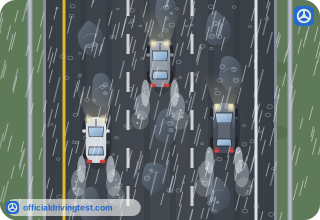
- Brake hard and hold the pedal all the way down
- Turn the wheel sharply the other way
- Shift into park right away
- Release the accelerator and ride out the skid
Show answer
Correct answer: Release the accelerator and ride out the skid
If you cannot regain control while hydroplaning, release the accelerator and ride out the skid.
Source: Illinois Rules of the Road (2026), page 85
-
What should you do if you come to a roadway or viaduct that is flooded after heavy rain?
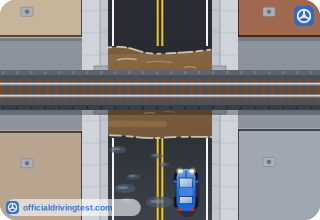
- Drive through slowly in low gear
- Turn around and find another route
- Drive through quickly to avoid stalling
- Follow another vehicle through the water
Show answer
Correct answer: Turn around and find another route
Do not drive through a flooded area; turn your vehicle around and find another route.
Source: Illinois Rules of the Road (2026), page 85
-
Why should you not drive through a flooded roadway?
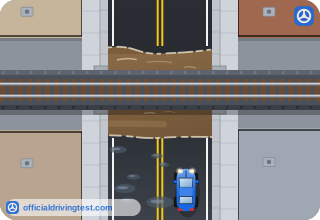
- The water will ruin the vehicle's paint finish
- Your headlights will stop working in water
- You cannot tell the water's depth or current
- Your tires will lose air pressure right away
Show answer
Correct answer: You cannot tell the water's depth or current
The manual explains that it is impossible to determine the depth or current of the water.
Source: Illinois Rules of the Road (2026), page 85
-
If you become stranded in your vehicle during winter, what does the manual advise?

- Walk to the nearest house or business for help
- Run the engine nonstop with the windows closed
- Remain in your vehicle
- Leave the vehicle and flag down other drivers
Show answer
Correct answer: Remain in your vehicle
If you become stranded, remain in your vehicle and run the engine only for brief times.
Source: Illinois Rules of the Road (2026), page 85
-
When you are stranded in winter and run the engine for brief times, why should you open the window?

- To prevent carbon monoxide poisoning
- To keep the battery charged
- To help the heater warm up faster
- To keep the windows from fogging
Show answer
Correct answer: To prevent carbon monoxide poisoning
Run the engine only for brief times and open the window to prevent carbon monoxide poisoning.
Source: Illinois Rules of the Road (2026), page 85
-
Which items does the manual suggest carrying in your vehicle in case you are stranded in winter?

- Extra motor oil and a jack
- Road flares and a spare key
- A tire gauge and a map
- A blanket, food, and a shovel
Show answer
Correct answer: A blanket, food, and a shovel
Carrying a blanket, food, and other survival equipment, such as a shovel, can be helpful if stranded.
Source: Illinois Rules of the Road (2026), page 85
-
If you must stop on the roadway at night, what does the manual recommend?
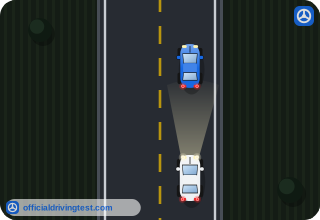
- Using a red warning light
- Turning off all your lights
- Using your high beams
- Turning on the dome light
Show answer
Correct answer: Using a red warning light
Do not stop on the roadway at night; if you must stop, the use of a red warning light is recommended.
Source: Illinois Rules of the Road (2026), page 87
-
A vehicle is approaching head-on in your lane. What should you do?
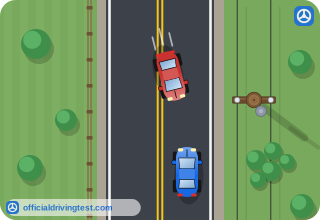
- Slow down, pull to the right, and sound the horn
- Speed up and swerve to the left
- Stop in your lane and flash your lights
- Swerve left into the lane for oncoming traffic
Show answer
Correct answer: Slow down, pull to the right, and sound the horn
When a vehicle approaches head-on in your lane, slow down, pull over to the right, and sound the horn.
Source: Illinois Rules of the Road (2026), page 87
-
What causes a vehicle to skid?
- Driving with low beams
- Using cruise control
- Driving in the left lane
- Tires losing traction
Show answer
Correct answer: Tires losing traction
Skidding occurs when tires lose traction.
Source: Illinois Rules of the Road (2026), page 87
-
If your vehicle starts to skid, what should you do?
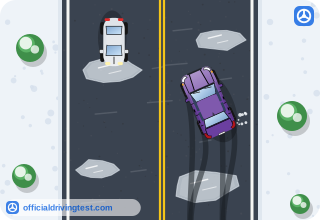
- Brake hard and steer away from the skid
- Ease off the pedals and steer into the skid
- Speed up and hold the steering wheel straight
- Shift into neutral and pull the parking brake
Show answer
Correct answer: Ease off the pedals and steer into the skid
In a skid, ease off the gas pedal or brakes, steer into the direction of the skid until you regain traction, then straighten the vehicle.
Source: Illinois Rules of the Road (2026), page 87
-
Your wheels drift off the pavement onto the shoulder. What should you do first?
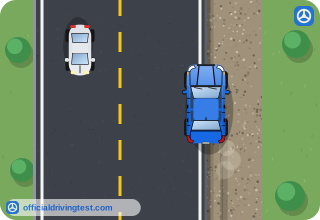
- Brake hard and quickly jerk the wheel back
- Speed up and steer back onto the road at once
- Grip the wheel, ease off the gas, brake gently
- Turn off the engine and coast to a stop
Show answer
Correct answer: Grip the wheel, ease off the gas, brake gently
If your wheels drift onto the shoulder, grip the wheel firmly, ease off the gas pedal, and brake gently before steering back after checking traffic.
Source: Illinois Rules of the Road (2026), page 87
-
After drifting onto the shoulder, why should you not jerk the wheel to get back on the pavement?
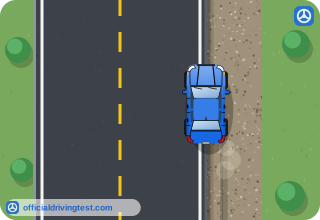
- It may send the vehicle into oncoming traffic
- It will usually cause a flat front tire
- It can damage the power steering pump
- It sets off the vehicle's air bags
Show answer
Correct answer: It may send the vehicle into oncoming traffic
Jerking the wheel may cause the vehicle to drive into oncoming traffic; steer back gently after checking for traffic behind you.
Source: Illinois Rules of the Road (2026), page 87
-
If smoke appears from your vehicle, what should you do after pulling off the road?
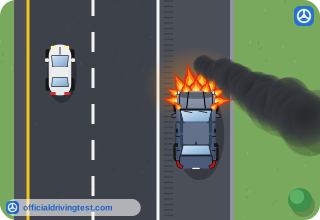
- Open the hood and put out the fire
- Keep the engine running and wait
- Stay in the vehicle and call for help
- Turn off the engine, move away, and call 911
Show answer
Correct answer: Turn off the engine, move away, and call 911
If smoke appears, pull off the road, turn off the engine, move away from the vehicle, and call 911.
Source: Illinois Rules of the Road (2026), page 88
-
What does the manual say about fighting a vehicle fire yourself?
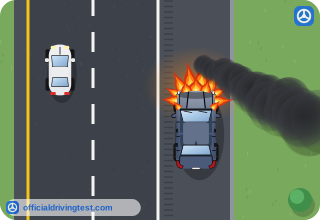
- Use water from a bottle
- Do not fight the fire yourself
- Use the floor mats to smother it
- Fight it only if it is small
Show answer
Correct answer: Do not fight the fire yourself
Vehicle fires can be very dangerous, so do not fight the fire yourself.
Source: Illinois Rules of the Road (2026), page 88
-
Your vehicle runs off the road into water but does not sink right away. How should you try to escape?
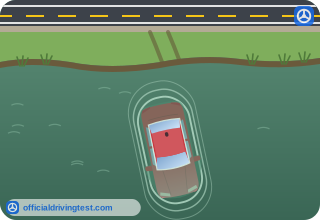
- Through the trunk
- Through the front door
- Through a window
- Wait for it to sink first
Show answer
Correct answer: Through a window
If the vehicle does not sink right away, try to escape through a window.
Source: Illinois Rules of the Road (2026), page 88
-
After running into water, why may you be unable to open the car doors?
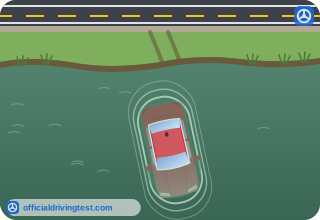
- Differences in water pressure
- The doors lock automatically
- The hinges rust at once
- The power windows fail
Show answer
Correct answer: Differences in water pressure
Because of differences in water pressure, you or your passengers may not be able to open the car doors.
Source: Illinois Rules of the Road (2026), page 88
-
If your vehicle sinks in water, where should you move?
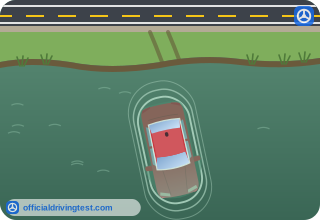
- To the driver's seat
- To the front passenger seat
- Down to the floor
- To the back seat area
Show answer
Correct answer: To the back seat area
If the vehicle sinks, move to the back seat area where an air pocket usually forms, then exit from a rear window if possible.
Source: Illinois Rules of the Road (2026), page 88
-
How are the symptoms of carbon monoxide poisoning often described?
- Allergy-like
- Flu-like
- Sunburn-like
- Hunger-like
Show answer
Correct answer: Flu-like
Carbon monoxide symptoms are often described as "flu-like."
Source: Illinois Rules of the Road (2026), page 88
-
Which is one of the most common symptoms of carbon monoxide poisoning?
- Itchy skin
- Sneezing
- Dizziness
- Fever blisters
Show answer
Correct answer: Dizziness
The most common symptoms are headache, dizziness, weakness, upset stomach, vomiting, chest pain, and confusion.
Source: Illinois Rules of the Road (2026), page 88
-
Who is particularly at risk from carbon monoxide in a vehicle?
- Older people and infants
- Teenagers and young adults
- Only the driver of the car
- Only front-seat passengers
Show answer
Correct answer: Older people and infants
Everyone in the vehicle is at risk, particularly older people, infants, and people with cardiac, pulmonary, or blood disorders.
Source: Illinois Rules of the Road (2026), page 88
-
How often does the manual recommend having a mechanic check your vehicle's exhaust system?
- Every five years
- Every two years
- Every month
- Every year
Show answer
Correct answer: Every year
The manual recommends having a mechanic check your vehicle exhaust system every year.
Source: Illinois Rules of the Road (2026), page 88
-
What does the manual say about running a vehicle inside a garage attached to a house?
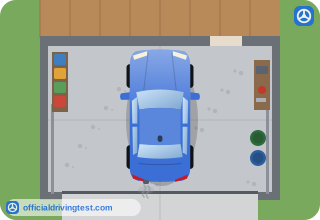
- It is fine with the door closed
- Never do it
- It is fine for under 10 minutes
- It is fine only in winter
Show answer
Correct answer: Never do it
Never run a vehicle inside a garage that is attached to a house, because of the carbon monoxide risk.
Source: Illinois Rules of the Road (2026), page 88
-
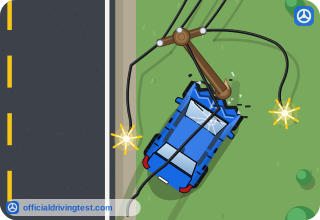
After a crash, power lines fall on your vehicle and there is no fire. What should you do?
- Get out quickly and run from the car
- Push the lines off with a dry stick
- Stay in the vehicle until help arrives
- Drive out from under the lines
Show answer
Correct answer: Stay in the vehicle until help arrives
Because of the danger of electrical shock, you and your passengers should remain in the vehicle until help arrives.
Source: Illinois Rules of the Road (2026), page 88
-
If fire forces you to jump clear of a vehicle touched by power lines, what must you avoid?
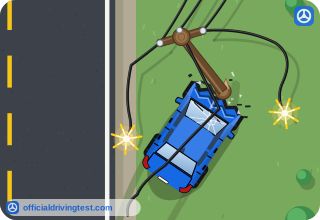
- Touching the car and the ground at once
- Landing on both feet
- Keeping your arms close to your body
- Shuffling away from the vehicle
Show answer
Correct answer: Touching the car and the ground at once
When jumping clear, do not let any part of your body touch the vehicle and the ground at the same time.
Source: Illinois Rules of the Road (2026), page 88
-
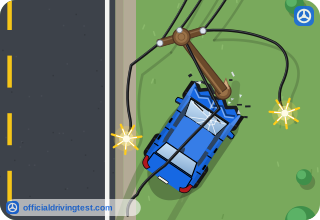
After jumping clear of a vehicle with power lines on it, how far away should you hop or shuffle?
- 10 feet
- 20 feet
- 100 feet
- 50 feet
Show answer
Correct answer: 50 feet
Land on both feet and hop or shuffle, with your arms close to your body, for a distance of 50 feet away from the vehicle.
Source: Illinois Rules of the Road (2026), page 88
-
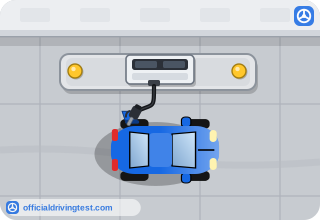
What should you always do with the engine when refueling your vehicle?
- Leave it idling
- Shut it off
- Rev it gently
- Leave it running in park
Show answer
Correct answer: Shut it off
To avoid an explosive fire hazard, always shut off your vehicle's engine when refueling.
Source: Illinois Rules of the Road (2026), page 88
-
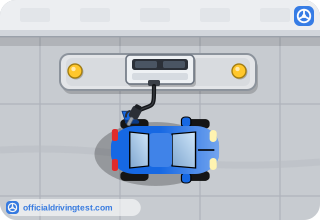
For safety, where does the manual say you should be while refueling?
- Inside the vehicle
- Inside the station
- With the pump
- Anywhere nearby
Show answer
Correct answer: With the pump
For safety purposes, remain with the pump while refueling, and never smoke around gas pumps.
Source: Illinois Rules of the Road (2026), page 88
-
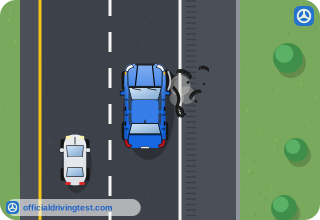
What sound may be a warning of a tire blowout?
- A thumping sound
- A high whistle
- A clicking sound
- A grinding squeal
Show answer
Correct answer: A thumping sound
A thumping sound may be a warning of a blowout.
Source: Illinois Rules of the Road (2026), page 88
-
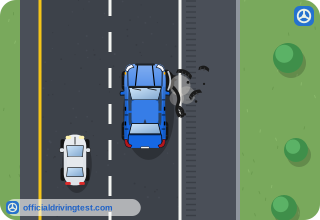
What should you do if a tire blows out?
- Brake hard right away
- Speed up to keep control
- Turn the wheel sharply toward the shoulder
- Ease off the gas and hold the wheel firmly
Show answer
Correct answer: Ease off the gas and hold the wheel firmly
If a tire blows out, ease your foot off the gas pedal and keep a firm grasp on the steering wheel, then pull safely off the road.
Source: Illinois Rules of the Road (2026), page 88
-
How should you react if you lose a wheel or tire while driving?
- Brake hard at once
- Shift into park
- As for a tire blowout
- Keep driving to a garage
Show answer
Correct answer: As for a tire blowout
For the loss of a wheel or tire, react the same as for a tire blowout.
Source: Illinois Rules of the Road (2026), page 88
-
If you suddenly have no control of the steering wheel, what should you do?
- Ease off the gas and use your flashers
- Brake hard to stop as fast as possible
- Turn off the ignition right away
- Shift into reverse to slow down
Show answer
Correct answer: Ease off the gas and use your flashers
With steering failure, ease off the gas pedal, turn on the emergency flashers, and let the vehicle come to a slow stop, braking very gently.
Source: Illinois Rules of the Road (2026), page 89
-
During a steering failure in a vehicle with power steering or a locking steering wheel, why should you not turn off the ignition?
- The airbags might deploy suddenly
- The doors will lock automatically
- The brakes will stop working
- You may lose the ability to steer
Show answer
Correct answer: You may lose the ability to steer
Turning off the ignition would make the vehicle lose either its power steering or its ability to steer.
Source: Illinois Rules of the Road (2026), page 89
-
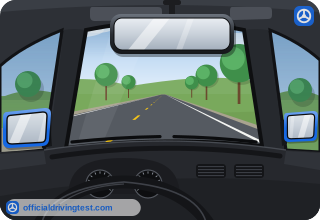
If the brake pedal suddenly sinks to the floor, what should you do first?
- Turn off the engine right away
- Pump the pedal to build pressure
- Shift the vehicle into park
- Steer off the road onto grass
Show answer
Correct answer: Pump the pedal to build pressure
If the brake pedal suddenly sinks to the floor, pump it to build pressure.
Source: Illinois Rules of the Road (2026), page 89
-
Your brake pedal sinks to the floor and your first attempt to restore braking fails. What should you use next?
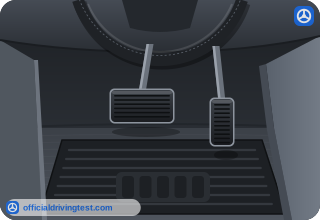
- Sounding the horn to warn others
- Reverse gear to slow down
- The emergency or parking brake
- The ignition switch, turned off
Show answer
Correct answer: The emergency or parking brake
If pumping the brake pedal does not work, use the emergency or parking brake.
Source: Illinois Rules of the Road (2026), page 89
-
When your brakes fail, how can you slow the vehicle down?
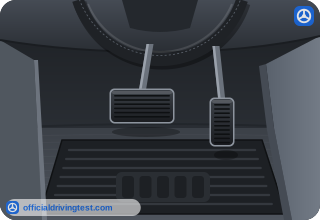
- Shift into a lower gear
- Shift into neutral
- Turn off the engine
- Speed up, then coast
Show answer
Correct answer: Shift into a lower gear
With brake failure, shift your vehicle into a lower gear to slow down.
Source: Illinois Rules of the Road (2026), page 89
-
If your headlights suddenly fail, what should you try using?
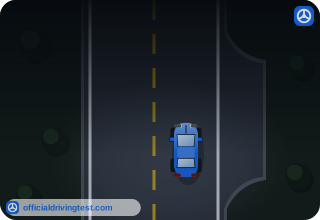
- The dome light and interior lights
- Nothing; drive on with no lights at all
- Another car's taillights as a guide
- Emergency flashers or parking lights
Show answer
Correct answer: Emergency flashers or parking lights
If your headlights fail suddenly, try using your emergency flashers, parking lights and/or turn signals, and pull off the road.
Source: Illinois Rules of the Road (2026), page 89
-
Your gas pedal is stuck and your first attempt to free it fails. What should you do?
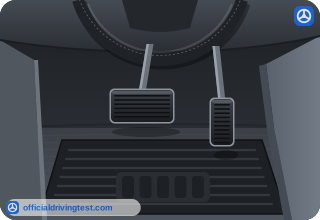
- Turn off the engine and remove the key
- Shift into neutral and brake gently
- Shift into park right away
- Pump the gas pedal hard
Show answer
Correct answer: Shift into neutral and brake gently
If the stuck gas pedal does not come free, shift into neutral and brake gently to slow down.
Source: Illinois Rules of the Road (2026), page 89
-
What is the first thing to try when your gas pedal becomes stuck?
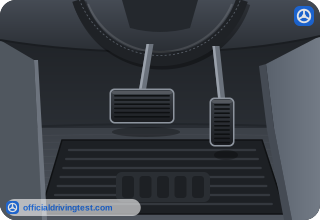
- Shift into reverse at once
- Turn off the ignition right away
- Hook your toe under it to free it
- Stomp hard on the pedal to free it
Show answer
Correct answer: Hook your toe under it to free it
If your gas pedal becomes stuck, hook your toe under it to free it.
Source: Illinois Rules of the Road (2026), page 89
-
If your vision suddenly becomes blocked while driving, what should you do?
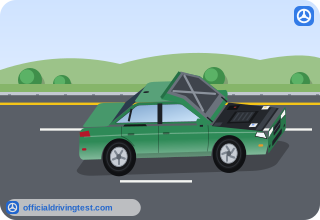
- Roll down your side window to see
- Stop right away in your lane
- Speed up to clear the windshield
- Close your eyes and brake hard
Show answer
Correct answer: Roll down your side window to see
If your vision becomes blocked, roll down your side window to see, turn on your emergency flashers, and pull off the road.
Source: Illinois Rules of the Road (2026), page 89
-
Which roads does the manual give as examples of high-capacity roadways?
- Quiet streets in residential areas
- Secondary routes in rural regions
- Highways and major urban arterials
- Alleys and private driveways
Show answer
Correct answer: Highways and major urban arterials
High-capacity roadways handle a large volume of traffic; examples include highways and major urban arterials.
Source: Illinois Rules of the Road (2026), page 90
-
Where are low-capacity roadways typically found?
- Residential and rural areas
- Along major urban arterials
- On interstate highways
- On toll roads and turnpikes
Show answer
Correct answer: Residential and rural areas
Low-capacity roadways are typically found in residential areas, rural regions, or secondary routes with less traffic.
Source: Illinois Rules of the Road (2026), page 90
-
Your vehicle breaks down on a high-capacity road. After pulling over and turning on your hazard lights, what should you do?
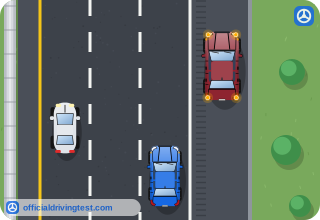
- Walk to the nearest exit for help
- Stand behind the vehicle to warn traffic
- Get out and wave down passing drivers
- Stay in the vehicle with your seatbelt on
Show answer
Correct answer: Stay in the vehicle with your seatbelt on
On higher-capacity roads, remain in your vehicle with your seatbelt on, activate your hazard lights, call 911, and wait for an emergency responder.
Source: Illinois Rules of the Road (2026), page 90
-
Your vehicle breaks down on a low-capacity road, and it is necessary and safe to get out. How should you exit?
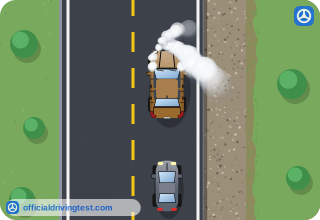
- From the side facing oncoming traffic
- From the side opposite oncoming traffic
- Through the rear hatch only
- From the driver's door only
Show answer
Correct answer: From the side opposite oncoming traffic
On lower-capacity roads, if it is necessary and safe, exit on the side opposite oncoming traffic and move away from the vehicle.
Source: Illinois Rules of the Road (2026), page 90
-
On a low-capacity road, after safely leaving your broken-down vehicle, where does the manual suggest standing?
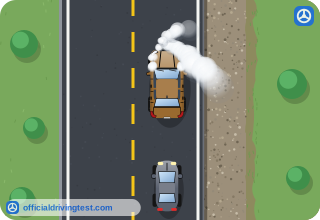
- Directly behind your vehicle
- In the travel lane to wave traffic
- Behind a guard rail or on a sidewalk
- Beside the driver's door
Show answer
Correct answer: Behind a guard rail or on a sidewalk
Move away from your vehicle: stand on a sidewalk, behind a guard rail, or by the edge of a field.
Source: Illinois Rules of the Road (2026), page 90
-
If your vehicle breaks down on the Illinois Tollway, what number(s) does the manual say to call for assistance?
- *999 or 911
- 311 only
- *55 or 411
- 411 only
Show answer
Correct answer: *999 or 911
On the Illinois Tollway, call *999 or 911 for assistance.
Source: Illinois Rules of the Road (2026), page 90
-
After a breakdown on the Illinois Tollway, who does the manual say to wait for?
- A private tow truck
- A passing driver
- A family member
- Tollway Maintenance
Show answer
Correct answer: Tollway Maintenance
On the Tollway, remain in your vehicle and wait for Tollway Maintenance or an emergency responder to arrive and assist you.
Source: Illinois Rules of the Road (2026), page 90
-
If your vehicle breaks down on a higher-capacity road, where should you pull over if possible?
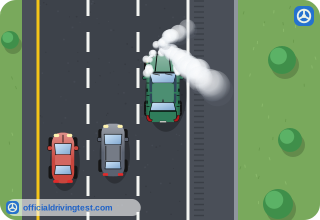
- The left shoulder next to the median
- The right shoulder or a safe location
- The center of the nearest travel lane
- The left lane with your flashers on
Show answer
Correct answer: The right shoulder or a safe location
If possible, pull over to the right shoulder or a safe location as far as possible to avoid passing traffic.
Source: Illinois Rules of the Road (2026), page 90