Illinois: Emergencies and special situations — Part 1 Practice Test
Questions in this part include: “Under Illinois law, when may you push a disabled vehicle on a rural highway?” · “After a traffic crash, what information should you ask all those involved for?”
Independent educational site · not affiliated with any government agency or DMV
Ready? Test yourself
- Instant feedback with an explanation
- Every answer cites its source in the manual
- Your best score is saved on this device
Questions are original and based on the official manual "Illinois Rules of the Road" (2026), Illinois Secretary of State.
All 17 questions in this practice test
Take the test above first, then use this list to study. Tap “Show answer” to see the correct answer and explanation.
Show the questions and answersHide the questions
-
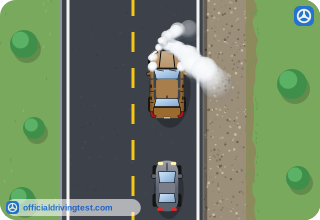
In an emergency on a paved highway outside a business or residential district, you may stop only if you have a clear view of how far in each direction?
- 200 feet
- 100 feet
- 500 feet
- 50 feet
Show answer
Correct answer: 200 feet
In an emergency, drivers may stop and park only if there is a clear view of 200 feet in each direction.
Source: Illinois Rules of the Road (2026), page 35
-
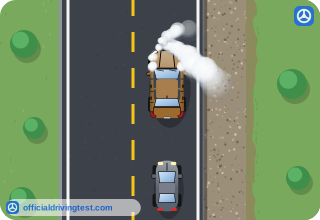
When you must stop on a paved highway outside a business or residential district in an emergency, what should you do?
- Leave your headlights on high beam to warn other drivers
- Park close to the center line so others can see you
- Turn on your emergency flashers and leave room to pass
- Stop partly in the lane so you are easier to notice
Show answer
Correct answer: Turn on your emergency flashers and leave room to pass
The driver should turn on the emergency flashers and make sure there is enough space for other vehicles to pass.
Source: Illinois Rules of the Road (2026), page 35
-
Under Illinois law, when may you push a disabled vehicle on a rural highway?
- At any time, if hazard lights are on
- Only during daylight hours, with care
- Only in an emergency, to remove a hazard
- Only with a police escort present
Show answer
Correct answer: Only in an emergency, to remove a hazard
A person may not push a disabled vehicle on a rural highway unless there is an emergency and it should be removed to avoid a hazard.
Source: Illinois Rules of the Road (2026), page 45
-
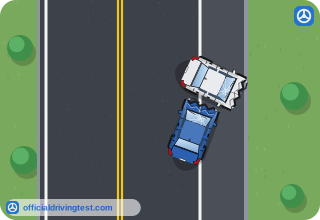
Before removing a wrecked or damaged vehicle from the roadway, what must be done?
- Photograph the whole scene
- Remove all glass and other debris
- Wait for a tow truck to arrive
- Mark the vehicle with flares
Show answer
Correct answer: Remove all glass and other debris
Illinois law states a person may not remove a wrecked or damaged vehicle from the roadway without removing all glass and other debris.
Source: Illinois Rules of the Road (2026), page 45
-
When one vehicle tows another, what must connect them, and how far apart should they be in most cases?
- A rope, no more than 25 feet apart
- A drawbar, no more than 15 feet apart
- A drawbar, no more than 30 feet apart
- A strap, no more than 10 feet apart
Show answer
Correct answer: A drawbar, no more than 15 feet apart
You may not tow one vehicle with another except by a drawbar, and in most cases the distance between the two cars should not exceed 15 feet.
Source: Illinois Rules of the Road (2026), page 45
-
How should a towed vehicle be coupled to the towing vehicle?
- With one tow rope
- With a single tow strap
- With a bungee cord
- With two chains or cables
Show answer
Correct answer: With two chains or cables
A towed vehicle should be coupled to the towing vehicle with two chains or cables.
Source: Illinois Rules of the Road (2026), page 45
-
A vehicle left along an interstate, expressway, or toll highway may be towed at the owner's expense after:
- Two hours
- Ten hours
- 24 hours
- 48 hours
Show answer
Correct answer: Two hours
Law enforcement may have a vehicle towed at the owner's expense if left on an interstate, expressway, or toll highway for two hours.
Source: Illinois Rules of the Road (2026), page 45
-
A disabled vehicle left along a highway in an urban area may be towed at the owner's expense after:
- Two hours
- 24 hours
- 10 hours
- Six hours
Show answer
Correct answer: 10 hours
On a highway in an urban area, a vehicle may be towed at the owner's expense after 10 hours.
Source: Illinois Rules of the Road (2026), page 45
-
A disabled vehicle left along a highway in a non-urban area may be towed at the owner's expense after:
- Two hours
- 10 hours
- 72 hours
- 24 hours
Show answer
Correct answer: 24 hours
On a highway in a non-urban area, a vehicle may be towed at the owner's expense after 24 hours.
Source: Illinois Rules of the Road (2026), page 45
-
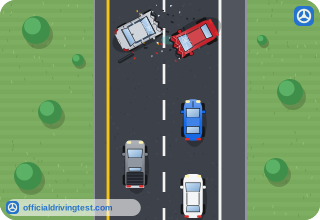
If you are involved in or come upon a traffic crash, where should you stop your vehicle, if able to do so?
- In a safe, well-lit public place that does not obstruct traffic
- In the traffic lane right beside the damaged vehicles
- On the shoulder at least 500 feet past the crash scene
- Only at the nearest police station or sheriff’s office
Show answer
Correct answer: In a safe, well-lit public place that does not obstruct traffic
The manual says to stop in a safe, well-lit public place that does not obstruct traffic, if you are able to do so.
Source: Illinois Rules of the Road (2026), page 54
-
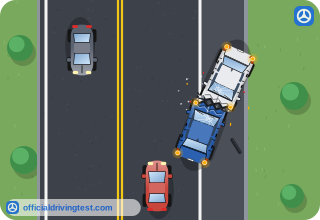
When you are involved in or come upon a traffic crash, when should you call 911?
- Only if a vehicle is on fire
- After you finish exchanging details
- Immediately
- Only if the damage exceeds $1,500
Show answer
Correct answer: Immediately
The crash checklist tells drivers to call 911 immediately.
Source: Illinois Rules of the Road (2026), page 54
-
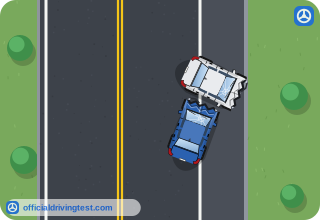
At a traffic crash, how should you warn other drivers?
- Stand in the travel lane and wave your arms
- Use emergency flashers and flares if available
- Sound your horn continuously until police arrive
- Flash your high beams at every oncoming car
Show answer
Correct answer: Use emergency flashers and flares if available
The manual says to warn other drivers by using emergency flashers and flares if available.
Source: Illinois Rules of the Road (2026), page 54
-
After a traffic crash, what information should you ask all those involved for?
- Only their names and the make, model and color of their vehicles
- Their insurance premium amounts, employer names and job titles
- Only their license plate numbers and the time the crash happened
- Names, addresses, phone numbers, license numbers and plate numbers
Show answer
Correct answer: Names, addresses, phone numbers, license numbers and plate numbers
You should ask everyone involved for their names, addresses, phone numbers, driver’s license numbers and license plate numbers.
Source: Illinois Rules of the Road (2026), page 54
-
You damage a parked vehicle and cannot find its owner. What must you leave on the vehicle?
- Only a note saying that you are sorry for the damage
- Your name, address, phone number and license plate number
- Your insurance card and the keys to your own vehicle
- Nothing, as long as you drive away slowly and safely
Show answer
Correct answer: Your name, address, phone number and license plate number
If the owner cannot be found, leave your name, address, phone number and license plate number on the vehicle or property, notify police and complete the required crash reports.
Source: Illinois Rules of the Road (2026), page 55
-
After a crash that damages an unattended vehicle or other property, which step is required besides leaving your information?
- Notify police and complete all required crash reports
- Wait at the scene for at least 24 hours for the owner
- Tow the damaged vehicle to the nearest repair shop
- Pay the owner in cash before leaving the scene
Show answer
Correct answer: Notify police and complete all required crash reports
For a crash with an unattended vehicle or property, you must stop away from traffic, leave your information, notify police and complete all required crash reports.
Source: Illinois Rules of the Road (2026), page 55
-
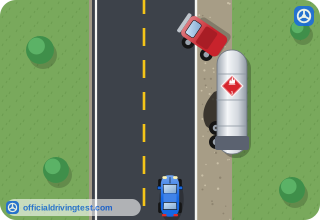
What does a hazardous materials placard indicate?
- That the vehicle is an authorized emergency vehicle
- That the vehicle may not use the expressway
- The presence and type of hazardous material being transported
- That the driver holds a commercial driver's license
Show answer
Correct answer: The presence and type of hazardous material being transported
A hazardous materials placard is a sign that indicates the presence and type of hazardous material being transported on roadways.
Source: Illinois Rules of the Road (2026), page 75
-
Which agency requires hazardous materials placards?
- The Secretary of State
- The Department of Transportation
- The local police department
- The Federal Railroad Administration
Show answer
Correct answer: The Department of Transportation
Placards are required by the Department of Transportation and are useful to emergency responders and other motorists in case of an accident.
Source: Illinois Rules of the Road (2026), page 75