Illinois: Emergencies and special situations — Part 3 Practice Test
Questions in this part include: “How are the symptoms of carbon monoxide poisoning often described?” · “Who is particularly at risk from carbon monoxide in a vehicle?”
Independent educational site · not affiliated with any government agency or DMV
Ready? Test yourself
- Instant feedback with an explanation
- Every answer cites its source in the manual
- Your best score is saved on this device
Questions are original and based on the official manual "Illinois Rules of the Road" (2026), Illinois Secretary of State.
All 17 questions in this practice test
Take the test above first, then use this list to study. Tap “Show answer” to see the correct answer and explanation.
Show the questions and answersHide the questions
-
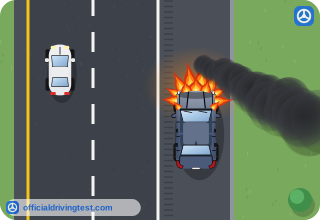
What does the manual say about fighting a vehicle fire yourself?
- Use water from a bottle
- Do not fight the fire yourself
- Use the floor mats to smother it
- Fight it only if it is small
Show answer
Correct answer: Do not fight the fire yourself
Vehicle fires can be very dangerous, so do not fight the fire yourself.
Source: Illinois Rules of the Road (2026), page 88
-
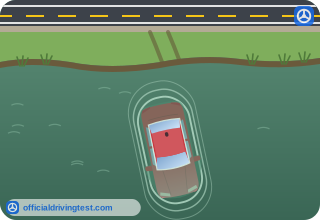
Your vehicle runs off the road into water but does not sink right away. How should you try to escape?
- Through the trunk
- Through the front door
- Through a window
- Wait for it to sink first
Show answer
Correct answer: Through a window
If the vehicle does not sink right away, try to escape through a window.
Source: Illinois Rules of the Road (2026), page 88
-
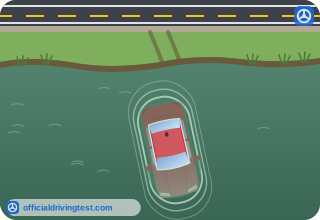
After running into water, why may you be unable to open the car doors?
- Differences in water pressure
- The doors lock automatically
- The hinges rust at once
- The power windows fail
Show answer
Correct answer: Differences in water pressure
Because of differences in water pressure, you or your passengers may not be able to open the car doors.
Source: Illinois Rules of the Road (2026), page 88
-
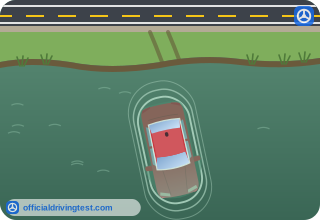
If your vehicle sinks in water, where should you move?
- To the driver's seat
- To the front passenger seat
- Down to the floor
- To the back seat area
Show answer
Correct answer: To the back seat area
If the vehicle sinks, move to the back seat area where an air pocket usually forms, then exit from a rear window if possible.
Source: Illinois Rules of the Road (2026), page 88
-
How are the symptoms of carbon monoxide poisoning often described?
- Allergy-like
- Flu-like
- Sunburn-like
- Hunger-like
Show answer
Correct answer: Flu-like
Carbon monoxide symptoms are often described as "flu-like."
Source: Illinois Rules of the Road (2026), page 88
-
Which is one of the most common symptoms of carbon monoxide poisoning?
- Itchy skin
- Sneezing
- Dizziness
- Fever blisters
Show answer
Correct answer: Dizziness
The most common symptoms are headache, dizziness, weakness, upset stomach, vomiting, chest pain, and confusion.
Source: Illinois Rules of the Road (2026), page 88
-
Who is particularly at risk from carbon monoxide in a vehicle?
- Older people and infants
- Teenagers and young adults
- Only the driver of the car
- Only front-seat passengers
Show answer
Correct answer: Older people and infants
Everyone in the vehicle is at risk, particularly older people, infants, and people with cardiac, pulmonary, or blood disorders.
Source: Illinois Rules of the Road (2026), page 88
-
How often does the manual recommend having a mechanic check your vehicle's exhaust system?
- Every five years
- Every two years
- Every month
- Every year
Show answer
Correct answer: Every year
The manual recommends having a mechanic check your vehicle exhaust system every year.
Source: Illinois Rules of the Road (2026), page 88
-
What does the manual say about running a vehicle inside a garage attached to a house?
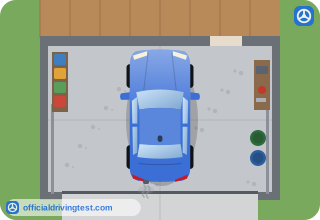
- It is fine with the door closed
- Never do it
- It is fine for under 10 minutes
- It is fine only in winter
Show answer
Correct answer: Never do it
Never run a vehicle inside a garage that is attached to a house, because of the carbon monoxide risk.
Source: Illinois Rules of the Road (2026), page 88
-
After a crash, power lines fall on your vehicle and there is no fire. What should you do?
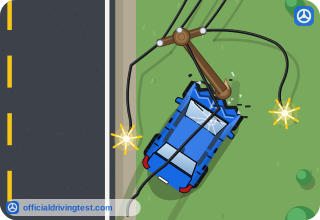
- Get out quickly and run from the car
- Push the lines off with a dry stick
- Stay in the vehicle until help arrives
- Drive out from under the lines
Show answer
Correct answer: Stay in the vehicle until help arrives
Because of the danger of electrical shock, you and your passengers should remain in the vehicle until help arrives.
Source: Illinois Rules of the Road (2026), page 88
-
If fire forces you to jump clear of a vehicle touched by power lines, what must you avoid?
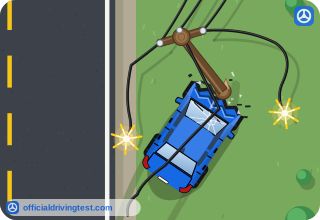
- Touching the car and the ground at once
- Landing on both feet
- Keeping your arms close to your body
- Shuffling away from the vehicle
Show answer
Correct answer: Touching the car and the ground at once
When jumping clear, do not let any part of your body touch the vehicle and the ground at the same time.
Source: Illinois Rules of the Road (2026), page 88
-
After jumping clear of a vehicle with power lines on it, how far away should you hop or shuffle?
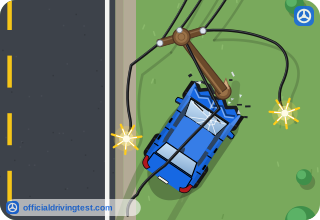
- 10 feet
- 20 feet
- 100 feet
- 50 feet
Show answer
Correct answer: 50 feet
Land on both feet and hop or shuffle, with your arms close to your body, for a distance of 50 feet away from the vehicle.
Source: Illinois Rules of the Road (2026), page 88
-
What should you always do with the engine when refueling your vehicle?
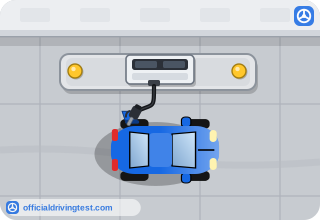
- Leave it idling
- Shut it off
- Rev it gently
- Leave it running in park
Show answer
Correct answer: Shut it off
To avoid an explosive fire hazard, always shut off your vehicle's engine when refueling.
Source: Illinois Rules of the Road (2026), page 88
-
For safety, where does the manual say you should be while refueling?
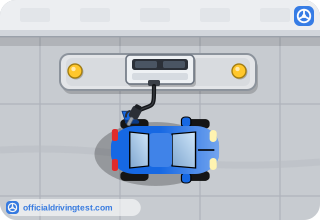
- Inside the vehicle
- Inside the station
- With the pump
- Anywhere nearby
Show answer
Correct answer: With the pump
For safety purposes, remain with the pump while refueling, and never smoke around gas pumps.
Source: Illinois Rules of the Road (2026), page 88
-
What sound may be a warning of a tire blowout?
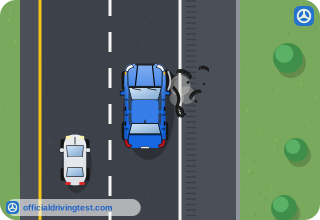
- A thumping sound
- A high whistle
- A clicking sound
- A grinding squeal
Show answer
Correct answer: A thumping sound
A thumping sound may be a warning of a blowout.
Source: Illinois Rules of the Road (2026), page 88
-
What should you do if a tire blows out?
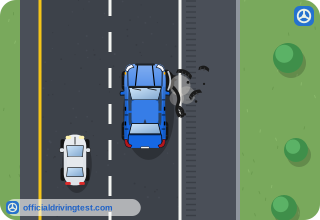
- Brake hard right away
- Speed up to keep control
- Turn the wheel sharply toward the shoulder
- Ease off the gas and hold the wheel firmly
Show answer
Correct answer: Ease off the gas and hold the wheel firmly
If a tire blows out, ease your foot off the gas pedal and keep a firm grasp on the steering wheel, then pull safely off the road.
Source: Illinois Rules of the Road (2026), page 88
-
How should you react if you lose a wheel or tire while driving?
- Brake hard at once
- Shift into park
- As for a tire blowout
- Keep driving to a garage
Show answer
Correct answer: As for a tire blowout
For the loss of a wheel or tire, react the same as for a tire blowout.
Source: Illinois Rules of the Road (2026), page 88