Georgia: Signals & vehicle controls
Headlights, turn signals, mirrors, lane changes, backing and the equipment your vehicle must have. Split into 3 shorter tests so you're not stuck in one long quiz.
Independent educational site · not affiliated with any government agency or DMV
Choose a part
Signals & vehicle controls — Part 1
Questions in this part include: “If the road test vehicle is not equipped with illuminated turn signals, what must you be able to do?”
StartSignals & vehicle controls — Part 2
Questions in this part include: “In which weather conditions should you dim (lower) your headlights?”
StartSignals & vehicle controls — Part 3
Questions in this part include: “Steering locks are anti-theft devices found in most cars manufactured since what year?”
StartAll 54 Signals & vehicle controls questions with answers
Choose a part above to take a practice test, or study every question and answer here.
Show the questions and answersHide the questions
-
If the road test vehicle is not equipped with illuminated turn signals, what must you be able to do?
- Borrow a vehicle from the examiner
- Reschedule until turn signals are installed
- Pass the road test using hand signals
- Switch to a four-door vehicle
Show answer
Correct answer: Pass the road test using hand signals
Without illuminated turn signals, you must be able to pass the road test using hand signals.
Source: Georgia Driver's Manual (2023-2024), page 12
-
When stopping for a sign or traffic signal on the driving test, which signal must you give?
- A horn signal
- A headlight flash signal
- An emergency flasher signal
- The proper hand or brake signal
Show answer
Correct answer: The proper hand or brake signal
The manual says to give the proper hand or brake signal when stopping for signs or traffic signals.
Source: Georgia Driver's Manual (2023-2024), page 12
-
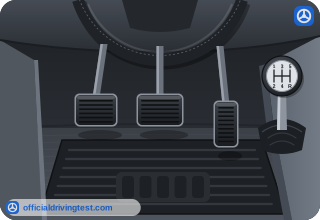
If your car has a manual transmission, what must you do regarding the clutch on the driving test?
- Shift quickly to show control
- Coast in neutral when approaching stops
- Keep the clutch partly pressed while driving
- Shift smoothly and correctly
Show answer
Correct answer: Shift smoothly and correctly
The manual says to shift smoothly and correctly if your car has a manual transmission.
Source: Georgia Driver's Manual (2023-2024), page 12
-
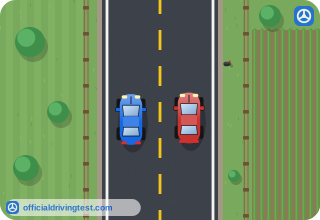
When should you activate your left turn signal when passing another vehicle?
- After you are beside the other vehicle
- As you begin passing
- After you have returned to the right lane
- Only if a vehicle is approaching from behind
Show answer
Correct answer: As you begin passing
The manual says to activate your left turn signal as you begin passing.
Source: Georgia Driver's Manual (2023-2024), page 18
-
Which turn signal should you activate before returning to the right lane after passing?
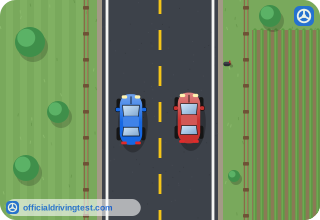
- Right turn signal
- Left turn signal
- Hazard lights
- No signal is needed
Show answer
Correct answer: Right turn signal
You activate your right turn signal before returning to the right lane.
Source: Georgia Driver's Manual (2023-2024), page 18
-
After you have returned to the right lane when passing, what should you be sure to do with your turn signal?
- Leave it on for 100 feet
- Switch it to the left signal
- Turn it off
- Flash it twice more
Show answer
Correct answer: Turn it off
The manual says to be sure to turn your signal off once you have returned to the right lane.
Source: Georgia Driver's Manual (2023-2024), page 18
-
When must a turn signal be given?
- Only when other vehicles are nearby
- Whenever a turn is made to the right or the left
- Only when turning left
- Only at intersections with traffic lights
Show answer
Correct answer: Whenever a turn is made to the right or the left
The manual says a turn signal must be given whenever a turn is made to the right or the left.
Source: Georgia Driver's Manual (2023-2024), page 19
-
How must a turn signal be given before you turn?
- Briefly, only at the moment that you begin the turn
- Flashed on and off several times before the turn
- Only after you have slowed down to a complete stop
- Continuously, for an adequate distance before you turn
Show answer
Correct answer: Continuously, for an adequate distance before you turn
You must give a continuous turn signal for an adequate distance to alert other drivers before turning.
Source: Georgia Driver's Manual (2023-2024), page 19
-
Which use of turn signals is against the law?
- Flashing them as a courtesy or "do pass" signal
- Turning one on before making a right turn
- Keeping one on until a turn is finished
- Using one to signal a left turn at an intersection
Show answer
Correct answer: Flashing them as a courtesy or "do pass" signal
The manual says it is against the law to flash turn signals as a courtesy or "do pass" signal to other drivers in the rear.
Source: Georgia Driver's Manual (2023-2024), page 19
-
When should you give the appropriate turn signal when parallel parking?
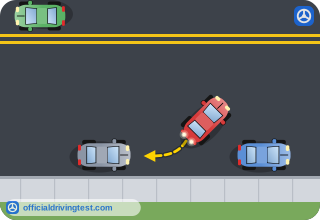
- Before you begin parking and when you exit the space
- Only at the moment when you exit from the parking space
- Only when another vehicle is close behind you
- After your vehicle is fully inside the space
Show answer
Correct answer: Before you begin parking and when you exit the space
Always give the appropriate turn signal before beginning the parking maneuver and when you exit from a parallel parking space.
Source: Georgia Driver's Manual (2023-2024), page 21
-
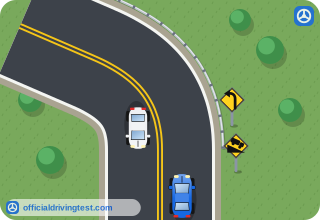
When traveling down a hill, what must the driver of a motor vehicle not do?
- Use a lower gear to help hold your speed
- Keep a safe following distance on the hill
- Apply the brakes to help control your speed
- Coast with the gears or transmission in neutral
Show answer
Correct answer: Coast with the gears or transmission in neutral
The manual says a driver traveling down a hill must not coast with the gears or transmission in neutral.
Source: Georgia Driver's Manual (2023-2024), page 23
-
When stopping or slowing down suddenly, what must be given?
- A series of short signals with the horn only
- A flash of the headlights and then the horn
- A signal with the hazard flashers only for a few seconds
- The proper hand, arm, or brake operated stop signal
Show answer
Correct answer: The proper hand, arm, or brake operated stop signal
The manual says the proper hand, arm, or brake operated stop signal must be given.
Source: Georgia Driver's Manual (2023-2024), page 23
-
When should you use high-beam headlights?
- Only when driving in rural areas and when other cars are not nearby
- Whenever you are driving on a well lighted road at night
- Whenever you are following another vehicle closely on a rural road
- Whenever it is raining or foggy and visibility is poor
Show answer
Correct answer: Only when driving in rural areas and when other cars are not nearby
High beams are to be used only in rural areas when other cars are not nearby.
Source: Georgia Driver's Manual (2023-2024), page 24
-
During which period must you use your headlights?
- From sunset to sunrise, and never during the day
- From one hour after sunset to one hour before sunrise
- From one-half hour after sunset to one-half hour before sunrise
- From one-half hour before sunset to one hour after sunrise
Show answer
Correct answer: From one-half hour after sunset to one-half hour before sunrise
The manual requires headlights between one-half hour after sunset and one-half hour before sunrise, in rain, and when visibility is limited.
Source: Georgia Driver's Manual (2023-2024), page 24
-
Besides nighttime, when else must you use your headlights?
- Only when it is raining heavily, not when visibility is limited
- Only on roads that have no center line or edge line
- Only when driving on a rural road that has no other traffic
- At any time when it is raining or when visibility is limited
Show answer
Correct answer: At any time when it is raining or when visibility is limited
The manual requires headlights at any time when it is raining or when visibility is limited.
Source: Georgia Driver's Manual (2023-2024), page 24
-
You should dim your headlights when you are within what distance of an approaching vehicle?
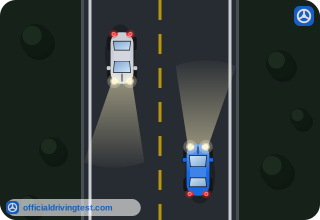
- 500 feet
- 200 feet
- 300 feet
- 1,000 feet
Show answer
Correct answer: 500 feet
The manual says to dim within 500 feet of an approaching vehicle so as not to blind the driver.
Source: Georgia Driver's Manual (2023-2024), page 24
-
You should dim your headlights when you are following closely behind another vehicle within what distance?
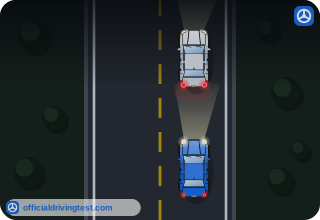
- 100 feet
- 300 feet
- 200 feet
- 500 feet
Show answer
Correct answer: 200 feet
The manual says to dim when following closely, within 200 feet, behind another vehicle.
Source: Georgia Driver's Manual (2023-2024), page 24
-
In which situation should you dim (lower) your headlights?
- When you are driving on a dark rural road with no other cars nearby
- When you are driving on lighted roads
- When you are driving in clear weather with no vehicle within 1,000 feet
- When you are backing out of a parking space
Show answer
Correct answer: When you are driving on lighted roads
Driving on lighted roads is one of the situations in which the manual says to dim your headlights.
Source: Georgia Driver's Manual (2023-2024), page 24
-
In which weather conditions should you dim (lower) your headlights?
- Rain, fog, snow, or smoke
- Clear, dry weather only
- Only in heavy thunderstorms
- Only in fog, never in rain or snow
Show answer
Correct answer: Rain, fog, snow, or smoke
The manual says to dim headlights when driving in rain, fog, snow, or smoke.
Source: Georgia Driver's Manual (2023-2024), page 24
-
You should dim your headlights when your vision is reduced to less than what distance?

- 100 feet
- 300 feet
- 200 feet
- 500 feet
Show answer
Correct answer: 200 feet
The manual says to dim headlights when your vision is reduced to less than 200 feet.
Source: Georgia Driver's Manual (2023-2024), page 24
-
How should a driver's signal to change lanes be indicated?
- With a brief flash as you move into the new lane
- Only when another vehicle is directly behind you
- Clearly, so as to warn vehicles of the movement
- With a horn blast just before you move over
Show answer
Correct answer: Clearly, so as to warn vehicles of the movement
The manual says a driver's signal to change lanes should be clearly indicated so as to warn vehicles of the movement.
Source: Georgia Driver's Manual (2023-2024), page 19
-
Where can you find the recommended tire pressure (psi) for your vehicle?
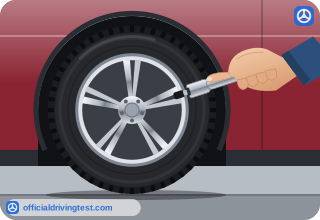
- On the door jam of the vehicle
- On a sticker inside the glove box
- Stamped on the tire's valve stem
- On a plate under the hood
Show answer
Correct answer: On the door jam of the vehicle
The manual says to check tire pressure using the recommended psi located in the door jam of the vehicle.
Source: Georgia Driver's Manual (2023-2024), page 38
-
Your tire pressure is above the psi listed on your door jam. What should you do?
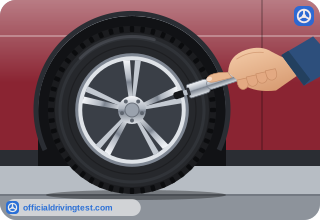
- Leave it, since extra pressure gives better grip
- Add air until the gauge reads even higher
- Let air out until it matches the number
- Drive until the tires warm up and settle down
Show answer
Correct answer: Let air out until it matches the number
If your psi is above the number on the door jam, you let air out until it matches.
Source: Georgia Driver's Manual (2023-2024), page 38
-
Your tire pressure is below the psi listed on your door jam. What should you do?
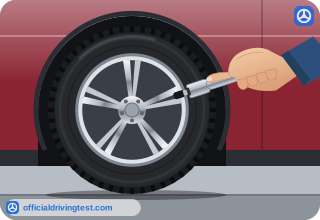
- Let air out until the tires feel soft
- Add air until it reaches the proper number
- Nothing, because lower pressure is safer
- Wait for the tires to warm up and then recheck
Show answer
Correct answer: Add air until it reaches the proper number
If the pressure is below the listed psi, add air (or have a retailer help you) until it reaches the proper number.
Source: Georgia Driver's Manual (2023-2024), page 38
-
When using the penny test, what shows that your tires have the legal and safe amount of tread?
- Lincoln's whole head shows above the tread
- The penny slides fully into the groove
- The groove is wider than the penny
- Part of Lincoln's head is covered by the tread
Show answer
Correct answer: Part of Lincoln's head is covered by the tread
If any part of Lincoln's head is covered by the tread, the tread is at the legal and safe amount.
Source: Georgia Driver's Manual (2023-2024), page 38
-
Below approximately what tread depth is your car's ability to grip the road in adverse conditions greatly reduced?
- 1/32 of an inch
- 4/32 of an inch
- 2/32 of an inch
- 6/32 of an inch
Show answer
Correct answer: 2/32 of an inch
The manual says that below approximately 2/32 of an inch, the ability to grip the road in adverse conditions is greatly reduced.
Source: Georgia Driver's Manual (2023-2024), page 38
-
How often should you check your tires for wear and damage?
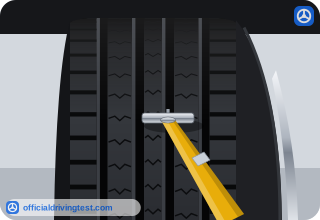
- Once every month, or before a long road trip
- Once every week, and again after every fill-up
- Once a year, at the time of inspection
- Only when a tire looks low on air
Show answer
Correct answer: Once every month, or before a long road trip
The manual says to check tires once every month, or before embarking on a long road trip.
Source: Georgia Driver's Manual (2023-2024), page 38
-
When your vehicle is parked on the street, from which side should you enter it?
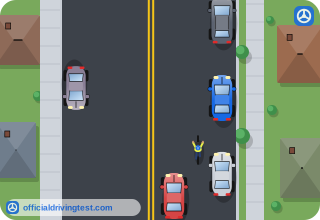
- The side facing traffic
- The side with the most space
- Whichever side is closest to your keys
- The curb side
Show answer
Correct answer: The curb side
If you are parked on the street, you should enter from the curb side of the vehicle.
Source: Georgia Driver's Manual (2023-2024), page 38
-
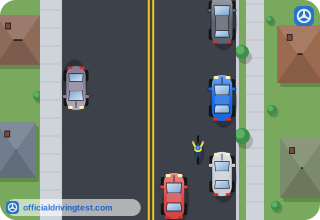
What should you do as you approach your vehicle to enter it?
- Keep your back to traffic to watch the car
- Have your keys ready and face traffic
- Walk behind the vehicle to check its tires
- Start the ignition remotely before you arrive
Show answer
Correct answer: Have your keys ready and face traffic
The manual says to have your keys ready and approach the vehicle facing traffic.
Source: Georgia Driver's Manual (2023-2024), page 38
-
Before a trip, what should you check about your passengers?
- That they are properly seated and not blocking your view
- That they know the route and can give you directions
- That they are seated behind the driver's seat only
- That they are not carrying any items in their hands
Show answer
Correct answer: That they are properly seated and not blocking your view
You should check that passengers are properly seated and do not interfere with your view.
Source: Georgia Driver's Manual (2023-2024), page 38
-
What should you do before starting your ignition?
- Check around the vehicle for bicyclists and pedestrians
- Give the proper signal for your move into traffic
- Fasten your seat belt and make sure passengers do the same
- Turn on your headlights and warm up the engine
Show answer
Correct answer: Fasten your seat belt and make sure passengers do the same
Before starting the ignition, you fasten your seat belt and make sure your passengers do the same.
Source: Georgia Driver's Manual (2023-2024), page 38
-
After starting your vehicle, what should you do before moving into the stream of traffic?
- Fasten your seat belt and adjust your seat and mirrors
- Check around the vehicle for hazards, bicyclists and pedestrians
- Turn the steering wheel fully before pulling out
- Wait until traffic clears in both directions for a full minute
Show answer
Correct answer: Check around the vehicle for hazards, bicyclists and pedestrians
After starting, you check around the vehicle for hazards or approaching traffic, including bicyclists and pedestrians, give the proper signal and move cautiously.
Source: Georgia Driver's Manual (2023-2024), page 38
-
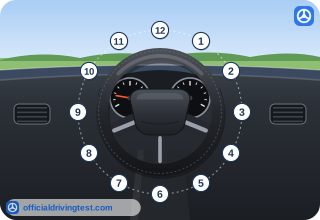
As a general rule, where should you place your hands on the steering wheel?
- Left hand at 10 o'clock and right hand at 2 o'clock
- Left hand at 11 o'clock and right hand at 1 o'clock
- Left hand at 7 o'clock and right hand at 5 o'clock
- Left hand at 9 o'clock and right hand at 3 o'clock
Show answer
Correct answer: Left hand at 9 o'clock and right hand at 3 o'clock
The general rule is the left hand at 9 o'clock and the right hand at 3 o'clock.
Source: Georgia Driver's Manual (2023-2024), page 38
-
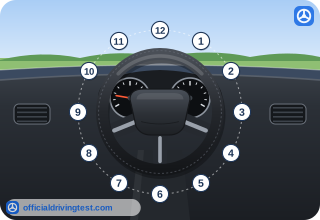
Which hand positions do some manufacturers recommend when the vehicle is equipped with air bags?
- 10 o'clock and 2 o'clock
- 7 o'clock and 5 o'clock
- 8 o'clock and 4 o'clock
- 11 o'clock and 1 o'clock
Show answer
Correct answer: 8 o'clock and 4 o'clock
Some manufacturers recommend the 8 o'clock and 4 o'clock positions for vehicles with air bags.
Source: Georgia Driver's Manual (2023-2024), page 38
-
When may you take a hand off the steering wheel?
- Only when safely doing a driving task, such as signaling
- Whenever the road ahead is straight and traffic is light
- Whenever the vehicle is going slower than 25 mph
- Whenever you are wearing gloves for a better grip
Show answer
Correct answer: Only when safely doing a driving task, such as signaling
You should always keep both hands on the wheel unless you are safely performing another driving-related task, such as activating your turn signal.
Source: Georgia Driver's Manual (2023-2024), page 38
-
Why is good posture while driving important?
- It lowers the fuel the engine uses on long trips
- It keeps the seat belt from locking in sudden stops
- It lets passengers sit closer to the driver
- It gives a better view of hazards and more control
Show answer
Correct answer: It gives a better view of hazards and more control
Good posture allows a better view of hazards and more control of the vehicle.
Source: Georgia Driver's Manual (2023-2024), page 38
-
Steering locks are anti-theft devices found in most cars manufactured since what year?
- 1959
- 1979
- 1989
- 1969
Show answer
Correct answer: 1969
The manual says steering locks are found in most cars manufactured since 1969.
Source: Georgia Driver's Manual (2023-2024), page 40
-
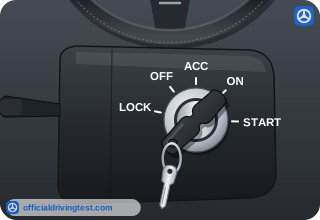
What happens if a vehicle's ignition is placed in the lock position while the vehicle is in motion?
- The vehicle shifts automatically into neutral
- The steering is disabled and you cannot steer
- The brakes engage automatically to stop the vehicle
- Only the radio and lights shut off
Show answer
Correct answer: The steering is disabled and you cannot steer
Locking the ignition while moving disables the steering capability, so the driver cannot steer.
Source: Georgia Driver's Manual (2023-2024), page 40
-
Emissions from cars and light duty trucks contribute to the formation of what?
- Ground-level ozone, a component of urban smog
- Carbon monoxide in the upper atmosphere
- Acid rain that damages road surfaces
- Fog that lowers visibility on highways
Show answer
Correct answer: Ground-level ozone, a component of urban smog
Vehicle emissions contribute to ground-level ozone, a component of urban smog.
Source: Georgia Driver's Manual (2023-2024), page 41
-
What do vehicle emissions react with at high temperatures to produce unhealthy levels of ground-level ozone?
- Rainwater
- Road salt
- Sunlight
- Cold air
Show answer
Correct answer: Sunlight
Vehicle emissions can react with sunlight at high temperatures to produce unhealthy levels of ground-level ozone.
Source: Georgia Driver's Manual (2023-2024), page 41
-
In which weather is ground-level ozone pollution especially a problem?
- Cold weather
- Warm weather
- Snowy weather
- Foggy weather
Show answer
Correct answer: Warm weather
The manual says this air pollution is especially true during warm weather.
Source: Georgia Driver's Manual (2023-2024), page 41
-
Which helps reduce vehicle emissions and ground-level ozone?
- Making several short separate trips
- Driving alone instead of carpooling
- Warming up the engine by idling for several minutes
- Proper vehicle maintenance and fewer trips and miles
Show answer
Correct answer: Proper vehicle maintenance and fewer trips and miles
Emissions can be reduced by proper maintenance per the manufacturer's instructions, and by fewer trips and vehicle miles traveled.
Source: Georgia Driver's Manual (2023-2024), page 41
-
In the thirteen-county metro Atlanta area, how often must gasoline-powered cars and light-duty trucks pass an emissions inspection?
- Every two years
- Every three years
- Every year
- Every five years
Show answer
Correct answer: Every year
Eligible vehicles must pass an emissions inspection every year before being registered.
Source: Georgia Driver's Manual (2023-2024), page 41
-
In the metro Atlanta emissions program, inspections apply to gasoline-powered vehicles less than how many model years old?
- 25
- 10
- 15
- 20
Show answer
Correct answer: 25
The requirement applies to gasoline-powered cars and light-duty trucks that are less than 25 model years old.
Source: Georgia Driver's Manual (2023-2024), page 41
-
In the metro Atlanta emissions program, how many of the most recent model years are exempt from inspection?
- Two
- Five
- Ten
- Three
Show answer
Correct answer: Three
The most recent three model years are exempt from the inspection requirement.
Source: Georgia Driver's Manual (2023-2024), page 41
-
How many metro counties are covered by Georgia's emissions inspection and maintenance program?
- Nine
- Thirteen
- Eleven
- Fifteen
Show answer
Correct answer: Thirteen
The manual says thirteen metro counties are covered by the state's inspection and maintenance program.
Source: Georgia Driver's Manual (2023-2024), page 41
-
Which of these counties is covered by Georgia's emissions inspection and maintenance program?
- Rockdale
- Chatham
- Bibb
- Muscogee
Show answer
Correct answer: Rockdale
Rockdale is one of the thirteen metro counties listed in the program.
Source: Georgia Driver's Manual (2023-2024), page 41
-
What is removing or disabling a vehicle's emissions control components?
- Allowed on vehicles more than ten years old
- Allowed with a mechanic's approval
- A violation of federal and state law
- A violation of county ordinance only
Show answer
Correct answer: A violation of federal and state law
The manual says removing or disabling emissions control components violates federal and state law.
Source: Georgia Driver's Manual (2023-2024), page 41
-
Which action helps reduce air pollution and traffic congestion?
- Making more, shorter trips
- Planning ahead to consolidate trips
- Driving alone at peak hours
- Leaving the engine running when parked
Show answer
Correct answer: Planning ahead to consolidate trips
You can help by limiting driving to necessary travel, consolidating trips, and using carpools, transit and ridesharing.
Source: Georgia Driver's Manual (2023-2024), page 41
-
What can eliminating unnecessary idling reduce?
- Tire wear, brake wear and road noise
- Battery drain, oil use and traffic delays
- Fuel consumption only
- Fuel consumption, engine wear and air pollution
Show answer
Correct answer: Fuel consumption, engine wear and air pollution
Eliminating unnecessary idling can reduce fuel consumption, engine wear and air pollution.
Source: Georgia Driver's Manual (2023-2024), page 41
-
Idling a vehicle for how long consumes more fuel than restarting the engine?
- 30 seconds
- 1 minute
- 10 seconds
- 5 minutes
Show answer
Correct answer: 10 seconds
Idling for 10 seconds will consume more fuel than restarting the engine.
Source: Georgia Driver's Manual (2023-2024), page 41
-
When warming up the engine, what should you follow?
- The manufacturer's guidelines
- A fixed five-minute idling period
- The advice of the nearest mechanic
- The local idling ordinance
Show answer
Correct answer: The manufacturer's guidelines
The manual says to follow the manufacturer's guidelines to assure sufficient engine performance for safe driving.
Source: Georgia Driver's Manual (2023-2024), page 41
-
Which tip for safe winter driving helps prevent pedal interference?
- Fill the windshield washer reservoir
- Verify floor mat installation
- Check the age of your tires
- Plan your travel and route
Show answer
Correct answer: Verify floor mat installation
The manual says to verify floor mat installation to prevent pedal interference.
Source: Georgia Driver's Manual (2023-2024), page 39
-
Which tire-related tip does the manual list for safe winter driving?
- Replace all four tires every winter
- Rotate your tires before every trip
- Lower your tire pressure for better grip
- Check the age of your tires
Show answer
Correct answer: Check the age of your tires
The manual lists checking the age of your tires among the tips for safe winter driving.
Source: Georgia Driver's Manual (2023-2024), page 39