Georgia: Signals & vehicle controls — Part 3 Practice Test
Questions in this part include: “Steering locks are anti-theft devices found in most cars manufactured since what year?” · “Which of these counties is covered by Georgia's emissions inspection and maintenance program?”
Independent educational site · not affiliated with any government agency or DMV
Ready? Test yourself
- Instant feedback with an explanation
- Every answer cites its source in the manual
- Your best score is saved on this device
Questions are original and based on the official manual "Georgia Driver's Manual" (2023-2024), Georgia Department of Driver Services (DDS).
All 18 questions in this practice test
Take the test above first, then use this list to study. Tap “Show answer” to see the correct answer and explanation.
Show the questions and answersHide the questions
-
Steering locks are anti-theft devices found in most cars manufactured since what year?
- 1959
- 1979
- 1989
- 1969
Show answer
Correct answer: 1969
The manual says steering locks are found in most cars manufactured since 1969.
Source: Georgia Driver's Manual (2023-2024), page 40
-
What happens if a vehicle's ignition is placed in the lock position while the vehicle is in motion?
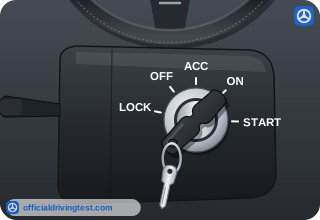
- The vehicle shifts automatically into neutral
- The steering is disabled and you cannot steer
- The brakes engage automatically to stop the vehicle
- Only the radio and lights shut off
Show answer
Correct answer: The steering is disabled and you cannot steer
Locking the ignition while moving disables the steering capability, so the driver cannot steer.
Source: Georgia Driver's Manual (2023-2024), page 40
-
Emissions from cars and light duty trucks contribute to the formation of what?
- Ground-level ozone, a component of urban smog
- Carbon monoxide in the upper atmosphere
- Acid rain that damages road surfaces
- Fog that lowers visibility on highways
Show answer
Correct answer: Ground-level ozone, a component of urban smog
Vehicle emissions contribute to ground-level ozone, a component of urban smog.
Source: Georgia Driver's Manual (2023-2024), page 41
-
What do vehicle emissions react with at high temperatures to produce unhealthy levels of ground-level ozone?
- Rainwater
- Road salt
- Sunlight
- Cold air
Show answer
Correct answer: Sunlight
Vehicle emissions can react with sunlight at high temperatures to produce unhealthy levels of ground-level ozone.
Source: Georgia Driver's Manual (2023-2024), page 41
-
In which weather is ground-level ozone pollution especially a problem?
- Cold weather
- Warm weather
- Snowy weather
- Foggy weather
Show answer
Correct answer: Warm weather
The manual says this air pollution is especially true during warm weather.
Source: Georgia Driver's Manual (2023-2024), page 41
-
Which helps reduce vehicle emissions and ground-level ozone?
- Making several short separate trips
- Driving alone instead of carpooling
- Warming up the engine by idling for several minutes
- Proper vehicle maintenance and fewer trips and miles
Show answer
Correct answer: Proper vehicle maintenance and fewer trips and miles
Emissions can be reduced by proper maintenance per the manufacturer's instructions, and by fewer trips and vehicle miles traveled.
Source: Georgia Driver's Manual (2023-2024), page 41
-
In the thirteen-county metro Atlanta area, how often must gasoline-powered cars and light-duty trucks pass an emissions inspection?
- Every two years
- Every three years
- Every year
- Every five years
Show answer
Correct answer: Every year
Eligible vehicles must pass an emissions inspection every year before being registered.
Source: Georgia Driver's Manual (2023-2024), page 41
-
In the metro Atlanta emissions program, inspections apply to gasoline-powered vehicles less than how many model years old?
- 25
- 10
- 15
- 20
Show answer
Correct answer: 25
The requirement applies to gasoline-powered cars and light-duty trucks that are less than 25 model years old.
Source: Georgia Driver's Manual (2023-2024), page 41
-
In the metro Atlanta emissions program, how many of the most recent model years are exempt from inspection?
- Two
- Five
- Ten
- Three
Show answer
Correct answer: Three
The most recent three model years are exempt from the inspection requirement.
Source: Georgia Driver's Manual (2023-2024), page 41
-
How many metro counties are covered by Georgia's emissions inspection and maintenance program?
- Nine
- Thirteen
- Eleven
- Fifteen
Show answer
Correct answer: Thirteen
The manual says thirteen metro counties are covered by the state's inspection and maintenance program.
Source: Georgia Driver's Manual (2023-2024), page 41
-
Which of these counties is covered by Georgia's emissions inspection and maintenance program?
- Rockdale
- Chatham
- Bibb
- Muscogee
Show answer
Correct answer: Rockdale
Rockdale is one of the thirteen metro counties listed in the program.
Source: Georgia Driver's Manual (2023-2024), page 41
-
What is removing or disabling a vehicle's emissions control components?
- Allowed on vehicles more than ten years old
- Allowed with a mechanic's approval
- A violation of federal and state law
- A violation of county ordinance only
Show answer
Correct answer: A violation of federal and state law
The manual says removing or disabling emissions control components violates federal and state law.
Source: Georgia Driver's Manual (2023-2024), page 41
-
Which action helps reduce air pollution and traffic congestion?
- Making more, shorter trips
- Planning ahead to consolidate trips
- Driving alone at peak hours
- Leaving the engine running when parked
Show answer
Correct answer: Planning ahead to consolidate trips
You can help by limiting driving to necessary travel, consolidating trips, and using carpools, transit and ridesharing.
Source: Georgia Driver's Manual (2023-2024), page 41
-
What can eliminating unnecessary idling reduce?
- Tire wear, brake wear and road noise
- Battery drain, oil use and traffic delays
- Fuel consumption only
- Fuel consumption, engine wear and air pollution
Show answer
Correct answer: Fuel consumption, engine wear and air pollution
Eliminating unnecessary idling can reduce fuel consumption, engine wear and air pollution.
Source: Georgia Driver's Manual (2023-2024), page 41
-
Idling a vehicle for how long consumes more fuel than restarting the engine?
- 30 seconds
- 1 minute
- 10 seconds
- 5 minutes
Show answer
Correct answer: 10 seconds
Idling for 10 seconds will consume more fuel than restarting the engine.
Source: Georgia Driver's Manual (2023-2024), page 41
-
When warming up the engine, what should you follow?
- The manufacturer's guidelines
- A fixed five-minute idling period
- The advice of the nearest mechanic
- The local idling ordinance
Show answer
Correct answer: The manufacturer's guidelines
The manual says to follow the manufacturer's guidelines to assure sufficient engine performance for safe driving.
Source: Georgia Driver's Manual (2023-2024), page 41
-
Which tip for safe winter driving helps prevent pedal interference?
- Fill the windshield washer reservoir
- Verify floor mat installation
- Check the age of your tires
- Plan your travel and route
Show answer
Correct answer: Verify floor mat installation
The manual says to verify floor mat installation to prevent pedal interference.
Source: Georgia Driver's Manual (2023-2024), page 39
-
Which tire-related tip does the manual list for safe winter driving?
- Replace all four tires every winter
- Rotate your tires before every trip
- Lower your tire pressure for better grip
- Check the age of your tires
Show answer
Correct answer: Check the age of your tires
The manual lists checking the age of your tires among the tips for safe winter driving.
Source: Georgia Driver's Manual (2023-2024), page 39