Georgia: Signals & vehicle controls — Part 1 Practice Test
Questions in this part include: “If the road test vehicle is not equipped with illuminated turn signals, what must you be able to do?” · “Which use of turn signals is against the law?”
Independent educational site · not affiliated with any government agency or DMV
Ready? Test yourself
- Instant feedback with an explanation
- Every answer cites its source in the manual
- Your best score is saved on this device
Questions are original and based on the official manual "Georgia Driver's Manual" (2023-2024), Georgia Department of Driver Services (DDS).
All 18 questions in this practice test
Take the test above first, then use this list to study. Tap “Show answer” to see the correct answer and explanation.
Show the questions and answersHide the questions
-
If the road test vehicle is not equipped with illuminated turn signals, what must you be able to do?
- Borrow a vehicle from the examiner
- Reschedule until turn signals are installed
- Pass the road test using hand signals
- Switch to a four-door vehicle
Show answer
Correct answer: Pass the road test using hand signals
Without illuminated turn signals, you must be able to pass the road test using hand signals.
Source: Georgia Driver's Manual (2023-2024), page 12
-
When stopping for a sign or traffic signal on the driving test, which signal must you give?
- A horn signal
- A headlight flash signal
- An emergency flasher signal
- The proper hand or brake signal
Show answer
Correct answer: The proper hand or brake signal
The manual says to give the proper hand or brake signal when stopping for signs or traffic signals.
Source: Georgia Driver's Manual (2023-2024), page 12
-
If your car has a manual transmission, what must you do regarding the clutch on the driving test?
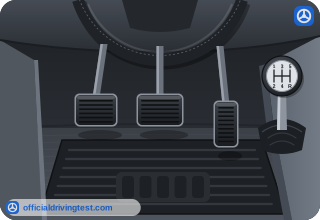
- Shift quickly to show control
- Coast in neutral when approaching stops
- Keep the clutch partly pressed while driving
- Shift smoothly and correctly
Show answer
Correct answer: Shift smoothly and correctly
The manual says to shift smoothly and correctly if your car has a manual transmission.
Source: Georgia Driver's Manual (2023-2024), page 12
-
When should you activate your left turn signal when passing another vehicle?
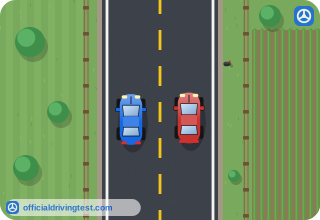
- After you are beside the other vehicle
- As you begin passing
- After you have returned to the right lane
- Only if a vehicle is approaching from behind
Show answer
Correct answer: As you begin passing
The manual says to activate your left turn signal as you begin passing.
Source: Georgia Driver's Manual (2023-2024), page 18
-
Which turn signal should you activate before returning to the right lane after passing?
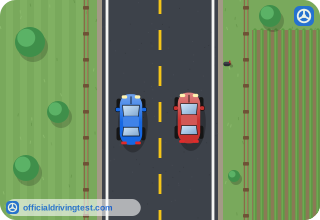
- Right turn signal
- Left turn signal
- Hazard lights
- No signal is needed
Show answer
Correct answer: Right turn signal
You activate your right turn signal before returning to the right lane.
Source: Georgia Driver's Manual (2023-2024), page 18
-
After you have returned to the right lane when passing, what should you be sure to do with your turn signal?
- Leave it on for 100 feet
- Switch it to the left signal
- Turn it off
- Flash it twice more
Show answer
Correct answer: Turn it off
The manual says to be sure to turn your signal off once you have returned to the right lane.
Source: Georgia Driver's Manual (2023-2024), page 18
-
When must a turn signal be given?
- Only when other vehicles are nearby
- Whenever a turn is made to the right or the left
- Only when turning left
- Only at intersections with traffic lights
Show answer
Correct answer: Whenever a turn is made to the right or the left
The manual says a turn signal must be given whenever a turn is made to the right or the left.
Source: Georgia Driver's Manual (2023-2024), page 19
-
How must a turn signal be given before you turn?
- Briefly, only at the moment that you begin the turn
- Flashed on and off several times before the turn
- Only after you have slowed down to a complete stop
- Continuously, for an adequate distance before you turn
Show answer
Correct answer: Continuously, for an adequate distance before you turn
You must give a continuous turn signal for an adequate distance to alert other drivers before turning.
Source: Georgia Driver's Manual (2023-2024), page 19
-
Which use of turn signals is against the law?
- Flashing them as a courtesy or "do pass" signal
- Turning one on before making a right turn
- Keeping one on until a turn is finished
- Using one to signal a left turn at an intersection
Show answer
Correct answer: Flashing them as a courtesy or "do pass" signal
The manual says it is against the law to flash turn signals as a courtesy or "do pass" signal to other drivers in the rear.
Source: Georgia Driver's Manual (2023-2024), page 19
-
When should you give the appropriate turn signal when parallel parking?
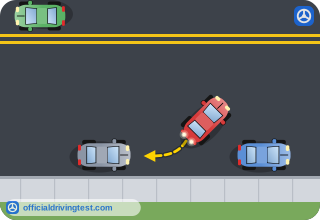
- Before you begin parking and when you exit the space
- Only at the moment when you exit from the parking space
- Only when another vehicle is close behind you
- After your vehicle is fully inside the space
Show answer
Correct answer: Before you begin parking and when you exit the space
Always give the appropriate turn signal before beginning the parking maneuver and when you exit from a parallel parking space.
Source: Georgia Driver's Manual (2023-2024), page 21
-
When traveling down a hill, what must the driver of a motor vehicle not do?
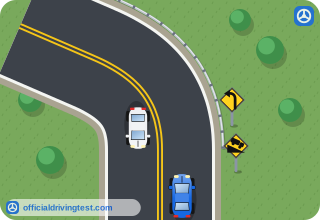
- Use a lower gear to help hold your speed
- Keep a safe following distance on the hill
- Apply the brakes to help control your speed
- Coast with the gears or transmission in neutral
Show answer
Correct answer: Coast with the gears or transmission in neutral
The manual says a driver traveling down a hill must not coast with the gears or transmission in neutral.
Source: Georgia Driver's Manual (2023-2024), page 23
-
When stopping or slowing down suddenly, what must be given?
- A series of short signals with the horn only
- A flash of the headlights and then the horn
- A signal with the hazard flashers only for a few seconds
- The proper hand, arm, or brake operated stop signal
Show answer
Correct answer: The proper hand, arm, or brake operated stop signal
The manual says the proper hand, arm, or brake operated stop signal must be given.
Source: Georgia Driver's Manual (2023-2024), page 23
-
When should you use high-beam headlights?
- Only when driving in rural areas and when other cars are not nearby
- Whenever you are driving on a well lighted road at night
- Whenever you are following another vehicle closely on a rural road
- Whenever it is raining or foggy and visibility is poor
Show answer
Correct answer: Only when driving in rural areas and when other cars are not nearby
High beams are to be used only in rural areas when other cars are not nearby.
Source: Georgia Driver's Manual (2023-2024), page 24
-
During which period must you use your headlights?
- From sunset to sunrise, and never during the day
- From one hour after sunset to one hour before sunrise
- From one-half hour after sunset to one-half hour before sunrise
- From one-half hour before sunset to one hour after sunrise
Show answer
Correct answer: From one-half hour after sunset to one-half hour before sunrise
The manual requires headlights between one-half hour after sunset and one-half hour before sunrise, in rain, and when visibility is limited.
Source: Georgia Driver's Manual (2023-2024), page 24
-
Besides nighttime, when else must you use your headlights?
- Only when it is raining heavily, not when visibility is limited
- Only on roads that have no center line or edge line
- Only when driving on a rural road that has no other traffic
- At any time when it is raining or when visibility is limited
Show answer
Correct answer: At any time when it is raining or when visibility is limited
The manual requires headlights at any time when it is raining or when visibility is limited.
Source: Georgia Driver's Manual (2023-2024), page 24
-
You should dim your headlights when you are within what distance of an approaching vehicle?
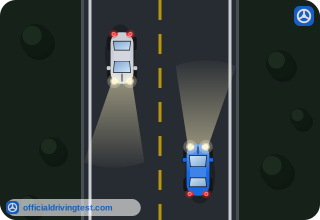
- 500 feet
- 200 feet
- 300 feet
- 1,000 feet
Show answer
Correct answer: 500 feet
The manual says to dim within 500 feet of an approaching vehicle so as not to blind the driver.
Source: Georgia Driver's Manual (2023-2024), page 24
-
You should dim your headlights when you are following closely behind another vehicle within what distance?
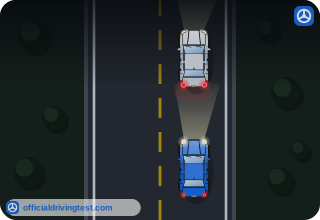
- 100 feet
- 300 feet
- 200 feet
- 500 feet
Show answer
Correct answer: 200 feet
The manual says to dim when following closely, within 200 feet, behind another vehicle.
Source: Georgia Driver's Manual (2023-2024), page 24
-
In which situation should you dim (lower) your headlights?
- When you are driving on a dark rural road with no other cars nearby
- When you are driving on lighted roads
- When you are driving in clear weather with no vehicle within 1,000 feet
- When you are backing out of a parking space
Show answer
Correct answer: When you are driving on lighted roads
Driving on lighted roads is one of the situations in which the manual says to dim your headlights.
Source: Georgia Driver's Manual (2023-2024), page 24