Georgia: Signals & vehicle controls — Part 2 Practice Test
Questions in this part include: “In which weather conditions should you dim (lower) your headlights?” · “Before a trip, what should you check about your passengers?”
Independent educational site · not affiliated with any government agency or DMV
Ready? Test yourself
- Instant feedback with an explanation
- Every answer cites its source in the manual
- Your best score is saved on this device
Questions are original and based on the official manual "Georgia Driver's Manual" (2023-2024), Georgia Department of Driver Services (DDS).
All 18 questions in this practice test
Take the test above first, then use this list to study. Tap “Show answer” to see the correct answer and explanation.
Show the questions and answersHide the questions
-
In which weather conditions should you dim (lower) your headlights?
- Rain, fog, snow, or smoke
- Clear, dry weather only
- Only in heavy thunderstorms
- Only in fog, never in rain or snow
Show answer
Correct answer: Rain, fog, snow, or smoke
The manual says to dim headlights when driving in rain, fog, snow, or smoke.
Source: Georgia Driver's Manual (2023-2024), page 24
-
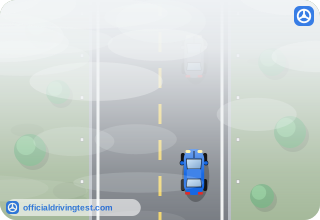
You should dim your headlights when your vision is reduced to less than what distance?
- 100 feet
- 300 feet
- 200 feet
- 500 feet
Show answer
Correct answer: 200 feet
The manual says to dim headlights when your vision is reduced to less than 200 feet.
Source: Georgia Driver's Manual (2023-2024), page 24
-
How should a driver's signal to change lanes be indicated?
- With a brief flash as you move into the new lane
- Only when another vehicle is directly behind you
- Clearly, so as to warn vehicles of the movement
- With a horn blast just before you move over
Show answer
Correct answer: Clearly, so as to warn vehicles of the movement
The manual says a driver's signal to change lanes should be clearly indicated so as to warn vehicles of the movement.
Source: Georgia Driver's Manual (2023-2024), page 19
-
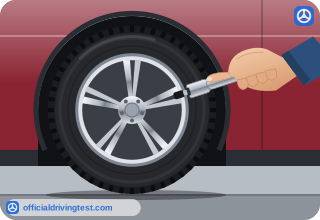
Where can you find the recommended tire pressure (psi) for your vehicle?
- On the door jam of the vehicle
- On a sticker inside the glove box
- Stamped on the tire's valve stem
- On a plate under the hood
Show answer
Correct answer: On the door jam of the vehicle
The manual says to check tire pressure using the recommended psi located in the door jam of the vehicle.
Source: Georgia Driver's Manual (2023-2024), page 38
-
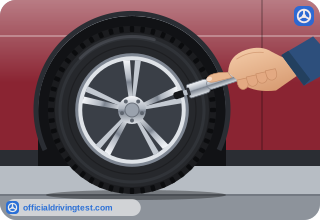
Your tire pressure is above the psi listed on your door jam. What should you do?
- Leave it, since extra pressure gives better grip
- Add air until the gauge reads even higher
- Let air out until it matches the number
- Drive until the tires warm up and settle down
Show answer
Correct answer: Let air out until it matches the number
If your psi is above the number on the door jam, you let air out until it matches.
Source: Georgia Driver's Manual (2023-2024), page 38
-
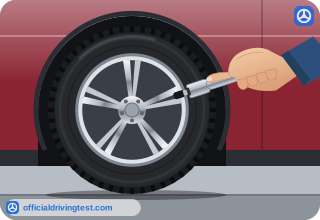
Your tire pressure is below the psi listed on your door jam. What should you do?
- Let air out until the tires feel soft
- Add air until it reaches the proper number
- Nothing, because lower pressure is safer
- Wait for the tires to warm up and then recheck
Show answer
Correct answer: Add air until it reaches the proper number
If the pressure is below the listed psi, add air (or have a retailer help you) until it reaches the proper number.
Source: Georgia Driver's Manual (2023-2024), page 38
-
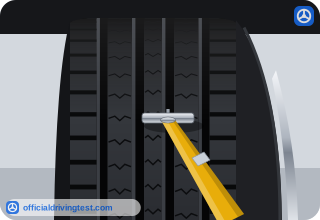
When using the penny test, what shows that your tires have the legal and safe amount of tread?
- Lincoln's whole head shows above the tread
- The penny slides fully into the groove
- The groove is wider than the penny
- Part of Lincoln's head is covered by the tread
Show answer
Correct answer: Part of Lincoln's head is covered by the tread
If any part of Lincoln's head is covered by the tread, the tread is at the legal and safe amount.
Source: Georgia Driver's Manual (2023-2024), page 38
-
Below approximately what tread depth is your car's ability to grip the road in adverse conditions greatly reduced?
- 1/32 of an inch
- 4/32 of an inch
- 2/32 of an inch
- 6/32 of an inch
Show answer
Correct answer: 2/32 of an inch
The manual says that below approximately 2/32 of an inch, the ability to grip the road in adverse conditions is greatly reduced.
Source: Georgia Driver's Manual (2023-2024), page 38
-
How often should you check your tires for wear and damage?
- Once every month, or before a long road trip
- Once every week, and again after every fill-up
- Once a year, at the time of inspection
- Only when a tire looks low on air
Show answer
Correct answer: Once every month, or before a long road trip
The manual says to check tires once every month, or before embarking on a long road trip.
Source: Georgia Driver's Manual (2023-2024), page 38
-
When your vehicle is parked on the street, from which side should you enter it?
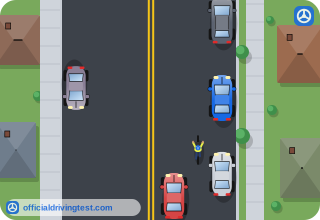
- The side facing traffic
- The side with the most space
- Whichever side is closest to your keys
- The curb side
Show answer
Correct answer: The curb side
If you are parked on the street, you should enter from the curb side of the vehicle.
Source: Georgia Driver's Manual (2023-2024), page 38
-
What should you do as you approach your vehicle to enter it?
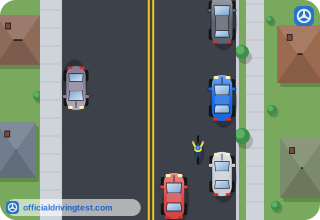
- Keep your back to traffic to watch the car
- Have your keys ready and face traffic
- Walk behind the vehicle to check its tires
- Start the ignition remotely before you arrive
Show answer
Correct answer: Have your keys ready and face traffic
The manual says to have your keys ready and approach the vehicle facing traffic.
Source: Georgia Driver's Manual (2023-2024), page 38
-
Before a trip, what should you check about your passengers?
- That they are properly seated and not blocking your view
- That they know the route and can give you directions
- That they are seated behind the driver's seat only
- That they are not carrying any items in their hands
Show answer
Correct answer: That they are properly seated and not blocking your view
You should check that passengers are properly seated and do not interfere with your view.
Source: Georgia Driver's Manual (2023-2024), page 38
-
What should you do before starting your ignition?
- Check around the vehicle for bicyclists and pedestrians
- Give the proper signal for your move into traffic
- Fasten your seat belt and make sure passengers do the same
- Turn on your headlights and warm up the engine
Show answer
Correct answer: Fasten your seat belt and make sure passengers do the same
Before starting the ignition, you fasten your seat belt and make sure your passengers do the same.
Source: Georgia Driver's Manual (2023-2024), page 38
-
After starting your vehicle, what should you do before moving into the stream of traffic?
- Fasten your seat belt and adjust your seat and mirrors
- Check around the vehicle for hazards, bicyclists and pedestrians
- Turn the steering wheel fully before pulling out
- Wait until traffic clears in both directions for a full minute
Show answer
Correct answer: Check around the vehicle for hazards, bicyclists and pedestrians
After starting, you check around the vehicle for hazards or approaching traffic, including bicyclists and pedestrians, give the proper signal and move cautiously.
Source: Georgia Driver's Manual (2023-2024), page 38
-
As a general rule, where should you place your hands on the steering wheel?
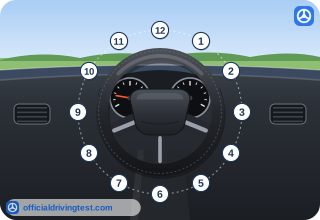
- Left hand at 10 o'clock and right hand at 2 o'clock
- Left hand at 11 o'clock and right hand at 1 o'clock
- Left hand at 7 o'clock and right hand at 5 o'clock
- Left hand at 9 o'clock and right hand at 3 o'clock
Show answer
Correct answer: Left hand at 9 o'clock and right hand at 3 o'clock
The general rule is the left hand at 9 o'clock and the right hand at 3 o'clock.
Source: Georgia Driver's Manual (2023-2024), page 38
-
Which hand positions do some manufacturers recommend when the vehicle is equipped with air bags?
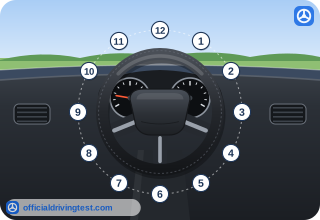
- 10 o'clock and 2 o'clock
- 7 o'clock and 5 o'clock
- 8 o'clock and 4 o'clock
- 11 o'clock and 1 o'clock
Show answer
Correct answer: 8 o'clock and 4 o'clock
Some manufacturers recommend the 8 o'clock and 4 o'clock positions for vehicles with air bags.
Source: Georgia Driver's Manual (2023-2024), page 38
-
When may you take a hand off the steering wheel?
- Only when safely doing a driving task, such as signaling
- Whenever the road ahead is straight and traffic is light
- Whenever the vehicle is going slower than 25 mph
- Whenever you are wearing gloves for a better grip
Show answer
Correct answer: Only when safely doing a driving task, such as signaling
You should always keep both hands on the wheel unless you are safely performing another driving-related task, such as activating your turn signal.
Source: Georgia Driver's Manual (2023-2024), page 38
-
Why is good posture while driving important?
- It lowers the fuel the engine uses on long trips
- It keeps the seat belt from locking in sudden stops
- It lets passengers sit closer to the driver
- It gives a better view of hazards and more control
Show answer
Correct answer: It gives a better view of hazards and more control
Good posture allows a better view of hazards and more control of the vehicle.
Source: Georgia Driver's Manual (2023-2024), page 38