Washington, D.C.: Pedestrians Practice Test
Yielding to pedestrians, pedestrian signals, crossing between intersections and people with disabilities.
Independent educational site · not affiliated with any government agency or DMV
Ready? Test yourself
Answer to start, or tap Start below:
Where do the vehicle safety tips tell drivers to use caution?
- Instant feedback with an explanation
- Every answer cites its source in the manual
- Your best score is saved on this device
- Keyboard: press 1 to 4 to answer and Enter for the next question
Questions are original and based on the official manual "District of Columbia Driver Manual" (Updated January 2024), District of Columbia Department of Motor Vehicles (DC DMV).
All 21 questions in this practice test
Take the test above first, then use this list to study. Tap “Show answer” to see the correct answer and explanation.
Show the questions and answersHide the questions
-
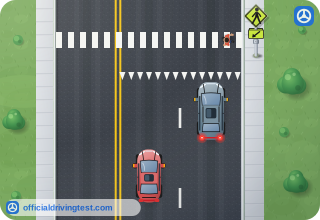
What do the vehicle safety tips for pedestrians say about passing a vehicle stopped at a crosswalk?
- Pass it only on the left
- Pass it if no pedestrian is visible
- Pass it if you sound your horn
- Never pass it
Show answer
Correct answer: Never pass it
Drivers are told never to pass a stopped vehicle at a crosswalk, since a pedestrian may be crossing in front of it.
Source: District of Columbia Driver Manual (Updated January 2024), page 6
-
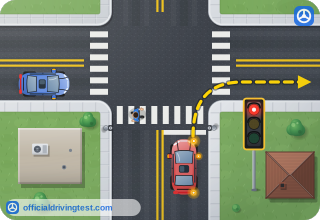
What should a driver do about pedestrians when turning?
- Yield to them
- Turn before they step off the curb
- Sound the horn to warn them
- Pass them before the turn
Show answer
Correct answer: Yield to them
The tips say to yield to pedestrians when turning.
Source: District of Columbia Driver Manual (Updated January 2024), page 6
-
Where do the vehicle safety tips tell drivers to use caution?
- Only when approaching stopped school buses
- Only on streets that have no sidewalks
- When approaching intersections and crosswalks
- Only when approaching a railroad crossing
Show answer
Correct answer: When approaching intersections and crosswalks
Drivers should use caution when approaching intersections and crosswalks.
Source: District of Columbia Driver Manual (Updated January 2024), page 6
-
Which person counts as a pedestrian under the manual’s definition?
- A person riding a bicycle
- A person traveling by wheelchair
- A person riding a motorcycle
- A person driving a light truck
Show answer
Correct answer: A person traveling by wheelchair
The manual defines a pedestrian as anyone traveling by foot, wheelchair, stroller, walking, running, or jogging.
Source: District of Columbia Driver Manual (Updated January 2024), page 6
-
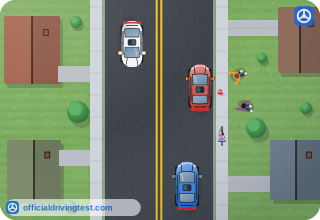
Why are children at greater risk of injury or death from traffic crashes, according to the manual?
- Their tendency to ignore signals and walk in the roadway
- Their slower walking speed and heavier backpacks
- Their reluctance to use sidewalks and crosswalks
- Their small size and lack of experience with traffic rules
Show answer
Correct answer: Their small size and lack of experience with traffic rules
The manual links children’s greater risk to their small size and lack of experience with traffic rules.
Source: District of Columbia Driver Manual (Updated January 2024), page 6
-
Where is it safest for pedestrians to walk, according to the safety tips?
- On a sidewalk
- On the road shoulder
- In a bike lane
- In the traffic lane
Show answer
Correct answer: On a sidewalk
The pedestrian safety tips say it is safest to walk on a sidewalk.
Source: District of Columbia Driver Manual (Updated January 2024), page 6
-
Where should pedestrians cross the street, according to the safety tips?
- Midblock, between parked cars
- Wherever traffic is lightest
- At crosswalks and intersections
- At the nearest curb cut only
Show answer
Correct answer: At crosswalks and intersections
Pedestrians should cross the street at crosswalks and intersections.
Source: District of Columbia Driver Manual (Updated January 2024), page 6
-
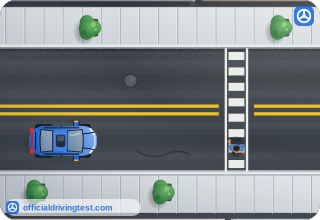
What does District law require of motorists regarding pedestrians within crosswalks?
- Slow down and sound the horn to warn them
- Stop and give them the right of way
- Stop only when a pedestrian pushes a button
- Slow down and pass behind them
Show answer
Correct answer: Stop and give them the right of way
District law requires motorists to stop and give the right of way to pedestrians within crosswalks.
Source: District of Columbia Driver Manual (Updated January 2024), page 7
-
At a HAWK signal, when should a pedestrian start crossing?
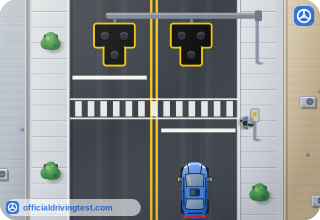
- As soon as the push button has been pressed
- When the lights facing traffic turn steady yellow
- After seeing the WALK signal, once traffic has stopped
- When the first car waves the pedestrian across
Show answer
Correct answer: After seeing the WALK signal, once traffic has stopped
Pedestrians start crossing after the WALK signal appears and should be sure traffic has stopped.
Source: District of Columbia Driver Manual (Updated January 2024), page 8
-
What should a pedestrian do when the countdown signal appears at a HAWK signal?
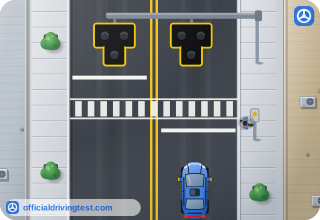
- Return to the curb
- Continue crossing
- Press the button again
- Stop and wait for traffic
Show answer
Correct answer: Continue crossing
The countdown signal means continue crossing.
Source: District of Columbia Driver Manual (Updated January 2024), page 8
-
When an RRFB’s lights are flashing, what should drivers do for pedestrians crossing the roadway?
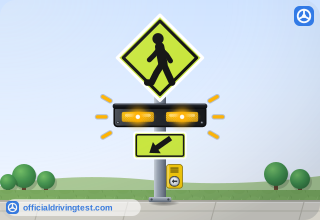
- Slow down and honk to warn them
- Come to a full and complete stop
- Slow down and proceed with caution
- Proceed if the pedestrian is not in their lane
Show answer
Correct answer: Come to a full and complete stop
Drivers should come to a full and complete stop for pedestrians crossing the roadway.
Source: District of Columbia Driver Manual (Updated January 2024), page 10
-
When a pedestrian in a crosswalk is on the half of the roadway on which your vehicle is traveling, what must you do?
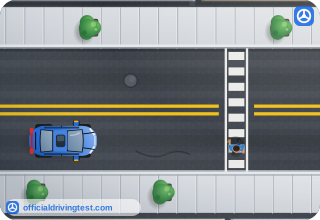
- Slow down and sound your horn
- Pass behind the pedestrian
- Come to a complete stop
- Proceed if the pedestrian is far enough away
Show answer
Correct answer: Come to a complete stop
A driver must come to a complete stop for a pedestrian crossing in a crosswalk on the vehicle's half of the roadway.
Source: District of Columbia Driver Manual (Updated January 2024), page 35
-
When a vehicle is stopped at a crosswalk to let a pedestrian cross, what must the driver of another vehicle approaching from the rear do?
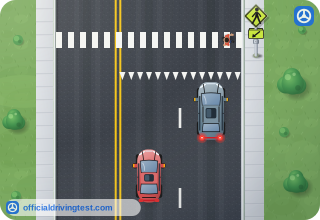
- Pass on the left if the other lane is clear
- Not overtake and pass the stopped vehicle
- Pass on the right at low speed
- Sound the horn and pass
Show answer
Correct answer: Not overtake and pass the stopped vehicle
Passing a vehicle stopped for a pedestrian could hit the pedestrian who is crossing.
Source: District of Columbia Driver Manual (Updated January 2024), page 35
-
What may a pedestrian not do at the curb?
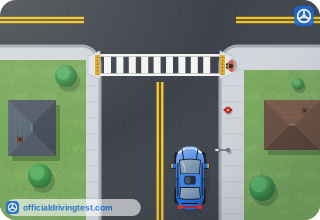
- Wait at the curb until the WALK signal appears and then go
- Look both ways before stepping into a crosswalk
- Cross in a marked crosswalk
- Suddenly leave the curb and walk into the path of a close vehicle
Show answer
Correct answer: Suddenly leave the curb and walk into the path of a close vehicle
A pedestrian may not step into the path of a vehicle that is too close to yield.
Source: District of Columbia Driver Manual (Updated January 2024), page 35
-
A pedestrian crosses the roadway outside a crosswalk. What must the driver do?
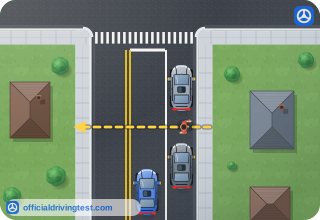
- Yield the right-of-way to the pedestrian
- Proceed, because the pedestrian is breaking the law
- Sound the horn and keep going
- Yield only to pedestrians who are children
Show answer
Correct answer: Yield the right-of-way to the pedestrian
Even though crossing outside a crosswalk is not recommended, the driver must always yield.
Source: District of Columbia Driver Manual (Updated January 2024), page 35
-
Drivers should be especially alert for and yield the right-of-way to pedestrians who use which of these?
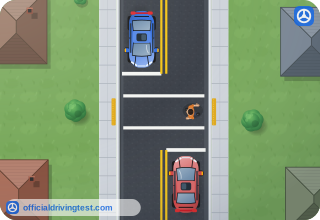
- Guide dogs or service animals
- Roller skates or a skateboard
- Hand-held umbrellas
- Shopping carts
Show answer
Correct answer: Guide dogs or service animals
Pedestrians with disabilities may have difficulty detecting traffic and may need more time to cross.
Source: District of Columbia Driver Manual (Updated January 2024), page 36
-
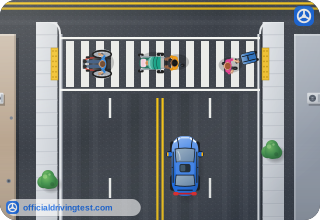
Why should drivers be careful around pedestrians with physical disabilities?
- They always cross against the traffic signal
- They cannot be seen at night
- They may have difficulty detecting oncoming traffic
- They must cross before a vehicle
Show answer
Correct answer: They may have difficulty detecting oncoming traffic
These pedestrians may have difficulty detecting oncoming traffic and need extra time.
Source: District of Columbia Driver Manual (Updated January 2024), page 36
-
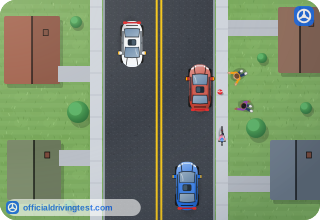
What should drivers do when approaching children or obviously confused or incapacitated individuals?
- Sound the horn to warn them that you are coming
- Exercise extreme care and be prepared to stop
- Speed up to pass quickly
- Keep a steady pace
Show answer
Correct answer: Exercise extreme care and be prepared to stop
Drivers should use extreme care and be ready to stop for these individuals.
Source: District of Columbia Driver Manual (Updated January 2024), page 36
-
What is a safety zone, which you must never drive through?
- A section of roadway marked by signs for emergency vehicles only
- A lane of the roadway marked by signs for bicycles and scooters only
- An area of highway where the speed limit is lowered for road workers
- An area on a roadway marked by signs for pedestrians only
Show answer
Correct answer: An area on a roadway marked by signs for pedestrians only
A safety zone is a roadway area marked by signs for pedestrians only, and you must never drive through it.
Source: District of Columbia Driver Manual (Updated January 2024), page 47
-
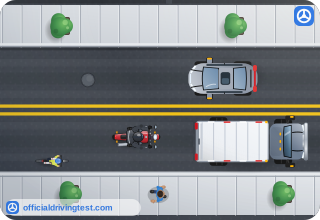
What should you do whenever people are standing, walking, sitting, or bicycling close to traffic?
- Proceed cautiously
- Stop and wait until they leave the area
- Sound your horn to warn them
- Move into the left lane and speed up
Show answer
Correct answer: Proceed cautiously
You should always proceed cautiously when people are close to traffic.
Source: District of Columbia Driver Manual (Updated January 2024), page 47
-
Whose directions must you follow when they are stationed to control traffic?
- Only a sworn police officer in a marked patrol car
- Any authorized crossing guard or traffic control officer
- Only school crossing guards stationed next to a school
- Only traffic control officers stationed at event venues
Show answer
Correct answer: Any authorized crossing guard or traffic control officer
You must follow the direction of any authorized crossing guard or traffic control officer.
Source: District of Columbia Driver Manual (Updated January 2024), page 47