Delaware: Speed and following distance — Part 2 Practice Test
Delaware speed limits, adjusting speed to the road and traffic, night driving, and the space around your vehicle. — Part 2
Independent educational site · not affiliated with any government agency or DMV
Ready? Test yourself
- Instant feedback with an explanation
- Every answer cites its source in the manual
- Your best score is saved on this device
Questions are original and based on the official manual "Delaware Driver Manual" (July 2026), Delaware Division of Motor Vehicles (DMV).
All 34 questions in this practice test
Take the test above first, then use this list to study. Tap “Show answer” to see the correct answer and explanation.
Show the questions and answersHide the questions
-
How does looking well ahead help you save fuel?
- You can keep your engine running while you are stopped
- You avoid unnecessary braking that lowers miles per gallon
- You can coast in neutral for long stretches of road
- You can leave the engine off at every red light
Show answer
Correct answer: You avoid unnecessary braking that lowers miles per gallon
Drivers who look ahead can slow down gradually or change lanes and avoid unnecessary braking that leads to lower miles per gallon.
Source: Delaware Driver Manual (July 2026), page 117 · Open this page in the manual (Manual page 117)
-
What does making driving changes before the last moment give the drivers behind you?
- More room to pass you
- A reason to brake harder
- More time to react
- Less time to see your signals
Show answer
Correct answer: More time to react
Making driving changes before the last moment gives drivers behind you more time to react.
Source: Delaware Driver Manual (July 2026), page 117 · Open this page in the manual (Manual page 117)
-
Compared with stopping at 30 mph, stopping at 60 mph takes about how much distance?
- Exactly twice the distance
- One and a half times the distance
- About the same distance
- Over three times the distance
Show answer
Correct answer: Over three times the distance
The manual says stopping at 60 mph takes over three times the distance it takes at 30 mph, not twice.
Source: Delaware Driver Manual (July 2026), page 123 · Open this page in the manual (Manual page 123)
-
In which situation must you slow down to be safe?
- Before a sharp curve
- When the road ahead is straight and dry
- When no other vehicles are nearby
- When the road is lit at night
Show answer
Correct answer: Before a sharp curve
The manual says you must slow down before a sharp curve, when the roadway is slippery and when there is standing water.
Source: Delaware Driver Manual (July 2026), page 123 · Open this page in the manual (Manual page 123)
-
What is your vehicle's only contact with the road?
- The suspension
- The brakes
- The tires
- The steering wheel
Show answer
Correct answer: The tires
The manual says the only contact your vehicle has with the road is through the tires.
Source: Delaware Driver Manual (July 2026), page 123 · Open this page in the manual (Manual page 123)
-
Where does the manual say to find the correct tire pressure for your vehicle?
- On the vehicle's registration card
- In the vehicle's owner manual
- In this driver manual's speed table
- On the dashboard warning light
Show answer
Correct answer: In the vehicle's owner manual
The manual refers drivers to the vehicle's owner manual for correct tire pressure.
Source: Delaware Driver Manual (July 2026), page 123 · Open this page in the manual (Manual page 123)
-
What should you do when driving on gravel or dirt roads?
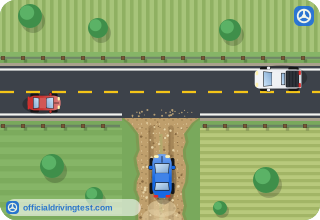
- Drive at the same speed as on asphalt
- Speed up to keep traction
- Brake hard in turns
- Slow down
Show answer
Correct answer: Slow down
There is less traction on gravel or dirt, so you must slow down.
Source: Delaware Driver Manual (July 2026), page 123 · Open this page in the manual (Manual page 123)
-
When should you slow down for a curve, and why?
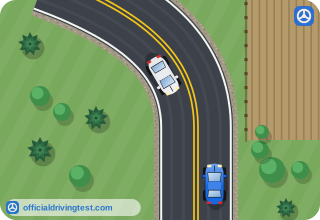
- Before you enter it, so you need not brake in it
- In the middle of it, so you can judge the turn
- As you leave it, so you do not skid
- Only if the curve is marked with a sign
Show answer
Correct answer: Before you enter it, so you need not brake in it
You should slow down before entering the curve so you do not have to brake in it, since braking in a curve can cause a skid.
Source: Delaware Driver Manual (July 2026), page 123 · Open this page in the manual (Manual page 123)
-
When should you slow down for rain, snow, or sleet?
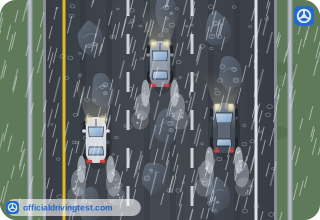
- Only when the road is covered
- After the road becomes icy
- At the first sign of it
- When the rain turns heavy
Show answer
Correct answer: At the first sign of it
The manual says to slow down at the first sign of rain, snow, or sleet, because they make the roadway slippery.
Source: Delaware Driver Manual (July 2026), page 123 · Open this page in the manual (Manual page 123)
-
By about how much should you reduce your speed on a wet road?
- 5 mph
- 10 mph
- 20 mph
- 30 mph
Show answer
Correct answer: 10 mph
The manual says to reduce your speed about 10 mph on a wet road.
Source: Delaware Driver Manual (July 2026), page 123 · Open this page in the manual (Manual page 123)
-
How much should you reduce your speed on packed snow?
- Reduce it by about 10 mph
- Reduce it by one quarter
- No reduction is needed with snow tires
- Cut it in half
Show answer
Correct answer: Cut it in half
On packed snow the manual says to cut your speed in half.
Source: Delaware Driver Manual (July 2026), page 123 · Open this page in the manual (Manual page 123)
-
How slow must you go on ice?
- To a crawl
- To half your normal speed
- About 10 mph less than normal
- To about 35 mph
Show answer
Correct answer: To a crawl
The manual says that on ice you must slow to a crawl.
Source: Delaware Driver Manual (July 2026), page 123 · Open this page in the manual (Manual page 123)
-
What does the manual say to use when the road has snow on it?
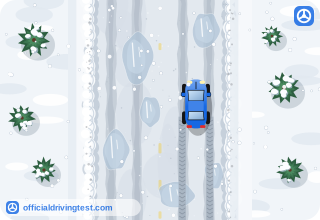
- Studded tires only
- Parking lights
- Snow tires or chains
- Under-inflated tires
Show answer
Correct answer: Snow tires or chains
The manual says to use snow tires or chains when the road has snow on it.
Source: Delaware Driver Manual (July 2026), page 123 · Open this page in the manual (Manual page 123)
-
Why are studded tires not allowed in many areas, on certain roads, or during summer months?
- They lose grip on dry roads
- They can cause road damage
- They cause hydroplaning
- They make braking distances longer on ice
Show answer
Correct answer: They can cause road damage
Because studded tires can cause road damage, they are banned in many areas, on certain roads, or in summer.
Source: Delaware Driver Manual (July 2026), page 123 · Open this page in the manual (Manual page 123)
-
On cold, wet days, which spots can be icy because they freeze first and dry out last?
- Sunny spots
- Spots next to buildings
- Spots on dirt roads
- Shady spots
Show answer
Correct answer: Shady spots
The manual says shady spots freeze first and dry out last on cold, wet days.
Source: Delaware Driver Manual (July 2026), page 123 · Open this page in the manual (Manual page 123)
-
Why can the pavement on bridges be icy even when other pavement is not?
- Bridges can be colder than other roadways
- Bridges are painted with a smoother surface
- Bridges collect more rain than other roadways
- Bridges are never salted
Show answer
Correct answer: Bridges can be colder than other roadways
The manual says bridges can be colder than other roadways.
Source: Delaware Driver Manual (July 2026), page 123 · Open this page in the manual (Manual page 123)
-
When is ice more slippery?
- When the temperature is well below freezing
- When the temperature is well above freezing
- When the temperature is around the freezing point
- When there is no moisture on the road
Show answer
Correct answer: When the temperature is around the freezing point
Around the freezing point ice can become wet, which is more slippery than at temperatures well below freezing.
Source: Delaware Driver Manual (July 2026), page 123 · Open this page in the manual (Manual page 123)
-
Why can pavement be very slippery in the first few minutes of rain on a hot day?
- The rain freezes on the hot pavement
- Heat brings the oil in the asphalt to the surface
- The hot tires lose their grip on the road
- Rain washes loose sand onto the road
Show answer
Correct answer: Heat brings the oil in the asphalt to the surface
On a hot day the oil in the asphalt comes to the surface, and the road is more slippery until the oil is washed off.
Source: Delaware Driver Manual (July 2026), page 124 · Open this page in the manual (Manual page 124)
-
Up to about what speed do most tires have good traction on a wet road?
- 25 mph
- 45 mph
- 55 mph
- 35 mph
Show answer
Correct answer: 35 mph
The manual says most tires have good traction up to about 35 mph when the road is wet.
Source: Delaware Driver Manual (July 2026), page 124 · Open this page in the manual (Manual page 124)
-
At about what speed can your tires lose all traction with the road in a heavy rain?
- 50 mph
- 30 mph
- 40 mph
- 65 mph
Show answer
Correct answer: 50 mph
In a heavy rain tires can lose all traction at about 50 mph.
Source: Delaware Driver Manual (July 2026), page 124 · Open this page in the manual (Manual page 124)
-
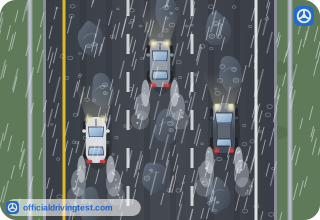
What is the best way to keep from hydroplaning?
- Brake firmly before every puddle
- Drive with slightly under-inflated tires
- Slow down in the rain or when the road is wet
- Follow the tracks of the vehicle ahead
Show answer
Correct answer: Slow down in the rain or when the road is wet
The manual says slowing down in the rain or on a wet road is the best way to keep from hydroplaning.
Source: Delaware Driver Manual (July 2026), page 124 · Open this page in the manual (Manual page 124)
-
How do bald or badly worn tires behave on a wet road?
- They grip as well as new tires
- They lose traction at much lower speeds
- They lose traction only above 50 mph
- They grip better in heavy rain
Show answer
Correct answer: They lose traction at much lower speeds
Bald or badly worn tires lose traction at much lower speeds.
Source: Delaware Driver Manual (July 2026), page 124 · Open this page in the manual (Manual page 124)
-
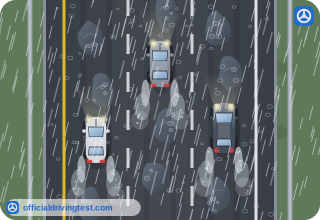
If it feels like your tires have lost traction with the road, what should you do with the gas pedal?
- Press it harder
- Hold it steady
- Switch to the brake and press it fully
- Ease your foot off it
Show answer
Correct answer: Ease your foot off it
The manual says to ease your foot off the gas pedal if your tires have lost traction.
Source: Delaware Driver Manual (July 2026), page 124 · Open this page in the manual (Manual page 124)
-
If your tires have lost traction, how should you handle the steering wheel?
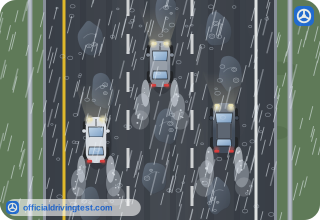
- Keep it straight, and turn slowly only if you must
- Turn it sharply in the direction of the skid
- Turn it back and forth to find traction
- Let go of it until the tires grip
Show answer
Correct answer: Keep it straight, and turn slowly only if you must
Keep the steering wheel straight, and if an emergency forces a turn do it slowly or you will cause a skid.
Source: Delaware Driver Manual (July 2026), page 124 · Open this page in the manual (Manual page 124)
-
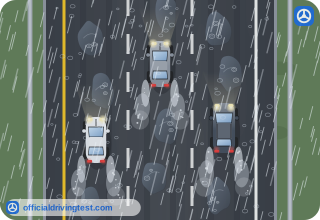
When can you try to stop or turn after your tires have lost traction?
- Immediately after easing off the gas
- As soon as the vehicle slows to 35 mph
- Once your tires are gripping the road again
- After you have braked hard
Show answer
Correct answer: Once your tires are gripping the road again
The manual says not to stop or turn until your tires are gripping the road again.
Source: Delaware Driver Manual (July 2026), page 124 · Open this page in the manual (Manual page 124)
-
What often causes crashes involving two or more vehicles?
- Drivers who keep pace with the other traffic
- Drivers going faster or slower than other traffic
- Drivers who use their turn signals too early
- Drivers who always stay in their own lane
Show answer
Correct answer: Drivers going faster or slower than other traffic
The manual says such crashes often happen when drivers go faster or slower than other vehicles.
Source: Delaware Driver Manual (July 2026), page 124 · Open this page in the manual (Manual page 124)
-
If you drive faster than traffic, what happens each time you pass someone?
- You gain a large amount of time
- The other driver must speed up
- The collision risk is removed
- There is a chance for a collision
Show answer
Correct answer: There is a chance for a collision
The manual says each time you pass someone there is a chance for a collision.
Source: Delaware Driver Manual (July 2026), page 124 · Open this page in the manual (Manual page 124)
-
How much time does the manual say speeding saves?
- No more than a few minutes an hour
- About half an hour on a long trip
- About ten minutes every mile
- A great deal on open highways
Show answer
Correct answer: No more than a few minutes an hour
The manual says speeding does not save more than a few minutes an hour.
Source: Delaware Driver Manual (July 2026), page 124 · Open this page in the manual (Manual page 124)
-
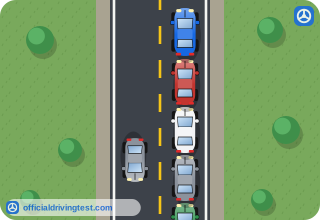
If vehicles are piled up behind you because you are driving much slower than other traffic, what should you do?
- Slow down further
- Brake sharply to warn them
- Pull over when safe and let them pass
- Stay in the lane and ignore them
Show answer
Correct answer: Pull over when safe and let them pass
The manual says to pull over when safe to do so and let them pass.
Source: Delaware Driver Manual (July 2026), page 124 · Open this page in the manual (Manual page 124)
-
When you turn from a high speed, two-lane roadway with traffic following you, what should you avoid?
- Tapping your brakes
- Signaling your turn
- Reducing your speed quickly but safely
- Slowing down too early
Show answer
Correct answer: Slowing down too early
With traffic following, try not to slow down too early; tap your brakes, reduce speed quickly but safely, and signal.
Source: Delaware Driver Manual (July 2026), page 124 · Open this page in the manual (Manual page 124)
-
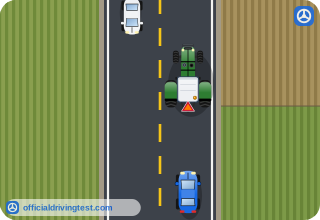
What can slowing suddenly for a slow-moving vehicle cause?
- A traffic crash
- Better traction
- A smoother merge
- A longer following distance
Show answer
Correct answer: A traffic crash
The manual says slowing suddenly can cause a traffic crash, so spot slow vehicles early.
Source: Delaware Driver Manual (July 2026), page 124 · Open this page in the manual (Manual page 124)
-
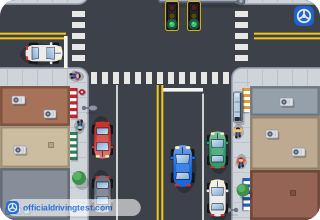
Why do you need to lower your speed wherever people or traffic gather?
- Your room to maneuver is limited, so you need time to react
- The speed limit is automatically lowered there by state law
- Other drivers are required to stop and yield to you there
- Your headlights work better when you drive at lower speeds
Show answer
Correct answer: Your room to maneuver is limited, so you need time to react
The manual says room to maneuver is limited where people or traffic gather, so you need to lower your speed to have time to react.
Source: Delaware Driver Manual (July 2026), page 125 · Open this page in the manual (Manual page 125)
-
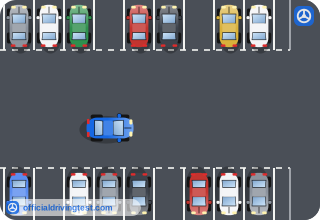
Why may you need to slow down in shopping centers, parking lots and downtown areas?
- Traffic signals in these areas are always out of order
- Pedestrians always have the right of way in these areas
- Vehicles and people stop, start and move in different directions
- Most vehicles in these areas travel at a high rate of speed
Show answer
Correct answer: Vehicles and people stop, start and move in different directions
The manual describes these as busy areas with vehicles and people stopping, starting and moving in different directions.
Source: Delaware Driver Manual (July 2026), page 125 · Open this page in the manual (Manual page 125)
-
What makes rush hours a place where you may need to slow down?
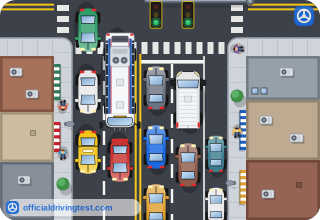
- Roads become narrower during the busiest rush hours
- Heavy traffic and drivers who always seem to be in a hurry
- Traffic signals stay red for much longer at those times
- Slow-moving farm vehicles fill most of the roads then
Show answer
Correct answer: Heavy traffic and drivers who always seem to be in a hurry
The manual says rush hours often have heavy traffic and drivers that always seem to be in a hurry.
Source: Delaware Driver Manual (July 2026), page 125 · Open this page in the manual (Manual page 125)