Connecticut: Emergencies
Brake, tire and headlight failures, skids, avoiding collisions and what to do after a crash. Split into 4 shorter tests so you're not stuck in one long quiz.
Independent educational site · not affiliated with any government agency or DMV
Choose a part
Emergencies — Part 1
Questions in this part include: “If you cannot get your vehicle off the roadway, where should you try to stop?”
StartEmergencies — Part 2
Questions in this part include: “If your engine dies while you are driving, what should you do with the steering wheel?”
StartEmergencies — Part 3
Questions in this part include: “How should you turn quickly if your vehicle does not have ABS?”
StartEmergencies — Part 4
Questions in this part include: “When reporting an accident, whose names and addresses should you get?”
StartAll 80 Emergencies questions with answers
Choose a part above to take a practice test, or study every question and answer here.
Show the questions and answersHide the questions
-
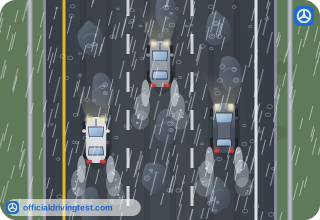
What is it called when your tires start to ride up on the water like water skis?
- Fishtailing
- Over-driving
- Hydroplaning
- Brake fade
Show answer
Correct answer: Hydroplaning
The manual calls it “hydroplaning” when tires ride up on the water like water skis as you go faster on a wet road.
Source: Connecticut Driver's Manual (Revised March 2023), page 25 · Open this page in the manual (Manual page 25)
-
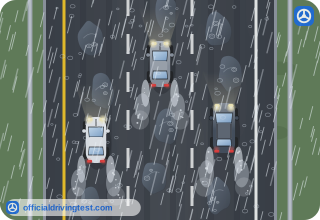
If it feels like your tires have lost traction with the road, what should you do with the gas pedal?
- Ease your foot off it
- Press it harder to regain control
- Hold it steady to keep your speed
- Tap it repeatedly
Show answer
Correct answer: Ease your foot off it
The manual lists easing your foot off the gas pedal as the first thing to do when the tires seem to have lost traction.
Source: Connecticut Driver's Manual (Revised March 2023), page 25 · Open this page in the manual (Manual page 25)
-
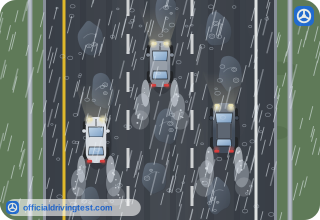
If your tires lose traction, how should you handle the steering wheel?
- Turn it sharply toward the road shoulder
- Turn it quickly back and forth to regain grip
- Keep it straight, turning only in an emergency
- Turn it gently toward the center of the road
Show answer
Correct answer: Keep it straight, turning only in an emergency
The manual says to keep the steering wheel straight and to turn only in an emergency, and then slowly.
Source: Connecticut Driver's Manual (Revised March 2023), page 25 · Open this page in the manual (Manual page 25)
-
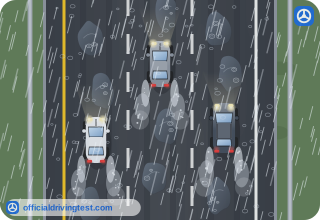
After your tires lose traction, when should you try to stop or turn?
- Immediately, before the vehicle gains speed
- Not until the tires grip the road again
- As soon as the vehicle begins to slow
- Once you have steered toward the shoulder
Show answer
Correct answer: Not until the tires grip the road again
The manual says not to try to stop or turn until your tires are gripping the road again.
Source: Connecticut Driver's Manual (Revised March 2023), page 25 · Open this page in the manual (Manual page 25)
-
In a very heavy downpour, you may not be able to see well enough to drive. What should you do?
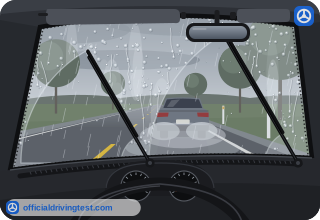
- Pull off the road in a safe place and wait until it clears
- Turn on your parking lights and keep driving slowly
- Use your high beams and keep a steady speed
- Stop in the traffic lane and turn on your flashers
Show answer
Correct answer: Pull off the road in a safe place and wait until it clears
The manual says to pull off the road in a safe place and wait until the downpour clears.
Source: Connecticut Driver's Manual (Revised March 2023), page 38 · Open this page in the manual (Manual page 38)
-
Your vehicle breaks down on a highway. What should you do first if at all possible?
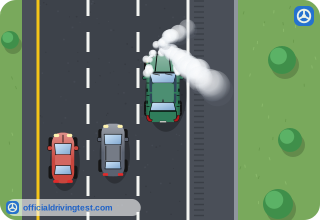
- Stop where it is and wait for help
- Change the tire in the traffic lane
- Leave it and walk along the roadway
- Get it off the road and away from traffic
Show answer
Correct answer: Get it off the road and away from traffic
The manual says to get your vehicle off the road and away from traffic if at all possible.
Source: Connecticut Driver's Manual (Revised March 2023), page 39 · Open this page in the manual (Manual page 39)
-
What should you turn on to show that your vehicle is having trouble?
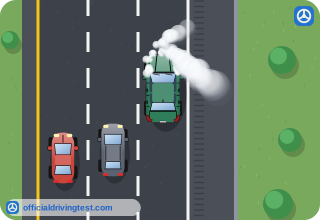
- Your emergency flashers
- Your high beams
- Your parking lights
- Your windshield wipers
Show answer
Correct answer: Your emergency flashers
The manual says to turn on your emergency flashers to show you are having trouble.
Source: Connecticut Driver's Manual (Revised March 2023), page 39 · Open this page in the manual (Manual page 39)
-
If you cannot get your vehicle off the roadway, where should you try to stop?
- Just over a hill so it is hidden from traffic
- Just around a curve
- Where other drivers have a clear view of your vehicle
- In the middle lane
Show answer
Correct answer: Where other drivers have a clear view of your vehicle
You should stop where other drivers can see you, not just over a hill or just around a curve.
Source: Connecticut Driver's Manual (Revised March 2023), page 39 · Open this page in the manual (Manual page 39)
-
Where should you place emergency flares when your vehicle is stalled?
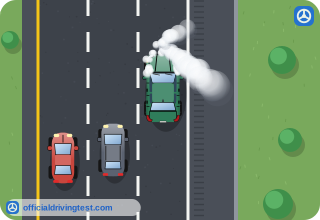
- In front of the vehicle
- Behind the vehicle
- Beside the driver's door
- On the roof of the vehicle
Show answer
Correct answer: Behind the vehicle
Flares placed behind the vehicle allow other drivers to change lanes if necessary.
Source: Connecticut Driver's Manual (Revised March 2023), page 39 · Open this page in the manual (Manual page 39)
-
You have no emergency flares or other warning devices. What can you do?
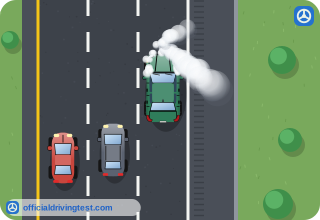
- Stand in the lane behind your vehicle and wave traffic around it
- Sit in the car and sound your horn continuously
- Walk ahead of your vehicle to warn traffic
- Stand safely beside the road and wave traffic around your vehicle
Show answer
Correct answer: Stand safely beside the road and wave traffic around your vehicle
The manual says to stand by the side of the road where you are safe from traffic and wave traffic around, using a white cloth if you have one.
Source: Connecticut Driver's Manual (Revised March 2023), page 39 · Open this page in the manual (Manual page 39)
-
Which should you never do when your vehicle has a flat tire in a traffic lane?
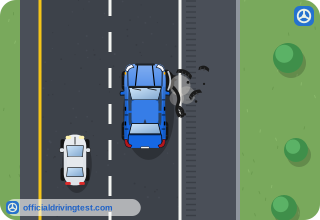
- Try to change the tire in the traffic lane
- Turn on your emergency flashers
- Place flares behind the vehicle
- Lift the hood to signal an emergency
Show answer
Correct answer: Try to change the tire in the traffic lane
The manual says never to stand in the roadway and not to change a tire if it means being in a traffic lane.
Source: Connecticut Driver's Manual (Revised March 2023), page 39 · Open this page in the manual (Manual page 39)
-
Which is a way to signal an emergency when your vehicle has broken down?
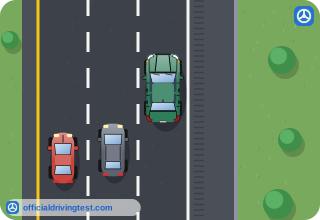
- Turn off all lights and wait inside the vehicle
- Turn on your high beams and your wipers
- Lift the hood or tie a white cloth to the antenna
- Park with your wheels turned toward the road
Show answer
Correct answer: Lift the hood or tie a white cloth to the antenna
The manual says to lift the hood or tie a white cloth to the antenna, side mirror or door handle.
Source: Connecticut Driver's Manual (Revised March 2023), page 39 · Open this page in the manual (Manual page 39)
-
If your vehicle breaks down on a highway, whom should you notify?
- Only the nearest relative
- The authorities
- The driver behind you
- The vehicle's manufacturer
Show answer
Correct answer: The authorities
The manual says to notify authorities that your vehicle, or someone else's, has broken down.
Source: Connecticut Driver's Manual (Revised March 2023), page 39 · Open this page in the manual (Manual page 39)
-
What does the manual say you should follow to greatly reduce the chance of a vehicle problem?
- The maintenance advice of other drivers
- A yearly road test given by the DMV
- A schedule of repairs posted by the DMV
- The recommended maintenance schedule
Show answer
Correct answer: The recommended maintenance schedule
Following the maintenance schedule listed in the vehicle owner's manual greatly reduces the chance of a problem.
Source: Connecticut Driver's Manual (Revised March 2023), page 39 · Open this page in the manual (Manual page 39)
-
If your brakes stop working, what should you do first?
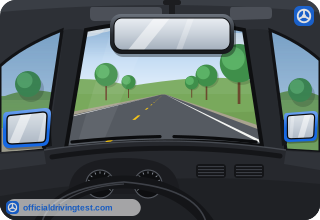
- Pump the brake pedal several times
- Pull on the parking brake handle quickly
- Shift to a lower gear
- Turn off the engine
Show answer
Correct answer: Pump the brake pedal several times
Pumping the brake pedal several times will often build up enough brake pressure to allow you to stop.
Source: Connecticut Driver's Manual (Revised March 2023), page 39 · Open this page in the manual (Manual page 39)
-
If pumping the pedal does not restore your brakes, how should you use the parking brake?
- Pull the handle quickly and hold it all the way up
- Hold it down firmly and never release it if you skid
- Pull the handle slowly to avoid locking the rear wheels
- Pull it only after you have shifted the gear to park
Show answer
Correct answer: Pull the handle slowly to avoid locking the rear wheels
Pulling slowly keeps you from locking the rear wheels and causing a skid; be ready to release it if the vehicle skids.
Source: Connecticut Driver's Manual (Revised March 2023), page 39 · Open this page in the manual (Manual page 39)
-
If neither pumping the brakes nor the parking brake works, what should you do?
- Drive on slowly to the nearest repair shop
- Shift to lower gears and look for a safe place to stop
- Speed up to reach the next exit quickly
- Steer toward other vehicles to help slow you down
Show answer
Correct answer: Shift to lower gears and look for a safe place to stop
The manual says to shift to lower gears, look for a safe place to stop, and never drive the vehicle without brakes.
Source: Connecticut Driver's Manual (Revised March 2023), page 39 · Open this page in the manual (Manual page 39)
-
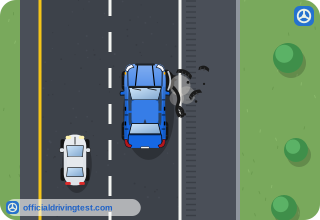
A tire suddenly goes flat. How should you hold the steering wheel?
- Loosely, letting the car drift with the flat tire
- Sharply toward the shoulder as fast as possible
- With one hand, so the other can work the brakes
- Tightly, keeping the vehicle going straight
Show answer
Correct answer: Tightly, keeping the vehicle going straight
The manual says to hold the steering wheel tightly and keep the vehicle going straight.
Source: Connecticut Driver's Manual (Revised March 2023), page 39 · Open this page in the manual (Manual page 39)
-
After a tire blowout, how should you slow down?
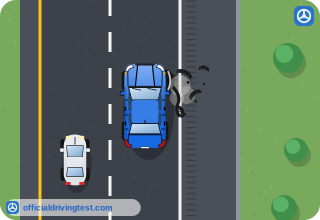
- Gradually, easing off the gas and using the brakes lightly
- Quickly, pressing the brake pedal as hard as you can
- By shifting to park as soon as the tire goes flat
- By steering sharply off the road at full speed
Show answer
Correct answer: Gradually, easing off the gas and using the brakes lightly
The manual says to slow down gradually, take your foot off the gas, and use the brakes lightly.
Source: Connecticut Driver's Manual (Revised March 2023), page 39 · Open this page in the manual (Manual page 39)
-
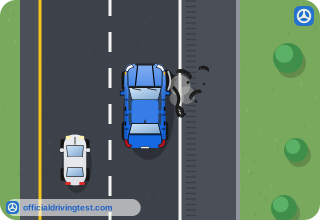
After a tire blowout, what should you do if at all possible?
- Stop in the lane and turn on your flashers
- Stop right away on the road
- Pull off the road in a safe place
- Keep driving until you reach a repair shop
Show answer
Correct answer: Pull off the road in a safe place
The manual says not to stop on the road if at all possible, but to pull off in a safe place.
Source: Connecticut Driver's Manual (Revised March 2023), page 39 · Open this page in the manual (Manual page 39)
-
If your engine dies while you are driving, what should you do with the steering wheel?
- Keep a strong grip, because it may be hard to turn but is possible
- Let go of it, because it will not turn without the engine
- Hold it loosely so the car can steer itself straight
- Lock it in place by turning the ignition to lock
Show answer
Correct answer: Keep a strong grip, because it may be hard to turn but is possible
The manual says to keep a strong grip on the wheel after a power failure: it may be difficult to turn, but it is possible.
Source: Connecticut Driver's Manual (Revised March 2023), page 40 · Open this page in the manual (Manual page 40)
-
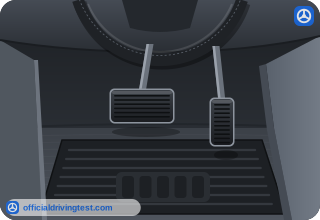
After the engine dies while you are driving, what is true about the brakes?
- They stop working completely, so only the parking brake can stop you
- They work normally with no extra effort needed
- They still work, but you may have to push very hard on the pedal
- They work only after you restart the engine
Show answer
Correct answer: They still work, but you may have to push very hard on the pedal
The manual says the brakes will still work after a power failure, but you may have to push very hard on the brake pedal.
Source: Connecticut Driver's Manual (Revised March 2023), page 40 · Open this page in the manual (Manual page 40)
-
If your engine dies while you are driving, where should you go?
- Stop in the middle of the lane
- Pull off the roadway
- Keep rolling until the car stops by itself in traffic
- Make a U-turn right away
Show answer
Correct answer: Pull off the roadway
The manual tells you to pull off the roadway after a power failure.
Source: Connecticut Driver's Manual (Revised March 2023), page 40 · Open this page in the manual (Manual page 40)
-
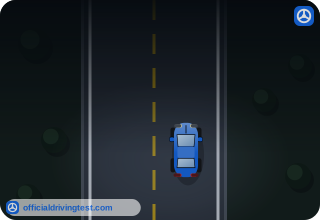
If your headlights suddenly go out, what should you do?
- Speed up to reach a lighted area quickly
- Keep driving at the same speed until you reach home
- Stop suddenly in the traffic lane
- Slow down gradually and pull off the road as soon as possible
Show answer
Correct answer: Slow down gradually and pull off the road as soon as possible
The manual says to slow down gradually and pull off the road as soon as possible when headlights fail.
Source: Connecticut Driver's Manual (Revised March 2023), page 40 · Open this page in the manual (Manual page 40)
-
If your headlights suddenly go out, what should you try after slowing down and pulling off the road?
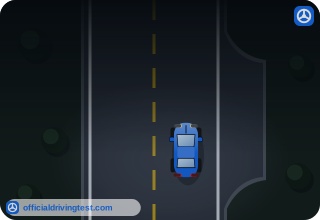
- Try the headlight switch a few times
- Turn the ignition to the lock position
- Shift into neutral
- Turn on the windshield wipers
Show answer
Correct answer: Try the headlight switch a few times
After slowing down, the manual says to try the headlight switch a few times.
Source: Connecticut Driver's Manual (Revised March 2023), page 40 · Open this page in the manual (Manual page 40)
-
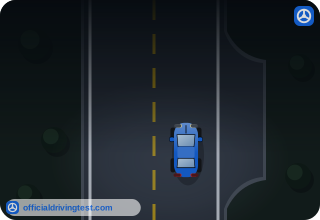
Your headlights have gone out and trying the switch did not help. What does the manual say to do?
- Flash the high beams repeatedly until the headlights come back on
- Turn on only the interior dome light
- Put on the emergency flashers, and use signals or fog lights if you have them
- Turn on the windshield wipers so others see you
Show answer
Correct answer: Put on the emergency flashers, and use signals or fog lights if you have them
If the switch does not work, the manual says to use the emergency flashers and signals or fog lights if you have them.
Source: Connecticut Driver's Manual (Revised March 2023), page 40 · Open this page in the manual (Manual page 40)
-
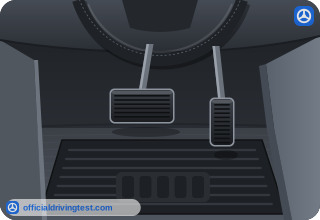
If the gas pedal sticks and the motor keeps going faster and faster, what should you do quickly?
- Turn the ignition to the lock position
- Shift to neutral
- Shift into a lower gear
- Take both hands off the steering wheel
Show answer
Correct answer: Shift to neutral
The manual lists quickly shifting to neutral as a step when the gas pedal sticks.
Source: Connecticut Driver's Manual (Revised March 2023), page 40 · Open this page in the manual (Manual page 40)
-
If the gas pedal sticks, where should you keep your eyes?
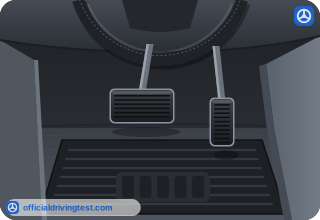
- On the gas pedal
- On the speedometer
- On the gear shift
- On the road
Show answer
Correct answer: On the road
The manual's first step for a stuck gas pedal is to keep your eyes on the road.
Source: Connecticut Driver's Manual (Revised March 2023), page 40 · Open this page in the manual (Manual page 40)
-
What can happen if you turn the ignition to the lock position while the vehicle is still moving?
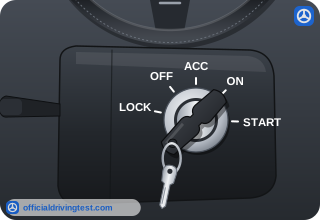
- The steering will lock and you will lose control
- The engine will restart on its own
- The brakes will lock up and stop the vehicle
- The headlights will turn off
Show answer
Correct answer: The steering will lock and you will lose control
The manual warns the steering will lock and you will lose control of the vehicle.
Source: Connecticut Driver's Manual (Revised March 2023), page 40 · Open this page in the manual (Manual page 40)
-
According to the manual, what three options do drivers have when trying to avoid a collision?
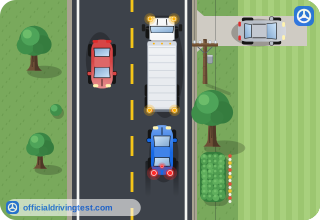
- Stop, honk or flash the lights
- Turn, reverse or brake
- Stop, turn or speed up
- Honk, swerve or speed up
Show answer
Correct answer: Stop, turn or speed up
The manual says that in avoiding a collision, drivers have three options: stop, turn or speed up.
Source: Connecticut Driver's Manual (Revised March 2023), page 40 · Open this page in the manual (Manual page 40)
-
What does an Antilock Braking System (ABS) allow you to do?
- Stop with half the pedal pressure
- Stop without skidding
- Skid for a shorter distance
- Drive faster on wet roads
Show answer
Correct answer: Stop without skidding
The manual says the ABS system will allow you to stop without skidding.
Source: Connecticut Driver's Manual (Revised March 2023), page 40 · Open this page in the manual (Manual page 40)
-
If you need to stop quickly in a vehicle with ABS, what should you do?
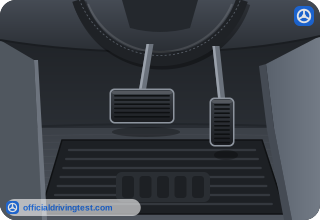
- Pump the brake pedal gently several times
- Press the brake pedal once, then let up
- Apply the brakes only hard enough to avoid locking them
- Press the brake pedal as hard as you can and keep pressing it
Show answer
Correct answer: Press the brake pedal as hard as you can and keep pressing it
With ABS, the manual says to press the brake pedal as hard as you can and keep pressing on it.
Source: Connecticut Driver's Manual (Revised March 2023), page 40 · Open this page in the manual (Manual page 40)
-
You feel the brake pedal pushing back while the ABS is working. What should you do?
- Do not let up on the brake pedal
- Let up on the brake pedal quickly
- Tap the brake pedal repeatedly
- Shift to neutral
Show answer
Correct answer: Do not let up on the brake pedal
The manual says the ABS system will only work with the brake pedal pushed down, so you must not let up.
Source: Connecticut Driver's Manual (Revised March 2023), page 40 · Open this page in the manual (Manual page 40)
-
If you must stop quickly in a vehicle without ABS, how should you apply the brakes?
- With a single gentle press
- As hard as you can, locking the wheels on purpose
- As hard as you can without locking them
- Only with the parking brake
Show answer
Correct answer: As hard as you can without locking them
Without ABS, the manual says to apply the brakes as hard as you can without locking them.
Source: Connecticut Driver's Manual (Revised March 2023), page 40 · Open this page in the manual (Manual page 40)
-
In a vehicle without ABS, the brakes lock up and you feel the vehicle start to skid. What should you do?
- Push harder on the brake pedal
- Quickly let up on the brake pedal
- Turn the ignition to the lock position
- Shift into a lower gear
Show answer
Correct answer: Quickly let up on the brake pedal
The manual says to quickly let up on the brake pedal when the brakes lock up and the vehicle starts to skid.
Source: Connecticut Driver's Manual (Revised March 2023), page 40 · Open this page in the manual (Manual page 40)
-
In a vehicle without ABS, what should you do as soon as the vehicle stops skidding while you are stopping quickly?
- Release the brake pedal and coast gently to a stop
- Shift to neutral and wait
- Turn off the engine
- Push down on the brake pedal again and repeat until stopped
Show answer
Correct answer: Push down on the brake pedal again and repeat until stopped
The manual says to push down on the brake pedal again as soon as the skid ends, repeating until the vehicle has stopped.
Source: Connecticut Driver's Manual (Revised March 2023), page 40 · Open this page in the manual (Manual page 40)
-
What does the manual say about turning and stopping when you need to avoid a collision?
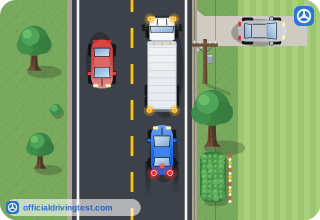
- In most cases, you can turn more quickly than you can stop
- In most cases, you can stop more quickly than you can turn
- You can turn and stop in the same amount of time
- Turning is never a good option
Show answer
Correct answer: In most cases, you can turn more quickly than you can stop
The manual says you can usually turn the vehicle more quickly than you can stop it, so you should consider turning.
Source: Connecticut Driver's Manual (Revised March 2023), page 40 · Open this page in the manual (Manual page 40)
-
Once you have turned away or changed lanes to avoid a collision, what must you be ready to do?
- Stop immediately in the new lane
- Honk the horn
- Keep the vehicle under control
- Take one hand off the steering wheel
Show answer
Correct answer: Keep the vehicle under control
The manual warns that some drivers steer away from one collision only to end up in another, so you must keep the vehicle under control.
Source: Connecticut Driver's Manual (Revised March 2023), page 40 · Open this page in the manual (Manual page 40)
-
In which direction should you always steer when avoiding a collision?
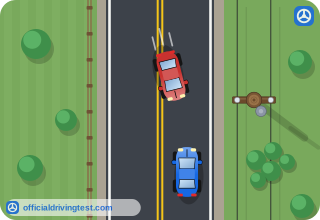
- Toward the object you are trying to avoid
- In the direction you want the vehicle to go
- Toward the center of the road
- Toward the shoulder
Show answer
Correct answer: In the direction you want the vehicle to go
The manual says to always steer in the direction you want the vehicle to go.
Source: Connecticut Driver's Manual (Revised March 2023), page 40 · Open this page in the manual (Manual page 40)
-
What is one aspect of having ABS when you must turn and stop or slow down?
- You cannot turn while braking
- You must release the brake before you turn
- You must brake only after the turn is finished
- You can turn while braking without skidding
Show answer
Correct answer: You can turn while braking without skidding
The manual says that with ABS you can turn your vehicle while braking without skidding, which is very helpful.
Source: Connecticut Driver's Manual (Revised March 2023), page 40 · Open this page in the manual (Manual page 40)
-
How should you turn quickly if your vehicle does not have ABS?
- Step on the brake pedal, then let up and turn the steering wheel
- Turn the steering wheel first, then step on the brake pedal
- Hold the brake pedal down while turning
- Take your foot off all pedals and turn
Show answer
Correct answer: Step on the brake pedal, then let up and turn the steering wheel
The manual says that without ABS you step on the brake pedal, then let up and turn the steering wheel.
Source: Connecticut Driver's Manual (Revised March 2023), page 40 · Open this page in the manual (Manual page 40)
-
Why does braking help you turn more quickly in a vehicle without ABS?
- It puts more weight on the rear tires
- It locks the front wheels
- It puts more weight on the front tires
- It makes the engine slow down
Show answer
Correct answer: It puts more weight on the front tires
The manual says braking slows the vehicle, puts more weight on the front tires and allows for a quicker turn.
Source: Connecticut Driver's Manual (Revised March 2023), page 40 · Open this page in the manual (Manual page 40)
-
When turning quickly without ABS, what should you not do?
- Brake before the turn
- Lock up the front wheels while braking
- Keep both hands on the steering wheel
- Turn the steering wheel at all
Show answer
Correct answer: Lock up the front wheels while braking
The manual says not to lock up the front wheels while braking or turn so sharply that the vehicle can only skid ahead.
Source: Connecticut Driver's Manual (Revised March 2023), page 40 · Open this page in the manual (Manual page 40)
-
Which is generally better when you cannot avoid a collision?
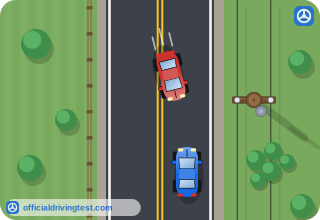
- To crash head-on than to run off the road
- To stay in the lane and brake than to run off the road
- To stop in the middle of the road than to turn away
- To run off the road than to crash head-on into another vehicle
Show answer
Correct answer: To run off the road than to crash head-on into another vehicle
The manual says it is generally better to run off the road than to crash head-on into another vehicle.
Source: Connecticut Driver's Manual (Revised March 2023), page 40 · Open this page in the manual (Manual page 40)
-
When may it be best or necessary to speed up to avoid a collision?
- When another vehicle is about to hit you from the side or behind and there is room ahead
- When another vehicle is stopped in front of you and there is no room to move
- When you are approaching a red light and want to get through it
- When a vehicle is about to hit you head-on and the road ahead is wet
Show answer
Correct answer: When another vehicle is about to hit you from the side or behind and there is room ahead
The manual says speeding up can help when another vehicle is about to hit you from the side or behind and there is room to the front.
Source: Connecticut Driver's Manual (Revised March 2023), page 40 · Open this page in the manual (Manual page 40)
-
After you speed up to avoid a collision, what must you do once the danger has passed?
- Keep speeding up
- Stop in the lane
- Slow down
- Turn on your emergency flashers
Show answer
Correct answer: Slow down
The manual says to be sure to slow down once the danger has passed.
Source: Connecticut Driver's Manual (Revised March 2023), page 40 · Open this page in the manual (Manual page 40)
-
What causes a skid?
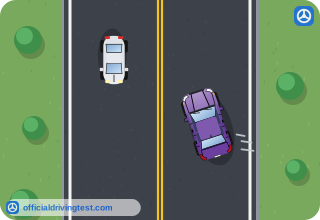
- The engine runs at low speed
- The tires can no longer grip the road
- The tires have too much air pressure
- The steering wheel is held too tightly
Show answer
Correct answer: The tires can no longer grip the road
The manual says skids are caused when the tires can no longer grip the road.
Source: Connecticut Driver's Manual (Revised March 2023), page 40 · Open this page in the manual (Manual page 40)
-
What should you do with the brake if your vehicle begins to skid?
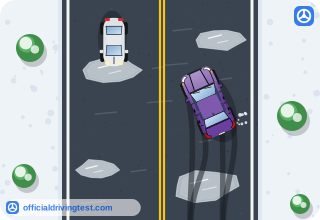
- Stay off the brake
- Press the brake pedal hard
- Press the brake pedal and the gas pedal together
- Pull the parking brake
Show answer
Correct answer: Stay off the brake
The manual says to stay off the brake because until the vehicle slows, your brakes will not work and could cause you to skid more.
Source: Connecticut Driver's Manual (Revised March 2023), page 40 · Open this page in the manual (Manual page 40)
-
If your vehicle begins to skid, how should you steer?
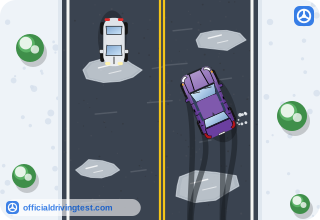
- Turn the wheel away from the direction you want to go
- Hold the wheel straight and still
- Turn the wheel in the direction you want the vehicle to go
- Take your hands off the wheel
Show answer
Correct answer: Turn the wheel in the direction you want the vehicle to go
The manual says to turn the steering wheel in the direction you want the vehicle to go.
Source: Connecticut Driver's Manual (Revised March 2023), page 40 · Open this page in the manual (Manual page 40)
-
What should you do as soon as the skidding vehicle begins to straighten out?
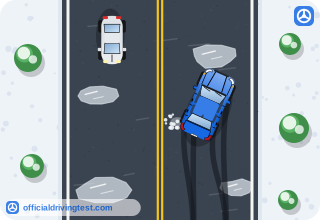
- Press hard on the brake pedal to stop
- Turn the steering wheel back the other way
- Let go of the steering wheel
- Press the gas pedal
Show answer
Correct answer: Turn the steering wheel back the other way
The manual says to turn the wheel back the other way as the vehicle begins to straighten out.
Source: Connecticut Driver's Manual (Revised March 2023), page 40 · Open this page in the manual (Manual page 40)
-
What may happen if you do not turn the steering wheel back as a skidding vehicle straightens out?
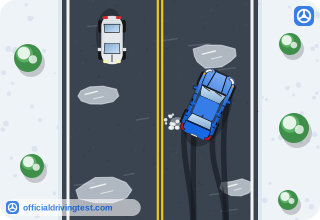
- The vehicle will stop at once
- The vehicle will straighten out on its own again
- The brakes will lock
- The vehicle may swing around in the other direction
Show answer
Correct answer: The vehicle may swing around in the other direction
The manual warns the vehicle may swing around in the other direction and you could start a new skid.
Source: Connecticut Driver's Manual (Revised March 2023), page 40 · Open this page in the manual (Manual page 40)
-
After starting to recover from a skid, how long should you continue to steer?
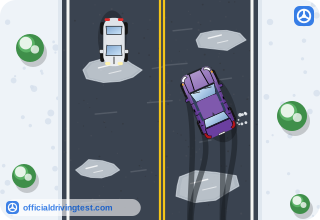
- Until the vehicle is moving down the road under your control
- Until the vehicle has slowed to 5 mph
- Until you have passed the next intersection
- Only until the vehicle first starts to straighten out
Show answer
Correct answer: Until the vehicle is moving down the road under your control
The manual says to keep correcting your steering, left and right, until the vehicle is again moving down the road under your control.
Source: Connecticut Driver's Manual (Revised March 2023), page 40 · Open this page in the manual (Manual page 40)
-
When should you stop at an accident you are not involved in?
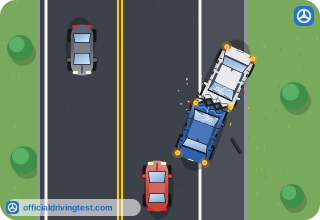
- Always, so you can look at the damage
- Only if you see smoke
- Only if emergency help has not yet arrived
- Only if the road is wet
Show answer
Correct answer: Only if emergency help has not yet arrived
The manual says not to stop at an accident unless you are involved or emergency help has not yet arrived.
Source: Connecticut Driver's Manual (Revised March 2023), page 41 · Open this page in the manual (Manual page 41)
-
Why should you never drive to the scene of an accident, fire or other disaster just to look?
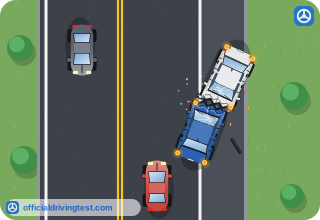
- It is a crime to look at a crash
- You may block the way for police, firefighters and other rescue vehicles
- Rescue workers will charge you for the cost of their response
- The police will take your license
Show answer
Correct answer: You may block the way for police, firefighters and other rescue vehicles
The manual says you may block the way for police, firefighters, ambulances, tow trucks and other rescue vehicles.
Source: Connecticut Driver's Manual (Revised March 2023), page 41 · Open this page in the manual (Manual page 41)
-
If you are involved in an accident with a parked vehicle, what must you do?
- Drive away if there is no damage
- Wait one hour and then leave
- Report it only if the owner calls you
- Try to locate the owner
Show answer
Correct answer: Try to locate the owner
The manual says you must try and locate the owner of the parked vehicle.
Source: Connecticut Driver's Manual (Revised March 2023), page 41 · Open this page in the manual (Manual page 41)
-
When is it a crime to leave a crash site in which your vehicle was involved?
- When the crash blocks one lane of traffic for more than ten minutes
- When you move your vehicle to the shoulder so it does not block traffic
- When someone is hurt or killed and police lack the information they need
- When the crash happens at night
Show answer
Correct answer: When someone is hurt or killed and police lack the information they need
The manual says it is a crime to leave such a crash site before police have talked to you and gotten all the information they need.
Source: Connecticut Driver's Manual (Revised March 2023), page 41 · Open this page in the manual (Manual page 41)
-
What does the manual say a basic vehicle emergency kit has?
- A fire extinguisher, a spare tire and a tow rope
- Emergency flares, first aid supplies and basic tools
- A flashlight, a map and drinking water
- A blanket, food and a cell phone
Show answer
Correct answer: Emergency flares, first aid supplies and basic tools
The manual says these kits have emergency flares, first aid supplies, and basic tools.
Source: Connecticut Driver's Manual (Revised March 2023), page 41 · Open this page in the manual (Manual page 41)
-
If your vehicle is hit from the rear, what should you do with your body?
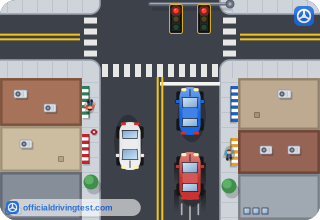
- Press yourself against the seat back and put your head against the head restraint
- Lean forward and brace yourself against the dashboard with both hands
- Turn sideways in the seat
- Duck below the dashboard
Show answer
Correct answer: Press yourself against the seat back and put your head against the head restraint
The manual says your body will be thrown backwards, so you press against the seat back and put your head against the head restraint.
Source: Connecticut Driver's Manual (Revised March 2023), page 41 · Open this page in the manual (Manual page 41)
-
If your vehicle is hit from the rear, why should you be ready to apply your brakes?
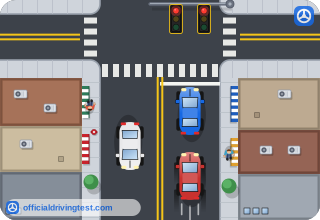
- So the airbags will inflate
- So the head restraint will lock
- So you will not be pushed into another vehicle
- So the driver behind you has time to stop
Show answer
Correct answer: So you will not be pushed into another vehicle
The manual says to be ready to apply your brakes so that you will not be pushed into another vehicle.
Source: Connecticut Driver's Manual (Revised March 2023), page 41 · Open this page in the manual (Manual page 41)
-
If your vehicle is hit from the side, in which direction will your body be thrown?
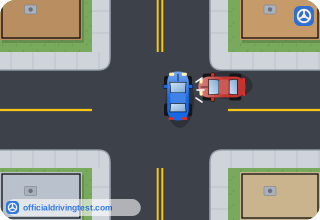
- Backward
- Toward the side that is hit
- Toward the side that is not hit
- Forward
Show answer
Correct answer: Toward the side that is hit
The manual says your body will be thrown towards the side that is hit.
Source: Connecticut Driver's Manual (Revised March 2023), page 41 · Open this page in the manual (Manual page 41)
-
If your vehicle is about to be hit from the front, what should you try to have?
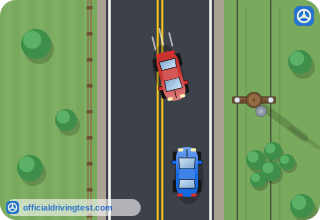
- A glancing blow rather than being struck head-on
- A head-on blow at low speed
- A hit on the passenger side only
- A blow to the rear of the other vehicle only
Show answer
Correct answer: A glancing blow rather than being struck head-on
The manual says to try to have a glancing blow rather than being struck head-on, which means trying to turn the vehicle.
Source: Connecticut Driver's Manual (Revised March 2023), page 41 · Open this page in the manual (Manual page 41)
-
If your vehicle has an air bag and is hit from the front, what should you be ready to do after the crash?
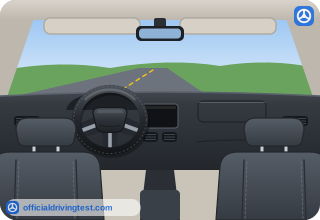
- Wait for the air bag to inflate again
- Remove your lap and shoulder belt right away
- Prevent your vehicle from hitting something else
- Keep your foot off the brake pedal
Show answer
Correct answer: Prevent your vehicle from hitting something else
The manual says the air bag will deflate following the crash, so you must be ready to prevent your vehicle from hitting something else.
Source: Connecticut Driver's Manual (Revised March 2023), page 41 · Open this page in the manual (Manual page 41)
-
At an accident scene, what should you do if your vehicle can still move?
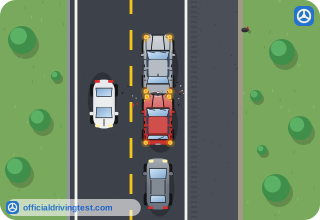
- Leave it where it stopped in the lane
- Get it off the road so it does not block traffic
- Leave it in the lane with the engine running
- Push it back into the lane when police arrive
Show answer
Correct answer: Get it off the road so it does not block traffic
The manual says if your vehicle can move, get it off the road so that it does not block traffic or cause another crash.
Source: Connecticut Driver's Manual (Revised March 2023), page 41 · Open this page in the manual (Manual page 41)
-
At an accident scene, where should you not stand or walk?
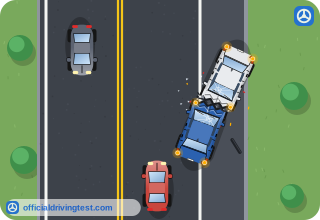
- On the shoulder
- On the sidewalk
- Behind a guardrail
- In traffic lanes
Show answer
Correct answer: In traffic lanes
The manual says not to stand or walk in traffic lanes because you could be struck by another vehicle.
Source: Connecticut Driver's Manual (Revised March 2023), page 41 · Open this page in the manual (Manual page 41)
-
At an accident scene, what should you do with each wrecked vehicle's ignition, and why?
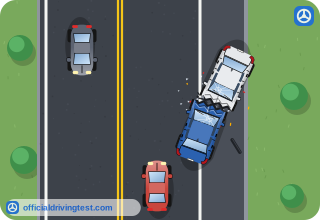
- Turn it off, because fuel could have spilled
- Leave it on so the lights stay on
- Turn it on to test the vehicle
- Turn it off, because the battery could drain
Show answer
Correct answer: Turn it off, because fuel could have spilled
The manual says to turn off the ignition of each wrecked vehicle and not to smoke around them because fuel could have spilled.
Source: Connecticut Driver's Manual (Revised March 2023), page 41 · Open this page in the manual (Manual page 41)
-
At an accident scene, what should you do if power lines are down with wires in the road?
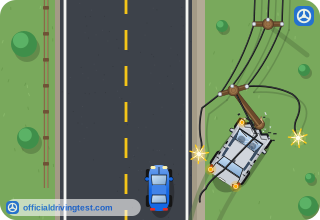
- Move the wires off the road with a stick
- Drive over them slowly
- Do not go near them
- Stand beside them and wave traffic around
Show answer
Correct answer: Do not go near them
The manual says if there are power lines down with wires in the road, do not go near them.
Source: Connecticut Driver's Manual (Revised March 2023), page 41 · Open this page in the manual (Manual page 41)
-
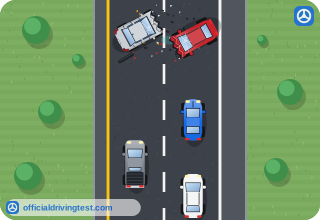
At an accident scene, how can you make sure that other traffic will not be involved in the crash?
- Stand in the lane and wave your arms
- Use flares or other warning devices to alert traffic
- Turn off the headlights of the wrecked vehicles
- Block the road with your vehicle
Show answer
Correct answer: Use flares or other warning devices to alert traffic
The manual says to use flares or other warning devices to alert traffic of the accident.
Source: Connecticut Driver's Manual (Revised March 2023), page 41 · Open this page in the manual (Manual page 41)
-
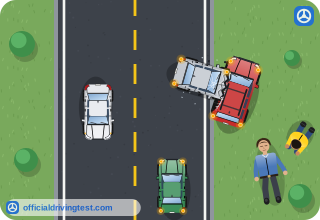
If someone is injured at a crash scene, what must you make sure of?
- The injured person is moved to the shoulder
- The injured person has been given water
- The injured person is driven to the hospital in your vehicle
- The police and emergency medical or rescue squad have been called
Show answer
Correct answer: The police and emergency medical or rescue squad have been called
The manual says to make sure the police and emergency medical or rescue squad have been called.
Source: Connecticut Driver's Manual (Revised March 2023), page 41 · Open this page in the manual (Manual page 41)
-
If there is a fire at a crash scene, what does the manual say to do when you call the police?
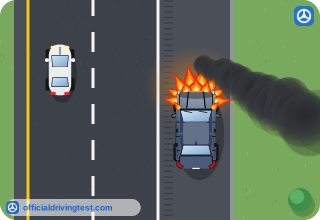
- Tell them there is a fire
- Say nothing, since they will see it
- Call the fire department only
- Wait to call until the fire is out
Show answer
Correct answer: Tell them there is a fire
The manual says if there is a fire, tell this to the police when you call them.
Source: Connecticut Driver's Manual (Revised March 2023), page 41 · Open this page in the manual (Manual page 41)
-
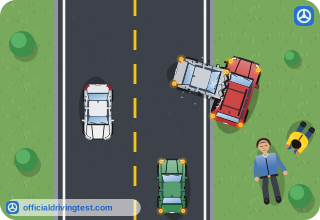
When may you move an injured person?
- Whenever they say they are in pain and want to be moved
- As soon as you arrive at the scene, to make them more comfortable
- Only if they are in a burning vehicle or in immediate danger of being hit
- Whenever their injuries look minor
Show answer
Correct answer: Only if they are in a burning vehicle or in immediate danger of being hit
The manual says not to move the injured unless in a burning vehicle or in immediate danger, because moving can make injuries worse.
Source: Connecticut Driver's Manual (Revised March 2023), page 41 · Open this page in the manual (Manual page 41)
-
Which injured people should you help first at a crash scene?
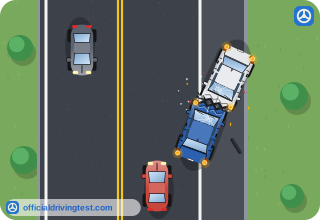
- Anyone who is walking and talking
- Anyone who is not already walking and talking
- The driver of the vehicle that caused the crash
- The person closest to the road
Show answer
Correct answer: Anyone who is not already walking and talking
The manual says to first help anyone who is not already walking and talking.
Source: Connecticut Driver's Manual (Revised March 2023), page 41 · Open this page in the manual (Manual page 41)
-
When you help an injured person, in what order should you check them?
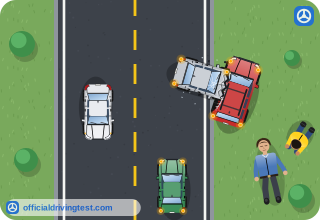
- Bleeding first, then breathing
- Broken bones first, then breathing
- Breathing first, then broken bones
- Breathing first, then bleeding
Show answer
Correct answer: Breathing first, then bleeding
The manual says to check for breathing, and then check for bleeding.
Source: Connecticut Driver's Manual (Revised March 2023), page 41 · Open this page in the manual (Manual page 41)
-
How should you help an injured person who is bleeding?
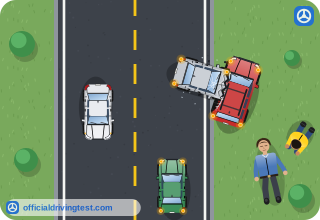
- Apply direct pressure to the wound with a hand or cloth
- Help the person stand up and walk around a bit
- Apply pressure far from the wound
- Rinse the wound with water and wait for bleeding to stop
Show answer
Correct answer: Apply direct pressure to the wound with a hand or cloth
The manual says to apply pressure directly on the wound with your hand or with a cloth, which can almost always stop or slow even severe bleeding.
Source: Connecticut Driver's Manual (Revised March 2023), page 41 · Open this page in the manual (Manual page 41)
-
What should you give an injured person to drink?
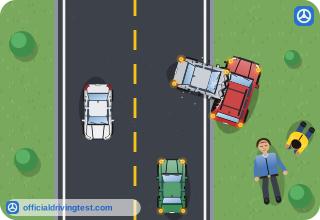
- Only small sips of water
- Warm tea or hot coffee
- Nothing, not even water
- A cold sports drink
Show answer
Correct answer: Nothing, not even water
The manual says not to give injured persons anything to drink, not even water.
Source: Connecticut Driver's Manual (Revised March 2023), page 41 · Open this page in the manual (Manual page 41)
-
How can you help prevent an injured person from going into shock?
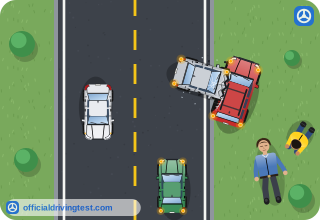
- Sit them up and walk them around slowly
- Cover them with a blanket or coat to keep them warm
- Give them something warm to drink right away
- Keep them uncovered so that they stay cool
Show answer
Correct answer: Cover them with a blanket or coat to keep them warm
The manual says to cover the injured person with a blanket or coat to keep them warm.
Source: Connecticut Driver's Manual (Revised March 2023), page 41 · Open this page in the manual (Manual page 41)
-
When reporting an accident, whose names and addresses should you get?
- Only the other driver
- Only the injured persons
- Only the owner of the other vehicle
- All people involved and any witnesses
Show answer
Correct answer: All people involved and any witnesses
The manual says to get the names and addresses of all people involved and any witnesses, including injured persons.
Source: Connecticut Driver's Manual (Revised March 2023), page 41 · Open this page in the manual (Manual page 41)
-
What information should you exchange with the other drivers involved in a crash?
- Name, address, driver’s license number, vehicle and insurance information
- Name, address, Social Security number, employer and vehicle information
- Name, address and date of birth only
- Name, phone number and bank account number
Show answer
Correct answer: Name, address, driver’s license number, vehicle and insurance information
The manual lists name, address, driver’s license number, vehicle information, and insurance company and policy number (if available).
Source: Connecticut Driver's Manual (Revised March 2023), page 41 · Open this page in the manual (Manual page 41)
-
What should you record after a crash?
- Only the speed of each vehicle
- Only damage to your own vehicle
- Any damage to the vehicles involved
- The weather for the last week
Show answer
Correct answer: Any damage to the vehicles involved
The manual says to record any damage to the vehicles involved in the crash.
Source: Connecticut Driver's Manual (Revised March 2023), page 41 · Open this page in the manual (Manual page 41)
-
If you are in an accident with a parked vehicle and cannot find its owner, what should you do?
- Drive away, since no one was hurt
- Leave a note with the date, time and how the owner can reach you
- Leave a note only if the damage is more than a small scratch
- Leave a note with only your license plate number
Show answer
Correct answer: Leave a note with the date, time and how the owner can reach you
The manual says to leave a note in a visible place with the date and time of the accident and how the owner can reach you.
Source: Connecticut Driver's Manual (Revised March 2023), page 41 · Open this page in the manual (Manual page 41)
-
When must you report an accident to the police?
- Only if there is a death
- Only if the damage is over a set dollar amount
- Only if the other driver was at fault
- If there is an injury, a death or property damage
Show answer
Correct answer: If there is an injury, a death or property damage
The manual says you must report the accident to police if there is an injury, a death or property damage.
Source: Connecticut Driver's Manual (Revised March 2023), page 41 · Open this page in the manual (Manual page 41)