Connecticut: Emergencies — Part 3 Practice Test
Questions in this part include: “How should you turn quickly if your vehicle does not have ABS?” · “After you speed up to avoid a collision, what must you do once the danger has passed?”
Independent educational site · not affiliated with any government agency or DMV
Ready? Test yourself
- Instant feedback with an explanation
- Every answer cites its source in the manual
- Your best score is saved on this device
Questions are original and based on the official manual "Connecticut Driver's Manual" (Revised March 2023), Connecticut Department of Motor Vehicles (DMV).
All 20 questions in this practice test
Take the test above first, then use this list to study. Tap “Show answer” to see the correct answer and explanation.
Show the questions and answersHide the questions
-
How should you turn quickly if your vehicle does not have ABS?
- Step on the brake pedal, then let up and turn the steering wheel
- Turn the steering wheel first, then step on the brake pedal
- Hold the brake pedal down while turning
- Take your foot off all pedals and turn
Show answer
Correct answer: Step on the brake pedal, then let up and turn the steering wheel
The manual says that without ABS you step on the brake pedal, then let up and turn the steering wheel.
Source: Connecticut Driver's Manual (Revised March 2023), page 40 · Open this page in the manual (Manual page 40)
-
Why does braking help you turn more quickly in a vehicle without ABS?
- It puts more weight on the rear tires
- It locks the front wheels
- It puts more weight on the front tires
- It makes the engine slow down
Show answer
Correct answer: It puts more weight on the front tires
The manual says braking slows the vehicle, puts more weight on the front tires and allows for a quicker turn.
Source: Connecticut Driver's Manual (Revised March 2023), page 40 · Open this page in the manual (Manual page 40)
-
When turning quickly without ABS, what should you not do?
- Brake before the turn
- Lock up the front wheels while braking
- Keep both hands on the steering wheel
- Turn the steering wheel at all
Show answer
Correct answer: Lock up the front wheels while braking
The manual says not to lock up the front wheels while braking or turn so sharply that the vehicle can only skid ahead.
Source: Connecticut Driver's Manual (Revised March 2023), page 40 · Open this page in the manual (Manual page 40)
-
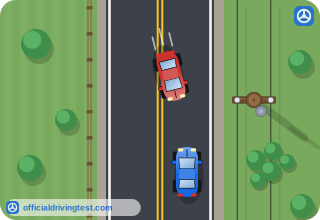
Which is generally better when you cannot avoid a collision?
- To crash head-on than to run off the road
- To stay in the lane and brake than to run off the road
- To stop in the middle of the road than to turn away
- To run off the road than to crash head-on into another vehicle
Show answer
Correct answer: To run off the road than to crash head-on into another vehicle
The manual says it is generally better to run off the road than to crash head-on into another vehicle.
Source: Connecticut Driver's Manual (Revised March 2023), page 40 · Open this page in the manual (Manual page 40)
-
When may it be best or necessary to speed up to avoid a collision?
- When another vehicle is about to hit you from the side or behind and there is room ahead
- When another vehicle is stopped in front of you and there is no room to move
- When you are approaching a red light and want to get through it
- When a vehicle is about to hit you head-on and the road ahead is wet
Show answer
Correct answer: When another vehicle is about to hit you from the side or behind and there is room ahead
The manual says speeding up can help when another vehicle is about to hit you from the side or behind and there is room to the front.
Source: Connecticut Driver's Manual (Revised March 2023), page 40 · Open this page in the manual (Manual page 40)
-
After you speed up to avoid a collision, what must you do once the danger has passed?
- Keep speeding up
- Stop in the lane
- Slow down
- Turn on your emergency flashers
Show answer
Correct answer: Slow down
The manual says to be sure to slow down once the danger has passed.
Source: Connecticut Driver's Manual (Revised March 2023), page 40 · Open this page in the manual (Manual page 40)
-
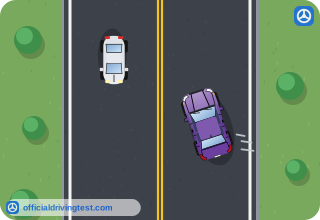
What causes a skid?
- The engine runs at low speed
- The tires can no longer grip the road
- The tires have too much air pressure
- The steering wheel is held too tightly
Show answer
Correct answer: The tires can no longer grip the road
The manual says skids are caused when the tires can no longer grip the road.
Source: Connecticut Driver's Manual (Revised March 2023), page 40 · Open this page in the manual (Manual page 40)
-
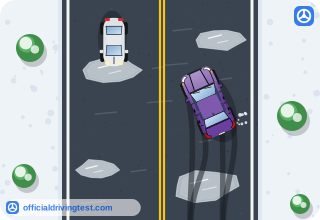
What should you do with the brake if your vehicle begins to skid?
- Stay off the brake
- Press the brake pedal hard
- Press the brake pedal and the gas pedal together
- Pull the parking brake
Show answer
Correct answer: Stay off the brake
The manual says to stay off the brake because until the vehicle slows, your brakes will not work and could cause you to skid more.
Source: Connecticut Driver's Manual (Revised March 2023), page 40 · Open this page in the manual (Manual page 40)
-
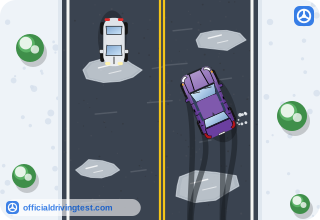
If your vehicle begins to skid, how should you steer?
- Turn the wheel away from the direction you want to go
- Hold the wheel straight and still
- Turn the wheel in the direction you want the vehicle to go
- Take your hands off the wheel
Show answer
Correct answer: Turn the wheel in the direction you want the vehicle to go
The manual says to turn the steering wheel in the direction you want the vehicle to go.
Source: Connecticut Driver's Manual (Revised March 2023), page 40 · Open this page in the manual (Manual page 40)
-
What should you do as soon as the skidding vehicle begins to straighten out?
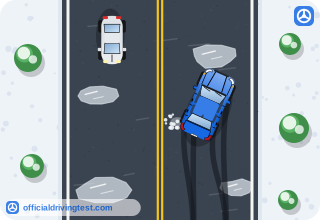
- Press hard on the brake pedal to stop
- Turn the steering wheel back the other way
- Let go of the steering wheel
- Press the gas pedal
Show answer
Correct answer: Turn the steering wheel back the other way
The manual says to turn the wheel back the other way as the vehicle begins to straighten out.
Source: Connecticut Driver's Manual (Revised March 2023), page 40 · Open this page in the manual (Manual page 40)
-
What may happen if you do not turn the steering wheel back as a skidding vehicle straightens out?
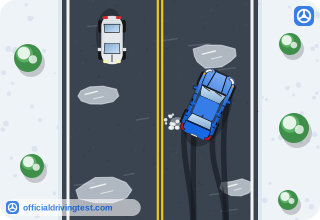
- The vehicle will stop at once
- The vehicle will straighten out on its own again
- The brakes will lock
- The vehicle may swing around in the other direction
Show answer
Correct answer: The vehicle may swing around in the other direction
The manual warns the vehicle may swing around in the other direction and you could start a new skid.
Source: Connecticut Driver's Manual (Revised March 2023), page 40 · Open this page in the manual (Manual page 40)
-
After starting to recover from a skid, how long should you continue to steer?
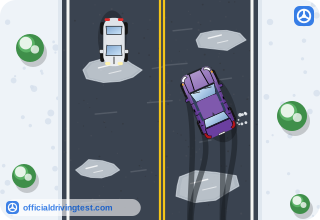
- Until the vehicle is moving down the road under your control
- Until the vehicle has slowed to 5 mph
- Until you have passed the next intersection
- Only until the vehicle first starts to straighten out
Show answer
Correct answer: Until the vehicle is moving down the road under your control
The manual says to keep correcting your steering, left and right, until the vehicle is again moving down the road under your control.
Source: Connecticut Driver's Manual (Revised March 2023), page 40 · Open this page in the manual (Manual page 40)
-
When should you stop at an accident you are not involved in?
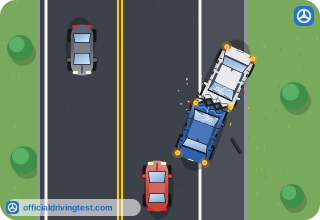
- Always, so you can look at the damage
- Only if you see smoke
- Only if emergency help has not yet arrived
- Only if the road is wet
Show answer
Correct answer: Only if emergency help has not yet arrived
The manual says not to stop at an accident unless you are involved or emergency help has not yet arrived.
Source: Connecticut Driver's Manual (Revised March 2023), page 41 · Open this page in the manual (Manual page 41)
-
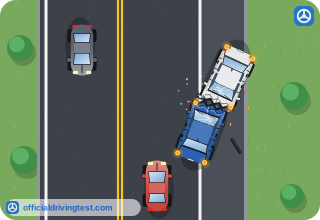
Why should you never drive to the scene of an accident, fire or other disaster just to look?
- It is a crime to look at a crash
- You may block the way for police, firefighters and other rescue vehicles
- Rescue workers will charge you for the cost of their response
- The police will take your license
Show answer
Correct answer: You may block the way for police, firefighters and other rescue vehicles
The manual says you may block the way for police, firefighters, ambulances, tow trucks and other rescue vehicles.
Source: Connecticut Driver's Manual (Revised March 2023), page 41 · Open this page in the manual (Manual page 41)
-
If you are involved in an accident with a parked vehicle, what must you do?
- Drive away if there is no damage
- Wait one hour and then leave
- Report it only if the owner calls you
- Try to locate the owner
Show answer
Correct answer: Try to locate the owner
The manual says you must try and locate the owner of the parked vehicle.
Source: Connecticut Driver's Manual (Revised March 2023), page 41 · Open this page in the manual (Manual page 41)
-
When is it a crime to leave a crash site in which your vehicle was involved?
- When the crash blocks one lane of traffic for more than ten minutes
- When you move your vehicle to the shoulder so it does not block traffic
- When someone is hurt or killed and police lack the information they need
- When the crash happens at night
Show answer
Correct answer: When someone is hurt or killed and police lack the information they need
The manual says it is a crime to leave such a crash site before police have talked to you and gotten all the information they need.
Source: Connecticut Driver's Manual (Revised March 2023), page 41 · Open this page in the manual (Manual page 41)
-
What does the manual say a basic vehicle emergency kit has?
- A fire extinguisher, a spare tire and a tow rope
- Emergency flares, first aid supplies and basic tools
- A flashlight, a map and drinking water
- A blanket, food and a cell phone
Show answer
Correct answer: Emergency flares, first aid supplies and basic tools
The manual says these kits have emergency flares, first aid supplies, and basic tools.
Source: Connecticut Driver's Manual (Revised March 2023), page 41 · Open this page in the manual (Manual page 41)
-
If your vehicle is hit from the rear, what should you do with your body?
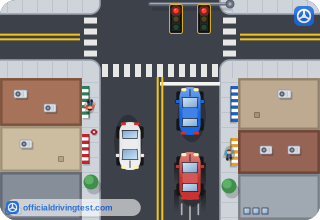
- Press yourself against the seat back and put your head against the head restraint
- Lean forward and brace yourself against the dashboard with both hands
- Turn sideways in the seat
- Duck below the dashboard
Show answer
Correct answer: Press yourself against the seat back and put your head against the head restraint
The manual says your body will be thrown backwards, so you press against the seat back and put your head against the head restraint.
Source: Connecticut Driver's Manual (Revised March 2023), page 41 · Open this page in the manual (Manual page 41)
-
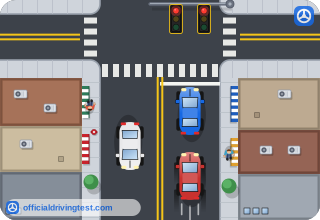
If your vehicle is hit from the rear, why should you be ready to apply your brakes?
- So the airbags will inflate
- So the head restraint will lock
- So you will not be pushed into another vehicle
- So the driver behind you has time to stop
Show answer
Correct answer: So you will not be pushed into another vehicle
The manual says to be ready to apply your brakes so that you will not be pushed into another vehicle.
Source: Connecticut Driver's Manual (Revised March 2023), page 41 · Open this page in the manual (Manual page 41)
-
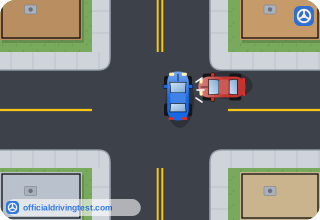
If your vehicle is hit from the side, in which direction will your body be thrown?
- Backward
- Toward the side that is hit
- Toward the side that is not hit
- Forward
Show answer
Correct answer: Toward the side that is hit
The manual says your body will be thrown towards the side that is hit.
Source: Connecticut Driver's Manual (Revised March 2023), page 41 · Open this page in the manual (Manual page 41)