Connecticut: Emergencies — Part 1 Practice Test
Questions in this part include: “If you cannot get your vehicle off the roadway, where should you try to stop?” · “What does the manual say you should follow to greatly reduce the chance of a vehicle problem?”
Independent educational site · not affiliated with any government agency or DMV
Ready? Test yourself
- Instant feedback with an explanation
- Every answer cites its source in the manual
- Your best score is saved on this device
Questions are original and based on the official manual "Connecticut Driver's Manual" (Revised March 2023), Connecticut Department of Motor Vehicles (DMV).
All 20 questions in this practice test
Take the test above first, then use this list to study. Tap “Show answer” to see the correct answer and explanation.
Show the questions and answersHide the questions
-
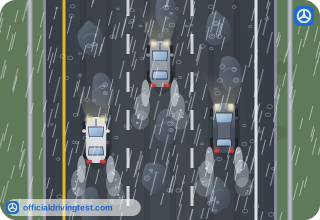
What is it called when your tires start to ride up on the water like water skis?
- Fishtailing
- Over-driving
- Hydroplaning
- Brake fade
Show answer
Correct answer: Hydroplaning
The manual calls it “hydroplaning” when tires ride up on the water like water skis as you go faster on a wet road.
Source: Connecticut Driver's Manual (Revised March 2023), page 25 · Open this page in the manual (Manual page 25)
-
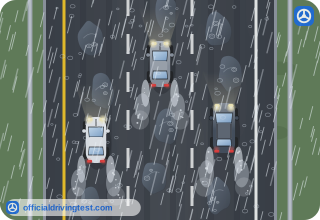
If it feels like your tires have lost traction with the road, what should you do with the gas pedal?
- Ease your foot off it
- Press it harder to regain control
- Hold it steady to keep your speed
- Tap it repeatedly
Show answer
Correct answer: Ease your foot off it
The manual lists easing your foot off the gas pedal as the first thing to do when the tires seem to have lost traction.
Source: Connecticut Driver's Manual (Revised March 2023), page 25 · Open this page in the manual (Manual page 25)
-
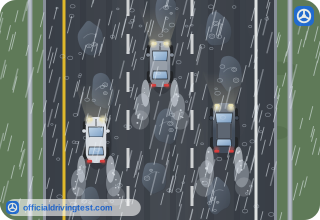
If your tires lose traction, how should you handle the steering wheel?
- Turn it sharply toward the road shoulder
- Turn it quickly back and forth to regain grip
- Keep it straight, turning only in an emergency
- Turn it gently toward the center of the road
Show answer
Correct answer: Keep it straight, turning only in an emergency
The manual says to keep the steering wheel straight and to turn only in an emergency, and then slowly.
Source: Connecticut Driver's Manual (Revised March 2023), page 25 · Open this page in the manual (Manual page 25)
-
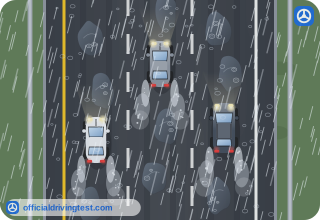
After your tires lose traction, when should you try to stop or turn?
- Immediately, before the vehicle gains speed
- Not until the tires grip the road again
- As soon as the vehicle begins to slow
- Once you have steered toward the shoulder
Show answer
Correct answer: Not until the tires grip the road again
The manual says not to try to stop or turn until your tires are gripping the road again.
Source: Connecticut Driver's Manual (Revised March 2023), page 25 · Open this page in the manual (Manual page 25)
-
In a very heavy downpour, you may not be able to see well enough to drive. What should you do?
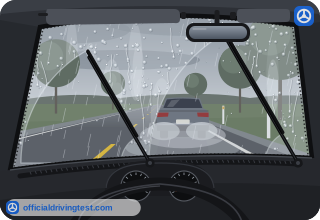
- Pull off the road in a safe place and wait until it clears
- Turn on your parking lights and keep driving slowly
- Use your high beams and keep a steady speed
- Stop in the traffic lane and turn on your flashers
Show answer
Correct answer: Pull off the road in a safe place and wait until it clears
The manual says to pull off the road in a safe place and wait until the downpour clears.
Source: Connecticut Driver's Manual (Revised March 2023), page 38 · Open this page in the manual (Manual page 38)
-
Your vehicle breaks down on a highway. What should you do first if at all possible?
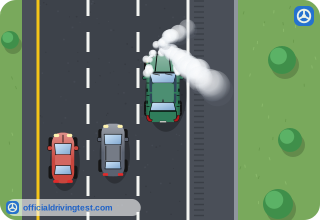
- Stop where it is and wait for help
- Change the tire in the traffic lane
- Leave it and walk along the roadway
- Get it off the road and away from traffic
Show answer
Correct answer: Get it off the road and away from traffic
The manual says to get your vehicle off the road and away from traffic if at all possible.
Source: Connecticut Driver's Manual (Revised March 2023), page 39 · Open this page in the manual (Manual page 39)
-
What should you turn on to show that your vehicle is having trouble?
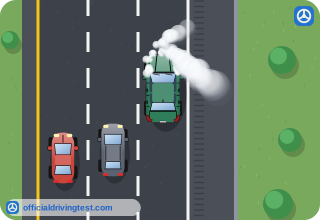
- Your emergency flashers
- Your high beams
- Your parking lights
- Your windshield wipers
Show answer
Correct answer: Your emergency flashers
The manual says to turn on your emergency flashers to show you are having trouble.
Source: Connecticut Driver's Manual (Revised March 2023), page 39 · Open this page in the manual (Manual page 39)
-
If you cannot get your vehicle off the roadway, where should you try to stop?
- Just over a hill so it is hidden from traffic
- Just around a curve
- Where other drivers have a clear view of your vehicle
- In the middle lane
Show answer
Correct answer: Where other drivers have a clear view of your vehicle
You should stop where other drivers can see you, not just over a hill or just around a curve.
Source: Connecticut Driver's Manual (Revised March 2023), page 39 · Open this page in the manual (Manual page 39)
-
Where should you place emergency flares when your vehicle is stalled?
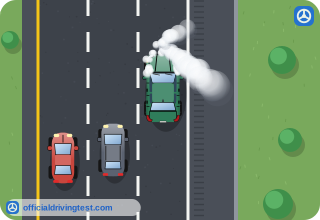
- In front of the vehicle
- Behind the vehicle
- Beside the driver's door
- On the roof of the vehicle
Show answer
Correct answer: Behind the vehicle
Flares placed behind the vehicle allow other drivers to change lanes if necessary.
Source: Connecticut Driver's Manual (Revised March 2023), page 39 · Open this page in the manual (Manual page 39)
-
You have no emergency flares or other warning devices. What can you do?
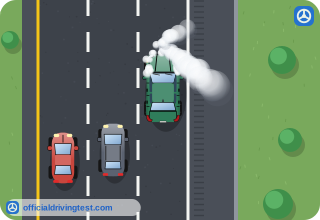
- Stand in the lane behind your vehicle and wave traffic around it
- Sit in the car and sound your horn continuously
- Walk ahead of your vehicle to warn traffic
- Stand safely beside the road and wave traffic around your vehicle
Show answer
Correct answer: Stand safely beside the road and wave traffic around your vehicle
The manual says to stand by the side of the road where you are safe from traffic and wave traffic around, using a white cloth if you have one.
Source: Connecticut Driver's Manual (Revised March 2023), page 39 · Open this page in the manual (Manual page 39)
-
Which should you never do when your vehicle has a flat tire in a traffic lane?
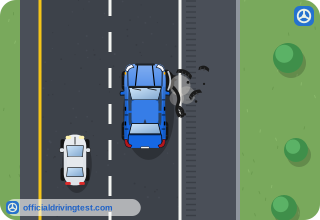
- Try to change the tire in the traffic lane
- Turn on your emergency flashers
- Place flares behind the vehicle
- Lift the hood to signal an emergency
Show answer
Correct answer: Try to change the tire in the traffic lane
The manual says never to stand in the roadway and not to change a tire if it means being in a traffic lane.
Source: Connecticut Driver's Manual (Revised March 2023), page 39 · Open this page in the manual (Manual page 39)
-
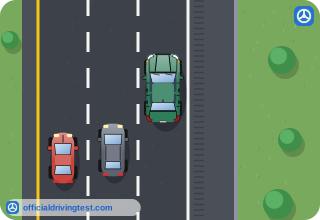
Which is a way to signal an emergency when your vehicle has broken down?
- Turn off all lights and wait inside the vehicle
- Turn on your high beams and your wipers
- Lift the hood or tie a white cloth to the antenna
- Park with your wheels turned toward the road
Show answer
Correct answer: Lift the hood or tie a white cloth to the antenna
The manual says to lift the hood or tie a white cloth to the antenna, side mirror or door handle.
Source: Connecticut Driver's Manual (Revised March 2023), page 39 · Open this page in the manual (Manual page 39)
-
If your vehicle breaks down on a highway, whom should you notify?
- Only the nearest relative
- The authorities
- The driver behind you
- The vehicle's manufacturer
Show answer
Correct answer: The authorities
The manual says to notify authorities that your vehicle, or someone else's, has broken down.
Source: Connecticut Driver's Manual (Revised March 2023), page 39 · Open this page in the manual (Manual page 39)
-
What does the manual say you should follow to greatly reduce the chance of a vehicle problem?
- The maintenance advice of other drivers
- A yearly road test given by the DMV
- A schedule of repairs posted by the DMV
- The recommended maintenance schedule
Show answer
Correct answer: The recommended maintenance schedule
Following the maintenance schedule listed in the vehicle owner's manual greatly reduces the chance of a problem.
Source: Connecticut Driver's Manual (Revised March 2023), page 39 · Open this page in the manual (Manual page 39)
-
If your brakes stop working, what should you do first?
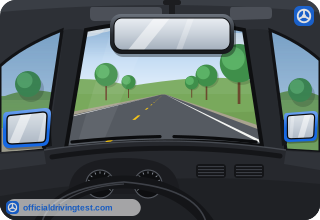
- Pump the brake pedal several times
- Pull on the parking brake handle quickly
- Shift to a lower gear
- Turn off the engine
Show answer
Correct answer: Pump the brake pedal several times
Pumping the brake pedal several times will often build up enough brake pressure to allow you to stop.
Source: Connecticut Driver's Manual (Revised March 2023), page 39 · Open this page in the manual (Manual page 39)
-
If pumping the pedal does not restore your brakes, how should you use the parking brake?
- Pull the handle quickly and hold it all the way up
- Hold it down firmly and never release it if you skid
- Pull the handle slowly to avoid locking the rear wheels
- Pull it only after you have shifted the gear to park
Show answer
Correct answer: Pull the handle slowly to avoid locking the rear wheels
Pulling slowly keeps you from locking the rear wheels and causing a skid; be ready to release it if the vehicle skids.
Source: Connecticut Driver's Manual (Revised March 2023), page 39 · Open this page in the manual (Manual page 39)
-
If neither pumping the brakes nor the parking brake works, what should you do?
- Drive on slowly to the nearest repair shop
- Shift to lower gears and look for a safe place to stop
- Speed up to reach the next exit quickly
- Steer toward other vehicles to help slow you down
Show answer
Correct answer: Shift to lower gears and look for a safe place to stop
The manual says to shift to lower gears, look for a safe place to stop, and never drive the vehicle without brakes.
Source: Connecticut Driver's Manual (Revised March 2023), page 39 · Open this page in the manual (Manual page 39)
-
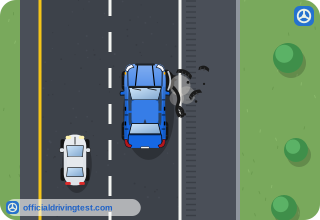
A tire suddenly goes flat. How should you hold the steering wheel?
- Loosely, letting the car drift with the flat tire
- Sharply toward the shoulder as fast as possible
- With one hand, so the other can work the brakes
- Tightly, keeping the vehicle going straight
Show answer
Correct answer: Tightly, keeping the vehicle going straight
The manual says to hold the steering wheel tightly and keep the vehicle going straight.
Source: Connecticut Driver's Manual (Revised March 2023), page 39 · Open this page in the manual (Manual page 39)
-
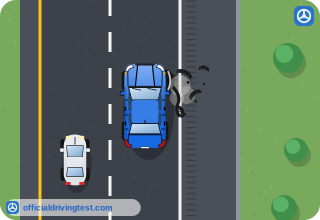
After a tire blowout, how should you slow down?
- Gradually, easing off the gas and using the brakes lightly
- Quickly, pressing the brake pedal as hard as you can
- By shifting to park as soon as the tire goes flat
- By steering sharply off the road at full speed
Show answer
Correct answer: Gradually, easing off the gas and using the brakes lightly
The manual says to slow down gradually, take your foot off the gas, and use the brakes lightly.
Source: Connecticut Driver's Manual (Revised March 2023), page 39 · Open this page in the manual (Manual page 39)
-
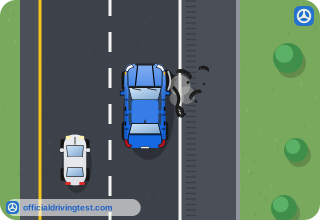
After a tire blowout, what should you do if at all possible?
- Stop in the lane and turn on your flashers
- Stop right away on the road
- Pull off the road in a safe place
- Keep driving until you reach a repair shop
Show answer
Correct answer: Pull off the road in a safe place
The manual says not to stop on the road if at all possible, but to pull off in a safe place.
Source: Connecticut Driver's Manual (Revised March 2023), page 39 · Open this page in the manual (Manual page 39)