Colorado: Signals and vehicle controls
Turn signals and hand signals, mirrors, steering and hand position, starting, stopping, backing up and keeping your vehicle in safe condition. Split into 4 shorter tests so you're not stuck in one long quiz.
Independent educational site · not affiliated with any government agency or DMV
Choose a part
Signals and vehicle controls — Part 1
Questions in this part include: “On the drive test, within how many seconds of turning or changing lanes should your turn signal be cancelled?”
StartSignals and vehicle controls — Part 2
Questions in this part include: “After starting the vehicle, what should you check to be sure it does not need maintenance?”
StartSignals and vehicle controls — Part 3
Questions in this part include: “What is the handbook's rule on signaling before a turn?”
StartSignals and vehicle controls — Part 4
Questions in this part include: “What does the handbook say about driving with only your parking lights on?”
StartAll 79 Signals and vehicle controls questions with answers
Choose a part above to take a practice test, or study every question and answer here.
Show the questions and answersHide the questions
-
On the drive test, within how many seconds of turning or changing lanes should your turn signal be cancelled?
- 1 second
- 5 seconds
- 10 seconds
- 3 seconds
Show answer
Correct answer: 3 seconds
The turn signal should be cancelled within 3 seconds of turning or changing lanes.
Source: Colorado Driver Handbook (DR 2337, January 2025), page 2 · Open this page in the manual (Manual page 2)
-
According to the handbook, who is responsible for ensuring the vehicles they drive are safe to operate?
- Only vehicle manufacturers
- Only mechanics
- Motorists
- The state
Show answer
Correct answer: Motorists
Motorists are responsible for making sure the vehicles they drive are safe to operate.
Source: Colorado Driver Handbook (DR 2337, January 2025), page 6 · Open this page in the manual (Manual page 6)
-
Besides being unsafe and costing more to drive, what else can a vehicle in poor operating condition result in?
- An automatic license suspension
- A citation from law enforcement
- A required retest of the driver
- Cancellation of the vehicle registration
Show answer
Correct answer: A citation from law enforcement
A vehicle in poor operating condition can result in a citation from law enforcement.
Source: Colorado Driver Handbook (DR 2337, January 2025), page 6 · Open this page in the manual (Manual page 6)
-
If the brakes do not seem to be working properly, what should you do?
- Wait until the next routine service
- Pump them hard while driving
- Drive only on flat roads
- Have a mechanic check them immediately
Show answer
Correct answer: Have a mechanic check them immediately
The handbook says to have a mechanic check the brakes immediately.
Source: Colorado Driver Handbook (DR 2337, January 2025), page 6 · Open this page in the manual (Manual page 6)
-
Which of these lights does the handbook say to make sure is operating properly?
- Interior dome lights
- Cargo-area work lights
- Brake lights
- Decorative underbody lights
Show answer
Correct answer: Brake lights
The handbook lists turn signals, brake lights, tail lights and headlights.
Source: Colorado Driver Handbook (DR 2337, January 2025), page 6 · Open this page in the manual (Manual page 6)
-
What does the handbook say to do if the windshield glass is damaged?
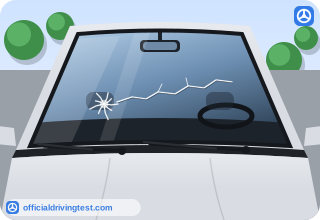
- Get the windshield replaced
- Cover the damage with tape
- Drive only in daylight
- Wait until the damage spreads
Show answer
Correct answer: Get the windshield replaced
Damaged glass can break easily or obstruct vision, so the windshield should be replaced.
Source: Colorado Driver Handbook (DR 2337, January 2025), page 6 · Open this page in the manual (Manual page 6)
-
Where should you clear snow, ice or frost from before driving?
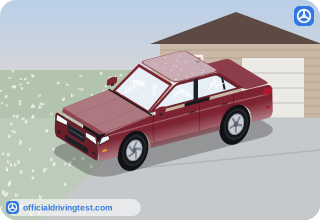
- Only the windshield
- Only the front and rear windows
- Only the driver’s side window
- All windows
Show answer
Correct answer: All windows
The handbook says to clear snow, ice or frost from all windows.
Source: Colorado Driver Handbook (DR 2337, January 2025), page 6 · Open this page in the manual (Manual page 6)
-
Which of these can worn or bald tires cause?
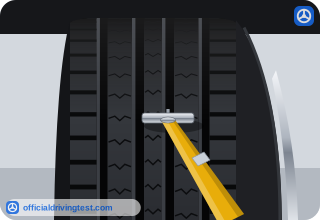
- Shorter stopping distance
- Increased stopping distance
- Better fuel economy
- Easier turning
Show answer
Correct answer: Increased stopping distance
Worn or bald tires increase stopping distance, make turning harder and can cause hydroplaning.
Source: Colorado Driver Handbook (DR 2337, January 2025), page 6 · Open this page in the manual (Manual page 6)
-
What do unbalanced wheels and low tire pressure do?
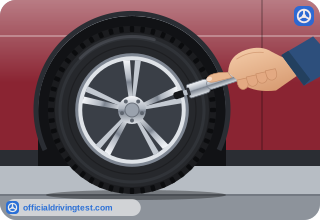
- Increase tire wear and make steering and stopping harder
- Improve fuel economy and make the vehicle steer easier
- Reduce tire wear but lengthen the stopping distance
- Only affect the ride, never tire wear or steering
Show answer
Correct answer: Increase tire wear and make steering and stopping harder
They increase tire wear, reduce fuel economy and make the vehicle harder to steer and stop.
Source: Colorado Driver Handbook (DR 2337, January 2025), page 6 · Open this page in the manual (Manual page 6)
-
If the vehicle bounces, the steering wheel shakes or the vehicle pulls to one side, what should you have a mechanic check?
- Your horn
- Your windshield wipers
- Your tires
- Your headlights
Show answer
Correct answer: Your tires
The handbook says to have a mechanic check your tires.
Source: Colorado Driver Handbook (DR 2337, January 2025), page 6 · Open this page in the manual (Manual page 6)
-
If the vehicle is hard to turn, what should you do?
- Turn the wheel with the palm of your hand
- Have the steering checked by a mechanic
- Replace the windshield wipers and blades
- Change the engine oil and wait a week
Show answer
Correct answer: Have the steering checked by a mechanic
The handbook says to have the steering checked by a mechanic.
Source: Colorado Driver Handbook (DR 2337, January 2025), page 6 · Open this page in the manual (Manual page 6)
-
What may you need if the vehicle bounces excessively or keeps bouncing after a bump or after you stop?
- New brake lights and tail lights
- A new steering wheel and column
- New windshield wipers and blades
- New shocks or other suspension parts
Show answer
Correct answer: New shocks or other suspension parts
Excessive bouncing may mean you need new shocks or other suspension parts.
Source: Colorado Driver Handbook (DR 2337, January 2025), page 6 · Open this page in the manual (Manual page 6)
-
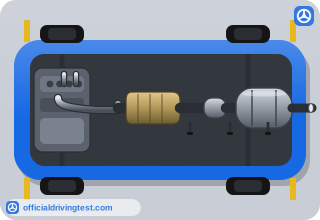
What can fumes from a leaky exhaust system cause?
- Slower acceleration only
- Cloudy windshields only
- Death in a very short time
- Damage to the tires
Show answer
Correct answer: Death in a very short time
Fumes from a leaky exhaust system can cause death in a very short time.
Source: Colorado Driver Handbook (DR 2337, January 2025), page 6 · Open this page in the manual (Manual page 6)
-
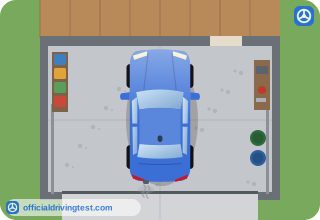
What does the handbook say about running the motor in your garage?
- Never do it
- Do it only with the garage door closed
- Do it only for a few minutes
- Do it only in cold weather
Show answer
Correct answer: Never do it
The handbook says never to run the motor in your garage because of exhaust fumes.
Source: Colorado Driver Handbook (DR 2337, January 2025), page 6 · Open this page in the manual (Manual page 6)
-
Which of these can a poorly tuned engine cause?
- It makes the tires wear less
- It improves fuel economy
- It lowers the noise of the exhaust
- It could stall while you are driving
Show answer
Correct answer: It could stall while you are driving
A poorly tuned engine can lose power, get poor fuel economy, pollute and stall on the road.
Source: Colorado Driver Handbook (DR 2337, January 2025), page 6 · Open this page in the manual (Manual page 6)
-
How often does the handbook say the horn should be checked?
- Only once a year
- Regularly
- Only before long trips
- Never, because it is not needed
Show answer
Correct answer: Regularly
The handbook says the horn should be checked regularly.
Source: Colorado Driver Handbook (DR 2337, January 2025), page 6 · Open this page in the manual (Manual page 6)
-
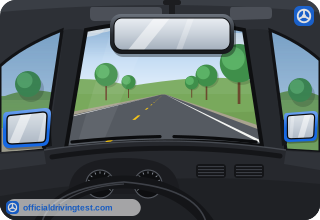
How does the handbook say to set the driver’s side mirror?
- Head against the left window, barely seeing the side of the car
- Head centered, so you see none of your car
- Head upright, so you see the whole side of your car
- Head against the right window, so you see the rear bumper
Show answer
Correct answer: Head against the left window, barely seeing the side of the car
Place your head against the left side window and set the mirror so you can barely see the side of the car.
Source: Colorado Driver Handbook (DR 2337, January 2025), page 6 · Open this page in the manual (Manual page 6)
-
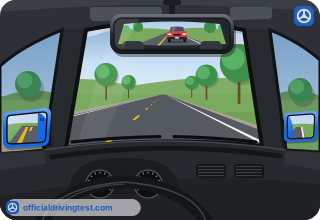
How does the handbook say to position your head to adjust the passenger’s side mirror?
- Against the right side window, as far over as possible
- Leaning toward the steering wheel and the dashboard area
- Centered under the inside rearview mirror or above the console
- Turned fully toward the back seat and the rear window
Show answer
Correct answer: Centered under the inside rearview mirror or above the console
Position your head centered under the inside rearview mirror or just above the center console.
Source: Colorado Driver Handbook (DR 2337, January 2025), page 6 · Open this page in the manual (Manual page 6)
-
What should you make sure of regarding objects on the floor of the vehicle?
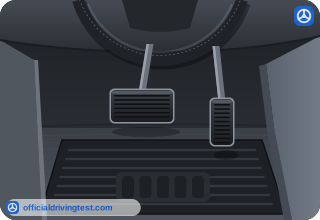
- They are stored near the pedals within easy reach
- None could roll under the brake pedal or accelerator
- They are placed under the front seat for safekeeping
- They are pinned in place by your feet on the floor
Show answer
Correct answer: None could roll under the brake pedal or accelerator
Objects on the floor could roll under the brake pedal or accelerator and interfere with safe driving.
Source: Colorado Driver Handbook (DR 2337, January 2025), page 6 · Open this page in the manual (Manual page 6)
-
How should head rests be adjusted?
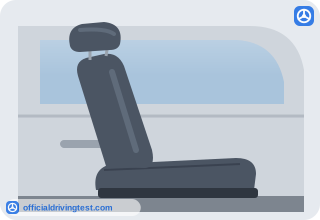
- As low as they will go to stay out of the way
- So they sit level with your shoulders and neck
- So they tilt away from the back of your head
- So the head restraint touches the back of your head
Show answer
Correct answer: So the head restraint touches the back of your head
The head restraint should touch the back of your head.
Source: Colorado Driver Handbook (DR 2337, January 2025), page 6 · Open this page in the manual (Manual page 6)
-
Where should your right foot be before starting the vehicle?
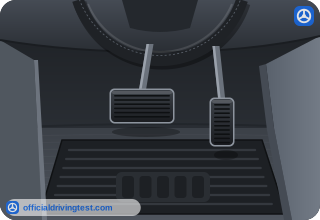
- On the accelerator
- On the floor beside the pedals
- On the brake
- On the clutch only
Show answer
Correct answer: On the brake
No matter the make and model, your right foot should be on the brake before starting the vehicle.
Source: Colorado Driver Handbook (DR 2337, January 2025), page 6 · Open this page in the manual (Manual page 6)
-
After starting the vehicle, what should you check to be sure it does not need maintenance?
- Indicator lights and gauges
- The tire tread depth only
- The windshield glass only
- The glove compartment contents
Show answer
Correct answer: Indicator lights and gauges
The handbook says to check indicator lights and gauges.
Source: Colorado Driver Handbook (DR 2337, January 2025), page 6 · Open this page in the manual (Manual page 6)
-
Before moving the vehicle, what should you check for?
- Only traffic directly ahead of the vehicle
- Only vehicles in the opposite lane of traffic
- Only pedestrians on the right side of the road
- Traffic or pedestrians to the sides and behind
Show answer
Correct answer: Traffic or pedestrians to the sides and behind
Look for a safe path and check for traffic or pedestrians to the sides and behind.
Source: Colorado Driver Handbook (DR 2337, January 2025), page 6 · Open this page in the manual (Manual page 6)
-
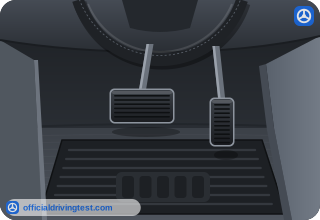
How should you press the accelerator when moving the vehicle?
- Firmly, with your whole foot flat on the pedal
- Gently, ball of the foot on the pedal and heel on the floor
- Gently, with your heel on the pedal and toes on the floor
- Quickly, with the ball of your foot lifted off the floor
Show answer
Correct answer: Gently, ball of the foot on the pedal and heel on the floor
Press gently with the ball of your foot on the pedal and the heel on the floor.
Source: Colorado Driver Handbook (DR 2337, January 2025), page 6 · Open this page in the manual (Manual page 6)
-
What should you do first when stopping the vehicle?
- Check your mirrors for traffic to the rear
- Shift the vehicle into the park position
- Press the brake pedal as hard as you can
- Turn on the hazard lights before braking
Show answer
Correct answer: Check your mirrors for traffic to the rear
The first step in stopping is to check your mirrors for traffic to the rear.
Source: Colorado Driver Handbook (DR 2337, January 2025), page 6 · Open this page in the manual (Manual page 6)
-
How should you press the brake pedal to stop the vehicle?
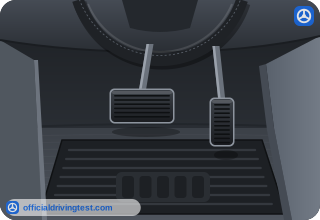
- In quick pumping motions until it stops
- With sudden hard pressure at the last moment
- With steady pressure until the vehicle stops
- With light taps while the vehicle coasts down
Show answer
Correct answer: With steady pressure until the vehicle stops
Press with steady pressure until the vehicle comes to a stop.
Source: Colorado Driver Handbook (DR 2337, January 2025), page 6 · Open this page in the manual (Manual page 6)
-
In which direction is the steering wheel always turned?
- Opposite to the direction you want to go in reverse
- The direction you want the vehicle to move
- Toward the center of the road
- In the direction of the car behind you
Show answer
Correct answer: The direction you want the vehicle to move
The wheel is always turned the way you want the vehicle to move, forward or in reverse.
Source: Colorado Driver Handbook (DR 2337, January 2025), page 6 · Open this page in the manual (Manual page 6)
-
Which hand positions give better vehicle control?
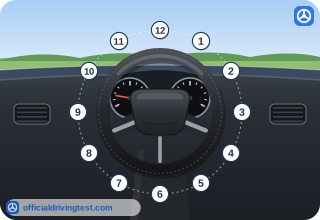
- 10 and 2 o’clock positions only
- 12 and 6 o’clock positions only
- 1 and 7 o’clock positions only
- 3 and 9 o’clock or 4 and 8 o’clock
Show answer
Correct answer: 3 and 9 o’clock or 4 and 8 o’clock
The handbook recommends the 3 and 9 or the 4 and 8 o’clock positions.
Source: Colorado Driver Handbook (DR 2337, January 2025), page 6 · Open this page in the manual (Manual page 6)
-
How should your grip on the steering wheel be?
- Tight and strong, using the palms of your hands
- Loose and relaxed, using only one hand at a time
- Firm but gentle, using fingers rather than palms
- Firm, with your wrists resting on the wheel
Show answer
Correct answer: Firm but gentle, using fingers rather than palms
Grip firm but gentle, with fingers rather than palms.
Source: Colorado Driver Handbook (DR 2337, January 2025), page 6 · Open this page in the manual (Manual page 6)
-
What should you never do with your hands when turning the steering wheel?
- Grip the inside of the wheel
- Keep your thumbs up along the face of the wheel
- Hold both hands on the outside of the wheel
- Use your fingers to hold the wheel
Show answer
Correct answer: Grip the inside of the wheel
The handbook says never to grip the inside of the steering wheel when turning it.
Source: Colorado Driver Handbook (DR 2337, January 2025), page 6 · Open this page in the manual (Manual page 6)
-
Why should you check behind your vehicle before you get in to back up?
- Children and small objects cannot be seen from the driver's seat
- The rear lights must be checked before the engine starts
- Other drivers expect you to walk around your vehicle
- Your mirrors cannot be adjusted once you are seated
Show answer
Correct answer: Children and small objects cannot be seen from the driver's seat
The manual says children and small objects cannot be seen from the driver's seat, so you check behind the vehicle first.
Source: Colorado Driver Handbook (DR 2337, January 2025), page 7 · Open this page in the manual (Manual page 7)
-
To back up safely, where do you grasp the steering wheel with your left hand?
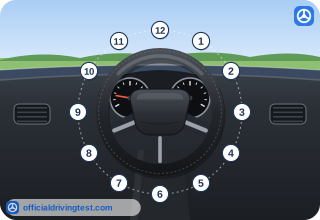
- At the 3 o'clock position
- At the 6 o'clock position
- At the 12 o'clock position
- At the 9 o'clock position
Show answer
Correct answer: At the 12 o'clock position
The manual says to grasp the steering wheel at the 12 o'clock position with your left hand.
Source: Colorado Driver Handbook (DR 2337, January 2025), page 7 · Open this page in the manual (Manual page 7)
-
When backing up, where do you place your right arm and where do you look?
- On the door window frame, looking only in your side mirrors while you reverse
- On the back of the passenger seat, looking over your shoulder through the rear window
- On the steering wheel, looking only at the rear view mirror as you reverse
- On the dashboard, looking straight ahead through the windshield as you reverse
Show answer
Correct answer: On the back of the passenger seat, looking over your shoulder through the rear window
The manual says to place your right arm on the back of the passenger seat and look directly over your shoulder through the rear window.
Source: Colorado Driver Handbook (DR 2337, January 2025), page 7 · Open this page in the manual (Manual page 7)
-
What do your mirrors NOT show you when you are backing up?
- The cars traveling far behind your vehicle
- The signs on the far side of the road
- The hood of your own vehicle
- The area immediately behind your vehicle
Show answer
Correct answer: The area immediately behind your vehicle
The manual warns that your mirrors do not show the area immediately behind your vehicle.
Source: Colorado Driver Handbook (DR 2337, January 2025), page 7 · Open this page in the manual (Manual page 7)
-
If your vehicle has a rear view camera, how should you use it when backing up?
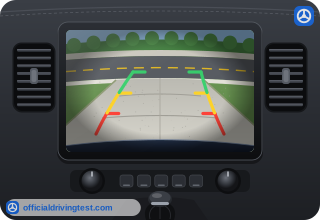
- In addition to checking over your shoulder and using your mirrors
- Instead of checking over your shoulder or using your mirrors
- Only when it is dark outside and visibility is poor
- Only when backing up with a trailer attached
Show answer
Correct answer: In addition to checking over your shoulder and using your mirrors
The manual says to use the rear view camera in addition to checking over your shoulder and using your mirrors.
Source: Colorado Driver Handbook (DR 2337, January 2025), page 7 · Open this page in the manual (Manual page 7)
-
Before backing up, what do you do with your foot and the gear shift?
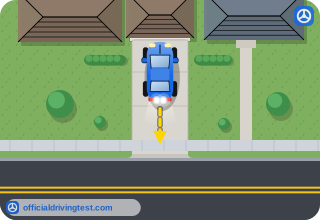
- Press the accelerator, then shift to reverse
- Place your foot on the brake and shift to neutral
- Place your foot on the brake and shift to reverse
- Release the brake and shift to park
Show answer
Correct answer: Place your foot on the brake and shift to reverse
The manual says to place your foot on the brake and shift to reverse.
Source: Colorado Driver Handbook (DR 2337, January 2025), page 7 · Open this page in the manual (Manual page 7)
-
How should you accelerate when backing up?
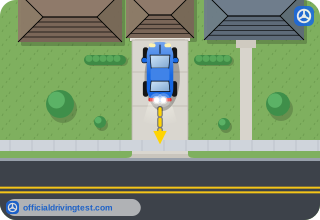
- Quickly, to clear the area fast
- Gently, smoothly and slowly
- Firmly, to stay ahead of traffic
- Only in short sudden bursts
Show answer
Correct answer: Gently, smoothly and slowly
The manual says to accelerate gently, smoothly and slowly when backing up.
Source: Colorado Driver Handbook (DR 2337, January 2025), page 7 · Open this page in the manual (Manual page 7)
-
When backing up, which way should you steer?
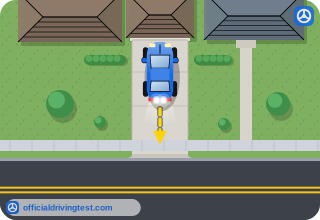
- Slightly in the direction the front of the vehicle should move
- Sharply away from the direction the rear should move
- Straight, with the wheels centered until you stop
- Slightly in the direction the rear of the vehicle should move
Show answer
Correct answer: Slightly in the direction the rear of the vehicle should move
You steer slightly in the direction the rear of the vehicle should move.
Source: Colorado Driver Handbook (DR 2337, January 2025), page 7 · Open this page in the manual (Manual page 7)
-
If you are backing up while turning, what should you also do?
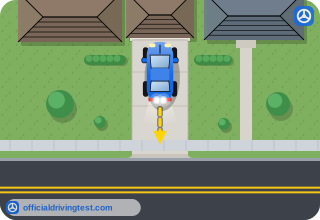
- Make quick checks to the front and sides
- Turn on your hazard lights and sound the horn continuously
- Shift to neutral and coast through the turn
- Stop and shift to drive between each turn
Show answer
Correct answer: Make quick checks to the front and sides
The manual says that when backing up while turning, you make quick checks to the front and sides.
Source: Colorado Driver Handbook (DR 2337, January 2025), page 7 · Open this page in the manual (Manual page 7)
-
Until when should you continue looking to the rear when backing up?
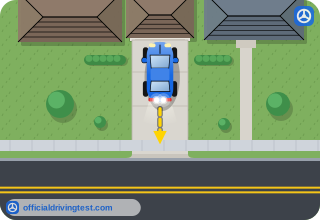
- Until the vehicle has moved one car length
- Until the rear wheels reach the street
- Until you come to a complete stop
- Until the front of the vehicle clears the curb
Show answer
Correct answer: Until you come to a complete stop
The manual says to continue looking to the rear until coming to a complete stop.
Source: Colorado Driver Handbook (DR 2337, January 2025), page 7 · Open this page in the manual (Manual page 7)
-
What is the handbook's rule on signaling before a turn?
- Signaling is only advised in urban areas
- Signaling is needed only when other vehicles are nearby
- Signaling is required only when turning onto another roadway
- Failure to signal is a traffic violation
Show answer
Correct answer: Failure to signal is a traffic violation
The handbook states that failure to signal is a traffic violation.
Source: Colorado Driver Handbook (DR 2337, January 2025), page 12 · Open this page in the manual (Manual page 12)
-
In which of these situations does the handbook say you should signal?
- Into a parking lot or when leaving a parked position
- Only when turning onto another roadway
- Only when other drivers are close enough to see you
- Only at intersections with traffic lights
Show answer
Correct answer: Into a parking lot or when leaving a parked position
You signal before any turn, whether onto another roadway, into a parking lot, into another lane or leaving a parked position.
Source: Colorado Driver Handbook (DR 2337, January 2025), page 12 · Open this page in the manual (Manual page 12)
-
In urban areas, for how far must you signal continuously before making a turn or lane change?
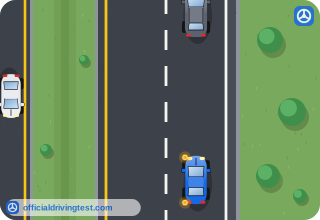
- 50 feet
- 200 feet
- 100 feet
- 500 feet
Show answer
Correct answer: 100 feet
In urban areas you must signal continuously for 100 feet before a turn or lane change.
Source: Colorado Driver Handbook (DR 2337, January 2025), page 12 · Open this page in the manual (Manual page 12)
-
On four lane highways where the posted speed limit is faster than 40 mph, for how far must you signal before making a turn or lane change?
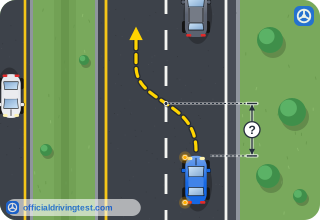
- 100 feet
- 200 feet
- 300 feet
- 500 feet
Show answer
Correct answer: 200 feet
On four lane highways where the limit is faster than 40 mph, you must signal for 200 feet.
Source: Colorado Driver Handbook (DR 2337, January 2025), page 12 · Open this page in the manual (Manual page 12)
-
What is a typical rule of thumb for how long to have your turn signal on before making a turn or changing lanes?
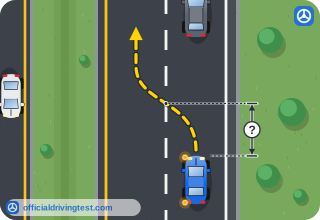
- At least 1 second
- At least 10 seconds
- Until you see the other drivers react
- At least 3 seconds
Show answer
Correct answer: At least 3 seconds
The handbook gives a rule of thumb of at least 3 seconds.
Source: Colorado Driver Handbook (DR 2337, January 2025), page 12 · Open this page in the manual (Manual page 12)
-
What must you use if your vehicle's turn signals do not work?
- Hand signals
- Your hazard lights
- Your headlights flashing
- Your horn
Show answer
Correct answer: Hand signals
If your turn signals do not work, you must use hand signals.
Source: Colorado Driver Handbook (DR 2337, January 2025), page 12 · Open this page in the manual (Manual page 12)
-
When should you end a hand signal?
- After you have completed the turn
- When you reach the middle of the intersection ahead
- Before starting to turn, so both hands are on the wheel
- Only after the vehicle behind you has passed
Show answer
Correct answer: Before starting to turn, so both hands are on the wheel
You end the hand signal before starting to turn so that both hands are on the wheel for the turn.
Source: Colorado Driver Handbook (DR 2337, January 2025), page 12 · Open this page in the manual (Manual page 12)
-
If your turn signals do not work, which hand signal shows that you are turning left?
- Left arm extended straight out
- Left arm bent upward at the elbow
- Left arm bent downward at the elbow
- Left arm waved up and down
Show answer
Correct answer: Left arm extended straight out
The handbook’s hand-signal figure shows a left turn as the left arm extended straight out.
Source: Colorado Driver Handbook (DR 2337, January 2025), page 12 · Open this page in the manual (Manual page 12)
-
What does a hand signal with the left arm bent downward at the elbow mean?
- Turning left
- Turning right
- Slowing down or stopping
- Asking others to pass
Show answer
Correct answer: Slowing down or stopping
The handbook’s hand-signal figure shows slow/stop as the left arm bent downward.
Source: Colorado Driver Handbook (DR 2337, January 2025), page 12 · Open this page in the manual (Manual page 12)
-
If your turn signals do not work, which hand signal shows that you are turning right?
- Left arm extended straight out
- Left arm bent downward at the elbow
- Left arm waved in a circle
- Left arm bent upward at the elbow
Show answer
Correct answer: Left arm bent upward at the elbow
The handbook’s hand-signal figure shows a right turn as the left arm bent upward.
Source: Colorado Driver Handbook (DR 2337, January 2025), page 12 · Open this page in the manual (Manual page 12)
-
Which of these actions counts as changing lanes?
- Slowing down while staying in the same lane
- Stopping at a stop line at an intersection
- Merging onto a roadway from an entrance ramp
- Backing into a parking space at the curb
Show answer
Correct answer: Merging onto a roadway from an entrance ramp
The handbook says changing lanes includes changing from one lane to another, passing, merging from an entrance ramp and entering the roadway from the curb or shoulder.
Source: Colorado Driver Handbook (DR 2337, January 2025), page 15 · Open this page in the manual (Manual page 15)
-
Before you change lanes, where must you check for hazards or vehicles?
- Only in your mirrors
- Ahead, to the side and behind your vehicle
- Only ahead and in the lane you are leaving
- Only over your shoulder
Show answer
Correct answer: Ahead, to the side and behind your vehicle
You must check for traffic ahead, to the side and behind your vehicle before you change lanes.
Source: Colorado Driver Handbook (DR 2337, January 2025), page 15 · Open this page in the manual (Manual page 15)
-
What is a blind spot?
- An area directly ahead of your vehicle that the hood of your vehicle hides from view
- An area directly behind your vehicle that your rear window and trunk hide from view
- An area far ahead of your vehicle that your headlights do not light at night
- An area slightly to the rear and sides of your vehicle that you cannot see in your mirrors
Show answer
Correct answer: An area slightly to the rear and sides of your vehicle that you cannot see in your mirrors
Blind spots are areas you cannot see in your rear view or side view mirrors, slightly to the sides and rear of your vehicle.
Source: Colorado Driver Handbook (DR 2337, January 2025), page 15 · Open this page in the manual (Manual page 15)
-
How do you check your blind spot before changing lanes?
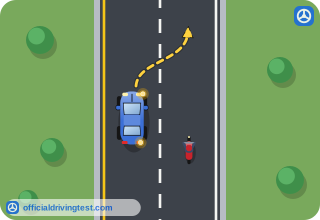
- Look over your shoulder
- Look in the rearview mirror only
- Look in the side mirror only
- Look at the vehicle ahead
Show answer
Correct answer: Look over your shoulder
The handbook says to look over your shoulder to check your blind spot.
Source: Colorado Driver Handbook (DR 2337, January 2025), page 15 · Open this page in the manual (Manual page 15)
-
After you are centered in the new lane following a lane change, what should you do?
- Look over your shoulder once again
- Brake to see how traffic reacts to you
- Check the mirror for traffic behind you
- Turn on your hazard lights briefly
Show answer
Correct answer: Check the mirror for traffic behind you
The handbook says that after you are centered in the new lane you check the mirror for traffic behind you.
Source: Colorado Driver Handbook (DR 2337, January 2025), page 15 · Open this page in the manual (Manual page 15)
-
When should you deactivate your turn signal after a lane change?
- After 10 seconds in the new lane
- Within 3 seconds of completing the lane change
- After you have passed the next intersection
- Before you start moving into the new lane
Show answer
Correct answer: Within 3 seconds of completing the lane change
The handbook says to deactivate the turn signal within 3 seconds of completing the lane change.
Source: Colorado Driver Handbook (DR 2337, January 2025), page 15 · Open this page in the manual (Manual page 15)
-
Which of these makes driving at dawn and dusk more hazardous than driving during the day?
- Limited visibility and the limited area lit by your headlights
- Fewer vehicles on the road, which makes drivers careless
- Road surfaces that are always icy at those hours
- Glare from the sun that dims all vehicle headlights
Show answer
Correct answer: Limited visibility and the limited area lit by your headlights
The handbook names limited visibility, the limited area your headlights illuminate and the blinding effect of headlights with fog lights.
Source: Colorado Driver Handbook (DR 2337, January 2025), page 16 · Open this page in the manual (Manual page 16)
-
According to Colorado law, when must you drive with your headlights on?
- From 30 minutes after sunset to 30 minutes before sunrise
- Only when visibility is less than 500 feet at any time of day
- From sunset to sunrise, or when visibility is less than 1,000 feet
- From sunset to midnight, or when visibility is less than 100 feet
Show answer
Correct answer: From sunset to sunrise, or when visibility is less than 1,000 feet
Colorado law requires headlights on from sunset to sunrise or when visibility is less than 1,000 feet.
Source: Colorado Driver Handbook (DR 2337, January 2025), page 16 · Open this page in the manual (Manual page 16)
-
What is one way to reduce risk when driving at dawn and dusk?
- Drive with only your parking lights on to avoid glare
- Drive with low beam or daylight running lights on at all times
- Drive with your high beams on whenever it is dim
- Drive with your fog lights on and your headlights off
Show answer
Correct answer: Drive with low beam or daylight running lights on at all times
The handbook suggests driving with your low beam or daylight running lights on at all times.
Source: Colorado Driver Handbook (DR 2337, January 2025), page 16 · Open this page in the manual (Manual page 16)
-
A vehicle is parked alongside the roadway from sunset to sunrise. What lights must it have on?
- None, if the driver stays in the vehicle
- High beam lights, if the vehicle is unattended
- Hazard lights, if the vehicle is parked on a hill
- Parking lights, whether or not anyone is in the vehicle
Show answer
Correct answer: Parking lights, whether or not anyone is in the vehicle
Any vehicle parked alongside the roadway, attended or not, must have its parking lights on from sunset to sunrise or when visibility is under 1,000 feet.
Source: Colorado Driver Handbook (DR 2337, January 2025), page 16 · Open this page in the manual (Manual page 16)
-
What does the handbook say about driving with only your parking lights on?
- You must not do it
- It is allowed in fog
- It is allowed from sunset to sunrise on city streets
- It is allowed if the road is well lit
Show answer
Correct answer: You must not do it
The handbook says not to drive with only your parking lights on.
Source: Colorado Driver Handbook (DR 2337, January 2025), page 16 · Open this page in the manual (Manual page 16)
-
When should you use your high beam lights at night?
- In city traffic where streets are well lit
- Whenever you are following another vehicle closely
- In rural areas and on open highways away from urban areas
- In fog or heavy rain to see farther
Show answer
Correct answer: In rural areas and on open highways away from urban areas
High beams are for rural areas and open highways away from urban and metropolitan areas.
Source: Colorado Driver Handbook (DR 2337, January 2025), page 16 · Open this page in the manual (Manual page 16)
-
Within what distance of an oncoming vehicle must you dim your high beam lights?
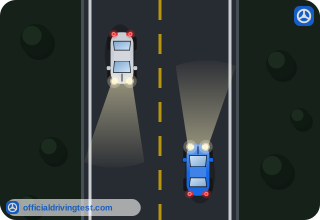
- 100 feet
- 500 feet
- 200 feet
- 1,000 feet
Show answer
Correct answer: 500 feet
You must dim high beams (or low beams with fog lights) before coming within 500 feet of any oncoming vehicle.
Source: Colorado Driver Handbook (DR 2337, January 2025), page 16 · Open this page in the manual (Manual page 16)
-
When you are within 200 feet of the vehicle ahead of you, what must you use?
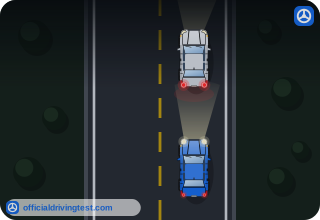
- High beam lights with fog lights on
- Parking lights only
- High beam lights with fog lights off
- Low beam lights with fog lights off
Show answer
Correct answer: Low beam lights with fog lights off
When following another vehicle within 200 feet you must use low beams with fog lights off.
Source: Colorado Driver Handbook (DR 2337, January 2025), page 16 · Open this page in the manual (Manual page 16)
-
How should you handle the glare of an approaching car's headlights at night?
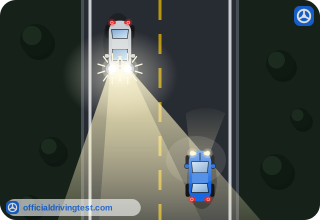
- Look below the glare and use the painted edge lines
- Look directly at the headlights to judge the distance
- Flash your high beams until the driver dims
- Close one eye and keep your gaze on the center line
Show answer
Correct answer: Look below the glare and use the painted edge lines
Never look directly into the headlights; drop your sight below the glare and use the painted edge lines to guide your vehicle.
Source: Colorado Driver Handbook (DR 2337, January 2025), page 16 · Open this page in the manual (Manual page 16)
-
What lights should you use when driving through fog at night?
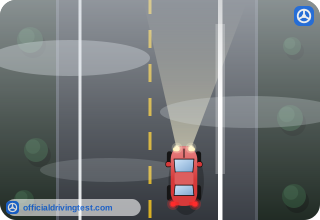
- High beam lights
- Parking lights only
- Low beam and/or fog lights
- High beams with fog lights
Show answer
Correct answer: Low beam and/or fog lights
Use low beams and/or fog lights in fog; high beams in these conditions are like shining your lights on a mirror.
Source: Colorado Driver Handbook (DR 2337, January 2025), page 16 · Open this page in the manual (Manual page 16)
-
What should you do with your headlights if visibility is poor in bad weather?
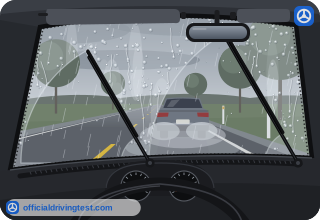
- Turn them off to reduce glare
- Use only your parking lights
- Use only your hazard lights
- Use them
Show answer
Correct answer: Use them
The handbook tells you to use your headlights if visibility is poor.
Source: Colorado Driver Handbook (DR 2337, January 2025), page 16 · Open this page in the manual (Manual page 16)
-
Why should your brakes be in good condition and properly adjusted?
- So the wheels lock up sooner on ice
- So the brake lights stay brighter in snow
- So the pedal needs less pressure on dry roads
- So the braking power of each wheel is uniform
Show answer
Correct answer: So the braking power of each wheel is uniform
Properly adjusted brakes give uniform braking power at each wheel.
Source: Colorado Driver Handbook (DR 2337, January 2025), page 17 · Open this page in the manual (Manual page 17)
-
How much ice, snow and frost should you remove from your windows, even if you are traveling only a short distance?
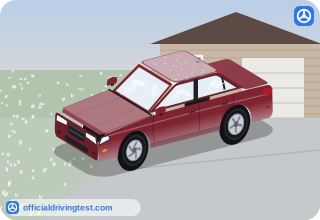
- All of it
- Only enough to see straight ahead
- Only the ice, since snow blows off
- Only the frost on the windshield
Show answer
Correct answer: All of it
Use a good window scraper to remove all ice, snow and frost even for a short trip.
Source: Colorado Driver Handbook (DR 2337, January 2025), page 17 · Open this page in the manual (Manual page 17)
-
How can fogging or condensation on the inside of the windshield be removed quickly?
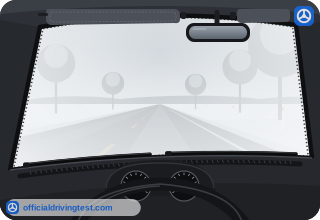
- By closing all vents and windows
- By turning on the windshield wipers
- By opening a window
- By turning on your hazard lights
Show answer
Correct answer: By opening a window
Fogging or condensation on the inside of the windshield can quickly be removed by opening a window.
Source: Colorado Driver Handbook (DR 2337, January 2025), page 17 · Open this page in the manual (Manual page 17)
-
What are the most effective hand positions on the steering wheel?
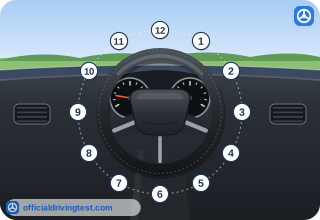
- 8 and 4, or 9 and 3 o'clock
- 10 o'clock and 2 o'clock only
- 11 o'clock and 1 o'clock only
- 6 o'clock and 12 o'clock only
Show answer
Correct answer: 8 and 4, or 9 and 3 o'clock
The handbook says to keep both hands on the wheel, most effectively at 8 and 4 or 9 and 3 o'clock.
Source: Colorado Driver Handbook (DR 2337, January 2025), page 18 · Open this page in the manual (Manual page 18)
-
What are the preferred methods for turning the steering wheel?
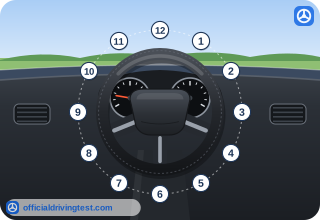
- Palm turning or letting the wheel slip through your fingers
- One-handed turning with the other hand on the gear shift
- Hand-over-hand or push-pull-slide
- Rapid back-and-forth shuffling of the wheel
Show answer
Correct answer: Hand-over-hand or push-pull-slide
The preferred turning methods are "hand-over-hand" or "push-pull-slide".
Source: Colorado Driver Handbook (DR 2337, January 2025), page 18 · Open this page in the manual (Manual page 18)
-
Which is NOT a correct way to handle the steering wheel when turning?
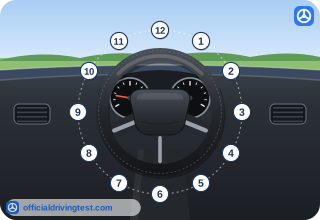
- Using the hand-over-hand method while turning
- Turning the wheel with the palm of your hand
- Using the push-pull-slide method while turning
- Keeping both hands on the wheel while turning
Show answer
Correct answer: Turning the wheel with the palm of your hand
The handbook says not to turn the wheel with the palm of your hand.
Source: Colorado Driver Handbook (DR 2337, January 2025), page 18 · Open this page in the manual (Manual page 18)
-
After making a turn, what should you not do with the steering wheel?
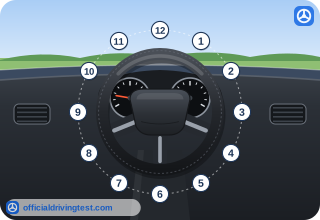
- Keep both hands on the wheel
- Use the hand-over-hand method
- Look ahead before the turn
- Let it slide through your fingers
Show answer
Correct answer: Let it slide through your fingers
The handbook says not to let the wheel slide through your fingers after making a turn.
Source: Colorado Driver Handbook (DR 2337, January 2025), page 18 · Open this page in the manual (Manual page 18)
-
As a driver, how should you use your turn signal around bicyclists?
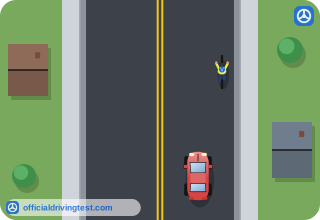
- Keep it on at all times when you are near bicyclists
- Use it only after you have already begun to turn
- Signal before turning; keep it off when going straight
- Use the horn instead of the turn signal near bicyclists
Show answer
Correct answer: Signal before turning; keep it off when going straight
The manual says to always use your turn signal to communicate before turning and keep it off when traveling straight.
Source: Colorado Driver Handbook (DR 2337, January 2025), page 23 · Open this page in the manual (Manual page 23)
-
Why might a bicyclist not use a hand signal even though hand signals are required for turning and stopping?
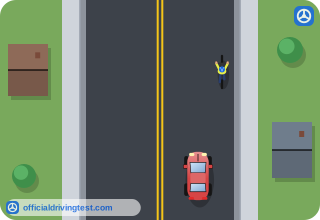
- Hand signals are not required of bicyclists on roads open to motor vehicles
- Bicyclists may use a horn or a bell instead of hand signals at all times
- Skill or road or traffic conditions may require both hands on the handlebars
- Bicyclists must signal only after dark or when other vehicles are close
Show answer
Correct answer: Skill or road or traffic conditions may require both hands on the handlebars
The manual says bicyclists may be unable to signal if skill level or road or traffic conditions require both hands on the handlebars.
Source: Colorado Driver Handbook (DR 2337, January 2025), page 23 · Open this page in the manual (Manual page 23)
-
Which hand signal can a bicyclist give for a right turn?
- The left arm extended straight out to the left of the bicycle
- The left arm dropped down at the elbow beside the body
- The right arm held straight down along the right side
- The right arm straight out, or the left arm up at a right angle
Show answer
Correct answer: The right arm straight out, or the left arm up at a right angle
The manual says for a right turn, extend the right arm straight out or the left arm upward at a right angle.
Source: Colorado Driver Handbook (DR 2337, January 2025), page 23 · Open this page in the manual (Manual page 23)
-
A bicyclist extends the left arm straight out to the left. What does this signal?
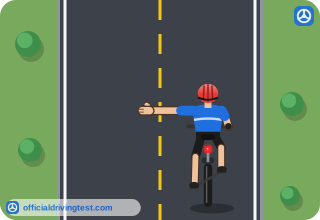
- A left turn
- A right turn
- Slowing or stopping
- A request for you to pass
Show answer
Correct answer: A left turn
The manual says for a left turn, the bicyclist extends the left arm directly out to the left.
Source: Colorado Driver Handbook (DR 2337, January 2025), page 23 · Open this page in the manual (Manual page 23)
-
A bicyclist drops the left arm down at the elbow. What does this signal?
- A left turn
- A right turn
- Slowing or stopping
- Passing is allowed
Show answer
Correct answer: Slowing or stopping
The manual says if slowing or stopping, the bicyclist drops the left arm down at the elbow.
Source: Colorado Driver Handbook (DR 2337, January 2025), page 23 · Open this page in the manual (Manual page 23)