Colorado: Signals and vehicle controls — Part 4 Practice Test
Questions in this part include: “What does the handbook say about driving with only your parking lights on?” · “Why should your brakes be in good condition and properly adjusted?”
Independent educational site · not affiliated with any government agency or DMV
Ready? Test yourself
- Instant feedback with an explanation
- Every answer cites its source in the manual
- Your best score is saved on this device
Questions are original and based on the official manual "Colorado Driver Handbook" (DR 2337, January 2025), Colorado Division of Motor Vehicles (DMV).
All 19 questions in this practice test
Take the test above first, then use this list to study. Tap “Show answer” to see the correct answer and explanation.
Show the questions and answersHide the questions
-
What does the handbook say about driving with only your parking lights on?
- You must not do it
- It is allowed in fog
- It is allowed from sunset to sunrise on city streets
- It is allowed if the road is well lit
Show answer
Correct answer: You must not do it
The handbook says not to drive with only your parking lights on.
Source: Colorado Driver Handbook (DR 2337, January 2025), page 16 · Open this page in the manual (Manual page 16)
-
When should you use your high beam lights at night?
- In city traffic where streets are well lit
- Whenever you are following another vehicle closely
- In rural areas and on open highways away from urban areas
- In fog or heavy rain to see farther
Show answer
Correct answer: In rural areas and on open highways away from urban areas
High beams are for rural areas and open highways away from urban and metropolitan areas.
Source: Colorado Driver Handbook (DR 2337, January 2025), page 16 · Open this page in the manual (Manual page 16)
-
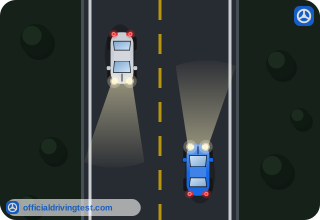
Within what distance of an oncoming vehicle must you dim your high beam lights?
- 100 feet
- 500 feet
- 200 feet
- 1,000 feet
Show answer
Correct answer: 500 feet
You must dim high beams (or low beams with fog lights) before coming within 500 feet of any oncoming vehicle.
Source: Colorado Driver Handbook (DR 2337, January 2025), page 16 · Open this page in the manual (Manual page 16)
-
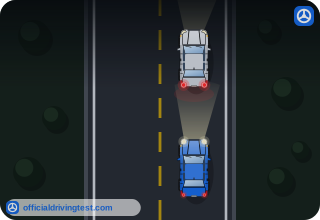
When you are within 200 feet of the vehicle ahead of you, what must you use?
- High beam lights with fog lights on
- Parking lights only
- High beam lights with fog lights off
- Low beam lights with fog lights off
Show answer
Correct answer: Low beam lights with fog lights off
When following another vehicle within 200 feet you must use low beams with fog lights off.
Source: Colorado Driver Handbook (DR 2337, January 2025), page 16 · Open this page in the manual (Manual page 16)
-
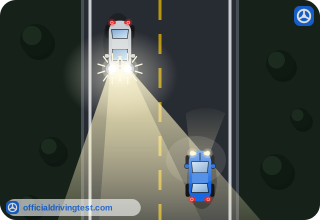
How should you handle the glare of an approaching car's headlights at night?
- Look below the glare and use the painted edge lines
- Look directly at the headlights to judge the distance
- Flash your high beams until the driver dims
- Close one eye and keep your gaze on the center line
Show answer
Correct answer: Look below the glare and use the painted edge lines
Never look directly into the headlights; drop your sight below the glare and use the painted edge lines to guide your vehicle.
Source: Colorado Driver Handbook (DR 2337, January 2025), page 16 · Open this page in the manual (Manual page 16)
-
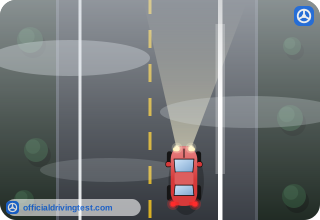
What lights should you use when driving through fog at night?
- High beam lights
- Parking lights only
- Low beam and/or fog lights
- High beams with fog lights
Show answer
Correct answer: Low beam and/or fog lights
Use low beams and/or fog lights in fog; high beams in these conditions are like shining your lights on a mirror.
Source: Colorado Driver Handbook (DR 2337, January 2025), page 16 · Open this page in the manual (Manual page 16)
-
What should you do with your headlights if visibility is poor in bad weather?
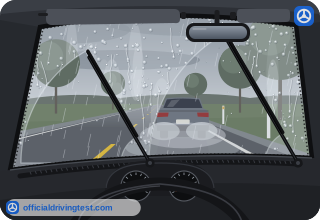
- Turn them off to reduce glare
- Use only your parking lights
- Use only your hazard lights
- Use them
Show answer
Correct answer: Use them
The handbook tells you to use your headlights if visibility is poor.
Source: Colorado Driver Handbook (DR 2337, January 2025), page 16 · Open this page in the manual (Manual page 16)
-
Why should your brakes be in good condition and properly adjusted?
- So the wheels lock up sooner on ice
- So the brake lights stay brighter in snow
- So the pedal needs less pressure on dry roads
- So the braking power of each wheel is uniform
Show answer
Correct answer: So the braking power of each wheel is uniform
Properly adjusted brakes give uniform braking power at each wheel.
Source: Colorado Driver Handbook (DR 2337, January 2025), page 17 · Open this page in the manual (Manual page 17)
-
How much ice, snow and frost should you remove from your windows, even if you are traveling only a short distance?
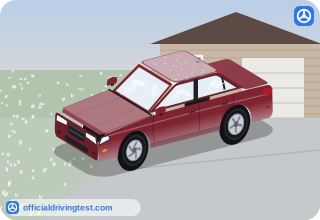
- All of it
- Only enough to see straight ahead
- Only the ice, since snow blows off
- Only the frost on the windshield
Show answer
Correct answer: All of it
Use a good window scraper to remove all ice, snow and frost even for a short trip.
Source: Colorado Driver Handbook (DR 2337, January 2025), page 17 · Open this page in the manual (Manual page 17)
-
How can fogging or condensation on the inside of the windshield be removed quickly?
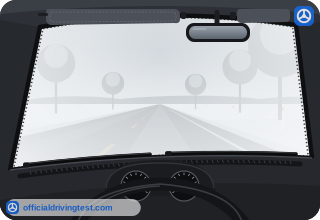
- By closing all vents and windows
- By turning on the windshield wipers
- By opening a window
- By turning on your hazard lights
Show answer
Correct answer: By opening a window
Fogging or condensation on the inside of the windshield can quickly be removed by opening a window.
Source: Colorado Driver Handbook (DR 2337, January 2025), page 17 · Open this page in the manual (Manual page 17)
-
What are the most effective hand positions on the steering wheel?
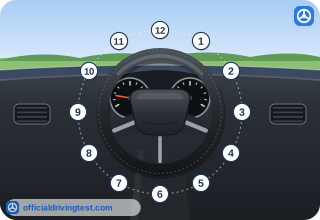
- 8 and 4, or 9 and 3 o'clock
- 10 o'clock and 2 o'clock only
- 11 o'clock and 1 o'clock only
- 6 o'clock and 12 o'clock only
Show answer
Correct answer: 8 and 4, or 9 and 3 o'clock
The handbook says to keep both hands on the wheel, most effectively at 8 and 4 or 9 and 3 o'clock.
Source: Colorado Driver Handbook (DR 2337, January 2025), page 18 · Open this page in the manual (Manual page 18)
-
What are the preferred methods for turning the steering wheel?
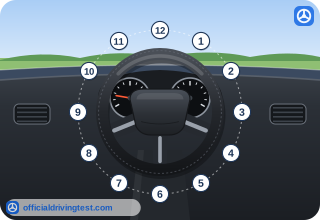
- Palm turning or letting the wheel slip through your fingers
- One-handed turning with the other hand on the gear shift
- Hand-over-hand or push-pull-slide
- Rapid back-and-forth shuffling of the wheel
Show answer
Correct answer: Hand-over-hand or push-pull-slide
The preferred turning methods are "hand-over-hand" or "push-pull-slide".
Source: Colorado Driver Handbook (DR 2337, January 2025), page 18 · Open this page in the manual (Manual page 18)
-
Which is NOT a correct way to handle the steering wheel when turning?
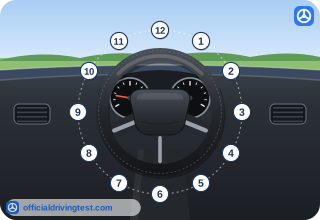
- Using the hand-over-hand method while turning
- Turning the wheel with the palm of your hand
- Using the push-pull-slide method while turning
- Keeping both hands on the wheel while turning
Show answer
Correct answer: Turning the wheel with the palm of your hand
The handbook says not to turn the wheel with the palm of your hand.
Source: Colorado Driver Handbook (DR 2337, January 2025), page 18 · Open this page in the manual (Manual page 18)
-
After making a turn, what should you not do with the steering wheel?
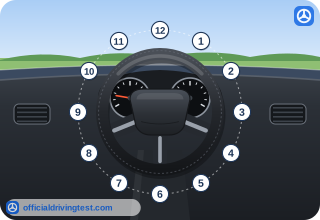
- Keep both hands on the wheel
- Use the hand-over-hand method
- Look ahead before the turn
- Let it slide through your fingers
Show answer
Correct answer: Let it slide through your fingers
The handbook says not to let the wheel slide through your fingers after making a turn.
Source: Colorado Driver Handbook (DR 2337, January 2025), page 18 · Open this page in the manual (Manual page 18)
-
As a driver, how should you use your turn signal around bicyclists?
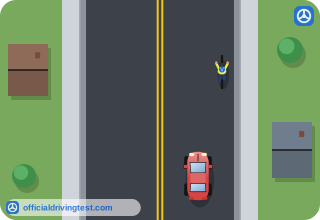
- Keep it on at all times when you are near bicyclists
- Use it only after you have already begun to turn
- Signal before turning; keep it off when going straight
- Use the horn instead of the turn signal near bicyclists
Show answer
Correct answer: Signal before turning; keep it off when going straight
The manual says to always use your turn signal to communicate before turning and keep it off when traveling straight.
Source: Colorado Driver Handbook (DR 2337, January 2025), page 23 · Open this page in the manual (Manual page 23)
-
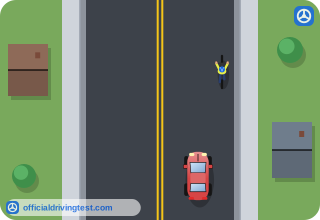
Why might a bicyclist not use a hand signal even though hand signals are required for turning and stopping?
- Hand signals are not required of bicyclists on roads open to motor vehicles
- Bicyclists may use a horn or a bell instead of hand signals at all times
- Skill or road or traffic conditions may require both hands on the handlebars
- Bicyclists must signal only after dark or when other vehicles are close
Show answer
Correct answer: Skill or road or traffic conditions may require both hands on the handlebars
The manual says bicyclists may be unable to signal if skill level or road or traffic conditions require both hands on the handlebars.
Source: Colorado Driver Handbook (DR 2337, January 2025), page 23 · Open this page in the manual (Manual page 23)
-
Which hand signal can a bicyclist give for a right turn?
- The left arm extended straight out to the left of the bicycle
- The left arm dropped down at the elbow beside the body
- The right arm held straight down along the right side
- The right arm straight out, or the left arm up at a right angle
Show answer
Correct answer: The right arm straight out, or the left arm up at a right angle
The manual says for a right turn, extend the right arm straight out or the left arm upward at a right angle.
Source: Colorado Driver Handbook (DR 2337, January 2025), page 23 · Open this page in the manual (Manual page 23)
-
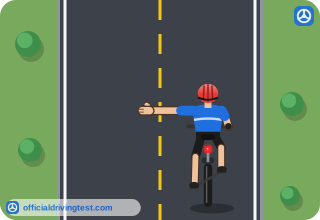
A bicyclist extends the left arm straight out to the left. What does this signal?
- A left turn
- A right turn
- Slowing or stopping
- A request for you to pass
Show answer
Correct answer: A left turn
The manual says for a left turn, the bicyclist extends the left arm directly out to the left.
Source: Colorado Driver Handbook (DR 2337, January 2025), page 23 · Open this page in the manual (Manual page 23)
-
A bicyclist drops the left arm down at the elbow. What does this signal?
- A left turn
- A right turn
- Slowing or stopping
- Passing is allowed
Show answer
Correct answer: Slowing or stopping
The manual says if slowing or stopping, the bicyclist drops the left arm down at the elbow.
Source: Colorado Driver Handbook (DR 2337, January 2025), page 23 · Open this page in the manual (Manual page 23)