Colorado: Signals and vehicle controls — Part 3 Practice Test
Questions in this part include: “What is the handbook's rule on signaling before a turn?” · “Before you change lanes, where must you check for hazards or vehicles?”
Independent educational site · not affiliated with any government agency or DMV
Ready? Test yourself
- Instant feedback with an explanation
- Every answer cites its source in the manual
- Your best score is saved on this device
Questions are original and based on the official manual "Colorado Driver Handbook" (DR 2337, January 2025), Colorado Division of Motor Vehicles (DMV).
All 20 questions in this practice test
Take the test above first, then use this list to study. Tap “Show answer” to see the correct answer and explanation.
Show the questions and answersHide the questions
-
What is the handbook's rule on signaling before a turn?
- Signaling is only advised in urban areas
- Signaling is needed only when other vehicles are nearby
- Signaling is required only when turning onto another roadway
- Failure to signal is a traffic violation
Show answer
Correct answer: Failure to signal is a traffic violation
The handbook states that failure to signal is a traffic violation.
Source: Colorado Driver Handbook (DR 2337, January 2025), page 12 · Open this page in the manual (Manual page 12)
-
In which of these situations does the handbook say you should signal?
- Into a parking lot or when leaving a parked position
- Only when turning onto another roadway
- Only when other drivers are close enough to see you
- Only at intersections with traffic lights
Show answer
Correct answer: Into a parking lot or when leaving a parked position
You signal before any turn, whether onto another roadway, into a parking lot, into another lane or leaving a parked position.
Source: Colorado Driver Handbook (DR 2337, January 2025), page 12 · Open this page in the manual (Manual page 12)
-
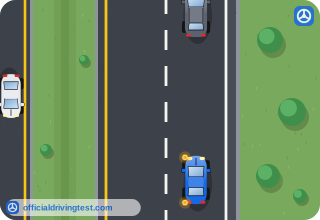
In urban areas, for how far must you signal continuously before making a turn or lane change?
- 50 feet
- 200 feet
- 100 feet
- 500 feet
Show answer
Correct answer: 100 feet
In urban areas you must signal continuously for 100 feet before a turn or lane change.
Source: Colorado Driver Handbook (DR 2337, January 2025), page 12 · Open this page in the manual (Manual page 12)
-
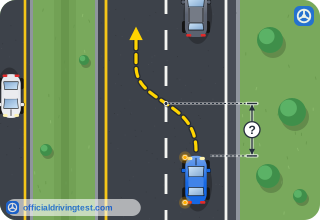
On four lane highways where the posted speed limit is faster than 40 mph, for how far must you signal before making a turn or lane change?
- 100 feet
- 200 feet
- 300 feet
- 500 feet
Show answer
Correct answer: 200 feet
On four lane highways where the limit is faster than 40 mph, you must signal for 200 feet.
Source: Colorado Driver Handbook (DR 2337, January 2025), page 12 · Open this page in the manual (Manual page 12)
-
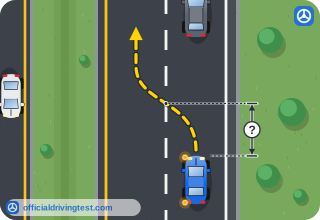
What is a typical rule of thumb for how long to have your turn signal on before making a turn or changing lanes?
- At least 1 second
- At least 10 seconds
- Until you see the other drivers react
- At least 3 seconds
Show answer
Correct answer: At least 3 seconds
The handbook gives a rule of thumb of at least 3 seconds.
Source: Colorado Driver Handbook (DR 2337, January 2025), page 12 · Open this page in the manual (Manual page 12)
-
What must you use if your vehicle's turn signals do not work?
- Hand signals
- Your hazard lights
- Your headlights flashing
- Your horn
Show answer
Correct answer: Hand signals
If your turn signals do not work, you must use hand signals.
Source: Colorado Driver Handbook (DR 2337, January 2025), page 12 · Open this page in the manual (Manual page 12)
-
When should you end a hand signal?
- After you have completed the turn
- When you reach the middle of the intersection ahead
- Before starting to turn, so both hands are on the wheel
- Only after the vehicle behind you has passed
Show answer
Correct answer: Before starting to turn, so both hands are on the wheel
You end the hand signal before starting to turn so that both hands are on the wheel for the turn.
Source: Colorado Driver Handbook (DR 2337, January 2025), page 12 · Open this page in the manual (Manual page 12)
-
If your turn signals do not work, which hand signal shows that you are turning left?
- Left arm extended straight out
- Left arm bent upward at the elbow
- Left arm bent downward at the elbow
- Left arm waved up and down
Show answer
Correct answer: Left arm extended straight out
The handbook’s hand-signal figure shows a left turn as the left arm extended straight out.
Source: Colorado Driver Handbook (DR 2337, January 2025), page 12 · Open this page in the manual (Manual page 12)
-
What does a hand signal with the left arm bent downward at the elbow mean?
- Turning left
- Turning right
- Slowing down or stopping
- Asking others to pass
Show answer
Correct answer: Slowing down or stopping
The handbook’s hand-signal figure shows slow/stop as the left arm bent downward.
Source: Colorado Driver Handbook (DR 2337, January 2025), page 12 · Open this page in the manual (Manual page 12)
-
If your turn signals do not work, which hand signal shows that you are turning right?
- Left arm extended straight out
- Left arm bent downward at the elbow
- Left arm waved in a circle
- Left arm bent upward at the elbow
Show answer
Correct answer: Left arm bent upward at the elbow
The handbook’s hand-signal figure shows a right turn as the left arm bent upward.
Source: Colorado Driver Handbook (DR 2337, January 2025), page 12 · Open this page in the manual (Manual page 12)
-
Which of these actions counts as changing lanes?
- Slowing down while staying in the same lane
- Stopping at a stop line at an intersection
- Merging onto a roadway from an entrance ramp
- Backing into a parking space at the curb
Show answer
Correct answer: Merging onto a roadway from an entrance ramp
The handbook says changing lanes includes changing from one lane to another, passing, merging from an entrance ramp and entering the roadway from the curb or shoulder.
Source: Colorado Driver Handbook (DR 2337, January 2025), page 15 · Open this page in the manual (Manual page 15)
-
Before you change lanes, where must you check for hazards or vehicles?
- Only in your mirrors
- Ahead, to the side and behind your vehicle
- Only ahead and in the lane you are leaving
- Only over your shoulder
Show answer
Correct answer: Ahead, to the side and behind your vehicle
You must check for traffic ahead, to the side and behind your vehicle before you change lanes.
Source: Colorado Driver Handbook (DR 2337, January 2025), page 15 · Open this page in the manual (Manual page 15)
-
What is a blind spot?
- An area directly ahead of your vehicle that the hood of your vehicle hides from view
- An area directly behind your vehicle that your rear window and trunk hide from view
- An area far ahead of your vehicle that your headlights do not light at night
- An area slightly to the rear and sides of your vehicle that you cannot see in your mirrors
Show answer
Correct answer: An area slightly to the rear and sides of your vehicle that you cannot see in your mirrors
Blind spots are areas you cannot see in your rear view or side view mirrors, slightly to the sides and rear of your vehicle.
Source: Colorado Driver Handbook (DR 2337, January 2025), page 15 · Open this page in the manual (Manual page 15)
-
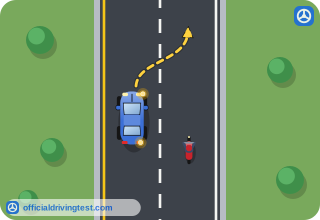
How do you check your blind spot before changing lanes?
- Look over your shoulder
- Look in the rearview mirror only
- Look in the side mirror only
- Look at the vehicle ahead
Show answer
Correct answer: Look over your shoulder
The handbook says to look over your shoulder to check your blind spot.
Source: Colorado Driver Handbook (DR 2337, January 2025), page 15 · Open this page in the manual (Manual page 15)
-
After you are centered in the new lane following a lane change, what should you do?
- Look over your shoulder once again
- Brake to see how traffic reacts to you
- Check the mirror for traffic behind you
- Turn on your hazard lights briefly
Show answer
Correct answer: Check the mirror for traffic behind you
The handbook says that after you are centered in the new lane you check the mirror for traffic behind you.
Source: Colorado Driver Handbook (DR 2337, January 2025), page 15 · Open this page in the manual (Manual page 15)
-
When should you deactivate your turn signal after a lane change?
- After 10 seconds in the new lane
- Within 3 seconds of completing the lane change
- After you have passed the next intersection
- Before you start moving into the new lane
Show answer
Correct answer: Within 3 seconds of completing the lane change
The handbook says to deactivate the turn signal within 3 seconds of completing the lane change.
Source: Colorado Driver Handbook (DR 2337, January 2025), page 15 · Open this page in the manual (Manual page 15)
-
Which of these makes driving at dawn and dusk more hazardous than driving during the day?
- Limited visibility and the limited area lit by your headlights
- Fewer vehicles on the road, which makes drivers careless
- Road surfaces that are always icy at those hours
- Glare from the sun that dims all vehicle headlights
Show answer
Correct answer: Limited visibility and the limited area lit by your headlights
The handbook names limited visibility, the limited area your headlights illuminate and the blinding effect of headlights with fog lights.
Source: Colorado Driver Handbook (DR 2337, January 2025), page 16 · Open this page in the manual (Manual page 16)
-
According to Colorado law, when must you drive with your headlights on?
- From 30 minutes after sunset to 30 minutes before sunrise
- Only when visibility is less than 500 feet at any time of day
- From sunset to sunrise, or when visibility is less than 1,000 feet
- From sunset to midnight, or when visibility is less than 100 feet
Show answer
Correct answer: From sunset to sunrise, or when visibility is less than 1,000 feet
Colorado law requires headlights on from sunset to sunrise or when visibility is less than 1,000 feet.
Source: Colorado Driver Handbook (DR 2337, January 2025), page 16 · Open this page in the manual (Manual page 16)
-
What is one way to reduce risk when driving at dawn and dusk?
- Drive with only your parking lights on to avoid glare
- Drive with low beam or daylight running lights on at all times
- Drive with your high beams on whenever it is dim
- Drive with your fog lights on and your headlights off
Show answer
Correct answer: Drive with low beam or daylight running lights on at all times
The handbook suggests driving with your low beam or daylight running lights on at all times.
Source: Colorado Driver Handbook (DR 2337, January 2025), page 16 · Open this page in the manual (Manual page 16)
-
A vehicle is parked alongside the roadway from sunset to sunrise. What lights must it have on?
- None, if the driver stays in the vehicle
- High beam lights, if the vehicle is unattended
- Hazard lights, if the vehicle is parked on a hill
- Parking lights, whether or not anyone is in the vehicle
Show answer
Correct answer: Parking lights, whether or not anyone is in the vehicle
Any vehicle parked alongside the roadway, attended or not, must have its parking lights on from sunset to sunrise or when visibility is under 1,000 feet.
Source: Colorado Driver Handbook (DR 2337, January 2025), page 16 · Open this page in the manual (Manual page 16)