School Bus: Students, ABS and special safety — Part 3
Questions in this part include: “What can very strong wind do to a school bus in extreme conditions?” · “While backing, where should your eyes keep going?”
Independent educational site · not affiliated with any government agency or DMV
Ready? Test yourself
Answer to start, or tap Start below:
Whom should you contact when strong winds make it unclear how to go on?
- Instant feedback with an explanation
- Every answer cites its source in the manual
- Your best score is saved on this device
- Keyboard: press 1 to 3 to answer and Enter for the next question
Questions are written in our own words from the CDL manual; they are not the real test's questions. With your state chosen, every answer gives its page in your state's CDL manual. Without a state, answers cite the CDL manual, national model as printed by New Jersey (July 2017).
All 17 questions in this practice test
Take the test above first, then use this list to study. Tap “Show answer” to see the correct answer and explanation.
Show the questions and answersHide the questions
-
What can very strong wind do to a school bus in extreme conditions?
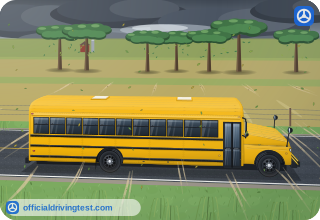
- Move it off the road or even tip it over
- Slow the bus down but never move it sideways
- Shift it within its lane but never off the road
Show answer
Correct answer: Move it off the road or even tip it over
Extreme wind can push a bus off the road, and it can even tip the bus over.
Source: CDL manual, national model as printed by New Jersey, Section 10 (July 2017)
-
How should you hold the steering wheel in strong wind?
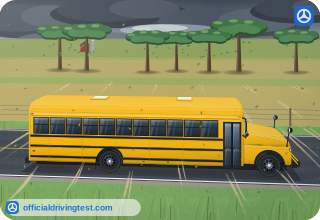
- Hold the wheel lightly and keep your normal speed
- Loosen your hands so the wheel can move freely
- Grip the wheel firmly and expect sudden gusts
Show answer
Correct answer: Grip the wheel firmly and expect sudden gusts
A firm grip on the wheel keeps the bus under control, and expecting gusts lets you react before they push the bus.
Source: CDL manual, national model as printed by New Jersey, Section 10 (July 2017)
-
Strong wind is pushing your bus around on the road. What is a good way to respond?
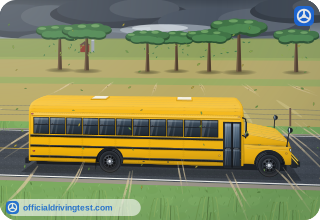
- Slow down, or leave the roadway and wait
- Speed up so you spend less time in the wind
- Hold your speed and move to the center of the lane
Show answer
Correct answer: Slow down, or leave the roadway and wait
Lower speed reduces the effect of the wind. You may also pull off the roadway and wait until it passes.
Source: CDL manual, national model as printed by New Jersey, Section 10 (July 2017)
-
Whom should you contact when strong winds make it unclear how to go on?
- Your dispatcher
- The students' parents along the route
- Other bus drivers on the same road
Show answer
Correct answer: Your dispatcher
Your dispatcher can give you more information about how to proceed in strong wind.
Source: CDL manual, national model as printed by New Jersey, Section 10 (July 2017)
-
When is it acceptable to back up a school bus?
- Whenever it saves time on a tight route
- Only when no other safe way to move the bus exists
- Any time a lookout is standing behind the bus
Show answer
Correct answer: Only when no other safe way to move the bus exists
Backing is strongly discouraged because it is dangerous and raises the risk of a collision. Back up only as a last resort.
Source: CDL manual, national model as printed by New Jersey, Section 10 (July 2017)
-
Students are standing outside near your bus. What is the rule about backing?
- Back slowly while an older student watches them
- Back only if the students are at least 10 feet away
- Never back while students are outside the bus
Show answer
Correct answer: Never back while students are outside the bus
Backing is dangerous and raises the risk of a collision, so a bus must never back while students are outside it.
Source: CDL manual, national model as printed by New Jersey, Section 10 (July 2017)
-
You post a lookout to help you back the bus. What should the lookout do?
- Tell you which way to turn the steering wheel
- Hold traffic back so you can back into the road
- Call out objects, people or cars in your way
Show answer
Correct answer: Call out objects, people or cars in your way
The lookout reports what is in the way, such as obstacles, people or vehicles, and does not direct how the backing is done.
Source: CDL manual, national model as printed by New Jersey, Section 10 (July 2017)
-
What should you ask of the passengers before you back the bus?
- That they all move to the rear seats
- That they open the windows on the right side
- That they remain quiet inside the bus
Show answer
Correct answer: That they remain quiet inside the bus
Signaling the passengers to be quiet is part of the backing procedure.
Source: CDL manual, national model as printed by New Jersey, Section 10 (July 2017)
-
While backing, where should your eyes keep going?
- Only the rear window, since mirrors can mislead
- All the mirrors and the rear windows, constantly
- The front door, to watch the students
Show answer
Correct answer: All the mirrors and the rear windows, constantly
Keep checking every mirror and the rear windows all the time while the bus moves backward.
Source: CDL manual, national model as printed by New Jersey, Section 10 (July 2017)
-
At what pace should you move a bus in reverse?
- At a steady medium speed to clear the area quickly
- Slowly and smoothly
- In short, quick bursts, stopping and starting often
Show answer
Correct answer: Slowly and smoothly
Backing slowly and smoothly gives you time to see problems and stop.
Source: CDL manual, national model as printed by New Jersey, Section 10 (July 2017)
-
No lookout is available and you must back up. Which step belongs before you walk to the rear?
- Pump the service brake several times
- Set the parking brake
- Hold the service brake down with the engine running
Show answer
Correct answer: Set the parking brake
When no lookout is available, setting the parking brake is part of the procedure before you check the way behind the bus on foot.
Source: CDL manual, national model as printed by New Jersey, Section 10 (July 2017)
-
You must leave your seat to check behind the bus before backing. What do you do with the engine and keys?
- Leave the engine running so the heater stays on
- Shut off the motor and carry the keys with you
- Leave the motor idling and the keys in the switch
Show answer
Correct answer: Shut off the motor and carry the keys with you
With no lookout, shutting off the motor and taking the keys is a step of the procedure, along with setting the parking brake.
Source: CDL manual, national model as printed by New Jersey, Section 10 (July 2017)
-
No lookout is available and you must back up. How do you find out if the way is clear?
- Open the door and listen for traffic behind you
- Walk to the back of the bus and look
- Check the overhead inside mirror from your seat
Show answer
Correct answer: Walk to the back of the bus and look
With no lookout, get out and go behind the bus on foot to see for yourself that the path is clear.
Source: CDL manual, national model as printed by New Jersey, Section 10 (July 2017)
-
You have to back up at a place where you pick students up. When should they board?
- After you back, once the bus has come to a stop
- While you back, one at a time through the door
- Before you back, and keep watching for late arrivals
Show answer
Correct answer: Before you back, and keep watching for late arrivals
Load the students first, then back, and keep looking for anyone running late toward the bus.
Source: CDL manual, national model as printed by New Jersey, Section 10 (July 2017)
-
You have to back up at a place where you drop students off. When should they get off?
- Before you back, so the area is clear
- While you back, to save time
- After you finish backing
Show answer
Correct answer: After you finish backing
Students must be unloaded only after the backing is done, so none are outside the bus while it moves in reverse.
Source: CDL manual, national model as printed by New Jersey, Section 10 (July 2017)
-
When a school bus turns, how far can its rear end swing out?
- About one foot
- As much as ten feet
- Up to three feet
Show answer
Correct answer: Up to three feet
The back of a school bus can swing out as much as three feet in a turn.
Source: CDL manual, national model as printed by New Jersey, Section 10 (July 2017)
-
When should you look at your mirrors to keep track of the tail swing?
- Only after the turn has been completed
- Before the turn and while you are turning
- Only when another vehicle is close behind
Show answer
Correct answer: Before the turn and while you are turning
Check the mirrors both before and during any turn so you can watch the rear of the bus swing.
Source: CDL manual, national model as printed by New Jersey, Section 10 (July 2017)