School Bus: Students, ABS and special safety — Part 2
Questions in this part include: “How should the brake pedal be used in an emergency stop in a bus with ABS?” · “What is true of ABS and the distance a bus needs to stop?”
Independent educational site · not affiliated with any government agency or DMV
Ready? Test yourself
Answer to start, or tap Start below:
How should the brake pedal be used in an emergency stop in a bus with ABS?
- Instant feedback with an explanation
- Every answer cites its source in the manual
- Your best score is saved on this device
- Keyboard: press 1 to 3 to answer and Enter for the next question
Questions are written in our own words from the CDL manual; they are not the real test's questions. With your state chosen, every answer gives its page in your state's CDL manual. Without a state, answers cite the CDL manual, national model as printed by New Jersey (July 2017).
All 18 questions in this practice test
Take the test above first, then use this list to study. Tap “Show answer” to see the correct answer and explanation.
Show the questions and answersHide the questions
-
How should the brake pedal be used in an emergency stop in a bus with ABS?
- Pump it quickly many times
- Brake lightly, then hard at the end
- Brake without pumping it
Show answer
Correct answer: Brake without pumping it
With ABS the driver keeps steady pressure in a hard stop and does not pump.
Source: CDL manual, national model as printed by New Jersey, Section 10 (July 2017)
-
While slowing down with ABS, what may the driver do to stay in control?
- Press harder as speed drops
- Ease off the brakes, if it is safe
- Pump the pedal to feel the grip
Show answer
Correct answer: Ease off the brakes, if it is safe
As the bus slows, the driver watches it and eases off the brakes when safe to keep control.
Source: CDL manual, national model as printed by New Jersey, Section 10 (July 2017)
-
If the ABS on a bus is not working, how should the driver brake?
- As usual, since the regular brakes still work
- With extra pumping, since the brakes are weaker
- Gently only, because the brakes cannot be trusted
Show answer
Correct answer: As usual, since the regular brakes still work
Losing ABS does not take away the normal brakes, so the driver brakes the way he or she always has.
Source: CDL manual, national model as printed by New Jersey, Section 10 (July 2017)
-
On a newer vehicle, what should the yellow ABS lamp do when the engine is started?
- Come on briefly for a bulb check, then go out
- Flash steadily until the brakes are tested
- Stay off the whole time unless there is a fault
Show answer
Correct answer: Come on briefly for a bulb check, then go out
On newer vehicles the light is tested for a moment at start-up and then turns off.
Source: CDL manual, national model as printed by New Jersey, Section 10 (July 2017)
-
On an older ABS system, how long might the yellow lamp stay on after start-up?
- Until the engine has warmed up fully
- Until the parking brake is released
- Until the bus is going over five mph
Show answer
Correct answer: Until the bus is going over five mph
With older systems the lamp can remain lit until the bus is driven faster than five mph.
Source: CDL manual, national model as printed by New Jersey, Section 10 (July 2017)
-
On a newer bus, what can it mean when the yellow ABS lamp stays on after the bulb check?
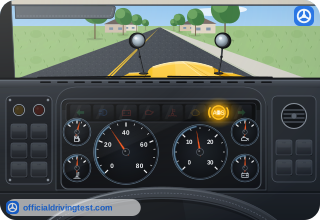
- ABS control may be lost at one or more wheels
- The regular brakes have stopped working
- The parking brake is still partly applied
Show answer
Correct answer: ABS control may be lost at one or more wheels
A lamp that stays lit, or comes on while driving, warns that ABS may not be working at some wheels.
Source: CDL manual, national model as printed by New Jersey, Section 10 (July 2017)
-
When should a driver have a malfunctioning ABS repaired?
- Only at the next yearly inspection
- Soon after the malfunction appears
- When the lamp has stayed on for a week
Show answer
Correct answer: Soon after the malfunction appears
The system should be serviced soon after a malfunction shows up.
Source: CDL manual, national model as printed by New Jersey, Section 10 (July 2017)
-
Your bus has ABS. How should that change the way you pick your speed and following distance?
- You may follow a little closer, since ABS prevents skids
- It should not change them; ABS gives no excuse to relax
- You may drive a little faster, since ABS adds control
Show answer
Correct answer: It should not change them; ABS gives no excuse to relax
ABS does not let you speed up, tailgate or take less care. Drive with the same speed and gap you would use without it.
Source: CDL manual, national model as printed by New Jersey, Section 10 (July 2017)
-
Which skid can ABS NOT stop from happening?
- A skid from braking too hard on a wet road
- A skid from locked steering wheels while braking
- A skid from entering a curve at too high a speed
Show answer
Correct answer: A skid from entering a curve at too high a speed
ABS works against skids caused by braking. It cannot stop a skid that comes from spinning the drive wheels or from taking a turn too fast.
Source: CDL manual, national model as printed by New Jersey, Section 10 (July 2017)
-
What is true of ABS and the distance a bus needs to stop?
- A shorter stop than any bus without ABS every time
- Stronger brakes that make up for a longer stop
- Better vehicle control, but not always a shorter stop
Show answer
Correct answer: Better vehicle control, but not always a shorter stop
ABS helps you keep control while braking, but the bus will not always stop in a shorter distance.
Source: CDL manual, national model as printed by New Jersey, Section 10 (July 2017)
-
How does ABS relate to the regular brakes of your bus?
- It is an extra feature added on top of the regular brakes
- It replaces the regular brakes with a better system
- It adds stopping power that the regular brakes lack
Show answer
Correct answer: It is an extra feature added on top of the regular brakes
ABS is an add-on to the normal brakes and does not replace them. It does not raise or lower their ultimate stopping power.
Source: CDL manual, national model as printed by New Jersey, Section 10 (July 2017)
-
In a bus with ABS, when does the ABS come into play?
- On every stop, to make the bus stop sooner
- Only when the road ahead is covered with ice or snow
- Only when a wheel is about to lock from braking too hard
Show answer
Correct answer: Only when a wheel is about to lock from braking too hard
ABS acts only if a wheel would lock up from over braking. In normal braking the bus stops just as it always did.
Source: CDL manual, national model as printed by New Jersey, Section 10 (July 2017)
-
Your bus has worn brakes that were never serviced properly. What will ABS do about it?
- It will correct the weak brakes whenever you press the pedal
- It will warn you, then repair the brakes while you drive
- Nothing; it cannot make up for poor brake upkeep
Show answer
Correct answer: Nothing; it cannot make up for poor brake upkeep
ABS cannot make up for bad brakes or poor maintenance. The brakes still have to be kept in good condition.
Source: CDL manual, national model as printed by New Jersey, Section 10 (July 2017)
-
What is the best safety feature a vehicle can have?
- A modern antilock braking system
- A safe driver behind the wheel
- A strong body and many mirrors
Show answer
Correct answer: A safe driver behind the wheel
No equipment beats a careful, safe driver. Technology such as ABS only supports good driving.
Source: CDL manual, national model as printed by New Jersey, Section 10 (July 2017)
-
What is the right attitude about using the ABS on your bus?
- Rely on it to stop the bus in a shorter distance
- Drive so that you never have to depend on it
- Brake later than usual, since ABS keeps you in control
Show answer
Correct answer: Drive so that you never have to depend on it
ABS is a backup. Good driving keeps you out of situations where you would need it.
Source: CDL manual, national model as printed by New Jersey, Section 10 (July 2017)
-
What do the optional strobe lights on some school buses look like?
- Amber lights mounted at the front bumper
- Red lights mounted along the sides of the body
- White lights mounted on the roof
Show answer
Correct answer: White lights mounted on the roof
The strobe lights on a school bus are white and are mounted on the roof.
Source: CDL manual, national model as printed by New Jersey, Section 10 (July 2017)
-
On a bus that has an overhead strobe light, when should you turn it on?
- When you cannot see well around the bus
- Whenever students are boarding or leaving
- When you are stopped at a railroad crossing
Show answer
Correct answer: When you cannot see well around the bus
The strobe is for times of limited visibility, when you cannot easily see in front, behind or beside the bus. Always follow your state or local rules on its use.
Source: CDL manual, national model as printed by New Jersey, Section 10 (July 2017)
-
Why can strong wind push a school bus sideways?
- Its high roof lets wind get under the body
- Its short wheelbase makes it turn with the wind
- Its long, tall side catches the wind like a sail
Show answer
Correct answer: Its long, tall side catches the wind like a sail
The large flat side of the bus works like a sail. Strong wind can push the bus sideways, off the road, or in extreme cases tip it over.
Source: CDL manual, national model as printed by New Jersey, Section 10 (July 2017)