School Bus: Danger zones and mirrors
How far the danger zones reach around a school bus, the blind spots, and what the flat, convex, crossover and inside mirrors must show.
Independent educational site · not affiliated with any government agency or DMV
Ready? Test yourself
Answer to start, or tap Start below:
How far in front of the bumper can a school bus's danger zone reach at most?
- Instant feedback with an explanation
- Every answer cites its source in the manual
- Your best score is saved on this device
- Keyboard: press 1 to 3 to answer and Enter for the next question
Questions are written in our own words from the CDL manual; they are not the real test's questions. With your state chosen, every answer gives its page in your state's CDL manual. Without a state, answers cite the CDL manual, national model as printed by New Jersey (July 2017).
All 27 questions in this practice test
Take the test above first, then use this list to study. Tap “Show answer” to see the correct answer and explanation.
Show the questions and answersHide the questions
-
What is the danger zone of a school bus?
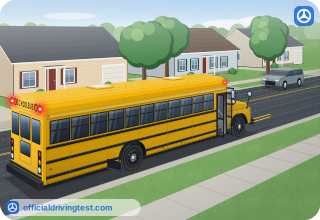
- The area around the bus where children risk being hit
- The part of the bus where children are not allowed to sit
- The stretch of road where the bus may not stop or load
Show answer
Correct answer: The area around the bus where children risk being hit
It is the space around every side of the bus in which a child is most likely to be struck, by the bus itself or by another vehicle.
Source: CDL manual, national model as printed by New Jersey, Section 10 (July 2017)
-
How far in front of the bumper can a school bus's danger zone reach at most?
- 20 feet
- 30 feet
- 40 feet
Show answer
Correct answer: 30 feet
The area ahead of the bumper where children are at risk can reach 30 feet.
Source: CDL manual, national model as printed by New Jersey, Section 10 (July 2017)
-
In the danger zone ahead of a school bus, which stretch is the most dangerous?
- The first 10 feet next to the bumper
- The outer 10 feet at the far edge of the zone
- The middle stretch of the zone, about 10 feet wide
Show answer
Correct answer: The first 10 feet next to the bumper
The 10 feet right in front of the bumper are the riskiest part of the zone ahead of the bus.
Source: CDL manual, national model as printed by New Jersey, Section 10 (July 2017)
-
How far does the danger zone reach from each side of the bus and from the rear bumper?
- 10 feet
- 5 feet
- 20 feet
Show answer
Correct answer: 10 feet
Along both sides and behind the rear bumper, the danger zone extends 10 feet.
Source: CDL manual, national model as printed by New Jersey, Section 10 (July 2017)
-
Which area beside a school bus is always considered dangerous?
- The area directly behind the bus
- The space on the left side of the bus
- The area to the right of the bus
Show answer
Correct answer: The space on the left side of the bus
Cars go by on the left side of the bus, so that side is always a danger area for children.
Source: CDL manual, national model as printed by New Jersey, Section 10 (July 2017)
-
When should you check every mirror of a school bus to get the widest view?
- Before you start to operate the bus
- Once the route is under way and traffic is light
- Only when a student reports a problem
Show answer
Correct answer: Before you start to operate the bus
Look at each mirror before you drive, and have it adjusted if it is not giving the best view of the area around the bus.
Source: CDL manual, national model as printed by New Jersey, Section 10 (July 2017)
-
Where are the outside flat mirrors mounted?
- On the two front corners of the bus
- On the rear corners of the bus body
- On the roof above the driver's seat
Show answer
Correct answer: On the two front corners of the bus
The outside flat mirrors sit at the two front corners of the bus, beside or in front of the windshield.
Source: CDL manual, national model as printed by New Jersey, Section 10 (July 2017)
-
What are the outside flat mirrors used for?
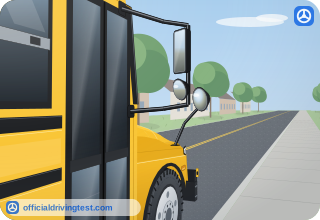
- To watch traffic, clearances and students at the sides and rear
- To see the danger zone right in front of the front bumper
- To keep an eye on the passengers seated inside the bus
Show answer
Correct answer: To watch traffic, clearances and students at the sides and rear
The flat mirrors let the driver watch traffic, clearances and students along the sides and toward the back of the bus.
Source: CDL manual, national model as printed by New Jersey, Section 10 (July 2017)
-
Where is a blind spot of the outside flat mirrors?
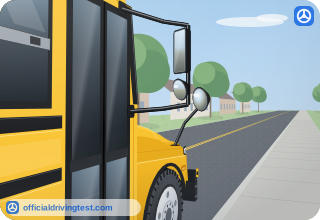
- Directly below and in front of each mirror
- Along the whole length of each side of the bus
- Above each mirror toward the roof line
Show answer
Correct answer: Directly below and in front of each mirror
The flat mirrors cannot show the spot right under and ahead of each mirror, or the spot just behind the rear bumper.
Source: CDL manual, national model as printed by New Jersey, Section 10 (July 2017)
-
What does the size of the blind spot behind a school bus depend on?
- The length and width of the bus
- The height of the bus and its windows
- How high the mirrors are mounted
Show answer
Correct answer: The length and width of the bus
The blind spot behind the bus depends on the bus's length and width.
Source: CDL manual, national model as printed by New Jersey, Section 10 (July 2017)
-
With the outside flat mirrors set correctly, how far back should you be able to see?
- 100 feet, about 2 bus lengths
- 200 feet, about 4 bus lengths
- 300 feet, about 6 bus lengths
Show answer
Correct answer: 200 feet, about 4 bus lengths
Flat mirrors should be set to show the road about 200 feet back, which is roughly four bus lengths.
Source: CDL manual, national model as printed by New Jersey, Section 10 (July 2017)
-
Which of these should a correctly set outside flat mirror show?
- The rear tires touching the ground
- The service door and its steps
- The roof line of the bus
Show answer
Correct answer: The rear tires touching the ground
A correctly set flat mirror shows the rear tires touching the ground.
Source: CDL manual, national model as printed by New Jersey, Section 10 (July 2017)
-
Where are the outside convex mirrors mounted compared with the outside flat mirrors?
- Above them on the windshield frame
- Below them
- Beside the overhead inside mirror
Show answer
Correct answer: Below them
Each convex mirror sits under the flat mirror and gives a wide-angle view of the side of the bus.
Source: CDL manual, national model as printed by New Jersey, Section 10 (July 2017)
-
Which area do the outside convex mirrors monitor?
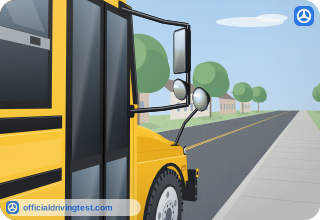
- Both sides of the bus, left and right
- The area in front of the bumper only
- The passengers inside the bus
Show answer
Correct answer: Both sides of the bus, left and right
Convex mirrors cover both sides of the bus at a wide angle, showing traffic, clearances and students beside the bus.
Source: CDL manual, national model as printed by New Jersey, Section 10 (July 2017)
-
What is the drawback of the picture in an outside convex mirror?
- Sizes and distances of objects are not shown accurately
- It cannot show traffic in the lane next to the bus at all
- It cannot show anything nearer than 200 feet to the bus
Show answer
Correct answer: Sizes and distances of objects are not shown accurately
A convex mirror gives a wide view, but people and objects in it look different in size and distance than they really are.
Source: CDL manual, national model as printed by New Jersey, Section 10 (July 2017)
-
How much of the bus's side should a correctly positioned convex mirror show?
- Only the area around the rear tires
- The whole side, up to the mirror mounts
- Only the half of the side nearest the front
Show answer
Correct answer: The whole side, up to the mirror mounts
Aim each convex mirror so the full side of the bus is visible, from the rear all the way up to where the mirror is attached.
Source: CDL manual, national model as printed by New Jersey, Section 10 (July 2017)
-
How much of the neighboring traffic should a correctly set convex mirror show on each side?
- At least one full traffic lane
- A strip about 10 feet wide beside the bus
- The shoulder of the road only
Show answer
Correct answer: At least one full traffic lane
On both sides, the convex mirror should let you see at least a whole lane of traffic next to the bus.
Source: CDL manual, national model as printed by New Jersey, Section 10 (July 2017)
-
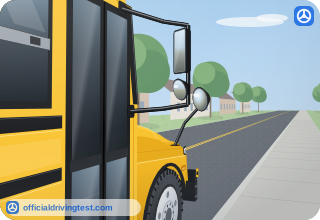
What do the crossover mirrors let you see?
- The area ahead that direct vision cannot see
- Students seated inside the bus
- Traffic far behind the bus on the left
Show answer
Correct answer: The area ahead that direct vision cannot see
Crossover mirrors show the danger zone just in front of the bumper, which you cannot see by looking straight ahead, as well as the front corners and service door area.
Source: CDL manual, national model as printed by New Jersey, Section 10 (July 2017)
-
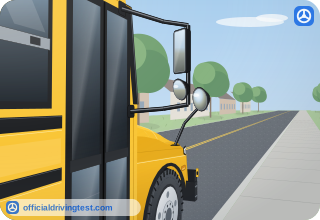
Besides the area in front of the bumper, which areas can you view in the crossover mirrors?
- The rear danger zone, including the rear emergency door
- The side danger zones, including the service door and front wheels
- The inside of the bus, including the aisle and rear seats
Show answer
Correct answer: The side danger zones, including the service door and front wheels
The crossover mirrors also show the danger zones on the left and right sides, including the service door and the front wheel area.
Source: CDL manual, national model as printed by New Jersey, Section 10 (July 2017)
-
How should your direct view and the view in a crossover mirror fit together?
- They should leave a small gap between them
- They should overlap each other
- They should end exactly where the other begins
Show answer
Correct answer: They should overlap each other
Set the crossover mirror so that part of what it shows is also seen directly, leaving no unseen strip in front of the bus.
Source: CDL manual, national model as printed by New Jersey, Section 10 (July 2017)
-
Which tires should you see touching the ground in correctly set crossover mirrors?
- The rear dual wheels
- The right and left front tires
- Only the tire on the driver's side
Show answer
Correct answer: The right and left front tires
When the crossover mirrors are aimed right, both front tires are visible where they meet the pavement.
Source: CDL manual, national model as printed by New Jersey, Section 10 (July 2017)
-
How should you use the crossover, convex and flat mirrors together?
- Look at them in a logical order to check each danger zone
- Glance at them in any order, as time allows
- Check the flat mirrors first, the others only if you see movement
Show answer
Correct answer: Look at them in a logical order to check each danger zone
Going through all the mirrors in an orderly way makes sure no child or object is hidden in any danger zone.
Source: CDL manual, national model as printed by New Jersey, Section 10 (July 2017)
-
What is the overhead inside rearview mirror mainly used for?
- Seeing cars that follow the bus closely
- Watching what passengers do inside the bus
- Checking the front danger zone at the bumper
Show answer
Correct answer: Watching what passengers do inside the bus
This mirror is above the windshield and lets the driver keep an eye on the students on board.
Source: CDL manual, national model as printed by New Jersey, Section 10 (July 2017)
-
What can give the inside mirror a limited view directly behind the bus?
- A glass-bottomed rear emergency door
- A second mirror on the rear bumper
- A wide-angle insert on the inside mirror
Show answer
Correct answer: A glass-bottomed rear emergency door
A glass-bottomed rear emergency door may let the inside mirror show a little of the area right behind the bus.
Source: CDL manual, national model as printed by New Jersey, Section 10 (July 2017)
-
Which mirrors must you use to watch traffic coming into the large blind area behind the bus?
- The overhead inside rearview mirror
- The exterior side mirrors
- The crossover mirrors
Show answer
Correct answer: The exterior side mirrors
The inside mirror cannot cover the long blind area behind the bus, so the outside side mirrors must be used to follow traffic entering it.
Source: CDL manual, national model as printed by New Jersey, Section 10 (July 2017)
-
Which view tells you the overhead inside mirror is set at the right height?
- The roof line across the top of the mirror
- The rear window's top edge at the mirror's top
- The center of the aisle in the middle of the mirror
Show answer
Correct answer: The rear window's top edge at the mirror's top
The vertical aim is right when the upper edge of the rear window appears along the top of the mirror.
Source: CDL manual, national model as printed by New Jersey, Section 10 (July 2017)
-
Which students should you be able to see in a properly set overhead inside mirror?
- All students, including those right behind you
- Only students seated in the rear rows
- Only students who are not near a window
Show answer
Correct answer: All students, including those right behind you
The mirror should show every student on the bus, even the heads of those seated just behind the driver.
Source: CDL manual, national model as printed by New Jersey, Section 10 (July 2017)
-
Only in Arizona's manual
How far back from the rear bumper can the blind spot behind a school bus usually reach?
- 10 to 30 feet
- 450 to 600 feet
- 50 to 150 feet
Show answer
Correct answer: 50 to 150 feet
The blind area directly behind a school bus commonly runs 50 to 150 feet, and on a long, wide bus it can reach as far as 400 feet.
Source: CDL manual, national model as printed by New Jersey, Section 10 (July 2017)