Hazardous Materials: Shipping papers, package markings and recognizing hazardous materials — Part 2
Questions in this part include: “In which case does the original shipping paper not need a signed shipper's certification?” · “Where must several labels on one package be placed?”
Independent educational site · not affiliated with any government agency or DMV
Ready? Test yourself
Answer to start, or tap Start below:
In which case does the original shipping paper not need a signed shipper's certification?
- Instant feedback with an explanation
- Every answer cites its source in the manual
- Your best score is saved on this device
- Keyboard: press 1 to 3 to answer and Enter for the next question
Questions are written in our own words from the CDL manual; they are not the real test's questions. With your state chosen, every answer gives its page in your state's CDL manual. Without a state, answers cite the CDL manual, national model as printed by New Jersey (July 2017).
All 21 questions in this practice test
Take the test above first, then use this list to study. Tap “Show answer” to see the correct answer and explanation.
Show the questions and answersHide the questions
-
In which case does the original shipping paper not need a signed shipper's certification?
- The load is a small amount
- Carrier supplies the package
- The shipper used this carrier before
Show answer
Correct answer: Carrier supplies the package
A signed certification is not required when the carrier provides the package, or when a private carrier is hauling its own product.
Source: CDL manual, national model as printed by New Jersey, Section 9 (July 2017)
-
When may a driver accept the shipper's word that a package was prepared correctly?
- Only after opening the package to look inside
- Unless it is clearly unsafe or breaks the rules
- Only when the shipper rides along on the trip
Show answer
Correct answer: Unless it is clearly unsafe or breaks the rules
The driver may rely on the certification as long as the package is not obviously unsafe and does not break the hazardous materials regulations.
Source: CDL manual, national model as printed by New Jersey, Section 9 (July 2017)
-
Some carriers add their own hazardous materials rules. What should a driver do about them when accepting shipments?
- Use them only on long trips
- Ignore them in favor of the shipper's
- Follow the employer's rules too
Show answer
Correct answer: Follow the employer's rules too
A driver should follow the employer's additional rules when accepting a shipment, on top of the legal requirements.
Source: CDL manual, national model as printed by New Jersey, Section 9 (July 2017)
-
Where does a shipper put the required hazardous material markings?
- On the bill of lading copy
- On the carrier's own invoice
- On the package, a label or a tag
Show answer
Correct answer: On the package, a label or a tag
Markings are printed straight onto the package or onto a label or tag attached to it.
Source: CDL manual, national model as printed by New Jersey, Section 9 (July 2017)
-
The hazardous material name marked on a package must match which other item?
- The name on the shipping paper
- The consignee's company name
- The name on the vehicle placard
Show answer
Correct answer: The name on the shipping paper
The material name printed on the package is the same name that appears on the shipping paper.
Source: CDL manual, national model as printed by New Jersey, Section 9 (July 2017)
-
What should a driver do to catch mistakes before accepting a hazardous materials load?
- Weigh each package at the dock
- Compare paper to markings and labels
- Count the pages of the paper
Show answer
Correct answer: Compare paper to markings and labels
Checking the description on the paper against the markings and labels on the packages shows whether the shipper got it right.
Source: CDL manual, national model as printed by New Jersey, Section 9 (July 2017)
-
A driver does not know the material being loaded. What is the suggested step?
- Skip the check and sign for the load
- Wait until reaching the destination
- Have the shipper contact your office
Show answer
Correct answer: Have the shipper contact your office
When the material is unfamiliar, the driver should ask the shipper to get in touch with the driver's office.
Source: CDL manual, national model as printed by New Jersey, Section 9 (July 2017)
-
Which word may a shipper have to put on a package when the rules require it?
- TOXIC LOAD
- BIOHAZARD
- HIGH RISK
Show answer
Correct answer: BIOHAZARD
Depending on the material, a package may have to carry a warning word such as BIOHAZARD or HOT, among others.
Source: CDL manual, national model as printed by New Jersey, Section 9 (July 2017)
-
Which marking is added to a package that holds liquid containers inside?
- A red stripe around the lid
- Arrows showing which way is up
- A scale showing the fill level
Show answer
Correct answer: Arrows showing which way is up
Packages containing liquids carry orientation arrows that point upright, so handlers keep them the right way up.
Source: CDL manual, national model as printed by New Jersey, Section 9 (July 2017)
-
What does the label on a hazardous materials package always reflect?
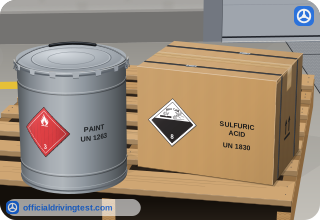
- Its product hazard class
- The package's gross weight
- The shipper's full address
Show answer
Correct answer: Its product hazard class
The label always matches the hazard class of the product inside the package.
Source: CDL manual, national model as printed by New Jersey, Section 9 (July 2017)
-
Where must several labels on one package be placed?
- Close together by the name
- One on each side of the box
- On the lid, away from the name
Show answer
Correct answer: Close together by the name
Multiple labels belong together and next to the proper shipping name on the package.
Source: CDL manual, national model as printed by New Jersey, Section 9 (July 2017)
-
Where should a driver look to find out if a shipment includes hazardous materials?
- The shipping paper
- The dock's loading schedule
- The trailer's inspection tag
Show answer
Correct answer: The shipping paper
The shipping paper tells whether hazardous materials are included, through entries such as a proper shipping name, hazard class and ID number.
Source: CDL manual, national model as printed by New Jersey, Section 9 (July 2017)
-
Which package types are often a clue that a shipment may be hazardous?
- Cylinders and drums
- Paper envelopes and bags
- Flat cloth-wrapped bundles
Show answer
Correct answer: Cylinders and drums
Cylinders and drums are common packages for hazardous materials, so seeing them is a reason to look closer at the paperwork.
Source: CDL manual, national model as printed by New Jersey, Section 9 (July 2017)
-
Which document must a driver sign by hand and carry when hauling hazardous waste?
- Hazardous Waste Manifest
- Marine Pollutant notice
- Reportable quantity list
Show answer
Correct answer: Hazardous Waste Manifest
For hazardous waste, the driver signs and carries the Uniform Hazardous Waste Manifest.
Source: CDL manual, national model as printed by New Jersey, Section 9 (July 2017)
-
Which kind of number is shown on the manifest for the shipper, the carriers and the destination?
- EPA registration number
- Packing group number
- UN identification number
Show answer
Correct answer: EPA registration number
The manifest gives each party's name and EPA registration number: shipper, carriers and the receiving destination.
Source: CDL manual, national model as printed by New Jersey, Section 9 (July 2017)
-
What must the shipper do by hand on the hazardous waste manifest, besides preparing it?
- Initial each page of it
- Add the route to be driven
- Date it and sign it
Show answer
Correct answer: Date it and sign it
The shipper prepares the manifest, writes the date on it and signs it by hand.
Source: CDL manual, national model as printed by New Jersey, Section 9 (July 2017)
-
How should a driver treat the hazardous waste manifest while hauling the waste?
- In the same way as a shipping paper
- Like a receipt kept in the office
- As a loading checklist for the dock
Show answer
Correct answer: In the same way as a shipping paper
The manifest is handled like any other shipping paper while the waste is on the road.
Source: CDL manual, national model as printed by New Jersey, Section 9 (July 2017)
-
To whom may a driver hand over a hazardous waste shipment?
- Any warehouse with an open loading dock
- A registered carrier or a treatment facility
- Any business that the driver trusts to hold it
Show answer
Correct answer: A registered carrier or a treatment facility
Hazardous waste may be handed only to another registered carrier or to a disposal or treatment facility.
Source: CDL manual, national model as printed by New Jersey, Section 9 (July 2017)
-
Which carriers must sign the hazardous waste manifest by hand?
- Only the very first carrier
- Every carrier hauling it
- Only the very last carrier
Show answer
Correct answer: Every carrier hauling it
Every carrier that moves the waste signs the manifest by hand.
Source: CDL manual, national model as printed by New Jersey, Section 9 (July 2017)
-
After delivering a hazardous waste load, what should the driver do with the driver's copy of the manifest?
- Give it back to the shipper
- Throw it away once signed
- Keep it
Show answer
Correct answer: Keep it
The driver keeps a copy of the manifest after delivery, with all needed signatures and dates on it.
Source: CDL manual, national model as printed by New Jersey, Section 9 (July 2017)
-
Whose signature and date must each manifest copy carry in addition to the other required ones?
- The person who received the waste
- The dispatcher who booked the load
- The inspector at the last scale
Show answer
Correct answer: The person who received the waste
Every copy needs all signatures and dates, including those of whoever took delivery of the waste.
Source: CDL manual, national model as printed by New Jersey, Section 9 (July 2017)