Hazardous Materials: Placards and the placard tables
Where and how placards are displayed, and which loads need which placard under the two placard tables.
Independent educational site · not affiliated with any government agency or DMV
Ready? Test yourself
Answer to start, or tap Start below:
When may a driver move a vehicle that does not carry the right placards?
- Instant feedback with an explanation
- Every answer cites its source in the manual
- Your best score is saved on this device
- Keyboard: press 1 to 3 to answer and Enter for the next question
Questions are written in our own words from the CDL manual; they are not the real test's questions. With your state chosen, every answer gives its page in your state's CDL manual. Without a state, answers cite the CDL manual, national model as printed by New Jersey (July 2017).
All 27 questions in this practice test
Take the test above first, then use this list to study. Tap “Show answer” to see the correct answer and explanation.
Show the questions and answersHide the questions
-
When must the correct placards be attached to the vehicle?
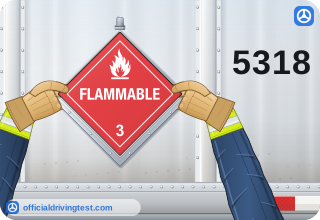
- Before you drive the vehicle
- Before you unload at the first stop
- After the load passes inspection
Show answer
Correct answer: Before you drive the vehicle
The right placards go on before the vehicle moves, not later on the trip.
Source: CDL manual, national model as printed by New Jersey, Section 9 (July 2017)
-
When may a driver move a vehicle that does not carry the right placards?
- Only if the trip is short and on local roads
- Only in an emergency, to protect life or property
- Only when the shipper gives written permission
Show answer
Correct answer: Only in an emergency, to protect life or property
A vehicle with wrong or missing placards may be moved only in an emergency to protect life or property. Otherwise the placards must be fixed before you drive.
Source: CDL manual, national model as printed by New Jersey, Section 9 (July 2017)
-
Where must placards be shown on a vehicle that needs them?
- On both sides and both ends
- On the two sides only
- On the front and back ends only
Show answer
Correct answer: On both sides and both ends
Placards go on all four faces of the vehicle: both sides and both ends.
Source: CDL manual, national model as printed by New Jersey, Section 9 (July 2017)
-
What is the minimum space between a placard and any other marking on the vehicle?
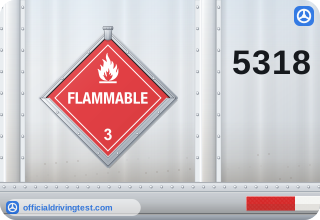
- One inch
- Three inches
- Six inches
Show answer
Correct answer: Three inches
Keep a placard at least three inches away from other markings so it stays clear to read.
Source: CDL manual, national model as printed by New Jersey, Section 9 (July 2017)
-
Which statement about a placard is true?
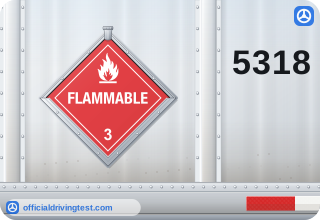
- It may be partly covered by an open door while parked
- It may be placed on a background of the same color
- It must be kept clear of ladders, doors, and tarpaulins
Show answer
Correct answer: It must be kept clear of ladders, doors, and tarpaulins
Ladders, doors, tarpaulins and similar attachments must stay clear of the placard so its color and message can be seen.
Source: CDL manual, national model as printed by New Jersey, Section 9 (July 2017)
-
What is the rule about putting a slogan such as "Drive Safely" on a placard?
- It is allowed if the letters are small
- It is allowed on trailer placards only
- It is not allowed
Show answer
Correct answer: It is not allowed
Slogans of any kind may not be used on placards.
Source: CDL manual, national model as printed by New Jersey, Section 9 (July 2017)
-
Where may the front placard be put on a tractor-trailer?
- Only on the front face of the trailer box
- Only on the front bumper of the tractor
- On the front of the tractor or of the trailer
Show answer
Correct answer: On the front of the tractor or of the trailer
The front placard has two permitted places: the tractor front or the trailer front.
Source: CDL manual, national model as printed by New Jersey, Section 9 (July 2017)
-
How much of a Table 1 material must be on board before a placard is needed?
- More than 500 pounds
- Any amount at all
- 1,001 pounds or more
Show answer
Correct answer: Any amount at all
Table 1 materials need placards no matter how small the amount.
Source: CDL manual, national model as printed by New Jersey, Section 9 (July 2017)
-
Apart from bulk packaging, when does a Table 2 hazard class need a placard?
- 1,001 pounds or more in total, package weight counted
- When the total is 2,205 pounds or more of one class
- When any amount at all is on board
Show answer
Correct answer: 1,001 pounds or more in total, package weight counted
Table 2 classes are placarded once the total reaches 1,001 pounds, with the weight of the packaging included.
Source: CDL manual, national model as printed by New Jersey, Section 9 (July 2017)
-
How do you work out the Table 2 total for placarding?
- Add the amounts on every shipping paper for all Table 2 products
- Count only the heaviest Table 2 class on the shipping papers
- Judge each shipping paper alone and keep the largest figure
Show answer
Correct answer: Add the amounts on every shipping paper for all Table 2 products
You combine the weights listed on every shipping paper for all Table 2 products in the vehicle.
Source: CDL manual, national model as printed by New Jersey, Section 9 (July 2017)
-
In Placard Table 1, which placard goes with class 2.3 Poisonous/Toxic Gases?
- Poison Gas
- Non-Flammable Gas
- Flammable Gas
Show answer
Correct answer: Poison Gas
Class 2.3 poisonous or toxic gases are placarded Poison Gas.
Source: CDL manual, national model as printed by New Jersey, Section 9 (July 2017)
-
Which class 6.1 materials are in Placard Table 1, needing a placard in any amount?
- Inhalation hazard zone A and B materials only
- Every class 6.1 poison, in any amount
- Class 6.1 materials in packages over 119 gallons
Show answer
Correct answer: Inhalation hazard zone A and B materials only
Only the inhalation hazard zone A and B poisons are in Table 1. Other class 6.1 materials fall under Table 2.
Source: CDL manual, national model as printed by New Jersey, Section 9 (July 2017)
-
Which class 7 radioactive shipments fall in Placard Table 1, needing a placard in any amount?
- Those with a White I label
- Those with a Yellow III label
- Those with a Yellow II label
Show answer
Correct answer: Those with a Yellow III label
Table 1 lists class 7 only for the Yellow III label, and the placard is Radioactive.
Source: CDL manual, national model as printed by New Jersey, Section 9 (July 2017)
-
When may a DANGEROUS placard be used in place of separate placards?
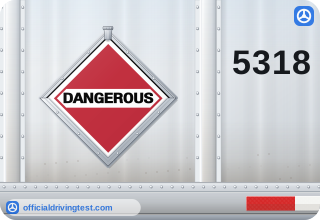
- Two or more Table 2 classes, 1,001 pounds or more, needing different placards
- A single Table 2 hazard class, in any amount at all, on the vehicle
- Any Table 1 material together with a Table 2 class on one trip
Show answer
Correct answer: Two or more Table 2 classes, 1,001 pounds or more, needing different placards
The DANGEROUS placard may replace separate ones when two or more Table 2 classes totaling 1,001 pounds or more call for different placards.
Source: CDL manual, national model as printed by New Jersey, Section 9 (July 2017)
-
How much of one Table 2 class loaded at one place means you must use that class's own placard instead of DANGEROUS?
- 1,001 pounds
- 5,000 pounds
- 2,205 pounds
Show answer
Correct answer: 2,205 pounds
Once 2,205 pounds or more of a single Table 2 class is loaded at one place, the specific placard for it is required.
Source: CDL manual, national model as printed by New Jersey, Section 9 (July 2017)
-
If you may use a DANGEROUS placard, must you use it?
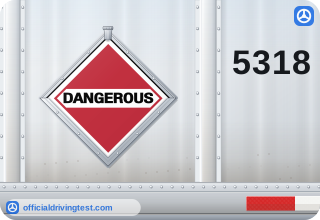
- Yes, it must always replace the specific placards
- Yes, but only when the vehicle carries a cargo tank
- No, it is optional and you may placard for each material
Show answer
Correct answer: No, it is optional and you may placard for each material
The DANGEROUS placard is a choice. You are always free to use the specific placards instead.
Source: CDL manual, national model as printed by New Jersey, Section 9 (July 2017)
-
A shipping paper carries the words INHALATION HAZARD. What placard must you display for it?
- Just the placard that the product's own hazard class calls for
- A DANGEROUS placard used in place of all the other placards
- POISON GAS or POISON INHALATION, plus the product's own placards
Show answer
Correct answer: POISON GAS or POISON INHALATION, plus the product's own placards
Inhalation hazard materials need a poison gas or poison inhalation placard on top of any other placard their class requires, and the 1,000 pound exception does not apply.
Source: CDL manual, national model as printed by New Jersey, Section 9 (July 2017)
-
A material has dangerous when wet as a secondary hazard. What does that mean for placarding?
- No extra placard is needed
- The DANGEROUS WHEN WET placard is shown as well as its other placards
- The DANGEROUS WHEN WET placard replaces its other placards
Show answer
Correct answer: The DANGEROUS WHEN WET placard is shown as well as its other placards
A secondary hazard of dangerous when wet adds that placard to those the main class needs, and the 1,000-pound exception does not apply.
Source: CDL manual, national model as printed by New Jersey, Section 9 (July 2017)
-
In Placard Table 2, which placard is listed for class 6.2 Infectious Substances?
- Poison
- No placard is listed
- Corrosive
Show answer
Correct answer: No placard is listed
Table 2 shows no placard for class 6.2 infectious substances.
Source: CDL manual, national model as printed by New Jersey, Section 9 (July 2017)
-
On which equipment may a FLAMMABLE placard be used in place of COMBUSTIBLE?
- On any box trailer
- On a vehicle carrying class 4.1 solids
- On a cargo tank or portable tank
Show answer
Correct answer: On a cargo tank or portable tank
A cargo tank or portable tank may show FLAMMABLE instead of COMBUSTIBLE.
Source: CDL manual, national model as printed by New Jersey, Section 9 (July 2017)
-
What does the Table 2 footnote say about the Class 9 placard?
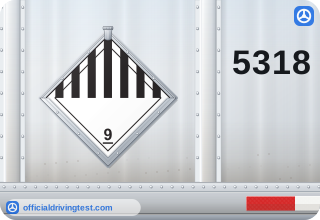
- It is not required for domestic transportation
- It is required only on cargo tank vehicles
- It replaces the DANGEROUS placard on mixed loads
Show answer
Correct answer: It is not required for domestic transportation
Within domestic transportation, the Class 9 placard is not required.
Source: CDL manual, national model as printed by New Jersey, Section 9 (July 2017)
-
Where on a placard must the hazard class or division number appear?
- In the upper corner
- In the center
- In the lower corner
Show answer
Correct answer: In the lower corner
The class or division number is printed in the lower corner of placards for primary or subsidiary hazards.
Source: CDL manual, national model as printed by New Jersey, Section 9 (July 2017)
-
When may a permanently affixed subsidiary hazard placard without a class number be used?
- Only if a number is written on it by hand on site
- As long as it stays within the color specifications
- Only on cargo tanks and portable tanks in bulk service
Show answer
Correct answer: As long as it stays within the color specifications
A permanent subsidiary placard may omit the class number if its colors still meet the specifications.
Source: CDL manual, national model as printed by New Jersey, Section 9 (July 2017)
-
May you display a placard that the rules do not require for your load?
- Yes, if the placard matches the hazard of the material you carry
- No, extra placards are never allowed on any vehicle at all
- Yes, with any placard you like, whatever the load carried
Show answer
Correct answer: Yes, if the placard matches the hazard of the material you carry
A placard that is not required may still be shown, provided it identifies the hazard of the material actually on board.
Source: CDL manual, national model as printed by New Jersey, Section 9 (July 2017)
-
What size of single container counts as bulk packaging?
- Over 55 gallons
- Over 500 gallons
- Over 119 gallons
Show answer
Correct answer: Over 119 gallons
A single container holding more than 119 gallons is bulk packaging.
Source: CDL manual, national model as printed by New Jersey, Section 9 (July 2017)
-
A bulk package has been emptied, but some hazardous residue is left. What about placards?
- Placards are still required on the package and the vehicle
- No placard is needed once it is emptied
- A placard is needed only if the residue is over 119 gallons
Show answer
Correct answer: Placards are still required on the package and the vehicle
Residue alone does not remove the placard rule: a bulk package and its vehicle stay placarded.
Source: CDL manual, national model as printed by New Jersey, Section 9 (July 2017)
-
Apart from the certain bulk packages allowed two opposite sides or labels, on how many sides must a bulk package be placarded?
- All four sides
- The front and rear ends only
- Three sides
Show answer
Correct answer: All four sides
Only certain bulk packages may use two opposite sides or labels. The rest need placards on all four sides.
Source: CDL manual, national model as printed by New Jersey, Section 9 (July 2017)
-
Only in Alaska's manual
A load does not require a placard. May the driver still display one?
- Yes, if it shows the hazard of the material
- No, only required placards are allowed
- Yes, but only for loads over 1,000 pounds
Show answer
Correct answer: Yes, if it shows the hazard of the material
A placard may be displayed even when none is required, as long as it correctly identifies the hazard of the load.
Source: CDL manual, national model as printed by New Jersey, Section 9 (July 2017)