Hazardous Materials: Hazard classes, package labels and the lists of regulated products
The nine hazard classes and their divisions, package labels, the Hazardous Materials Table, the List of Hazardous Substances and Reportable Quantities, and the List of Marine Pollutants. Split into 3 shorter tests so you're not stuck in one long quiz.
Independent educational site · not affiliated with any government agency or DMV
Choose a part
Hazard classes, package labels and the lists of regulated products — Part 1
Questions in this part include: “What does a material's hazard class tell you about it?”
Hazard classes, package labels and the lists of regulated products — Part 2
Questions in this part include: “What does a placard tell people about the cargo?”
Hazard classes, package labels and the lists of regulated products — Part 3
Questions in this part include: “To pick the right placards, which of these must you know?”
Questions are written in our own words from the CDL manual; they are not the real test's questions. With your state chosen, every answer gives its page in your state's CDL manual. Without a state, answers cite the CDL manual, national model as printed by New Jersey (July 2017).
All 57 Hazard classes, package labels and the lists of regulated products questions with answers
Choose a part above to take a practice test, or study every question and answer here.
Show the questions and answersHide the questions
1Part 119 questions
-
What does a material's hazard class tell you about it?
- The name its shipper uses on the papers
- The order it is listed in the table
- The risks that go with the material
Show answer
Correct answer: The risks that go with the material
A material's hazard class shows the risks that come with it.
Source: CDL manual, national model as printed by New Jersey, Section 9 (July 2017)
-
How many hazard classes are used to sort hazardous materials?
- Nine
- Seven
- Twelve
Show answer
Correct answer: Nine
Hazardous materials are sorted into nine hazard classes, and each class groups materials with similar risks.
Source: CDL manual, national model as printed by New Jersey, Section 9 (July 2017)
-
In the hazard class table, what is the name of Division 1.1?
- Fire Hazard
- Mass Explosion
- Very Insensitive
Show answer
Correct answer: Mass Explosion
Division 1.1 of the explosives class is called Mass Explosion, and dynamite is the example listed for it.
Source: CDL manual, national model as printed by New Jersey, Section 9 (July 2017)
-
In the hazard class table, what is the name of Division 1.4?
- Minor Explosion
- Projection Hazard
- Fire Hazard
Show answer
Correct answer: Minor Explosion
Division 1.4 of the explosives class is called Minor Explosion, and ammunition is the example listed for it.
Source: CDL manual, national model as printed by New Jersey, Section 9 (July 2017)
-
Propane is a flammable gas. Which class number holds gases such as propane?
- Class 2
- Class 1
- Class 3
Show answer
Correct answer: Class 2
Gases make up Class 2; Division 2.1 is flammable gases, with propane as the example.
Source: CDL manual, national model as printed by New Jersey, Section 9 (July 2017)
-
Gasoline is a flammable liquid. Which class number holds flammable liquids?
- Class 2
- Class 3
- Class 4
Show answer
Correct answer: Class 3
Flammable liquids make up Class 3, with gasoline as the example. Class 2 is gases, and Class 4 includes flammable solids.
Source: CDL manual, national model as printed by New Jersey, Section 9 (July 2017)
-
What kind of material is in Division 5.1?
- Corrosives
- Flammable Solids
- Oxidizers
Show answer
Correct answer: Oxidizers
Division 5.1 is the oxidizers division, and ammonium nitrate is the example given.
Source: CDL manual, national model as printed by New Jersey, Section 9 (July 2017)
-
What is Division 6.1 called in the hazard class table?
- Infectious Substances
- Flammable Solids
- Poison (Toxic Material)
Show answer
Correct answer: Poison (Toxic Material)
Division 6.1 is Poison (Toxic Material), and potassium cyanide is the example given.
Source: CDL manual, national model as printed by New Jersey, Section 9 (July 2017)
-
Radioactive materials, such as uranium, belong to which class?
- Class 6
- Class 7
- Class 8
Show answer
Correct answer: Class 7
Class 7 is the radioactive class; uranium is its listed example.
Source: CDL manual, national model as printed by New Jersey, Section 9 (July 2017)
-
Corrosives, such as battery fluid, belong to which class?
- Class 7
- Class 8
- Class 9
Show answer
Correct answer: Class 8
Class 8 is the corrosives class, and battery fluid is its listed example.
Source: CDL manual, national model as printed by New Jersey, Section 9 (July 2017)
-
In the hazard class table, fuel oil is listed as which kind of material?
- Flammable Liquids
- Corrosives
- Combustible Liquids
Show answer
Correct answer: Combustible Liquids
The table lists fuel oil as the example of combustible liquids, which have no class number.
Source: CDL manual, national model as printed by New Jersey, Section 9 (July 2017)
-
Which of these papers counts as a shipping paper?
- A pre-trip inspection report
- A bill of lading
- A driver's trip log
Show answer
Correct answer: A bill of lading
A bill of lading is one kind of shipping paper, along with shipping orders and manifests.
Source: CDL manual, national model as printed by New Jersey, Section 9 (July 2017)
-
Why must hazmat shipping papers be quick to find after a crash?
- Responders must count packages to weigh the load
- The driver may be too hurt to tell responders what the load is
- Police need them to check the driver's hours of service
Show answer
Correct answer: The driver may be too hurt to tell responders what the load is
After a crash or spill the driver may not be able to speak, so the papers tell responders what is aboard and can reduce harm.
Source: CDL manual, national model as printed by New Jersey, Section 9 (July 2017)
-
Besides describing the material correctly, what must shippers put on the shipping papers?
- The receiving dock's telephone number
- The carrier's insurance policy number
- An emergency response telephone number
Show answer
Correct answer: An emergency response telephone number
The number goes on the shipping papers so responders can learn what hazard is aboard.
Source: CDL manual, national model as printed by New Jersey, Section 9 (July 2017)
-
Which is one way the rules allow a driver to keep hazmat papers among other shipping papers?
- At the bottom, in order of delivery
- In a sealed envelope in the cargo area
- On top of the other shipping papers
Show answer
Correct answer: On top of the other shipping papers
Putting the hazmat papers on top of the pile is one allowed way; they may instead be marked clearly so they are quick to identify. The emergency response information stays with them.
Source: CDL manual, national model as printed by New Jersey, Section 9 (July 2017)
-
If the papers are not in the door pouch while you drive, where must they be?
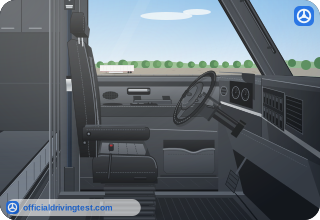
- Behind the seat in a closed bag
- In clear view and within immediate reach
- In the cargo area near the shipment
Show answer
Correct answer: In clear view and within immediate reach
While driving, the papers may sit where you can see them and grab them without leaving your seat belt.
Source: CDL manual, national model as printed by New Jersey, Section 9 (July 2017)
-
Where do hazmat papers go when the driver steps out of the vehicle?
- In the glove box
- On the driver's seat
- In the trailer
Show answer
Correct answer: On the driver's seat
When you leave the cab, put the papers on the driver's seat so anyone reaching the vehicle can find them.
Source: CDL manual, national model as printed by New Jersey, Section 9 (July 2017)
-
What shape are the warning labels shippers put on most hazmat packages?
- Octagon
- Triangle
- Diamond
Show answer
Correct answer: Diamond
Package hazard labels are diamonds, and they warn other people about the hazard inside.
Source: CDL manual, national model as printed by New Jersey, Section 9 (July 2017)
-
A hazard label cannot fit on a package, such as a gas cylinder. What may the shipper do?
- Leave it unlabeled because it is small
- Put the label on a tag fixed firmly to it
- Mark the class number on the side
Show answer
Correct answer: Put the label on a tag fixed firmly to it
A label that will not fit may go on a tag that is attached securely to the package.
Source: CDL manual, national model as printed by New Jersey, Section 9 (July 2017)
2Part 219 questions
-
What does a placard tell people about the cargo?
- Its hazard class
- Its packing group
- Its shipper's name
Show answer
Correct answer: Its hazard class
A placard shows the hazard class of the cargo, on the outside of the vehicle and on bulk packages.
Source: CDL manual, national model as printed by New Jersey, Section 9 (July 2017)
-
A vehicle that needs placards must carry at least how many identical placards?
- Four
- Two
- Six
Show answer
Correct answer: Four
A placarded vehicle needs a minimum of four identical placards, one for each side and the front and rear.
Source: CDL manual, national model as printed by New Jersey, Section 9 (July 2017)
-
Where on a vehicle are hazmat placards put?
- Front, rear and both sides
- Front and rear only
- Both sides and the roof
Show answer
Correct answer: Front, rear and both sides
Placards go on all four sides so they can be read from every direction.
Source: CDL manual, national model as printed by New Jersey, Section 9 (July 2017)
-
What is the smallest size of a placard?
- 150 mm (5.9 inches) square
- 250 mm (9.84 inches) square
- 350 mm (13.8 inches) square
Show answer
Correct answer: 250 mm (9.84 inches) square
A placard is a diamond (square-on-point) at least 250 mm, or 9.84 inches, on each side.
Source: CDL manual, national model as printed by New Jersey, Section 9 (July 2017)
-
Besides on placards, how can a cargo tank show the identification number of its contents?
- On an orange panel
- On a small red flag
- On a green tag at the cab
Show answer
Correct answer: On an orange panel
Bulk packaging may show the number on an orange panel or a white diamond display the size of a placard, as well as on placards.
Source: CDL manual, national model as printed by New Jersey, Section 9 (July 2017)
-
What kind of code is a hazardous material identification number?
- A two-letter code
- A six-digit code
- A four-digit code
Show answer
Correct answer: A four-digit code
The identification number has four digits and lets first responders quickly tell what material is involved.
Source: CDL manual, national model as printed by New Jersey, Section 9 (July 2017)
-
Can a single identification number stand for more than one chemical?
- No, each chemical has its own number
- Only when the chemicals are gases
- Yes, one number can cover several chemicals
Show answer
Correct answer: Yes, one number can cover several chemicals
Some identification numbers are shared, so one number may point to several different chemicals.
Source: CDL manual, national model as printed by New Jersey, Section 9 (July 2017)
-
Which publication lists chemicals together with the identification numbers assigned to them?
- The Carrier Safety Handbook
- The Emergency Response Guidebook
- The Shipper's Reference Manual
Show answer
Correct answer: The Emergency Response Guidebook
The Emergency Response Guidebook (ERG) pairs chemicals with their identification numbers.
Source: CDL manual, national model as printed by New Jersey, Section 9 (July 2017)
-
Before hauling a material, you look for its name on three lists. Which one is among them?
- The List of Marine Pollutants
- The List of Approved Carriers
- The List of Licensed Shippers
Show answer
Correct answer: The List of Marine Pollutants
Shippers and drivers check the Hazardous Materials Table, the list of hazardous substances with their reportable quantities, and the list of marine pollutants.
Source: CDL manual, national model as printed by New Jersey, Section 9 (July 2017)
-
In the Hazardous Materials Table, what does Column 1 show?
- The packing group of the material
- The identification number
- Which shipping modes the entry affects
Show answer
Correct answer: Which shipping modes the entry affects
Column 1 holds symbols about which shipping modes the entry applies to and other notes about the description.
Source: CDL manual, national model as printed by New Jersey, Section 9 (July 2017)
-
In Column 1 of the Hazardous Materials Table, what does a plus sign (+) mean?
- Applies only to domestic shipments by road
- Use this name and class despite the definition
- Requires an extra hazard label on the package
Show answer
Correct answer: Use this name and class despite the definition
A plus sign fixes the shipping name, class and packing group to use even where the material would not otherwise meet the class definition.
Source: CDL manual, national model as printed by New Jersey, Section 9 (July 2017)
-
In Column 1 of the Hazardous Materials Table, what does the letter (A) mean?
- Material may only be carried on aircraft
- Material needs an approved air container
- Rules apply only to air shipping, with limits
Show answer
Correct answer: Rules apply only to air shipping, with limits
An (A) limits the hazardous materials rules to air transport, except for hazardous substances and hazardous waste.
Source: CDL manual, national model as printed by New Jersey, Section 9 (July 2017)
-
In Column 1 of the Hazardous Materials Table, what does the letter (W) mean?
- Rules apply only to water shipping, with limits
- Material must be kept dry during the trip
- Material is banned from all ships and boats
Show answer
Correct answer: Rules apply only to water shipping, with limits
A (W) limits the rules to water transport, except for hazardous substances, hazardous waste and marine pollutants.
Source: CDL manual, national model as printed by New Jersey, Section 9 (July 2017)
-
In Column 1 of the Hazardous Materials Table, what does the letter (D) mean?
- Material becomes dangerous when it gets wet
- Name is meant for international shipments only
- Name suits domestic use, maybe not international
Show answer
Correct answer: Name suits domestic use, maybe not international
A (D) shows a shipping name good for domestic shipments that may not be right for international ones.
Source: CDL manual, national model as printed by New Jersey, Section 9 (July 2017)
-
In Column 1 of the Hazardous Materials Table, what does the letter (I) mean?
- Material is a poison inhalation hazard
- International name; domestic may use another
- Shipping name can never be changed
Show answer
Correct answer: International name; domestic may use another
An (I) marks a name used for international shipping. A shipment that stays within the country may use a different name.
Source: CDL manual, national model as printed by New Jersey, Section 9 (July 2017)
-
What must go on the shipping paper with a generic shipping name, marked (G)?
- A second packing group
- A technical name
- The driver's signature
Show answer
Correct answer: A technical name
A generic name is broad, so the shipping paper adds the technical name, the specific chemical that makes the product hazardous.
Source: CDL manual, national model as printed by New Jersey, Section 9 (July 2017)
-
How are the entries in Column 2 of the Hazardous Materials Table arranged?
- By hazard class number
- By identification number
- In alphabetical order
Show answer
Correct answer: In alphabetical order
The entries follow alphabetical order, which makes it quicker to find the right one.
Source: CDL manual, national model as printed by New Jersey, Section 9 (July 2017)
-
In Column 2 of the Hazardous Materials Table, how can you tell that a name is NOT a proper shipping name?
- It is printed in italics
- It is printed in capital letters
- It is followed by a number
Show answer
Correct answer: It is printed in italics
Only names in regular type are proper shipping names; italic names must not be used as the shipping name.
Source: CDL manual, national model as printed by New Jersey, Section 9 (July 2017)
-
What should you do with a material that shows "Forbidden" in Column 3 of the table?
- Never carry it
- Haul it only with a placard
- Haul it only in a cargo tank
Show answer
Correct answer: Never carry it
Column 3 gives the hazard class or division, and a "Forbidden" entry means the material is never to be transported.
Source: CDL manual, national model as printed by New Jersey, Section 9 (July 2017)
3Part 319 questions
-
To pick the right placards, which of these must you know?
- The length of the planned route
- The weight of the empty trailer
- Total hazmat of all classes aboard
Show answer
Correct answer: Total hazmat of all classes aboard
Placards depend on the material's class, the amount being shipped and the total of all hazmat of all classes aboard.
Source: CDL manual, national model as printed by New Jersey, Section 9 (July 2017)
-
In Column 4, what do the letters "NA" before an identification number tell you?
- Material is barred from all highway trips
- Used only within the U.S. and to or from Canada
- Name used on international air shipments only
Show answer
Correct answer: Used only within the U.S. and to or from Canada
An NA number goes with a name used only within the United States and to or from Canada.
Source: CDL manual, national model as printed by New Jersey, Section 9 (July 2017)
-
Where must the identification number of a hazardous material appear?
- On the shipping paper and the package
- Only on the shipping paper itself
- Only in the driver's own trip log
Show answer
Correct answer: On the shipping paper and the package
The number is part of the shipping description on the paper and is also shown on the package; bulk packaging shows it too.
Source: CDL manual, national model as printed by New Jersey, Section 9 (July 2017)
-
What does Column 5 of the Hazardous Materials Table show?
- The hazard class, in Arabic numerals
- The packing group, in Roman numerals
- The required placard color
Show answer
Correct answer: The packing group, in Roman numerals
Column 5 gives the packing group of the material, written in Roman numerals.
Source: CDL manual, national model as printed by New Jersey, Section 9 (July 2017)
-
Why might a package of a hazardous material need more than one label from Column 6?
- The material has several hazards
- The package is very large
- The material is being exported
Show answer
Correct answer: The material has several hazards
Column 6 lists the required hazard labels, and a product with multiple hazards needs more than one.
Source: CDL manual, national model as printed by New Jersey, Section 9 (July 2017)
-
If Column 7 has an entry for a material, what must you do?
- Look up the federal regulations
- Ask the shipper to repack it
- Call the emergency number first
Show answer
Correct answer: Look up the federal regulations
Column 7 lists special provisions, and each one has to be looked up in the federal regulations.
Source: CDL manual, national model as printed by New Jersey, Section 9 (July 2017)
-
In Column 7, what do the numbers 1 through 6 mean?
- The material is a poison inhalation hazard
- The material is flammable
- The material is a generic shipping name
Show answer
Correct answer: The material is a poison inhalation hazard
Special provisions numbered 1-6 flag a poison inhalation hazard, which has special rules for shipping papers, marking and placards.
Source: CDL manual, national model as printed by New Jersey, Section 9 (July 2017)
-
What does Column 8 of the Hazardous Materials Table give?
- The shipper's emergency phone line
- The reportable quantity in pounds
- Section numbers for packaging rules
Show answer
Correct answer: Section numbers for packaging rules
Column 8 has three parts, each pointing to the regulation sections about packaging.
Source: CDL manual, national model as printed by New Jersey, Section 9 (July 2017)
-
Which columns of the Hazardous Materials Table do not apply to transport by highway?
- Columns 1 and 2
- Columns 5 and 6
- Columns 9 and 10
Show answer
Correct answer: Columns 9 and 10
The manual notes that highway shipments can ignore columns 9 and 10.
Source: CDL manual, national model as printed by New Jersey, Section 9 (July 2017)
-
In the list of hazardous substances in Appendix A, what does Column 2 show for each product?
- Its hazard class
- Its identification number
- Its reportable quantity
Show answer
Correct answer: Its reportable quantity
Column 2 of that list gives the reportable quantity for each product.
Source: CDL manual, national model as printed by New Jersey, Section 9 (July 2017)
-
Where does the shipper display the letters RQ?
- On the shipping paper and package
- Only on the shipping paper itself
- On the outside of the vehicle
Show answer
Correct answer: On the shipping paper and package
Letters RQ on the shipping paper and the package mark a reportable quantity. They may come before or after the basic description.
Source: CDL manual, national model as printed by New Jersey, Section 9 (July 2017)
-
Where may the letters RQ appear in relation to the basic description of a material?
- Before or after it
- Only before it
- Only after it
Show answer
Correct answer: Before or after it
The letters RQ can stand either ahead of or behind the basic description.
Source: CDL manual, national model as printed by New Jersey, Section 9 (July 2017)
-
If a hazardous substance spills in a reportable quantity, who must report it?
- You or your employer
- Only the shipper
- Only the firefighters at the scene
Show answer
Correct answer: You or your employer
The DOT and the EPA want to hear about spills of these substances, so the driver or the employer must report them.
Source: CDL manual, national model as printed by New Jersey, Section 9 (July 2017)
-
A shipping paper says INHALATION HAZARD. What placards are required?
- The class placard plus POISON INHALATION HAZARD
- Only the POISON INHALATION HAZARD placard
- The class placard if the load is large
Show answer
Correct answer: The class placard plus POISON INHALATION HAZARD
The poison inhalation placard is always added to the placard for the product's hazard class, whatever the amount.
Source: CDL manual, national model as printed by New Jersey, Section 9 (July 2017)
-
What kind of chemicals are listed in Appendix B, the List of Marine Pollutants?
- Chemicals that react violently with water
- Chemicals harmful only to people
- Chemicals that are toxic to marine life
Show answer
Correct answer: Chemicals that are toxic to marine life
Appendix B names chemicals that are poisonous to sea and water life.
Source: CDL manual, national model as printed by New Jersey, Section 9 (July 2017)
-
For highway transport, the List of Marine Pollutants is used only for chemicals in a container of what capacity?
- 55 gallons or more
- 500 gallons or more
- 119 gallons or more
Show answer
Correct answer: 119 gallons or more
On the highway, the marine pollutant list matters for containers of 119 gallons or more that carry no placard or label under the rules.
Source: CDL manual, national model as printed by New Jersey, Section 9 (July 2017)
-
What does the marking for a marine pollutant look like?
- A red diamond with a fish drawn on it
- A blue circle with a wave symbol
- A white triangle with a crossed-out fish
Show answer
Correct answer: A white triangle with a crossed-out fish
Bulk packages of a marine pollutant carry this marking, which is not a placard.
Source: CDL manual, national model as printed by New Jersey, Section 9 (July 2017)
-
Besides on bulk packages, where must the marine pollutant marking be displayed?
- Inside the cab by the driver
- On the outside of the vehicle
- On the shipper's loading dock
Show answer
Correct answer: On the outside of the vehicle
The marking, which is not a placard, goes on the outside of the vehicle as well as on the bulk packages.
Source: CDL manual, national model as printed by New Jersey, Section 9 (July 2017)
-
What must the shipping papers show near the description of a marine pollutant?
- The letters RQ inside a box
- The words "Poison Inhalation"
- The words "Marine Pollutant"
Show answer
Correct answer: The words "Marine Pollutant"
A note saying Marine Pollutant goes on the shipping papers next to the description of the material.
Source: CDL manual, national model as printed by New Jersey, Section 9 (July 2017)
-
Only in Arizona's manual
What is the smallest size a hazardous materials placard may be?
- At least 10 3/4 inches square
- At least 9 3/4 inches square
- At least 12 inches square
Show answer
Correct answer: At least 10 3/4 inches square
A placard is a diamond standing on a point, and each side must measure at least 10 3/4 inches.
Source: CDL manual, national model as printed by New Jersey, Section 9 (July 2017)