General Knowledge: Accident procedures and fires — Part 2
Questions in this part include: “When should you read the instructions printed on your fire extinguisher?” · “Which kinds of fire is a B:C extinguisher designed for?”
Independent educational site · not affiliated with any government agency or DMV
Ready? Test yourself
Answer to start, or tap Start below:
Your truck is on fire and you must stop. Where should you park it?
- Instant feedback with an explanation
- Every answer cites its source in the manual
- Your best score is saved on this device
- Keyboard: press 1 to 3 to answer and Enter for the next question
Questions are written in our own words from the CDL manual; they are not the real test's questions. With your state chosen, every answer gives its page in your state's CDL manual. Without a state, answers cite the CDL manual, national model as printed by New Jersey (July 2017).
All 21 questions in this practice test
Take the test above first, then use this list to study. Tap “Show answer” to see the correct answer and explanation.
Show the questions and answersHide the questions
-
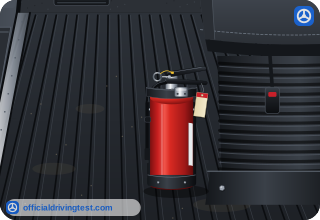
When should you read the instructions printed on your fire extinguisher?
- While the fire is burning
- Before you need to use it
- After you have used it once
Show answer
Correct answer: Before you need to use it
Some drivers lacking this knowledge have made fires worse, so learn how your extinguisher works ahead of time.
Source: CDL manual, national model as printed by New Jersey, Sections 1 to 3 (July 2017)
-
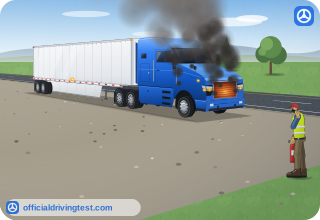
Your truck is on fire and you must stop. Where should you park it?
- Close to the trees at the roadside so it is out of traffic
- In a clear open space away from anything that could burn
- Beside a nearby building where help can reach you quickly
Show answer
Correct answer: In a clear open space away from anything that could burn
A burning vehicle can ignite whatever is near it, so stop in the open, away from buildings, trees, brush and other vehicles.
Source: CDL manual, national model as printed by New Jersey, Sections 1 to 3 (July 2017)
-
A fire starts on your vehicle while a service station is just ahead. What should you do?
- Do not pull in; stop somewhere clear of fire hazards
- Stop there, since the staff will have extinguishers
- Pull in, but park away from the fuel pumps
Show answer
Correct answer: Do not pull in; stop somewhere clear of fire hazards
Do not pull into a service station with a vehicle fire; park in an open area away from anything that might catch fire.
Source: CDL manual, national model as printed by New Jersey, Sections 1 to 3 (July 2017)
-
After you pull off the road because of a vehicle fire, what should you tell emergency services?
- Your problem and where you are
- Your cargo and your carrier's name
- Your license number and destination
Show answer
Correct answer: Your problem and where you are
Emergency services need to know what is wrong and exactly where you are in order to reach you.
Source: CDL manual, national model as printed by New Jersey, Sections 1 to 3 (July 2017)
-
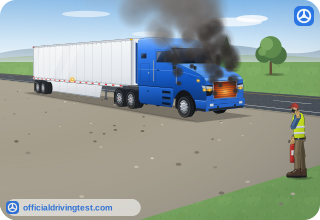
What must you make sure of before you try to put a fire out?
- That every passing driver has been warned
- That the cargo doors have been opened to check
- That the fire cannot spread any further
Show answer
Correct answer: That the fire cannot spread any further
Before fighting a fire, first stop it from spreading, for example by turning off the engine or keeping cargo doors shut.
Source: CDL manual, national model as printed by New Jersey, Sections 1 to 3 (July 2017)
-
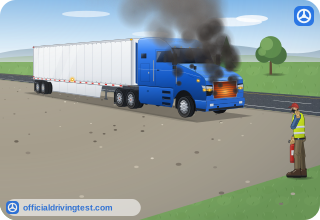
What should you do with the engine as soon as you can when the fire is in the engine?
- Keep it running to power the water pump
- Rev it to blow the flames out
- Shut it off
Show answer
Correct answer: Shut it off
Turning the engine off helps stop the fire from spreading.
Source: CDL manual, national model as printed by New Jersey, Sections 1 to 3 (July 2017)
-
How should you apply an extinguisher to an engine fire?
- Open the hood a little and spray into the gap
- Wait for the flames to die down, then spray the engine
- Spray via louvers, radiator or underside, hood closed
Show answer
Correct answer: Spray via louvers, radiator or underside, hood closed
Avoid opening the hood if you can; shoot foam through the louvers, the radiator or from underneath.
Source: CDL manual, national model as printed by New Jersey, Sections 1 to 3 (July 2017)
-
Your cargo is burning inside a van or box trailer. Why should you keep the doors shut?
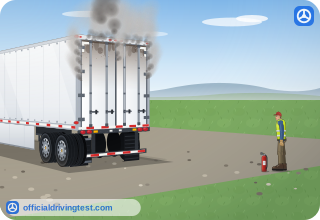
- Opening them would give the fire air so it burns very fast
- Opening them would let the cargo shift and fall out
- Opening them would let the smoke blind passing drivers
Show answer
Correct answer: Opening them would give the fire air so it burns very fast
Fresh air feeds a fire. Keeping the doors closed, especially with hazardous materials aboard, limits the oxygen it gets.
Source: CDL manual, national model as printed by New Jersey, Sections 1 to 3 (July 2017)
-
How close should you stand to a fire while you use the extinguisher?
- As far away as you can while still using it
- As near as you can, to make sure the spray reaches
- About one arm's length from the flames
Show answer
Correct answer: As far away as you can while still using it
Staying as far from the fire as possible keeps you away from heat and flames.
Source: CDL manual, national model as printed by New Jersey, Sections 1 to 3 (July 2017)
-
Where should you aim the extinguisher spray?
- Into the tallest flames above it
- At the smoke rising above
- Down at the base of the blaze
Show answer
Correct answer: Down at the base of the blaze
The agent must reach what is actually burning, which is at the base, not the flames above it.
Source: CDL manual, national model as printed by New Jersey, Sections 1 to 3 (July 2017)
-
Which kinds of fire is a B:C extinguisher designed for?
- Wood, paper and cloth fires only
- Electrical fires and burning liquids
- Burning tires and wood fires only
Show answer
Correct answer: Electrical fires and burning liquids
A B:C extinguisher works on electrical fires and burning liquids; the A:B:C type also handles wood, paper and cloth.
Source: CDL manual, national model as printed by New Jersey, Sections 1 to 3 (July 2017)
-
What does an A:B:C extinguisher handle that a B:C type does not?
- Wood, paper and cloth fires
- Electrical equipment fires
- Burning gasoline
Show answer
Correct answer: Wood, paper and cloth fires
The A:B:C type covers electrical fires and burning liquids like the B:C type, and also wood, paper and cloth.
Source: CDL manual, national model as printed by New Jersey, Sections 1 to 3 (July 2017)
-
For which kind of fire is water an acceptable choice?
- A fire in wood, paper or cloth
- A fire in electrical wiring
- A fire in spilled gasoline
Show answer
Correct answer: A fire in wood, paper or cloth
Fires in ordinary materials like wood, paper and cloth may be fought with water; electrical and gasoline fires may not.
Source: CDL manual, national model as printed by New Jersey, Sections 1 to 3 (July 2017)
-
Why should you avoid putting water on a gasoline fire?
- It makes the fuel burn hotter and longer
- It will spread the flames
- It turns the fuel into a poisonous gas
Show answer
Correct answer: It will spread the flames
Water will spread the flames of a gasoline fire, and on an electrical fire it can cause shock.
Source: CDL manual, national model as printed by New Jersey, Sections 1 to 3 (July 2017)
-
What does a burning tire need in order to be put out?
- To be smothered with a small dose of dry chemical
- To be left alone until it burns itself out
- To be cooled, which may take lots of water
Show answer
Correct answer: To be cooled, which may take lots of water
A tire fire must be cooled down, and a large amount of water may be needed.
Source: CDL manual, national model as printed by New Jersey, Sections 1 to 3 (July 2017)
-
You do not know which extinguisher suits a fire, and hazardous materials are involved. What should you do?
- Try the largest extinguisher you have
- Wait for the firefighters
- Use water first and see what happens
Show answer
Correct answer: Wait for the firefighters
The wrong agent can make a fire worse, so when unsure, especially with hazardous materials, leave it to firefighters.
Source: CDL manual, national model as printed by New Jersey, Sections 1 to 3 (July 2017)
-
Where should you stand relative to the wind when fighting a fire?
- Downwind, so the smoke blows away from the road
- Wherever you are closest to the fire
- Upwind, so the wind helps carry the spray to the fire
Show answer
Correct answer: Upwind, so the wind helps carry the spray to the fire
Standing upwind lets the wind carry the extinguishing agent to the fire.
Source: CDL manual, national model as printed by New Jersey, Sections 1 to 3 (July 2017)
-
The smoke and flames have disappeared. What should you remember?
- The fire can still restart, so keep going until it is cooled
- The fire is out for good and you can leave
- Only a cargo fire can restart after the flames stop
Show answer
Correct answer: The fire can still restart, so keep going until it is cooled
Keep working until whatever was burning has cooled, because a fire with no visible smoke or flame can restart.
Source: CDL manual, national model as printed by New Jersey, Sections 1 to 3 (July 2017)
-
How are gasoline, oil and grease fires put out?
- Soaking them with plenty of water until cool
- Opening the area up so fresh air cools it
- Smothering or cooling, with CO2 or dry chemicals
Show answer
Correct answer: Smothering or cooling, with CO2 or dry chemicals
Gasoline, oil and grease fires are fought by smothering, cooling or shielding from heat, with carbon dioxide or dry chemicals.
Source: CDL manual, national model as printed by New Jersey, Sections 1 to 3 (July 2017)
-
What kind of agent should you use on a fire in electrical equipment?
- A water-based agent that cools the fire quickly
- Non-conducting one, like carbon dioxide or dry chemicals
- Any agent, as long as you use a large amount
Show answer
Correct answer: Non-conducting one, like carbon dioxide or dry chemicals
Electrical fires need a non-conducting agent. Water is not to be used on them.
Source: CDL manual, national model as printed by New Jersey, Sections 1 to 3 (July 2017)
-
What is needed to put out a fire in combustible metals?
- A large amount of plain water
- Carbon dioxide from an ordinary extinguisher
- Specialized extinguishing powders
Show answer
Correct answer: Specialized extinguishing powders
Combustible metal fires call for specialized extinguishing powders.
Source: CDL manual, national model as printed by New Jersey, Sections 1 to 3 (July 2017)