California: Speed & following distance Practice Test
The basic speed law and how to judge a safe following distance.
Independent educational site · not affiliated with any government agency or DMV
Ready? Test yourself
- Instant feedback with an explanation
- Every answer cites its source in the manual
- Your best score is saved on this device
- Keyboard: press 1 to 4 to answer and Enter for the next question
Questions are original and based on the official manual "California Driver Handbook" (2025), California DMV.
All 20 questions in this practice test
Take the test above first, then use this list to study. Tap “Show answer” to see the correct answer and explanation.
Show the questions and answersHide the questions
-
What is the smooth way to bring your car to a stop?
- Press the brake hard at first, then release the pedal just before the car comes to rest.
- Ease off the accelerator, let the car slow, then brake lightly until you stop.
- Shift into neutral and coast up to the line.
- Pump the brake pedal repeatedly.
Show answer
Correct answer: Ease off the accelerator, let the car slow, then brake lightly until you stop.
Take your foot off the accelerator, let the vehicle slow, and press the brake lightly until you come to a full stop, allowing yourself enough space and time.
Source: California Driver Handbook (2025), page 22 · Open this page in the manual (Manual page 22)
-
You are stopping behind another vehicle. How much space should you leave?
- Enough to see its rear wheels.
- About one foot.
- Three car lengths.
- Just enough that you can open your door without touching it.
Show answer
Correct answer: Enough to see its rear wheels.
Leave enough room to see the rear wheels of the vehicle ahead. When stopping at a limit line, do not cross over it.
Source: California Driver Handbook (2025), page 22 · Open this page in the manual (Manual page 22)
-
What is the main problem with tailgating a large vehicle?
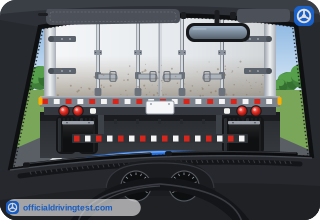
- It uses more fuel.
- It reduces your vehicle's safety distance.
- It makes your headlights reflect off the trailer.
- It is legal but impolite.
Show answer
Correct answer: It reduces your vehicle's safety distance.
Tailgating a large vehicle decreases your safety distance.
Source: California Driver Handbook (2025), page 43 · Open this page in the manual (Manual page 43)
-
What following distance does the handbook recommend when you are driving behind a motorcycle?
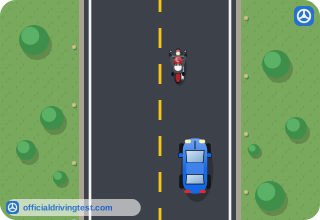
- One second
- Two seconds
- Three seconds
- Half a car length
Show answer
Correct answer: Three seconds
Three seconds of space gives you time to react if the rider brakes suddenly or falls.
Source: California Driver Handbook (2025), page 44 · Open this page in the manual (Manual page 44)
-
You come up behind a bicyclist who is travelling in your lane and you cannot pass yet. What should you do?
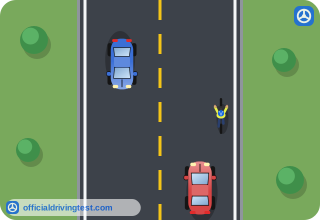
- Follow at a safe distance until it is safe to pass
- Drive close behind so the rider moves over
- Sound your horn continuously
- Pass immediately using the oncoming lane
Show answer
Correct answer: Follow at a safe distance until it is safe to pass
Drivers should follow a bicyclist at a safe distance; when it is safe the rider should move over to let vehicles by.
Source: California Driver Handbook (2025), page 48 · Open this page in the manual (Manual page 48)
-
Heavy traffic and bad weather require you to drive more slowly. Can you still be ticketed for going too slow?
- No, slower is always legal
- Yes, if you block normal traffic flow
- Only on freeways at night
- Only if you are towing a trailer
Show answer
Correct answer: Yes, if you block normal traffic flow
You must drive slower in heavy traffic or bad weather, but you should not block normal and reasonable traffic flow by driving too slowly. If you drive faster or slower than the speed limit, you may be cited.
Source: California Driver Handbook (2025), page 50 · Open this page in the manual (Manual page 50)
-
Another driver is close behind you and clearly wants to travel faster. What should you do?
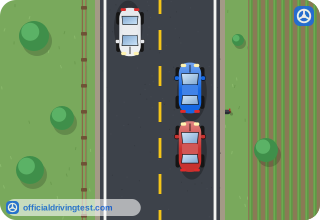
- Brake to warn the driver
- Move to the right
- Keep your position and hold your speed
- Accelerate above the speed limit
Show answer
Correct answer: Move to the right
Move right and let the faster driver by; if you choose to drive slower than traffic, stay in the right lane.
Source: California Driver Handbook (2025), page 50 · Open this page in the manual (Manual page 50)
-
Unless signs say otherwise, what is the speed limit within 500 feet of a school while children are outside or crossing the street?
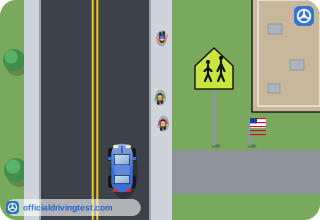
- 35 mph
- 30 mph
- 25 mph
- 20 mph
Show answer
Correct answer: 25 mph
The school-zone limit is 25 mph within 500 feet of a school when children are present outside or crossing.
Source: California Driver Handbook (2025), page 50 · Open this page in the manual (Manual page 50)
-
Some school zones post a speed limit as low as:
- 15 mph
- 5 mph
- 20 mph
- 10 mph
Show answer
Correct answer: 15 mph
Certain school zones are posted at 15 mph, lower than the usual 25 mph school limit.
Source: California Driver Handbook (2025), page 50 · Open this page in the manual (Manual page 50)
-
What makes an intersection "blind," and what is the speed limit there?
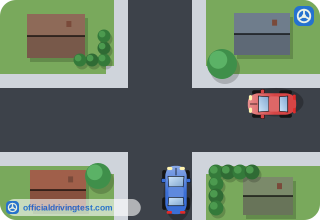
- It has no traffic signal; the limit is 25 mph
- It has no stop signs at any corner; the limit is 15 mph
- It has a hill on one side; the limit is 20 mph
- It has four stop signs; the limit is 10 mph
Show answer
Correct answer: It has no stop signs at any corner; the limit is 15 mph
An intersection with no stop signs on any corner is blind, and the limit is 15 mph. Edge forward slowly until you can see.
Source: California Driver Handbook (2025), page 51 · Open this page in the manual (Manual page 51)
-
An alley is a road no wider than 25 feet used to reach rear or side entrances. What is the speed limit in an alley?
- 25 mph
- 20 mph
- 15 mph
- 10 mph
Show answer
Correct answer: 15 mph
The speed limit in an alley is 15 mph. You may drive on or cross a sidewalk to enter or exit a driveway or alley.
Source: California Driver Handbook (2025), page 51 · Open this page in the manual (Manual page 51)
-
Unless a sign says otherwise, what is the speed limit in a business or residential district?
- 35 mph
- 30 mph
- 25 mph
- 15 mph
Show answer
Correct answer: 25 mph
Business and residential districts carry a 25 mph limit unless a posted sign states something different.
Source: California Driver Handbook (2025), page 52 · Open this page in the manual (Manual page 52)
-
How far ahead of your vehicle should you keep scanning the road so you have time to react?
- At least 10 seconds ahead
- About 2 seconds ahead
- Only as far as your headlights reach
- Just to the bumper of the car in front
Show answer
Correct answer: At least 10 seconds ahead
Keeping your eyes moving and looking at least 10 seconds down the road lets you spot hazards early and avoid last-minute moves.
Source: California Driver Handbook (2025), page 57 · Open this page in the manual (Manual page 57)
-
Which rule does the handbook recommend for keeping a safe following distance?
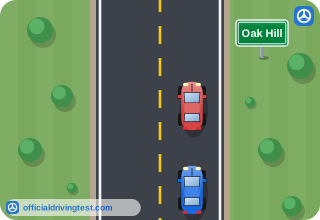
- The one-car-length rule
- The half-speed rule
- The 100-foot rule
- The three-second rule
Show answer
Correct answer: The three-second rule
The three-second rule gives you room to react if the driver ahead brakes suddenly or makes a mistake.
Source: California Driver Handbook (2025), page 57 · Open this page in the manual (Manual page 57)
-
A driver is tailgating you on a multilane road. What should you do?
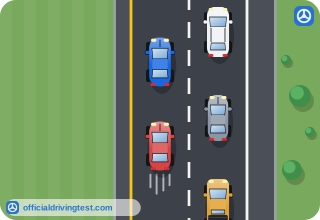
- Tap your brakes to warn the driver off
- Speed up until the gap behind you grows
- Hold your course and speed, then merge right when it is safe
- Turn on your emergency flashers and stop on the shoulder
Show answer
Correct answer: Hold your course and speed, then merge right when it is safe
Stay predictable: keep your speed and lane position, then change lanes to the right when it is safe and let the tailgater go by.
Source: California Driver Handbook (2025), page 57 · Open this page in the manual (Manual page 57)
-
On a wet road, by how much does the handbook say you should reduce your speed?
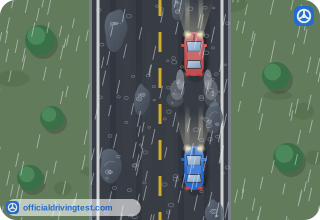
- By 5 to 10 mph
- By half
- By 20 to 25 mph
- No reduction is needed if it is only drizzling
Show answer
Correct answer: By 5 to 10 mph
A wet surface calls for cutting your speed by about 5 to 10 mph and leaving extra following distance.
Source: California Driver Handbook (2025), page 61 · Open this page in the manual (Manual page 61)
-
On packed snow and on ice, what speeds does the handbook give?
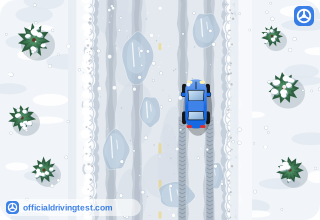
- Reduce by 5 mph on snow; 25 mph maximum on ice
- Reduce by half on packed snow; no more than 5 mph on ice
- Reduce by a third on snow; 15 mph maximum on ice
- Keep the posted limit on both if you have snow chains
Show answer
Correct answer: Reduce by half on packed snow; no more than 5 mph on ice
Packed snow calls for cutting your speed in half, and ice calls for no more than 5 mph.
Source: California Driver Handbook (2025), page 61 · Open this page in the manual (Manual page 61)
-
In a heavy rainstorm you cannot see farther than 100 feet ahead. What is the fastest safe speed?
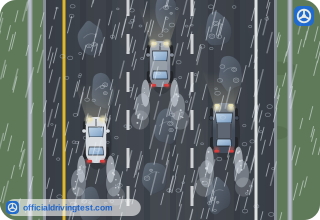
- 55 mph
- 45 mph
- 30 mph
- The posted limit still applies unchanged
Show answer
Correct answer: 30 mph
If visibility drops below 100 feet, it is not safe to drive faster than 30 mph.
Source: California Driver Handbook (2025), page 62 · Open this page in the manual (Manual page 62)
-
What does California's Basic Speed Law require?
- That you never drive faster than is safe for current conditions
- That you always drive at exactly the posted speed limit
- That you match the speed of surrounding traffic
- That you stay 10 mph below the limit in any rain
Show answer
Correct answer: That you never drive faster than is safe for current conditions
Regardless of the posted limit, your speed must suit traffic, road surface, weather, and the presence of pedestrians or bicyclists.
Source: California Driver Handbook (2025), page 67 · Open this page in the manual (Manual page 67)
-
Unless posted otherwise, what is the maximum speed limit for a vehicle towing a trailer, or on a two-lane undivided highway?
- 65 mph
- 55 mph
- 45 mph
- 70 mph
Show answer
Correct answer: 55 mph
The ideal maximum on most California highways is 65 mph, but it drops to 55 mph on two-lane undivided highways and for vehicles towing trailers.
Source: California Driver Handbook (2025), page 67 · Open this page in the manual (Manual page 67)