California: Seat belts & child safety Practice Test
Seat belt requirements and child car seat rules.
Independent educational site · not affiliated with any government agency or DMV
Ready? Test yourself
- Instant feedback with an explanation
- Every answer cites its source in the manual
- Your best score is saved on this device
- Keyboard: press 1 to 4 to answer and Enter for the next question
Questions are original and based on the official manual "California Driver Handbook" (2025), California DMV.
All 12 questions in this practice test
Take the test above first, then use this list to study. Tap “Show answer” to see the correct answer and explanation.
Show the questions and answersHide the questions
-
Your 15-year-old passenger is not wearing a seat belt. Who can be ticketed?
- The passenger only
- The driver, because the passenger is under 16
- The registered owner of the vehicle, whoever is driving
- No one, since belts are optional for rear-seat passengers
Show answer
Correct answer: The driver, because the passenger is under 16
You and your passengers must wear seat belts, and if a passenger is under 16 years old the driver can also be ticketed.
Source: California Driver Handbook (2025), page 65 · Open this page in the manual (Manual page 65)
-
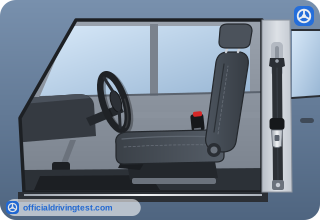
How should the shoulder harness of a seat belt be worn?
- Tucked under the arm for comfort
- Behind the back if it rubs your neck
- Loose enough to lean forward and reach the radio
- Across the shoulder and chest with little or no slack
Show answer
Correct answer: Across the shoulder and chest with little or no slack
The shoulder strap belongs across the shoulder and chest, snug. Wearing it under your arm or behind your back can cause serious injury in a crash.
Source: California Driver Handbook (2025), page 65 · Open this page in the manual (Manual page 65)
-
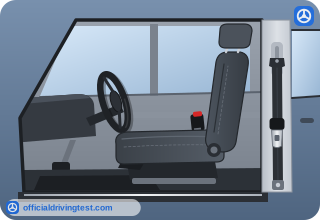
Where should the lap belt sit?
- Across the stomach, above the navel
- Snug and low across the hips
- Loosely across the thighs
- Anywhere, as long as it is buckled
Show answer
Correct answer: Snug and low across the hips
Adjust the lap belt so it lies low and snug across your hips, or you may slide out from under it in a crash.
Source: California Driver Handbook (2025), page 65 · Open this page in the manual (Manual page 65)
-
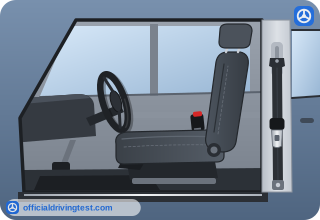
How should a pregnant driver or passenger wear the seat belt?
- Lap belt above the abdomen and shoulder strap behind the back
- Shoulder strap only, with the lap belt unfastened
- Lap belt low under the abdomen and shoulder strap between the breasts
- No belt is required during pregnancy
Show answer
Correct answer: Lap belt low under the abdomen and shoulder strap between the breasts
Keep the lap belt low under the abdomen and route the shoulder strap between the breasts and to the side of the bulge.
Source: California Driver Handbook (2025), page 65 · Open this page in the manual (Manual page 65)
-
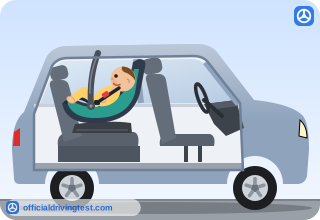
Which child must be secured in a rear-facing child passenger restraint system?
- Any child under 8 years old
- A child under 2 years, 40 pounds, and 3 feet 4 inches tall
- A child under 4 feet 9 inches tall, regardless of age
- A child under 5 years old weighing less than 60 pounds
Show answer
Correct answer: A child under 2 years, 40 pounds, and 3 feet 4 inches tall
Rear-facing is required for children who are under 2 years old, under 40 pounds, and under 3 feet 4 inches tall.
Source: California Driver Handbook (2025), page 66 · Open this page in the manual (Manual page 66)
-
A child is in a rear-facing child passenger restraint system. Where may that child NOT ride?
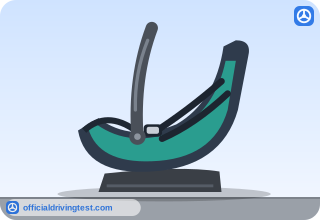
- In the front seat of a car with an air bag
- In the middle position of the rear seat
- Behind the driver's seat
- In any vehicle with two rows of seats
Show answer
Correct answer: In the front seat of a car with an air bag
A child in a rear-facing restraint may not ride in the front seat of an air-bag-equipped vehicle.
Source: California Driver Handbook (2025), page 66 · Open this page in the manual (Manual page 66)
-
Children under 8 years old, or shorter than 4 feet 9 inches, must be secured:
- With an adult lap belt in any seat
- In a child passenger restraint system in a rear seat
- On an adult's lap in the back seat
- Only when the trip is longer than 10 miles
Show answer
Correct answer: In a child passenger restraint system in a rear seat
These children need a federally approved child passenger restraint system, and it belongs in a rear seat except in specific listed situations.
Source: California Driver Handbook (2025), page 66 · Open this page in the manual (Manual page 66)
-
Which situation allows a child under 8 to ride in the front seat in a federally approved restraint?
- The child gets carsick in the back
- The trip is short and within the city
- All rear seats are occupied by children 7 or younger
- An adult is riding in the rear seat to supervise
Show answer
Correct answer: All rear seats are occupied by children 7 or younger
Listed exceptions include no rear seat, side-facing or rear-facing rear seats, a restraint that cannot be installed properly in back, all rear seats filled by children 7 or younger, or medical reasons.
Source: California Driver Handbook (2025), page 66 · Open this page in the manual (Manual page 66)
-
When may a child use a regular safety belt instead of a child passenger restraint system?
- At 6 years old or when weighing 50 pounds
- At 10 years old only
- As soon as the child can buckle the belt without help
- At 8 years old or older, or when at least 4 feet 9 inches tall
Show answer
Correct answer: At 8 years old or older, or when at least 4 feet 9 inches tall
Children who are 8 or older, or at least 4 feet 9 inches tall, may use a properly secured safety belt that meets federal standards.
Source: California Driver Handbook (2025), page 66 · Open this page in the manual (Manual page 66)
-
How far from the air bag cover should you sit, and how is that distance measured?
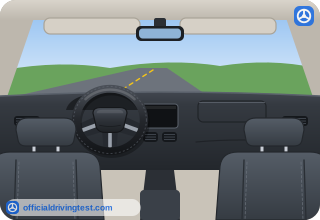
- At least 6 inches, measured from your knees to the bottom of the dashboard
- At least 10 inches, measured from the center of the steering wheel to your breastbone
- At least 18 inches, measured from the top of the windshield to your forehead
- As close as possible for better steering control
Show answer
Correct answer: At least 10 inches, measured from the center of the steering wheel to your breastbone
Sit at least 10 inches back, measured from the center of the steering wheel to your breastbone, as long as you keep full control. Passengers should do the same, and children seated next to a side air bag are at risk of serious injury.
Source: California Driver Handbook (2025), page 67 · Open this page in the manual (Manual page 67)
-
Under California law, leaving a child unattended in a vehicle is illegal when the child is:
- Six years old or younger
- Under three years old
- Under twelve years old in all cases
- Under sixteen years old
Show answer
Correct answer: Six years old or younger
It is illegal to leave a child six or younger alone in a vehicle, though the child may be supervised by someone who is at least 12 years old.
Source: California Driver Handbook (2025), page 67 · Open this page in the manual (Manual page 67)
-
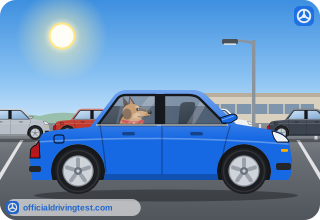
Why is leaving a child or a pet in a parked vehicle in the sun so dangerous?
- The battery drains and the doors lock automatically
- The car can heat up rapidly inside, even with a window cracked open
- Exhaust fumes build up inside the cabin
- It is only a problem in vehicles without air conditioning
Show answer
Correct answer: The car can heat up rapidly inside, even with a window cracked open
Heat builds fast inside a parked car even with a window slightly open, and too much heat exposure can cause dehydration, heat stroke, and death.
Source: California Driver Handbook (2025), page 67 · Open this page in the manual (Manual page 67)