California: Freeway driving Practice Test
Merging, exiting, passing, and carpool (HOV) lanes.
Independent educational site · not affiliated with any government agency or DMV
Ready? Test yourself
- Instant feedback with an explanation
- Every answer cites its source in the manual
- Your best score is saved on this device
- Keyboard: press 1 to 4 to answer and Enter for the next question
Questions are original and based on the official manual "California Driver Handbook" (2025), California DMV.
All 24 questions in this practice test
Take the test above first, then use this list to study. Tap “Show answer” to see the correct answer and explanation.
Show the questions and answersHide the questions
-
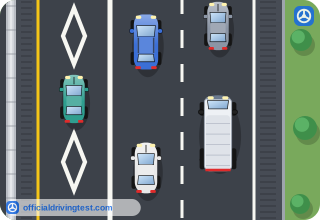
The lane you are in is marked with unusually large broken lines. What does that mean?
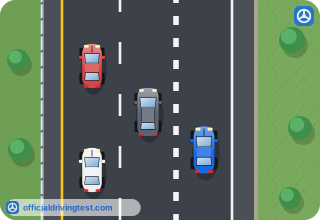
- The lane is reserved for trucks and other slow-moving heavy vehicles that are climbing the grade.
- You have entered a carpool lane.
- The lane is ending or becoming an exit, so look for a sign telling you to exit or merge.
- Passing is allowed in both directions.
Show answer
Correct answer: The lane is ending or becoming an exit, so look for a sign telling you to exit or merge.
Large broken lines mark freeway and street lanes that are ending. Be ready to exit or for the lane to end, and watch for a sign to exit or merge.
Source: California Driver Handbook (2025), page 14 · Open this page in the manual (Manual page 14)
-
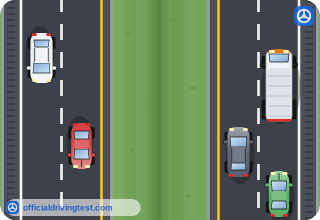
Which lane is called the Number 1 Lane?
- The lane nearest the right shoulder.
- The left, or fast, lane.
- Whichever lane carries the most traffic at that moment.
- The carpool lane.
Show answer
Correct answer: The left, or fast, lane.
The left or fast lane is the Number 1 Lane; the lane to its right is Number 2, then Number 3, and so on.
Source: California Driver Handbook (2025), page 15 · Open this page in the manual (Manual page 15)
-
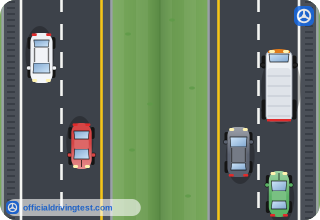
Which lane should you use to pass or turn left?
- The right lane.
- The center lane.
- Any lane at all, provided you have signalled your intention first.
- The left lane.
Show answer
Correct answer: The left lane.
Use the left lane to pass or turn left. Use the right lane to enter or exit traffic, or when you join the road from a curb or shoulder.
Source: California Driver Handbook (2025), page 15 · Open this page in the manual (Manual page 15)
-
On a multilane road, which lane is the passing lane?
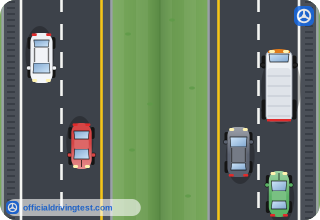
- The far left lane.
- The far right lane.
- Any lane marked with a diamond.
- The shoulder.
Show answer
Correct answer: The far left lane.
The passing lane is the far left lane, next to the center divider.
Source: California Driver Handbook (2025), page 15 · Open this page in the manual (Manual page 15)
-
Who may use an HOV (carpool) lane?
- Any driver who is running late may use it during the posted peak hours on weekdays.
- Carpools, buses, motorcycles, and qualifying low-emission vehicles with a decal.
- Commercial trucks only.
- Any vehicle after dark.
Show answer
Correct answer: Carpools, buses, motorcycles, and qualifying low-emission vehicles with a decal.
HOV lanes are reserved for carpools, buses, motorcycles, and low-emission vehicles carrying a decal. Motorcyclists may use them unless signs say otherwise.
Source: California Driver Handbook (2025), page 15 · Open this page in the manual (Manual page 15)
-
How do you find out how many people your car needs to use an HOV lane?
- The minimum is always two.
- Call DMV before you set out.
- Signs at the on-ramp or along the road state the minimum, and the hours the rule applies.
- It depends on the size of your vehicle and on the number of seats it was built with at the factory.
Show answer
Correct answer: Signs at the on-ramp or along the road state the minimum, and the hours the rule applies.
Signs at the on-ramp or along the road give the minimum number of people required and list the hours when HOV rules are in force.
Source: California Driver Handbook (2025), page 16 · Open this page in the manual (Manual page 16)
-
A low-emission vehicle may use the carpool lane alone only if it displays what?
- A special decal issued by DMV.
- A green front license plate.
- A dealer sticker in the rear window.
- Nothing at all; the vehicle type is enough on its own.
Show answer
Correct answer: A special decal issued by DMV.
Low-emission and zero-emission vehicles must display a special DMV-issued decal to use an HOV lane.
Source: California Driver Handbook (2025), page 16 · Open this page in the manual (Manual page 16)
-
How is the road surface of an HOV lane marked?
- With a painted green stripe.
- With a diamond symbol and the words Carpool Lane.
- With a row of white triangles.
- With no pavement marking at all; only roadside signs identify it.
Show answer
Correct answer: With a diamond symbol and the words Carpool Lane.
HOV lanes are marked on the pavement with a diamond symbol and the words Carpool Lane.
Source: California Driver Handbook (2025), page 16 · Open this page in the manual (Manual page 16)
-
How should you enter and leave an HOV lane?
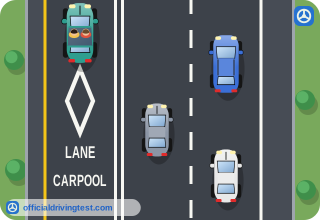
- Cross the double solid lines wherever a gap in traffic appears.
- Only after signalling for ten seconds.
- Only from the right-hand lane.
- Only at the designated entrances and exits.
Show answer
Correct answer: Only at the designated entrances and exits.
Do not cross double solid lines to enter or leave an HOV lane; use the designated entrances and exits.
Source: California Driver Handbook (2025), page 16 · Open this page in the manual (Manual page 16)
-
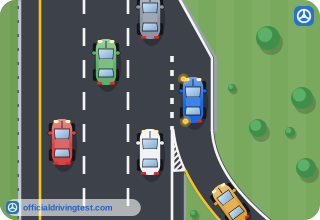
You are entering a highway from an on-ramp. Who has the right-of-way?
- Whichever vehicle is moving faster
- The traffic already traveling on the highway
- The vehicle on the on-ramp, because it must speed up
- Neither one; both drivers share the right-of-way equally
Show answer
Correct answer: The traffic already traveling on the highway
Vehicles already on the highway keep the right-of-way. The merging driver must find a safe gap and blend in.
Source: California Driver Handbook (2025), page 23 · Open this page in the manual (Manual page 23)
-
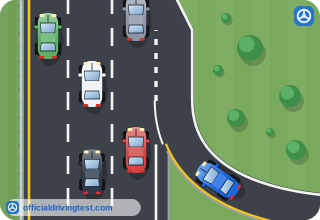
While you travel along the on-ramp, what should your speed be?
- Well under the speed of highway traffic so you can look around
- Stopped at the end of the ramp until a large gap appears
- At or near the speed of the traffic you are joining
- Exactly 10 mph slower than the posted limit
Show answer
Correct answer: At or near the speed of the traffic you are joining
You should reach a speed close to that of highway traffic before merging, and you should not stop on the ramp unless it is absolutely necessary.
Source: California Driver Handbook (2025), page 23 · Open this page in the manual (Manual page 23)
-
How much following space should you leave when you merge onto a highway?
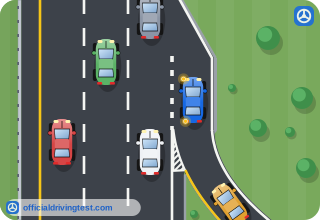
- Three seconds
- One car length
- Twenty feet
- Half a second, so no one cuts in front of you
Show answer
Correct answer: Three seconds
Leave at least three seconds of space ahead of you so you can stop safely after merging.
Source: California Driver Handbook (2025), page 23 · Open this page in the manual (Manual page 23)
-
You need to move across several highway lanes. What is the correct method?
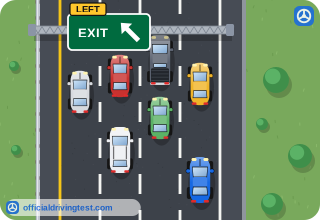
- Cross all of them in one continuous movement while your turn signal stays on
- Cross the solid line nearest to you to shorten the trip
- Signal once and let other drivers make room for you
- Signal and cross one lane at a time, checking your blind spots each time
Show answer
Correct answer: Signal and cross one lane at a time, checking your blind spots each time
Lanes are changed one at a time, with a signal and a shoulder check for vehicles, motorcyclists, bicyclists, and pedestrians before each move. Never cross a solid line while merging.
Source: California Driver Handbook (2025), page 23 · Open this page in the manual (Manual page 23)
-
How far in advance should you signal before leaving a highway?
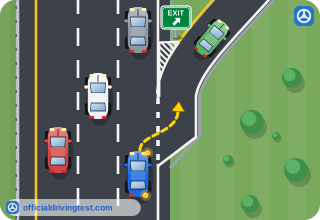
- About 100 feet
- Five seconds, which is roughly 400 feet
- One second before reaching the exit ramp
- Only after you are already on the exit ramp
Show answer
Correct answer: Five seconds, which is roughly 400 feet
Once you are in the proper lane, signal about five seconds (roughly 400 feet) ahead of the exit.
Source: California Driver Handbook (2025), page 23 · Open this page in the manual (Manual page 23)
-
On city streets, about how much space do you need to enter or cross traffic?
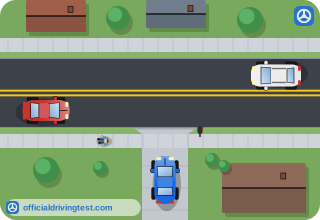
- About 50 feet
- About 75 feet
- About 300 feet, which is the length of a full block
- Half a block, which is about 150 feet
Show answer
Correct answer: Half a block, which is about 150 feet
A gap of roughly half a block, about 150 feet, gives you room to reach the speed of city traffic.
Source: California Driver Handbook (2025), page 24 · Open this page in the manual (Manual page 24)
-
About how much space do you need to merge, enter, or exit traffic on a highway?
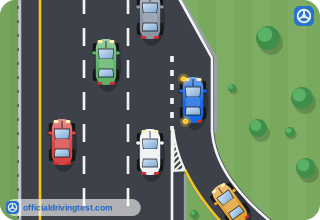
- A full block, about 300 feet
- Half a block, about 150 feet
- About 200 feet
- Roughly one quarter of a mile
Show answer
Correct answer: A full block, about 300 feet
Highway speeds are higher, so you need a gap about the length of a full block, roughly 300 feet.
Source: California Driver Handbook (2025), page 24 · Open this page in the manual (Manual page 24)
-
To pass safely, how far ahead should an approaching hill or curve be?
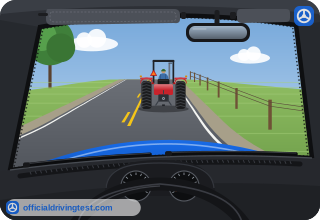
- At least 100 feet
- At least one full mile
- At least 500 feet
- At least a third of a mile
Show answer
Correct answer: At least a third of a mile
A hill or curve must be at least one-third of a mile away before you have room to pass safely.
Source: California Driver Handbook (2025), page 24 · Open this page in the manual (Manual page 24)
-
You must not pass within 100 feet of which of the following?
- A parked delivery truck that is blocking part of your lane
- An intersection, bridge, tunnel, or railroad crossing
- A bus stop
- A shopping center entrance
Show answer
Correct answer: An intersection, bridge, tunnel, or railroad crossing
Passing is prohibited within 100 feet of an intersection, bridge, tunnel, railroad crossing, or other hazardous area.
Source: California Driver Handbook (2025), page 24 · Open this page in the manual (Manual page 24)
-
You should never begin a pass unless:
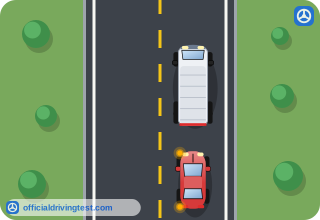
- The driver ahead waves you around
- You can finish it within ten seconds of leaving your lane
- You have enough room to return to your own lane
- The road has a broken white line
Show answer
Correct answer: You have enough room to return to your own lane
Never start a pass at crossroads or driveways, or when you do not have a clear place to return to your lane.
Source: California Driver Handbook (2025), page 24 · Open this page in the manual (Manual page 24)
-
On an open highway, when may you pass another vehicle on the right?
- When there are two or more lanes going in your direction
- Any time the right lane looks empty
- Whenever the driver ahead is going below the speed limit
- By using the paved shoulder
Show answer
Correct answer: When there are two or more lanes going in your direction
Passing on the right is allowed only with two or more lanes in your direction, when the driver ahead is turning left and it is safe, or on a one-way street.
Source: California Driver Handbook (2025), page 25 · Open this page in the manual (Manual page 25)
-
The driver in front of you is signaling a left turn. What is true?
- You may pass on either side as long as you signal
- You must wait until the turn is completed before doing anything
- You may pass on the right if it is safe, but never on the left
- You must use the shoulder to get around
Show answer
Correct answer: You may pass on the right if it is safe, but never on the left
You may pass on the right if the driver ahead is turning left and you can do so safely. Never pass on the left if the driver is signaling a left turn.
Source: California Driver Handbook (2025), page 25 · Open this page in the manual (Manual page 25)
-
May you drive off the paved or main-traveled part of the road to pass?
- Yes, if the shoulder is wide and firm
- Yes, when passing slow farm equipment
- Yes, if you stay under 25 mph
- No, never
Show answer
Correct answer: No, never
You may never leave the paved or main-traveled portion of the roadway in order to pass another vehicle.
Source: California Driver Handbook (2025), page 25 · Open this page in the manual (Manual page 25)
-
Another driver signals that they intend to pass you. You should:
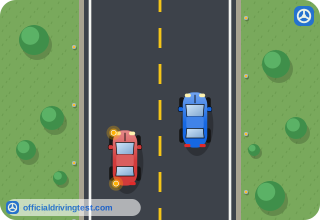
- Speed up so the pass takes less time
- Hold your lane position and your speed
- Pull onto the shoulder and stop
- Brake firmly to open a gap
Show answer
Correct answer: Hold your lane position and your speed
Allow the vehicle to pass, and keep your lane position and your speed.
Source: California Driver Handbook (2025), page 25 · Open this page in the manual (Manual page 25)
-
Vehicles are entering the freeway from an on-ramp ahead of you and you have the right-of-way. What does the handbook advise?
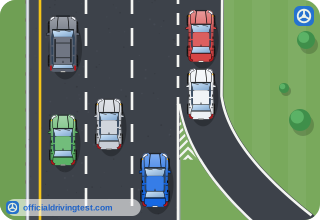
- Make space for them anyway and watch for their signals
- Hold your position since they must yield to you
- Sound your horn as a warning
- Speed up so they merge behind you
Show answer
Correct answer: Make space for them anyway and watch for their signals
Even when you have the right-of-way, making room for merging traffic prevents conflicts; be ready for rapid changes.
Source: California Driver Handbook (2025), page 58 · Open this page in the manual (Manual page 58)