California: Parking rules Practice Test
Parallel parking, hill parking, illegal parking, and colored curbs.
Independent educational site · not affiliated with any government agency or DMV
Ready? Test yourself
- Instant feedback with an explanation
- Every answer cites its source in the manual
- Your best score is saved on this device
- Keyboard: press 1 to 4 to answer and Enter for the next question
Questions are original and based on the official manual "California Driver Handbook" (2025), California DMV.
All 27 questions in this practice test
Take the test above first, then use this list to study. Tap “Show answer” to see the correct answer and explanation.
Show the questions and answersHide the questions
-
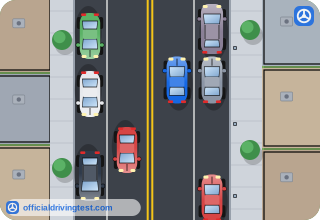
How long should a parallel parking space be?
- Exactly the same length as your vehicle
- At least three feet longer than your vehicle
- At least 18 inches longer than your vehicle
- At least twice the length of your vehicle
Show answer
Correct answer: At least three feet longer than your vehicle
Look for a gap at least three feet longer than your car, then signal to show that you plan to park.
Source: California Driver Handbook (2025), page 26 · Open this page in the manual (Manual page 26)
-
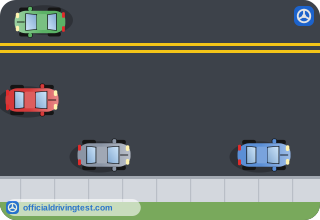
When you pull up alongside the vehicle in front of your parallel parking space, you should:
- Line your side mirror up with the other driver mirror so that the spacing is exactly right
- Leave about six feet of space and cancel your signal
- Leave about two feet of space, with your rear bumper even with the front of the space
- Stop with your front bumper even with the rear of the space
Show answer
Correct answer: Leave about two feet of space, with your rear bumper even with the front of the space
About two feet of side clearance and a rear bumper lined up with the front of the space set up the correct backing angle. Keep your signal on.
Source: California Driver Handbook (2025), page 26 · Open this page in the manual (Manual page 26)
-
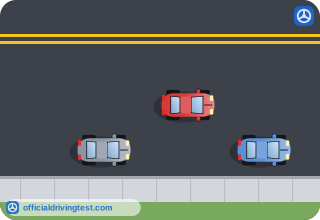
At about what angle should you back into a parallel parking space?
- About 90 degrees
- About 20 degrees
- About 60 degrees
- About 45 degrees
Show answer
Correct answer: About 45 degrees
After checking your mirror and blind spots, back in at roughly a 45-degree angle.
Source: California Driver Handbook (2025), page 26 · Open this page in the manual (Manual page 26)
-
While backing into the space, when do you begin turning the steering wheel away from the curb?
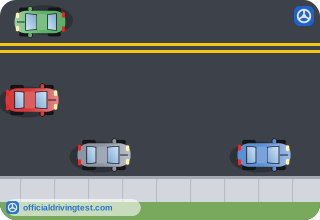
- When your rear wheel is within 18 inches of the curb
- As soon as the rear bumper enters the space
- When the rear wheel touches the curb
- When your front bumper clears the vehicle ahead
Show answer
Correct answer: When your rear wheel is within 18 inches of the curb
Straighten out once the rear wheel is within 18 inches of the curb. When finished, the vehicle should sit parallel and within 18 inches of the curb.
Source: California Driver Handbook (2025), page 26 · Open this page in the manual (Manual page 26)
-
In the straight line backing exercise, how far do you back up and how close to the curb do you stay?
- One vehicle length, within 18 inches of the curb
- Five vehicle lengths, within one foot of the curb
- Three vehicle lengths, within three feet of the curb
- Three vehicle lengths, within ten feet of the curb
Show answer
Correct answer: Three vehicle lengths, within three feet of the curb
Back straight for three vehicle lengths while staying within three feet of the curb, at a smooth and controlled speed.
Source: California Driver Handbook (2025), page 27 · Open this page in the manual (Manual page 27)
-
Whenever you park on a hill, you should always:
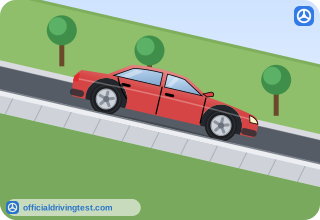
- Leave the vehicle in neutral with the wheels straight so it can be pushed aside if needed
- Set the parking brake and leave the vehicle in park, or in gear if it is a manual
- Rely on the parking brake only
- Leave the front wheels straight
Show answer
Correct answer: Set the parking brake and leave the vehicle in park, or in gear if it is a manual
Equipment can fail, so the parking brake plus park (or a gear on a manual) backs up the turned wheels.
Source: California Driver Handbook (2025), page 27 · Open this page in the manual (Manual page 27)
-
You are parking on a sloping driveway. Which way should the wheels point?
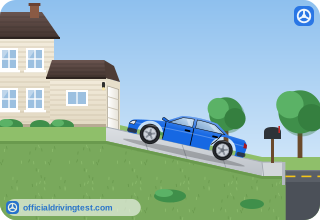
- Straight ahead toward the garage
- Whichever way is easiest to drive away
- So the vehicle cannot roll into the street
- Always to the left
Show answer
Correct answer: So the vehicle cannot roll into the street
Aim the wheels so a rolling vehicle would stay out of the roadway, leave it in park, and set the parking brake.
Source: California Driver Handbook (2025), page 27 · Open this page in the manual (Manual page 27)
-
You are parking facing downhill next to a curb. Your front wheels should be turned:
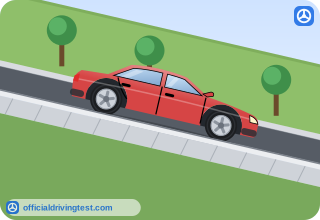
- Into the curb, toward the side of the road
- Away from the curb, toward the center of the road
- Straight ahead
- It does not matter if the parking brake is set
Show answer
Correct answer: Into the curb, toward the side of the road
Facing downhill, turn the front wheels into the curb so the curb blocks the vehicle if it starts to roll.
Source: California Driver Handbook (2025), page 27 · Open this page in the manual (Manual page 27)
-
You are parking facing uphill next to a curb. What is the correct procedure?
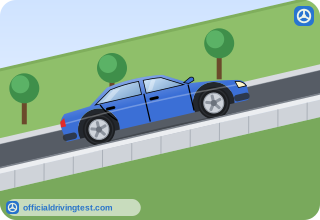
- Turn the wheels into the curb and roll forward slightly
- Leave the front wheels pointing straight ahead, set the parking brake, and shift into park
- Turn the wheels away from the curb and roll back until a wheel gently touches it
- Turn the wheels toward the curb and leave the vehicle in neutral
Show answer
Correct answer: Turn the wheels away from the curb and roll back until a wheel gently touches it
Facing uphill, the front wheels point away from the curb (to the left) and the vehicle rolls back a few inches so the tire rests against the curb.
Source: California Driver Handbook (2025), page 27 · Open this page in the manual (Manual page 27)
-
You are parking on a hill where there is no curb, either facing uphill or downhill. Turn your wheels:
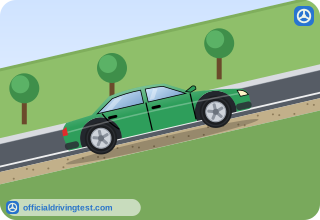
- To the left
- To the right, so the vehicle would roll away from the center of the road
- Straight, and shift into neutral
- Uphill when you are facing up the slope and downhill when you are facing down
Show answer
Correct answer: To the right, so the vehicle would roll away from the center of the road
With no curb, the wheels point right toward the shoulder so a brake failure sends the vehicle off the road instead of into traffic.
Source: California Driver Handbook (2025), page 27 · Open this page in the manual (Manual page 27)
-
What does a white painted curb mean?
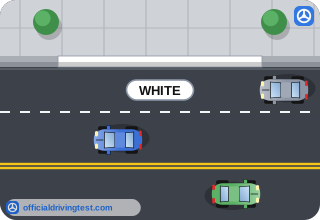
- Parking is free for up to two hours
- Stop only long enough to pick up or drop off passengers
- Commercial loading only
- No stopping at any time of day or night, for any reason at all
Show answer
Correct answer: Stop only long enough to pick up or drop off passengers
A white curb is a short passenger loading zone, not a parking space.
Source: California Driver Handbook (2025), page 28 · Open this page in the manual (Manual page 28)
-
A green painted curb means:
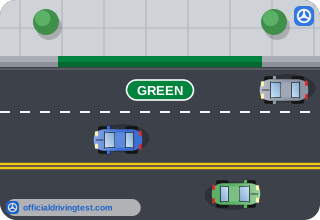
- Limited-time parking, posted on a sign or painted on the curb
- Free unlimited parking
- Parking for zero-emission vehicles only
- Loading and unloading of freight, but only by commercial vehicles
Show answer
Correct answer: Limited-time parking, posted on a sign or painted on the curb
Green means limited-time parking; check the sign or the paint on the curb for the limit.
Source: California Driver Handbook (2025), page 28 · Open this page in the manual (Manual page 28)
-
A yellow painted curb allows you to:
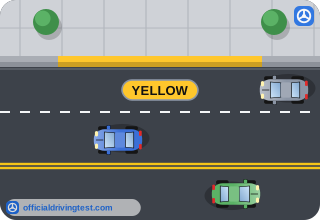
- Park overnight
- Stop only long enough to drop off a passenger who has a disabled placard
- Wait for a parking space to open up
- Load and unload passengers and freight, no longer than the posted time
Show answer
Correct answer: Load and unload passengers and freight, no longer than the posted time
Yellow is a loading zone. If you drive a noncommercial vehicle, you are usually required to stay with your vehicle.
Source: California Driver Handbook (2025), page 28 · Open this page in the manual (Manual page 28)
-
What is allowed at a red painted curb?
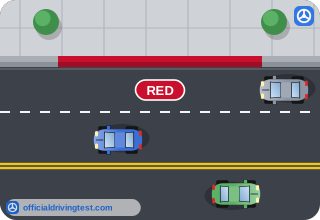
- Stopping briefly with your hazard flashers on while you wait for someone
- Nothing, except that buses may stop in a red zone marked for buses
- Loading freight for up to ten minutes
- Parking with a disabled placard
Show answer
Correct answer: Nothing, except that buses may stop in a red zone marked for buses
A red curb means no stopping, standing, or parking at all; only buses in a marked bus zone are excepted.
Source: California Driver Handbook (2025), page 28 · Open this page in the manual (Manual page 28)
-
Who may park at a blue painted curb?
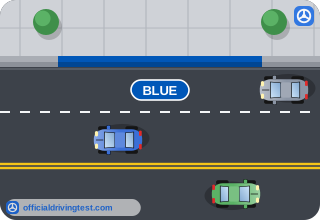
- Any driver, for up to 15 minutes, as long as the vehicle is never left unattended
- Emergency vehicles only
- A disabled person, or a driver transporting one, with a placard or special plate
- Drivers of zero-emission vehicles
Show answer
Correct answer: A disabled person, or a driver transporting one, with a placard or special plate
Blue curbs are reserved for vehicles displaying a disabled person placard or special license plate.
Source: California Driver Handbook (2025), page 28 · Open this page in the manual (Manual page 28)
-
How close may you park to a sidewalk ramp built for people with disabilities?
- No closer than three feet
- No closer than 15 feet
- No closer than 20 feet
- You may park right up against it if you are not blocking it
Show answer
Correct answer: No closer than three feet
Never park within three feet of a sidewalk ramp, or in front of a curb that provides wheelchair access.
Source: California Driver Handbook (2025), page 28 · Open this page in the manual (Manual page 28)
-
May you park in the crosshatched (diagonal lines) area beside a designated disabled parking space?
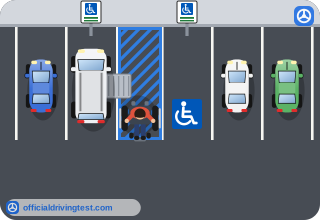
- Yes, if you have a disabled placard
- Yes, for short stops under five minutes
- No, never
- Yes, if no disabled space is occupied
Show answer
Correct answer: No, never
Never park or leave your vehicle in the crosshatched (diagonal lines) area next to a designated disabled parking space.
Source: California Driver Handbook (2025), page 28 · Open this page in the manual (Manual page 28)
-
Who may use a space designated for parking or fueling zero-emission vehicles?
- Any vehicle when the space is empty
- Only drivers of zero-emission vehicles
- Any hybrid or fuel-efficient vehicle
- Any vehicle for up to 30 minutes
Show answer
Correct answer: Only drivers of zero-emission vehicles
Those spaces are off-limits unless you are driving a zero-emission vehicle. Local authorities may also reserve street spaces for electric vehicle charging.
Source: California Driver Handbook (2025), page 28 · Open this page in the manual (Manual page 28)
-
Parking in a tunnel or on a bridge is:
- Allowed during daylight hours
- Allowed if you stay with your vehicle
- Prohibited unless signs permit it
- Allowed for up to four hours
Show answer
Correct answer: Prohibited unless signs permit it
Do not park in a tunnel or on a bridge unless posted signs specifically allow it.
Source: California Driver Handbook (2025), page 28 · Open this page in the manual (Manual page 28)
-
How far from a fire hydrant or a fire station driveway must you park?
- At least 10 feet
- At least 15 feet
- At least 25 feet
- At least 3 feet
Show answer
Correct answer: At least 15 feet
Never park within 15 feet of a fire hydrant or of a fire station driveway.
Source: California Driver Handbook (2025), page 28 · Open this page in the manual (Manual page 28)
-
How far from a marked or unmarked crosswalk must you park?
- At least 5 feet
- At least 10 feet
- At least 20 feet
- At least 50 feet
Show answer
Correct answer: At least 20 feet
Never park within 20 feet of a marked or unmarked crosswalk, or within 15 feet of a crosswalk where a curb extension is present.
Source: California Driver Handbook (2025), page 28 · Open this page in the manual (Manual page 28)
-
At a crosswalk where a curb extension is present, how far away must you park?
- At least 15 feet
- At least 20 feet
- At least 25 feet
- There is no distance rule there
Show answer
Correct answer: At least 15 feet
The general rule is 20 feet from a marked or unmarked crosswalk. Where a curb extension is present, the distance is 15 feet.
Source: California Driver Handbook (2025), page 28 · Open this page in the manual (Manual page 28)
-
Which of these is legal parking?
- Partially blocking a sidewalk
- In front of a private driveway, as long as it is your own driveway
- At a legal space beside the curb with your wheels parallel to it
- On an unmarked crosswalk
Show answer
Correct answer: At a legal space beside the curb with your wheels parallel to it
You may never park on a sidewalk, even partially, in front of a driveway, or on a marked or unmarked crosswalk.
Source: California Driver Handbook (2025), page 28 · Open this page in the manual (Manual page 28)
-
You must never park or leave your vehicle:
- At a green curb, within the posted time limit
- Double parked
- At a blue curb, with a disabled person placard
- 25 feet from a marked crosswalk
Show answer
Correct answer: Double parked
Being double parked is on the manual's list of places where you must never park or leave your vehicle. Green and blue curbs allow parking under their own rules, and the crosswalk limit is 20 feet.
Source: California Driver Handbook (2025), page 28 · Open this page in the manual (Manual page 28)
-
When is it legal to stop on a freeway?
- In an emergency, when an officer requires it, or where it is specifically permitted
- Any time you need to check a map
- Whenever your vehicle is completely off the pavement and onto the right shoulder
- During daylight hours only
Show answer
Correct answer: In an emergency, when an officer requires it, or where it is specifically permitted
Stopping on a freeway, or parking on the wrong side of the street, is illegal except for those three situations.
Source: California Driver Handbook (2025), page 29 · Open this page in the manual (Manual page 29)
-
A vehicle left standing on a freeway may be removed after how long?
- One hour
- Two hours
- Four hours
- Twenty-four hours
Show answer
Correct answer: Four hours
A vehicle stopped, parked, or left standing on a freeway for more than four hours may be towed away.
Source: California Driver Handbook (2025), page 29 · Open this page in the manual (Manual page 29)
-
Regarding electric vehicle charging on public streets, local authorities may:
- Reserve parking spaces for electric vehicle charging
- Charge electric vehicles a special parking tax
- Ban electric vehicles from metered spaces
- Require all drivers to yield charging spaces after one hour
Show answer
Correct answer: Reserve parking spaces for electric vehicle charging
Cities and counties are allowed to set aside on-street parking spaces specifically for charging electric vehicles.
Source: California Driver Handbook (2025), page 29 · Open this page in the manual (Manual page 29)