Arizona: Right-of-way and turning
Who goes first at intersections, left and right turns, roundabouts, diverging diamonds and passing. Split into 4 shorter tests so you're not stuck in one long quiz.
Independent educational site · not affiliated with any government agency or DMV
Choose a part
Right-of-way and turning — Part 1
Questions in this part include: “What does the law designate about making turns?”
StartRight-of-way and turning — Part 2
Questions in this part include: “On which side of the central island must you enter a roundabout?”
StartRight-of-way and turning — Part 3
Questions in this part include: “According to the manual, what does the law actually do about the right-of-way?”
StartRight-of-way and turning — Part 4
Questions in this part include: “Unless signs direct you otherwise, which lane of the road should you turn into after turning right?”
StartAll 67 Right-of-way and turning questions with answers
Choose a part above to take a practice test, or study every question and answer here.
Show the questions and answersHide the questions
-
When approaching an intersection, what must you be sure to check before proceeding?
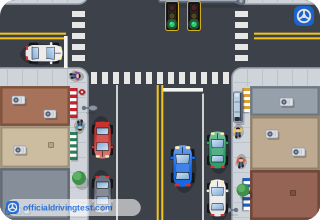
- Only the lane you plan to enter
- Only the traffic signal ahead
- Both left and right
- Only the traffic to your right
Show answer
Correct answer: Both left and right
The manual says to check both left and right before proceeding through an intersection.
Source: Arizona Driver License Manual and Customer Service Guide (Revised March 2026), page 25
-
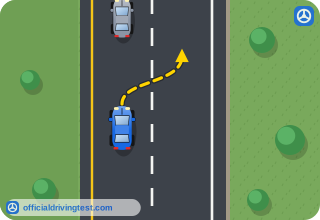
When changing lanes, what should you do besides checking your side mirrors?
- Sound your horn to alert drivers in the next lane
- Brake briefly to signal the drivers behind you
- Check only your rearview mirror before moving
- Turn your head and look over your shoulder
Show answer
Correct answer: Turn your head and look over your shoulder
The manual says to check your side mirrors and turn your head to look over your shoulder before a lane change.
Source: Arizona Driver License Manual and Customer Service Guide (Revised March 2026), page 25
-
When entering the roadway from a side road or private drive, what should you do?
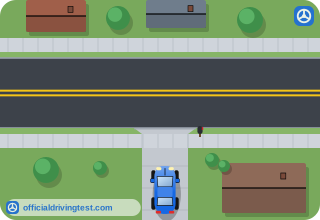
- Stop and wait for traffic to clear
- Enter slowly and let traffic adjust to you
- Merge into the first gap while sounding your horn
- Signal and enter ahead of vehicles using turn signals
Show answer
Correct answer: Stop and wait for traffic to clear
The manual says to stop and wait for traffic to clear when entering the roadway from a side road or private drive.
Source: Arizona Driver License Manual and Customer Service Guide (Revised March 2026), page 26
-
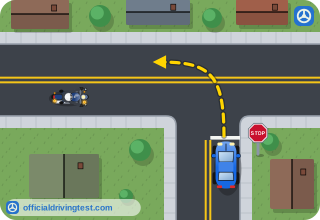
A vehicle or motorcycle ahead is using a turn signal while you wait to enter the roadway. What should you do?
- Enter as soon as the signal begins to flash
- Assume it will turn and pull out immediately
- Enter only if the vehicle is a motorcycle
- Wait until the other driver commits to the turn
Show answer
Correct answer: Wait until the other driver commits to the turn
The manual says not to assume a signaling vehicle will turn; wait until you see the driver commit to the turn.
Source: Arizona Driver License Manual and Customer Service Guide (Revised March 2026), page 26
-
What does the law designate about making turns?
- How many seconds you must wait before starting any turn
- Which lanes and positions you must use when turning
- Which vehicle must go first at every intersection
- Which speed you must slow to before every turn
Show answer
Correct answer: Which lanes and positions you must use when turning
The manual says the law designates which lanes and positions you must use when turning.
Source: Arizona Driver License Manual and Customer Service Guide (Revised March 2026), page 27
-
When you want to pass a vehicle traveling in the same direction, on which side should you pass?
- On the right
- On the side with more room
- On the shoulder
- On the left
Show answer
Correct answer: On the left
The manual says to pass a vehicle traveling in the same direction on the left.
Source: Arizona Driver License Manual and Customer Service Guide (Revised March 2026), page 27
-
Before moving into the left lane to pass, what must you make sure you have?
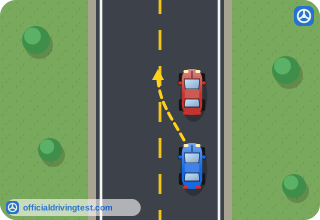
- Permission from the driver of the vehicle you plan to pass
- Time and room to get all the way in front of the passed vehicle
- A clear view of at least one mile of road ahead of you
- A speed at least 10 miles per hour over the posted limit
Show answer
Correct answer: Time and room to get all the way in front of the passed vehicle
The manual says to make sure you have time and room to get all the way in front of the vehicle without creating danger for oncoming vehicles.
Source: Arizona Driver License Manual and Customer Service Guide (Revised March 2026), page 27
-
After passing, when should you start returning to the lane on the right?
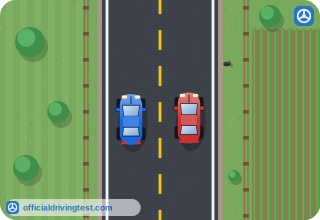
- When you have counted three seconds after passing the vehicle
- When you see both headlights of the passed vehicle in your mirror
- As soon as the vehicle you are passing begins to slow down
- When you have passed the vehicle by at least one car length
Show answer
Correct answer: When you see both headlights of the passed vehicle in your mirror
The manual says to return to the right lane after you can see the entire front or both headlights of the passed vehicle in your rearview mirror, after looking over your shoulder and signaling.
Source: Arizona Driver License Manual and Customer Service Guide (Revised March 2026), page 27
-
The passing procedure also applies to passing which of the following?
- Only motor vehicles with four wheels
- Only vehicles traveling under 25 miles per hour
- Only large trucks and buses
- Slow-moving motorcycles, bicycles and mopeds
Show answer
Correct answer: Slow-moving motorcycles, bicycles and mopeds
The manual says the passing procedure also applies to slow-moving motorcycles, bicycles and mopeds.
Source: Arizona Driver License Manual and Customer Service Guide (Revised March 2026), page 27
-
What should you do when a vehicle behind you sounds its horn or flashes its lights?
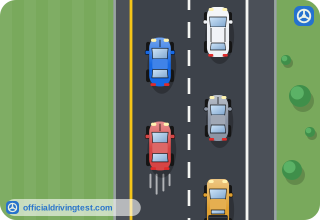
- Move to the right when safe and let it pass
- Hold your lane and speed up to discourage passing
- Brake to signal the driver to stay back
- Move to the left lane and slow down
Show answer
Correct answer: Move to the right when safe and let it pass
The manual says to move to the right when safe and let the vehicle pass.
Source: Arizona Driver License Manual and Customer Service Guide (Revised March 2026), page 27
-
What should you never do when another vehicle is passing you?
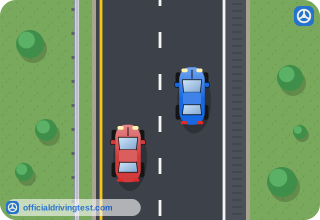
- Stay in your lane
- Let it pass
- Speed up
- Check your mirrors
Show answer
Correct answer: Speed up
The manual says never to speed up when another vehicle is passing you.
Source: Arizona Driver License Manual and Customer Service Guide (Revised March 2026), page 27
-
Passing on the right is permitted only when it is safe and which condition is met?
- The driver of the other vehicle is turning left
- The driver of the other vehicle is slowing down
- The driver of the other vehicle is traveling under the speed limit
- The other vehicle has moved onto the shoulder
Show answer
Correct answer: The driver of the other vehicle is turning left
The manual lists a driver turning left as one condition under which passing on the right is permitted when safe.
Source: Arizona Driver License Manual and Customer Service Guide (Revised March 2026), page 27
-
Passing on the right is permitted when it is safe on which kind of road?
- A narrow two-lane road with traffic coming in both directions
- Any two-lane road where the vehicle ahead is moving slowly
- An open highway marked for two or more lanes in your direction
- A road where passing on the left is blocked by a hill or curve
Show answer
Correct answer: An open highway marked for two or more lanes in your direction
The manual permits passing on the right when safe on an open highway clearly marked for two or more lanes moving in your direction.
Source: Arizona Driver License Manual and Customer Service Guide (Revised March 2026), page 27
-
When passing on the right, what must you never do?
- Drive off the paved or main portion of the roadway
- Signal your intention well before moving to the right
- Check your mirrors before you move over to the right
- Stay within a marked lane while you pass on the right
Show answer
Correct answer: Drive off the paved or main portion of the roadway
The manual says you must never pass on the right by driving off the paved or main portion of the roadway.
Source: Arizona Driver License Manual and Customer Service Guide (Revised March 2026), page 28
-
When must you not pass because you cannot see far enough ahead to be sure of safe passing?
- When driving on a straight, level road
- When approaching a curve or the top of a hill
- When the road has two lanes in your direction
- When the shoulder is paved
Show answer
Correct answer: When approaching a curve or the top of a hill
You must not pass when approaching a curve or the top of a hill where you cannot see ahead to be sure of safe passing.
Source: Arizona Driver License Manual and Customer Service Guide (Revised March 2026), page 28
-
You must not pass when you are approaching within how many feet of a street crossing?
- 25 feet
- 50 feet
- 75 feet
- 100 feet
Show answer
Correct answer: 100 feet
The manual prohibits passing within 100 feet of a street crossing.
Source: Arizona Driver License Manual and Customer Service Guide (Revised March 2026), page 28
-
You must not pass within how many feet of a bridge, tunnel, or underpass where your view is blocked?
- 40 feet
- 100 feet
- 200 feet
- 300 feet
Show answer
Correct answer: 100 feet
Passing is prohibited within 100 feet of a bridge, tunnel, or underpass where your view is blocked.
Source: Arizona Driver License Manual and Customer Service Guide (Revised March 2026), page 28
-
What is a roundabout?
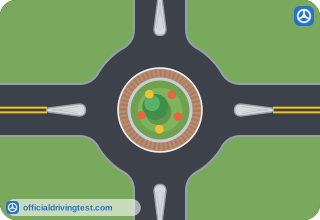
- A circular intersection in which traffic flows in both directions around a central island
- A circular intersection where every driver must come to a full stop before entering
- A circular intersection in which traffic flows almost continuously in one direction around a central island
- A circular intersection in which traffic around a central island is controlled by signal lights
Show answer
Correct answer: A circular intersection in which traffic flows almost continuously in one direction around a central island
The manual defines a roundabout as a circular intersection or junction where traffic flows almost continuously in one direction around a central island.
Source: Arizona Driver License Manual and Customer Service Guide (Revised March 2026), page 28
-
On which side of the central island must you enter a roundabout?
- To the left of the central island
- To the right of the central island
- Straight across the central island
- On whichever side has less traffic
Show answer
Correct answer: To the right of the central island
The manual says to always enter a roundabout to the right of the central island.
Source: Arizona Driver License Manual and Customer Service Guide (Revised March 2026), page 28
-
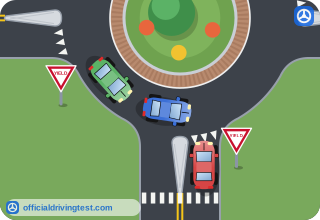
Vehicles approaching a roundabout must yield to which vehicles?
- Only vehicles that entered from your right and are about to leave the roundabout
- Only the vehicles in the roundabout that are traveling faster than you
- No vehicles, because vehicles on the approach have the right-of-way
- Every vehicle already in the roundabout, and large vehicles entering at the same time
Show answer
Correct answer: Every vehicle already in the roundabout, and large vehicles entering at the same time
Vehicles approaching must yield to all vehicles already in the roundabout and to large vehicles entering at the same time.
Source: Arizona Driver License Manual and Customer Service Guide (Revised March 2026), page 28
-
For what speeds are roundabouts designed?
- 15-20 mph
- 5-10 mph
- 25-30 mph
- 35-40 mph
Show answer
Correct answer: 15-20 mph
The manual says roundabouts are designed for speeds of 15-20 mph, so you should slow down as you approach.
Source: Arizona Driver License Manual and Customer Service Guide (Revised March 2026), page 28
-
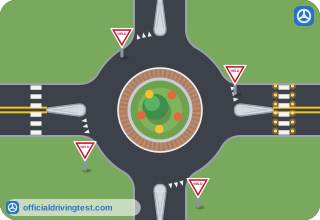
When should you enter a roundabout?
- As soon as you arrive, before circulating traffic reaches you
- When all vehicles inside have come to a stop
- When there is a gap in traffic
- Right behind the vehicle ahead, whether or not there is a gap
Show answer
Correct answer: When there is a gap in traffic
You enter the roundabout when there is a gap in traffic.
Source: Arizona Driver License Manual and Customer Service Guide (Revised March 2026), page 28
-
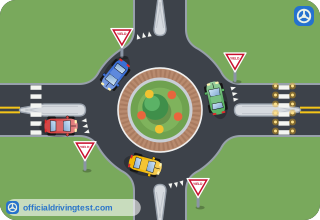
Once you are inside a roundabout, what should you do?
- Stop at each street you pass to check for gaps in traffic, then continue
- Stop briefly at your exit and signal before you leave the roundabout
- Do not stop, and follow signs or pavement markings about which lane to use
- Stay in the lane you entered and ignore any pavement markings inside
Show answer
Correct answer: Do not stop, and follow signs or pavement markings about which lane to use
Once inside a roundabout you do not stop, and you follow directions on signs or pavement markings about which lane to use.
Source: Arizona Driver License Manual and Customer Service Guide (Revised March 2026), page 28
-
What may you do if you miss your exit from a roundabout?
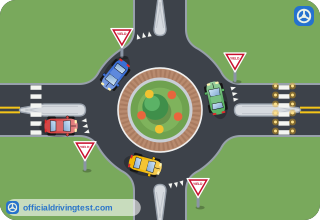
- Exit at any street or continue around
- Stop at the missed exit and wait for traffic to clear
- Back up in the roundabout to the exit you missed
- Cross the central island to reach your exit
Show answer
Correct answer: Exit at any street or continue around
The manual says you may exit at any street or continue around if you miss your exit.
Source: Arizona Driver License Manual and Customer Service Guide (Revised March 2026), page 28
-
What should you not try to do in a roundabout?
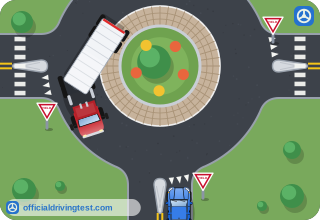
- Slow down for a large truck
- Pass a large truck
- Follow the signs for your lane
- Yield to a large truck that is entering
Show answer
Correct answer: Pass a large truck
The manual says not to try to pass large trucks in the roundabout.
Source: Arizona Driver License Manual and Customer Service Guide (Revised March 2026), page 28
-
At a Diverging Diamond interchange (DDI), what does traffic on the cross street briefly do?
- Travel in a circle around a central island
- Switch to the left side of the roadway
- Cross the freeway without any signals or signs
- Stop in the middle of the interchange to turn left
Show answer
Correct answer: Switch to the left side of the roadway
A DDI lets cross-street traffic briefly switch to the left side of the roadway to improve traffic flow and safety.
Source: Arizona Driver License Manual and Customer Service Guide (Revised March 2026), page 29
-
Where do the crossover points in a Diverging Diamond interchange occur?
- At the freeway on-ramps only
- At stop signs on each side of the freeway
- In the middle of the bridge between the signals
- At the signals
Show answer
Correct answer: At the signals
The crossover points, where traffic moves between the right and left sides of the road, occur at the signals.
Source: Arizona Driver License Manual and Customer Service Guide (Revised March 2026), page 29
-
How do drivers travel through a Diverging Diamond interchange?
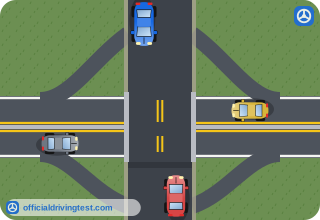
- By following only the pavement markings, since signals are not used
- By yielding to every vehicle on the cross street
- By following the vehicle ahead and ignoring signs
- By following traffic signals, signs and pavement markings
Show answer
Correct answer: By following traffic signals, signs and pavement markings
As with other interchanges, drivers go through a DDI by following traffic signals, signs and pavement markings.
Source: Arizona Driver License Manual and Customer Service Guide (Revised March 2026), page 29
-
In a Diverging Diamond interchange, how are left turns from the cross street to the on-ramps made?
- Using a protected green arrow at the crossover
- Using free-flowing lanes after the crossover
- Using a stop sign before the on-ramp
- From the right lane before the crossover
Show answer
Correct answer: Using free-flowing lanes after the crossover
Instead of needing special green time, left turns are made using free-flowing lanes after the crossover.
Source: Arizona Driver License Manual and Customer Service Guide (Revised March 2026), page 29
-
In a business or residential district, passing on the right is permitted when it is safe and what is true?
- The pavement is marked for two or more lanes going your way
- The vehicle ahead is moving below the posted speed limit
- The paved shoulder is wide enough for your vehicle to use
- No pedestrians are walking on the sidewalk beside you
Show answer
Correct answer: The pavement is marked for two or more lanes going your way
In a business or residential district, you may pass on the right when it is safe and the pavement is marked for two or more lanes of vehicles moving in your direction.
Source: Arizona Driver License Manual and Customer Service Guide (Revised March 2026), page 28
-
When may you turn right at a red light?
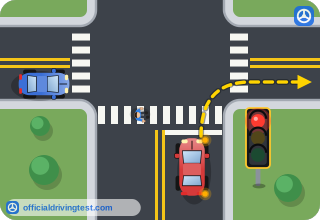
- After a rolling slow-down, when no sign prohibits it and cross traffic is clear
- Only when a police officer is directing traffic at the intersection
- After a complete stop, when motor and pedestrian traffic are clear and no sign prohibits it
- Only after waiting at least 30 seconds, if pedestrians are clear
Show answer
Correct answer: After a complete stop, when motor and pedestrian traffic are clear and no sign prohibits it
Where signs do not prohibit it, a right turn may be made after coming to a complete stop when motor and pedestrian traffic are clear.
Source: Arizona Driver License Manual and Customer Service Guide (Revised March 2026), page 34
-
Two vehicles arrive at an intersection with an inoperative signal at about the same time. Who must yield?
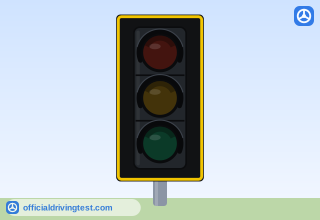
- The driver on the right yields to the driver on the left
- The driver of the vehicle on the left yields to the driver on the right
- The faster vehicle yields to the slower vehicle
- The vehicle that is turning yields to the vehicle going straight
Show answer
Correct answer: The driver of the vehicle on the left yields to the driver on the right
Both must stop, and the driver of the vehicle on the left must yield the right-of-way to the driver on the right.
Source: Arizona Driver License Manual and Customer Service Guide (Revised March 2026), page 35
-
At a "T" intersection, who must yield the right-of-way to vehicles on the cross street?
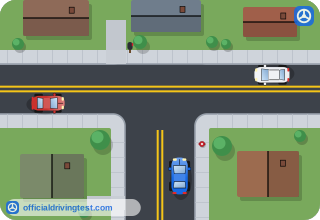
- The driver on the cross street
- The driver who arrived first
- The driver who is turning right
- The driver on the street which ends
Show answer
Correct answer: The driver on the street which ends
At a “T” intersection the driver on the street which ends must yield to vehicles on the cross street.
Source: Arizona Driver License Manual and Customer Service Guide (Revised March 2026), page 35
-
You have the right-of-way at a controlled intersection. What should you still do?
- Check for traffic and pedestrians
- Proceed without slowing, because others must yield
- Flash your headlights to warn others
- Stop and wait for other drivers to wave you on
Show answer
Correct answer: Check for traffic and pedestrians
The manual says not to assume it is safe to proceed just because you have the right-of-way; check for traffic and pedestrians.
Source: Arizona Driver License Manual and Customer Service Guide (Revised March 2026), page 36
-
What must you do when approaching an intersection that has no traffic lights, stop signs or yield signs?
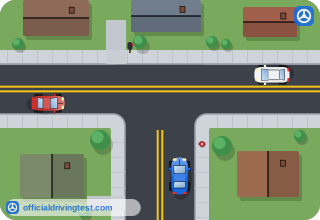
- Slow down and proceed without stopping if no vehicle is approaching
- Yield only to vehicles approaching from the right
- Come to a complete stop, then proceed when the roadway is clear
- Maintain your speed and sound your horn
Show answer
Correct answer: Come to a complete stop, then proceed when the roadway is clear
Such an intersection is treated as a 4-way stop: come to a complete stop and proceed when the roadway is clear.
Source: Arizona Driver License Manual and Customer Service Guide (Revised March 2026), page 36
-
According to the manual, what does the law actually do about the right-of-way?
- It gives the right-of-way to the driver who arrived first
- It states who must yield, rather than giving it to any motorist
- It gives the right-of-way to the larger vehicle
- It gives the right-of-way to the driver going straight
Show answer
Correct answer: It states who must yield, rather than giving it to any motorist
The law does not “give” the right-of-way to any particular motorist; it just states who must yield.
Source: Arizona Driver License Manual and Customer Service Guide (Revised March 2026), page 36
-
A driver is not allowed to take the right-of-way if doing so:
- Would require passing another vehicle
- Would make the driver exceed the speed limit
- Would block a crosswalk
- Means a crash may result
Show answer
Correct answer: Means a crash may result
No one is allowed to take the right-of-way if taking it means a crash may result.
Source: Arizona Driver License Manual and Customer Service Guide (Revised March 2026), page 36
-
Where must you stop when entering the roadway from an alley or driveway?
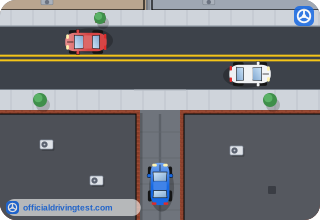
- At the curb after crossing the sidewalk
- Before reaching the sidewalk
- Only at the edge of the roadway
- Only if traffic is approaching
Show answer
Correct answer: Before reaching the sidewalk
When entering the roadway from an alley or driveway, you must stop before reaching the sidewalk.
Source: Arizona Driver License Manual and Customer Service Guide (Revised March 2026), page 37
-
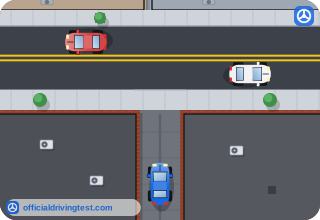
Who must you yield the right-of-way to when entering the roadway from an alley or driveway?
- Only approaching vehicles
- Only pedestrians
- Only vehicles approaching from the right
- Pedestrians and approaching vehicles
Show answer
Correct answer: Pedestrians and approaching vehicles
You must yield the right-of-way to pedestrians and approaching vehicles.
Source: Arizona Driver License Manual and Customer Service Guide (Revised March 2026), page 37
-
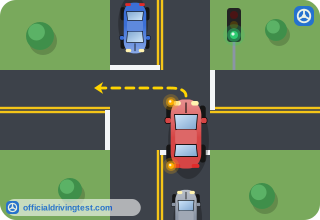
When you are preparing to turn left, you must yield the right-of-way to what?
- Any oncoming vehicle, bicycle or pedestrian
- Only oncoming motor vehicles, not bicycles
- Only vehicles turning right at the intersection
- Only pedestrians who are in the crosswalk
Show answer
Correct answer: Any oncoming vehicle, bicycle or pedestrian
When preparing to turn left, you must yield to any oncoming vehicle, bicycle or pedestrian.
Source: Arizona Driver License Manual and Customer Service Guide (Revised March 2026), page 37
-
Under what conditions are U-turns permitted?
- Only at intersections with a traffic signal, and never in the middle of a block
- Only when no other vehicle is within sight and a police officer allows it
- When it can be made safely, does not interfere with other traffic and no sign prohibits it
- Only when you can complete it in one motion without using the shoulder
Show answer
Correct answer: When it can be made safely, does not interfere with other traffic and no sign prohibits it
U-turns are permitted as long as the movement can be made safely, does not interfere with other traffic and is not prohibited by signs.
Source: Arizona Driver License Manual and Customer Service Guide (Revised March 2026), page 37
-
A funeral procession is being led by a funeral escort vehicle flashing a red or a blue light. What must drivers do?
- Yield the right-of-way to any vehicle in the procession
- Pass the procession as quickly as possible
- Join the procession and follow it
- Stop and turn off the engine until it has passed
Show answer
Correct answer: Yield the right-of-way to any vehicle in the procession
Drivers must yield the right-of-way to any vehicle that is part of a funeral procession led by an escort vehicle flashing a red or a blue light.
Source: Arizona Driver License Manual and Customer Service Guide (Revised March 2026), page 39
-
If you will be traveling on a one-way street for several blocks, which lane is it best to stay in?
- The far left lane
- The center lane
- The far right lane
- Whichever lane is empty
Show answer
Correct answer: The center lane
The left and right lanes will be used by turning vehicles, so the center lane is best.
Source: Arizona Driver License Manual and Customer Service Guide (Revised March 2026), page 46
-
On a one-way street, why is it best to avoid the left and right lanes if you are going several blocks?
- Those lanes are for slow traffic only
- Those lanes are reserved for buses
- Those lanes are for passing only
- Turning vehicles will use those lanes
Show answer
Correct answer: Turning vehicles will use those lanes
The left and right lanes are used by turning vehicles.
Source: Arizona Driver License Manual and Customer Service Guide (Revised March 2026), page 46
-
Where do the rules for turning apply?
- Only at intersections of two public roads
- At all locations, even driveways and alleys
- Only at intersections with traffic signals
- Only on roads with more than two lanes
Show answer
Correct answer: At all locations, even driveways and alleys
The turning rules apply at all locations, including driveways and alleys.
Source: Arizona Driver License Manual and Customer Service Guide (Revised March 2026), page 47
-
Which of these is part of the turning procedure in the manual?
- Speed up to clear the intersection quickly
- Sound your horn before every single turn
- Turn on your hazard lights while you turn
- Signal, reduce speed and turn smoothly when safe
Show answer
Correct answer: Signal, reduce speed and turn smoothly when safe
The manual says to signal, reduce speed and turn smoothly when safe.
Source: Arizona Driver License Manual and Customer Service Guide (Revised March 2026), page 47
-
As you turn, what should you make sure to check for?
- Pedestrians, mopeds and bicycles
- Only other cars and trucks nearby
- Only trucks coming toward you
- Only emergency vehicles that are close
Show answer
Correct answer: Pedestrians, mopeds and bicycles
The manual says to check for pedestrians, mopeds and bicycles as you turn.
Source: Arizona Driver License Manual and Customer Service Guide (Revised March 2026), page 47
-
In some areas turns may be made from more than one lane. What directs you in that case?
- Hand signals from other drivers
- The vehicle ahead of you
- Signs and pavement markings
- Your own judgment alone
Show answer
Correct answer: Signs and pavement markings
If turns from more than one lane are allowed, signs and pavement markings direct you.
Source: Arizona Driver License Manual and Customer Service Guide (Revised March 2026), page 47
-
How should you position your car as you prepare to turn right?
- Move to the left side of your lane before you turn
- Stay close to the right curb or edge, and do not swing wide
- Swing wide before the turn to give yourself more room
- Stay in the center of the roadway until the turn
Show answer
Correct answer: Stay close to the right curb or edge, and do not swing wide
The manual says to stay close to the right curb or edge and not swing wide before or while turning.
Source: Arizona Driver License Manual and Customer Service Guide (Revised March 2026), page 47
-
When turning right at a red light, what must you do first?
- Slow down and roll through if no one is near
- Stop only if a pedestrian is in the crosswalk
- Stop past the crosswalk so you can see traffic
- Stop completely before reaching the crosswalk
Show answer
Correct answer: Stop completely before reaching the crosswalk
You must stop completely before reaching the crosswalk, marked or unmarked, and look for No Turn On Red signs.
Source: Arizona Driver License Manual and Customer Service Guide (Revised March 2026), page 47
-
When you turn right on red, to whom must you always yield the right-of-way?
- Pedestrians, bicyclists and oncoming traffic
- Only pedestrians who are in the crosswalk
- Only vehicles that are behind you
- Only emergency vehicles that are nearby
Show answer
Correct answer: Pedestrians, bicyclists and oncoming traffic
The manual says to always yield to pedestrians, bicyclists and oncoming traffic.
Source: Arizona Driver License Manual and Customer Service Guide (Revised March 2026), page 47
-
Unless signs direct you otherwise, which lane of the road should you turn into after turning right?
- The center lane
- The left lane
- The right lane
- Any open lane
Show answer
Correct answer: The right lane
Unless signs direct otherwise, turn into the right lane of the road you enter.
Source: Arizona Driver License Manual and Customer Service Guide (Revised March 2026), page 47
-
On a two-way road, where should your car be as you approach a left turn?
- In the lane next to the right curb of the road
- In the lane just right of the center line
- Over the center line into the oncoming lane
- In the middle of the intersection ahead of you
Show answer
Correct answer: In the lane just right of the center line
On a two-way road, you approach in the lane just to the right of the center line.
Source: Arizona Driver License Manual and Customer Service Guide (Revised March 2026), page 47
-
When making a left turn from a two-way road, where should you turn in relation to the center point of the intersection?
- Just to the right of the center point
- Directly across the center point
- Beyond the far side of the intersection
- Just to the left of the center point
Show answer
Correct answer: Just to the left of the center point
You turn just to the left of the center point of the intersection and enter the lane just right of the center line.
Source: Arizona Driver License Manual and Customer Service Guide (Revised March 2026), page 47
-
If a special lane for making left turns has been signed or marked, what should you do?
- Use that lane and do not turn left from any other lane
- Use it only when traffic is heavy
- Turn left from whichever lane has the least traffic
- Use it only when turning at night
Show answer
Correct answer: Use that lane and do not turn left from any other lane
The manual says to use the marked left-turn lane and not to turn left from any other lane.
Source: Arizona Driver License Manual and Customer Service Guide (Revised March 2026), page 47
-
For a left turn from a one-way road to a one-way road, which lane should you approach in?
- The traffic lane nearest the right curb
- The center lane
- The traffic lane nearest the left curb
- Any lane with no traffic
Show answer
Correct answer: The traffic lane nearest the left curb
You approach in the lane nearest the left curb and bring your car into the extreme left lane of the road you enter.
Source: Arizona Driver License Manual and Customer Service Guide (Revised March 2026), page 47
-
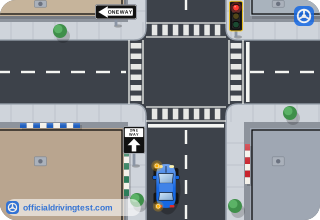
What may you do in a left turn from a one-way road to a one-way road, unless signs prohibit it?
- Turn on red without stopping when the way is clear
- Turn on red after stopping and yielding to others
- Turn only when you have a green arrow to go
- Turn only from the extreme right lane on the road
Show answer
Correct answer: Turn on red after stopping and yielding to others
The manual says this is the only left turn situation where you may turn against a red light after stopping and yielding.
Source: Arizona Driver License Manual and Customer Service Guide (Revised March 2026), page 47
-
For a left turn from a two-way road to a one-way road, into which lane of the road you are entering should you turn?
- The extreme right lane
- The center lane
- The lane just right of the center line
- The extreme left lane
Show answer
Correct answer: The extreme left lane
As you enter the intersection from a two-way road, you turn into the extreme left lane of the one-way road.
Source: Arizona Driver License Manual and Customer Service Guide (Revised March 2026), page 47
-
For a left turn from a one-way road to a two-way road, into which lane should you turn?
- The lane just right of the center line
- The extreme left lane of the road you enter
- The extreme right lane of the road you enter
- Whichever lane is closest to the left curb
Show answer
Correct answer: The lane just right of the center line
You turn into the lane just to the right of the center line.
Source: Arizona Driver License Manual and Customer Service Guide (Revised March 2026), page 48
-
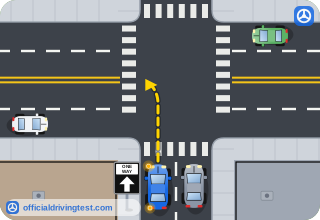
After a left turn from a one-way road to a two-way road, what must you do before moving to the right lane?
- Sound your horn to warn others
- Stop in the lane you entered first
- Check traffic to your right and signal
- Wait for a green arrow before moving
Show answer
Correct answer: Check traffic to your right and signal
The manual says not to move to the right lane without checking traffic to your right and signaling.
Source: Arizona Driver License Manual and Customer Service Guide (Revised March 2026), page 48
-
Can a left turn from a one-way road to a two-way road be made against a red light?
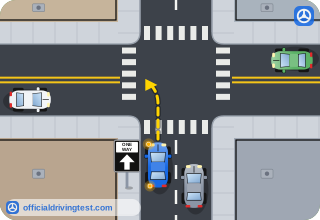
- Yes, after stopping and yielding to traffic
- No, it cannot be made against a red light
- Yes, if no other vehicles are near you
- Yes, if you signal for the entire turn
Show answer
Correct answer: No, it cannot be made against a red light
The manual states this turn cannot be made against a red light.
Source: Arizona Driver License Manual and Customer Service Guide (Revised March 2026), page 48
-
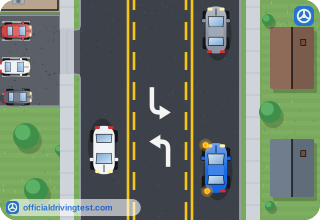
How is a two-way left turn lane bordered?
- Two solid white lines on either side of the lane
- A single solid yellow line on each side of the lane
- Two broken white lines on each side of the lane
- Two yellow lines on each side, inner broken and outer solid
Show answer
Correct answer: Two yellow lines on each side, inner broken and outer solid
A two-way left turn lane has a broken inner and solid outer yellow line on each side.
Source: Arizona Driver License Manual and Customer Service Guide (Revised March 2026), page 48
-
Who may use a two-way left turn lane?
- Only vehicles turning left, in either direction
- Vehicles turning right only
- Through traffic that wants to avoid congestion
- Only vehicles traveling in one direction
Show answer
Correct answer: Only vehicles turning left, in either direction
The lane is only for vehicles turning left in either direction.
Source: Arizona Driver License Manual and Customer Service Guide (Revised March 2026), page 48
-
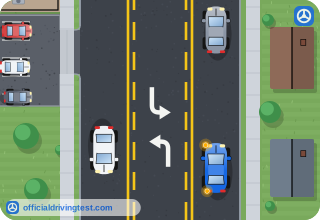
What does a two-way left turn lane provide?
- A lane for passing slower vehicles on a two-way street at any time
- A lane where vehicles may stop and park for a short while
- A safe area to slow before a left turn off the street
- A lane for speeding up before merging with through traffic
Show answer
Correct answer: A safe area to slow before a left turn off the street
The lane gives a safe area to slow before turning left off the street or to enter when turning left from a side street or driveway.
Source: Arizona Driver License Manual and Customer Service Guide (Revised March 2026), page 48
-
What should you do before entering a two-way left turn lane?
- Sound your horn
- Signal
- Stop completely
- Flash your headlights
Show answer
Correct answer: Signal
The first rule listed for the lane is to signal before entering it.
Source: Arizona Driver License Manual and Customer Service Guide (Revised March 2026), page 48
-
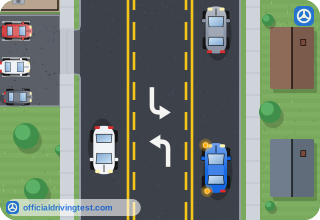
How far into the two-way left turn lane should you move?
- Only with your front wheels
- Only halfway
- Just over the line
- Completely into the lane
Show answer
Correct answer: Completely into the lane
The manual says to move completely into the lane.
Source: Arizona Driver License Manual and Customer Service Guide (Revised March 2026), page 48
-
Which of these is something you must not do in a two-way left turn lane?
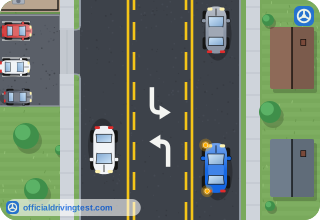
- Use it for passing or for through traffic
- Signal before you enter the lane to turn left
- Be alert for others who are also using the lane
- Move completely into the lane before you turn left
Show answer
Correct answer: Use it for passing or for through traffic
The manual forbids using the lane for passing, thru traffic or accelerating to merge with thru traffic.
Source: Arizona Driver License Manual and Customer Service Guide (Revised March 2026), page 48