Arizona: Right-of-way and turning — Part 2 Practice Test
Questions in this part include: “On which side of the central island must you enter a roundabout?” · “Where do the crossover points in a Diverging Diamond interchange occur?”
Independent educational site · not affiliated with any government agency or DMV
Ready? Test yourself
- Instant feedback with an explanation
- Every answer cites its source in the manual
- Your best score is saved on this device
Questions are original and based on the official manual "Arizona Driver License Manual and Customer Service Guide" (Revised March 2026), Arizona Department of Transportation Motor Vehicle Division (ADOT MVD).
All 17 questions in this practice test
Take the test above first, then use this list to study. Tap “Show answer” to see the correct answer and explanation.
Show the questions and answersHide the questions
-
What is a roundabout?
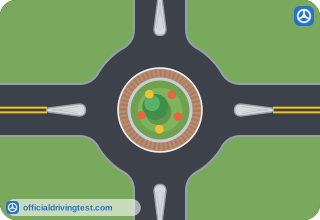
- A circular intersection in which traffic flows in both directions around a central island
- A circular intersection where every driver must come to a full stop before entering
- A circular intersection in which traffic flows almost continuously in one direction around a central island
- A circular intersection in which traffic around a central island is controlled by signal lights
Show answer
Correct answer: A circular intersection in which traffic flows almost continuously in one direction around a central island
The manual defines a roundabout as a circular intersection or junction where traffic flows almost continuously in one direction around a central island.
Source: Arizona Driver License Manual and Customer Service Guide (Revised March 2026), page 28
-
On which side of the central island must you enter a roundabout?
- To the left of the central island
- To the right of the central island
- Straight across the central island
- On whichever side has less traffic
Show answer
Correct answer: To the right of the central island
The manual says to always enter a roundabout to the right of the central island.
Source: Arizona Driver License Manual and Customer Service Guide (Revised March 2026), page 28
-
Vehicles approaching a roundabout must yield to which vehicles?
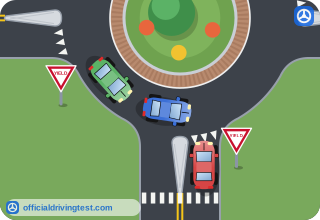
- Only vehicles that entered from your right and are about to leave the roundabout
- Only the vehicles in the roundabout that are traveling faster than you
- No vehicles, because vehicles on the approach have the right-of-way
- Every vehicle already in the roundabout, and large vehicles entering at the same time
Show answer
Correct answer: Every vehicle already in the roundabout, and large vehicles entering at the same time
Vehicles approaching must yield to all vehicles already in the roundabout and to large vehicles entering at the same time.
Source: Arizona Driver License Manual and Customer Service Guide (Revised March 2026), page 28
-
For what speeds are roundabouts designed?
- 15-20 mph
- 5-10 mph
- 25-30 mph
- 35-40 mph
Show answer
Correct answer: 15-20 mph
The manual says roundabouts are designed for speeds of 15-20 mph, so you should slow down as you approach.
Source: Arizona Driver License Manual and Customer Service Guide (Revised March 2026), page 28
-
When should you enter a roundabout?
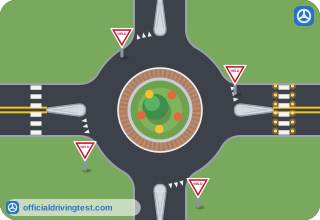
- As soon as you arrive, before circulating traffic reaches you
- When all vehicles inside have come to a stop
- When there is a gap in traffic
- Right behind the vehicle ahead, whether or not there is a gap
Show answer
Correct answer: When there is a gap in traffic
You enter the roundabout when there is a gap in traffic.
Source: Arizona Driver License Manual and Customer Service Guide (Revised March 2026), page 28
-
Once you are inside a roundabout, what should you do?
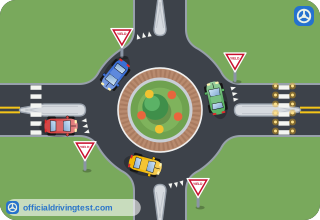
- Stop at each street you pass to check for gaps in traffic, then continue
- Stop briefly at your exit and signal before you leave the roundabout
- Do not stop, and follow signs or pavement markings about which lane to use
- Stay in the lane you entered and ignore any pavement markings inside
Show answer
Correct answer: Do not stop, and follow signs or pavement markings about which lane to use
Once inside a roundabout you do not stop, and you follow directions on signs or pavement markings about which lane to use.
Source: Arizona Driver License Manual and Customer Service Guide (Revised March 2026), page 28
-
What may you do if you miss your exit from a roundabout?
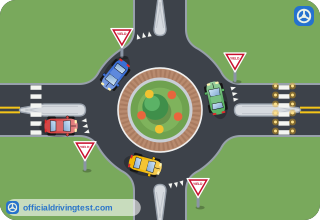
- Exit at any street or continue around
- Stop at the missed exit and wait for traffic to clear
- Back up in the roundabout to the exit you missed
- Cross the central island to reach your exit
Show answer
Correct answer: Exit at any street or continue around
The manual says you may exit at any street or continue around if you miss your exit.
Source: Arizona Driver License Manual and Customer Service Guide (Revised March 2026), page 28
-
What should you not try to do in a roundabout?
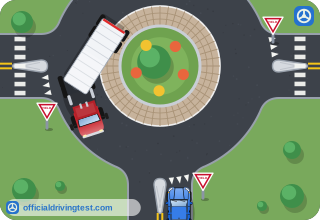
- Slow down for a large truck
- Pass a large truck
- Follow the signs for your lane
- Yield to a large truck that is entering
Show answer
Correct answer: Pass a large truck
The manual says not to try to pass large trucks in the roundabout.
Source: Arizona Driver License Manual and Customer Service Guide (Revised March 2026), page 28
-
At a Diverging Diamond interchange (DDI), what does traffic on the cross street briefly do?
- Travel in a circle around a central island
- Switch to the left side of the roadway
- Cross the freeway without any signals or signs
- Stop in the middle of the interchange to turn left
Show answer
Correct answer: Switch to the left side of the roadway
A DDI lets cross-street traffic briefly switch to the left side of the roadway to improve traffic flow and safety.
Source: Arizona Driver License Manual and Customer Service Guide (Revised March 2026), page 29
-
Where do the crossover points in a Diverging Diamond interchange occur?
- At the freeway on-ramps only
- At stop signs on each side of the freeway
- In the middle of the bridge between the signals
- At the signals
Show answer
Correct answer: At the signals
The crossover points, where traffic moves between the right and left sides of the road, occur at the signals.
Source: Arizona Driver License Manual and Customer Service Guide (Revised March 2026), page 29
-
How do drivers travel through a Diverging Diamond interchange?
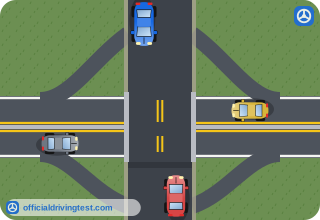
- By following only the pavement markings, since signals are not used
- By yielding to every vehicle on the cross street
- By following the vehicle ahead and ignoring signs
- By following traffic signals, signs and pavement markings
Show answer
Correct answer: By following traffic signals, signs and pavement markings
As with other interchanges, drivers go through a DDI by following traffic signals, signs and pavement markings.
Source: Arizona Driver License Manual and Customer Service Guide (Revised March 2026), page 29
-
In a Diverging Diamond interchange, how are left turns from the cross street to the on-ramps made?
- Using a protected green arrow at the crossover
- Using free-flowing lanes after the crossover
- Using a stop sign before the on-ramp
- From the right lane before the crossover
Show answer
Correct answer: Using free-flowing lanes after the crossover
Instead of needing special green time, left turns are made using free-flowing lanes after the crossover.
Source: Arizona Driver License Manual and Customer Service Guide (Revised March 2026), page 29
-
In a business or residential district, passing on the right is permitted when it is safe and what is true?
- The pavement is marked for two or more lanes going your way
- The vehicle ahead is moving below the posted speed limit
- The paved shoulder is wide enough for your vehicle to use
- No pedestrians are walking on the sidewalk beside you
Show answer
Correct answer: The pavement is marked for two or more lanes going your way
In a business or residential district, you may pass on the right when it is safe and the pavement is marked for two or more lanes of vehicles moving in your direction.
Source: Arizona Driver License Manual and Customer Service Guide (Revised March 2026), page 28
-
When may you turn right at a red light?
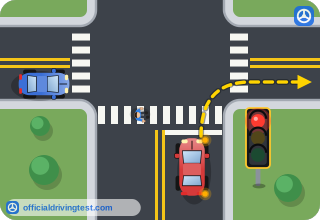
- After a rolling slow-down, when no sign prohibits it and cross traffic is clear
- Only when a police officer is directing traffic at the intersection
- After a complete stop, when motor and pedestrian traffic are clear and no sign prohibits it
- Only after waiting at least 30 seconds, if pedestrians are clear
Show answer
Correct answer: After a complete stop, when motor and pedestrian traffic are clear and no sign prohibits it
Where signs do not prohibit it, a right turn may be made after coming to a complete stop when motor and pedestrian traffic are clear.
Source: Arizona Driver License Manual and Customer Service Guide (Revised March 2026), page 34
-
Two vehicles arrive at an intersection with an inoperative signal at about the same time. Who must yield?
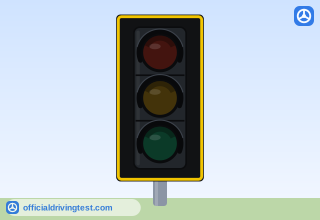
- The driver on the right yields to the driver on the left
- The driver of the vehicle on the left yields to the driver on the right
- The faster vehicle yields to the slower vehicle
- The vehicle that is turning yields to the vehicle going straight
Show answer
Correct answer: The driver of the vehicle on the left yields to the driver on the right
Both must stop, and the driver of the vehicle on the left must yield the right-of-way to the driver on the right.
Source: Arizona Driver License Manual and Customer Service Guide (Revised March 2026), page 35
-
At a "T" intersection, who must yield the right-of-way to vehicles on the cross street?
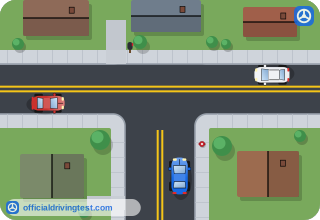
- The driver on the cross street
- The driver who arrived first
- The driver who is turning right
- The driver on the street which ends
Show answer
Correct answer: The driver on the street which ends
At a “T” intersection the driver on the street which ends must yield to vehicles on the cross street.
Source: Arizona Driver License Manual and Customer Service Guide (Revised March 2026), page 35
-
You have the right-of-way at a controlled intersection. What should you still do?
- Check for traffic and pedestrians
- Proceed without slowing, because others must yield
- Flash your headlights to warn others
- Stop and wait for other drivers to wave you on
Show answer
Correct answer: Check for traffic and pedestrians
The manual says not to assume it is safe to proceed just because you have the right-of-way; check for traffic and pedestrians.
Source: Arizona Driver License Manual and Customer Service Guide (Revised March 2026), page 36