Arizona: Right-of-way and turning — Part 3 Practice Test
Questions in this part include: “According to the manual, what does the law actually do about the right-of-way?” · “Which of these is part of the turning procedure in the manual?”
Independent educational site · not affiliated with any government agency or DMV
Ready? Test yourself
- Instant feedback with an explanation
- Every answer cites its source in the manual
- Your best score is saved on this device
Questions are original and based on the official manual "Arizona Driver License Manual and Customer Service Guide" (Revised March 2026), Arizona Department of Transportation Motor Vehicle Division (ADOT MVD).
All 17 questions in this practice test
Take the test above first, then use this list to study. Tap “Show answer” to see the correct answer and explanation.
Show the questions and answersHide the questions
-
What must you do when approaching an intersection that has no traffic lights, stop signs or yield signs?
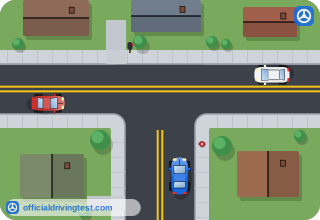
- Slow down and proceed without stopping if no vehicle is approaching
- Yield only to vehicles approaching from the right
- Come to a complete stop, then proceed when the roadway is clear
- Maintain your speed and sound your horn
Show answer
Correct answer: Come to a complete stop, then proceed when the roadway is clear
Such an intersection is treated as a 4-way stop: come to a complete stop and proceed when the roadway is clear.
Source: Arizona Driver License Manual and Customer Service Guide (Revised March 2026), page 36
-
According to the manual, what does the law actually do about the right-of-way?
- It gives the right-of-way to the driver who arrived first
- It states who must yield, rather than giving it to any motorist
- It gives the right-of-way to the larger vehicle
- It gives the right-of-way to the driver going straight
Show answer
Correct answer: It states who must yield, rather than giving it to any motorist
The law does not “give” the right-of-way to any particular motorist; it just states who must yield.
Source: Arizona Driver License Manual and Customer Service Guide (Revised March 2026), page 36
-
A driver is not allowed to take the right-of-way if doing so:
- Would require passing another vehicle
- Would make the driver exceed the speed limit
- Would block a crosswalk
- Means a crash may result
Show answer
Correct answer: Means a crash may result
No one is allowed to take the right-of-way if taking it means a crash may result.
Source: Arizona Driver License Manual and Customer Service Guide (Revised March 2026), page 36
-
Where must you stop when entering the roadway from an alley or driveway?
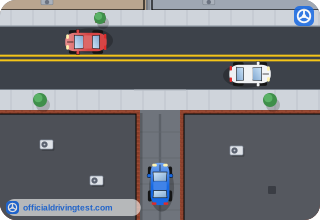
- At the curb after crossing the sidewalk
- Before reaching the sidewalk
- Only at the edge of the roadway
- Only if traffic is approaching
Show answer
Correct answer: Before reaching the sidewalk
When entering the roadway from an alley or driveway, you must stop before reaching the sidewalk.
Source: Arizona Driver License Manual and Customer Service Guide (Revised March 2026), page 37
-
Who must you yield the right-of-way to when entering the roadway from an alley or driveway?
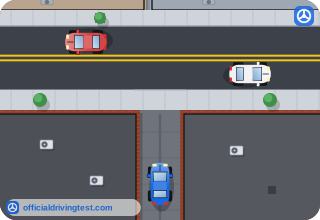
- Only approaching vehicles
- Only pedestrians
- Only vehicles approaching from the right
- Pedestrians and approaching vehicles
Show answer
Correct answer: Pedestrians and approaching vehicles
You must yield the right-of-way to pedestrians and approaching vehicles.
Source: Arizona Driver License Manual and Customer Service Guide (Revised March 2026), page 37
-
When you are preparing to turn left, you must yield the right-of-way to what?
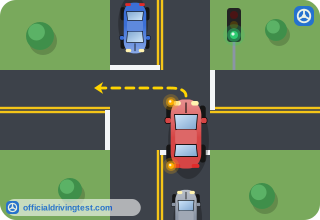
- Any oncoming vehicle, bicycle or pedestrian
- Only oncoming motor vehicles, not bicycles
- Only vehicles turning right at the intersection
- Only pedestrians who are in the crosswalk
Show answer
Correct answer: Any oncoming vehicle, bicycle or pedestrian
When preparing to turn left, you must yield to any oncoming vehicle, bicycle or pedestrian.
Source: Arizona Driver License Manual and Customer Service Guide (Revised March 2026), page 37
-
Under what conditions are U-turns permitted?
- Only at intersections with a traffic signal, and never in the middle of a block
- Only when no other vehicle is within sight and a police officer allows it
- When it can be made safely, does not interfere with other traffic and no sign prohibits it
- Only when you can complete it in one motion without using the shoulder
Show answer
Correct answer: When it can be made safely, does not interfere with other traffic and no sign prohibits it
U-turns are permitted as long as the movement can be made safely, does not interfere with other traffic and is not prohibited by signs.
Source: Arizona Driver License Manual and Customer Service Guide (Revised March 2026), page 37
-
A funeral procession is being led by a funeral escort vehicle flashing a red or a blue light. What must drivers do?
- Yield the right-of-way to any vehicle in the procession
- Pass the procession as quickly as possible
- Join the procession and follow it
- Stop and turn off the engine until it has passed
Show answer
Correct answer: Yield the right-of-way to any vehicle in the procession
Drivers must yield the right-of-way to any vehicle that is part of a funeral procession led by an escort vehicle flashing a red or a blue light.
Source: Arizona Driver License Manual and Customer Service Guide (Revised March 2026), page 39
-
If you will be traveling on a one-way street for several blocks, which lane is it best to stay in?
- The far left lane
- The center lane
- The far right lane
- Whichever lane is empty
Show answer
Correct answer: The center lane
The left and right lanes will be used by turning vehicles, so the center lane is best.
Source: Arizona Driver License Manual and Customer Service Guide (Revised March 2026), page 46
-
On a one-way street, why is it best to avoid the left and right lanes if you are going several blocks?
- Those lanes are for slow traffic only
- Those lanes are reserved for buses
- Those lanes are for passing only
- Turning vehicles will use those lanes
Show answer
Correct answer: Turning vehicles will use those lanes
The left and right lanes are used by turning vehicles.
Source: Arizona Driver License Manual and Customer Service Guide (Revised March 2026), page 46
-
Where do the rules for turning apply?
- Only at intersections of two public roads
- At all locations, even driveways and alleys
- Only at intersections with traffic signals
- Only on roads with more than two lanes
Show answer
Correct answer: At all locations, even driveways and alleys
The turning rules apply at all locations, including driveways and alleys.
Source: Arizona Driver License Manual and Customer Service Guide (Revised March 2026), page 47
-
Which of these is part of the turning procedure in the manual?
- Speed up to clear the intersection quickly
- Sound your horn before every single turn
- Turn on your hazard lights while you turn
- Signal, reduce speed and turn smoothly when safe
Show answer
Correct answer: Signal, reduce speed and turn smoothly when safe
The manual says to signal, reduce speed and turn smoothly when safe.
Source: Arizona Driver License Manual and Customer Service Guide (Revised March 2026), page 47
-
As you turn, what should you make sure to check for?
- Pedestrians, mopeds and bicycles
- Only other cars and trucks nearby
- Only trucks coming toward you
- Only emergency vehicles that are close
Show answer
Correct answer: Pedestrians, mopeds and bicycles
The manual says to check for pedestrians, mopeds and bicycles as you turn.
Source: Arizona Driver License Manual and Customer Service Guide (Revised March 2026), page 47
-
In some areas turns may be made from more than one lane. What directs you in that case?
- Hand signals from other drivers
- The vehicle ahead of you
- Signs and pavement markings
- Your own judgment alone
Show answer
Correct answer: Signs and pavement markings
If turns from more than one lane are allowed, signs and pavement markings direct you.
Source: Arizona Driver License Manual and Customer Service Guide (Revised March 2026), page 47
-
How should you position your car as you prepare to turn right?
- Move to the left side of your lane before you turn
- Stay close to the right curb or edge, and do not swing wide
- Swing wide before the turn to give yourself more room
- Stay in the center of the roadway until the turn
Show answer
Correct answer: Stay close to the right curb or edge, and do not swing wide
The manual says to stay close to the right curb or edge and not swing wide before or while turning.
Source: Arizona Driver License Manual and Customer Service Guide (Revised March 2026), page 47
-
When turning right at a red light, what must you do first?
- Slow down and roll through if no one is near
- Stop only if a pedestrian is in the crosswalk
- Stop past the crosswalk so you can see traffic
- Stop completely before reaching the crosswalk
Show answer
Correct answer: Stop completely before reaching the crosswalk
You must stop completely before reaching the crosswalk, marked or unmarked, and look for No Turn On Red signs.
Source: Arizona Driver License Manual and Customer Service Guide (Revised March 2026), page 47
-
When you turn right on red, to whom must you always yield the right-of-way?
- Pedestrians, bicyclists and oncoming traffic
- Only pedestrians who are in the crosswalk
- Only vehicles that are behind you
- Only emergency vehicles that are nearby
Show answer
Correct answer: Pedestrians, bicyclists and oncoming traffic
The manual says to always yield to pedestrians, bicyclists and oncoming traffic.
Source: Arizona Driver License Manual and Customer Service Guide (Revised March 2026), page 47