Alabama: Speed and following distance
Speed limits, the two-second rule, stopping distance and driving in bad weather or at night. Split into 5 shorter tests so you're not stuck in one long quiz.
Independent educational site · not affiliated with any government agency or DMV
Choose a part
Speed and following distance — Part 1
Questions in this part include: “According to the manual, what causes most rear-end collisions?”
StartSpeed and following distance — Part 2
Questions in this part include: “Which wind condition might make a sudden stop at high speed harder than drivers realize?”
StartSpeed and following distance — Part 3
Questions in this part include: “What does Alabama's basic speed law say you must never do?”
StartSpeed and following distance — Part 4
Questions in this part include: “According to the manual, why are speed limits imposed on highways?”
StartSpeed and following distance — Part 5
Speed limits, the two-second rule, stopping distance and driving in bad weather or at night. — Part 5
StartAll 88 Speed and following distance questions with answers
Choose a part above to take a practice test, or study every question and answer here.
Show the questions and answersHide the questions
-
Why should you slow down before entering a curve?
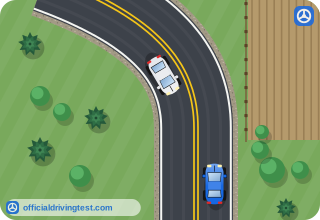
- Because the road surface is always wet on curves in the road
- Because of the danger of running over the center line or leaving the road
- Because passing other vehicles is required on all curves
- Because other drivers cannot see curves in the daylight hours
Show answer
Correct answer: Because of the danger of running over the center line or leaving the road
The manual says to slow down before entering curves because of the danger of running over the center line or leaving the roadway.
Source: Alabama Driver Manual (November 2024), page 23 · Open this page in the manual (Manual page 23)
-
How slowly should you enter a curve?
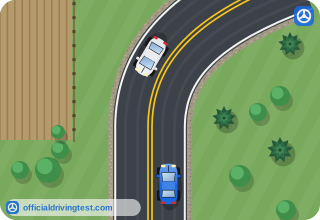
- Slowly enough to brake firmly in the middle of the curve itself
- At a speed that lets you coast through the entire curve
- At the posted speed limit, however sharp the curve may be
- Slowly enough to accelerate slightly while actually rounding the curve
Show answer
Correct answer: Slowly enough to accelerate slightly while actually rounding the curve
The manual says to enter a curve slow enough to accelerate slightly when actually rounding it.
Source: Alabama Driver Manual (November 2024), page 23 · Open this page in the manual (Manual page 23)
-
According to the manual, what causes most rear-end collisions?
- Following too closely
- Driving faster than the posted speed limit
- Sudden stops by the vehicle ahead
- Failing to signal before a lane change
Show answer
Correct answer: Following too closely
The manual states that most rear-end collisions are caused by following too closely.
Source: Alabama Driver Manual (November 2024), page 36 · Open this page in the manual (Manual page 36)
-
Which space around your vehicle is the easiest to control?
- The space behind your vehicle
- The space to the left of your vehicle
- The space ahead of your vehicle
- The space to the right of your vehicle
Show answer
Correct answer: The space ahead of your vehicle
The manual says the space ahead of your vehicle is the space easiest to control.
Source: Alabama Driver Manual (November 2024), page 36 · Open this page in the manual (Manual page 36)
-
What is the space cushion ahead of your vehicle called?
- Braking distance
- Following distance
- Reaction distance
- Safety margin
Show answer
Correct answer: Following distance
The manual calls the space cushion ahead of your vehicle "following distance."
Source: Alabama Driver Manual (November 2024), page 36 · Open this page in the manual (Manual page 36)
-
What was the old rule-of-thumb formula for following distance?
- One car length for every five miles per hour
- Two car lengths for every ten miles per hour
- One car length for every twenty miles per hour
- One car length for every ten miles per hour
Show answer
Correct answer: One car length for every ten miles per hour
The older formula was one car length for every ten miles per hour, replaced by the two-second rule.
Source: Alabama Driver Manual (November 2024), page 36 · Open this page in the manual (Manual page 36)
-
Which newer formula does the manual describe as more positive and easier to apply for following distance?
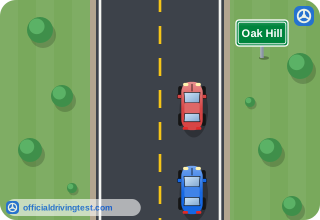
- The two-second rule
- The three-second rule
- The half-speed rule
- The one-car-length rule
Show answer
Correct answer: The two-second rule
The manual introduces the "two-second rule" as the newer formula for following distance.
Source: Alabama Driver Manual (November 2024), page 36 · Open this page in the manual (Manual page 36)
-
To use the two-second rule, what do you choose on the road ahead?
- The brake lights of the vehicle ahead
- A vehicle traveling in the next lane
- A fixed object
- The edge line of the road
Show answer
Correct answer: A fixed object
You choose a fixed object, such as a sign post, tree, overpass or bridge abutment.
Source: Alabama Driver Manual (November 2024), page 36 · Open this page in the manual (Manual page 36)
-
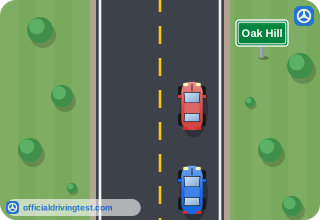
When do you begin counting “One thousand one, one thousand two” in the two-second rule?
- When your own vehicle reaches the fixed object
- When the vehicle ahead passes the fixed object
- When the vehicle ahead first shows its brake lights
- When the vehicle ahead begins to slow down
Show answer
Correct answer: When the vehicle ahead passes the fixed object
You begin counting when the vehicle ahead passes the chosen fixed object.
Source: Alabama Driver Manual (November 2024), page 36 · Open this page in the manual (Manual page 36)
-
You reach the fixed object before you finish saying “one thousand two.” What does the manual say you should do?
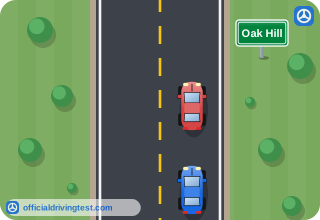
- Brake hard at once to open a larger gap quickly
- Keep your speed, because the two-second rule has been met
- Change lanes immediately to get away from the vehicle ahead
- Slow down gradually until you reach a safe following distance
Show answer
Correct answer: Slow down gradually until you reach a safe following distance
You are following too closely and should gradually slow down until you reach a safe following distance.
Source: Alabama Driver Manual (November 2024), page 36 · Open this page in the manual (Manual page 36)
-
If road and weather conditions are not good, to what count should you increase your following distance?
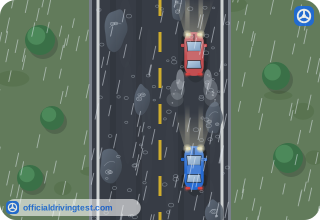
- A four or five second count
- A six or seven second count
- A three second count
- A ten second count
Show answer
Correct answer: A four or five second count
In poor road or weather conditions the manual says to increase following distance to a four or five second count.
Source: Alabama Driver Manual (November 2024), page 36 · Open this page in the manual (Manual page 36)
-
What does the manual say about following distance when you drive a vehicle longer than a car?
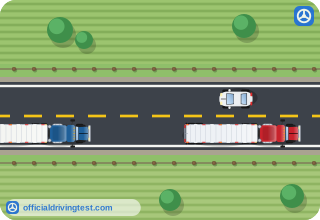
- It can be shorter because longer vehicles are heavier
- It stays the same as for a car in good weather
- The increased following distance also applies
- It only needs to be increased when on a freeway
Show answer
Correct answer: The increased following distance also applies
The manual says the increased following limit also applies to vehicles with longer lengths than cars.
Source: Alabama Driver Manual (November 2024), page 36 · Open this page in the manual (Manual page 36)
-
What should you do if you see brake lights ahead or notice the following distance getting less?
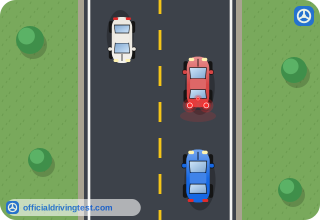
- Flash your headlights at the driver ahead
- Shift your foot to the brake pedal promptly
- Sound your horn to warn the driver ahead
- Move to the next lane at once
Show answer
Correct answer: Shift your foot to the brake pedal promptly
The manual says to shift your foot to the brake pedal promptly so you are ready to stop.
Source: Alabama Driver Manual (November 2024), page 36 · Open this page in the manual (Manual page 36)
-
Which of these is listed as a factor that affects stopping distance?
- The number of passengers riding in the vehicle
- The age of the driver’s license at the time
- The color and make of the vehicle
- Mental and physical reaction time of the driver
Show answer
Correct answer: Mental and physical reaction time of the driver
The manual lists the mental and physical reaction time of the driver as the first factor.
Source: Alabama Driver Manual (November 2024), page 36 · Open this page in the manual (Manual page 36)
-
According to the manual, which pavements differ greatly in stopping from rough, dry concrete?
- Slippery brick or smooth asphalt
- Packed gravel or loose sand
- Fresh snow or thin ice
- Wet grass or packed dirt
Show answer
Correct answer: Slippery brick or smooth asphalt
The manual notes a great difference between rough, dry concrete and slippery brick or smooth asphalt.
Source: Alabama Driver Manual (November 2024), page 36 · Open this page in the manual (Manual page 36)
-
According to the manual, what can happen with large, wide tires on slippery or wet surfaces?
- They cut through standing water better
- They always stop quicker than narrow tires
- They skid or hydroplane more easily
- They gain traction as the tread wears down
Show answer
Correct answer: They skid or hydroplane more easily
Large, wide tires may stop quicker on smooth, dry surfaces but skid or hydroplane easier on slippery or wet ones.
Source: Alabama Driver Manual (November 2024), page 37 · Open this page in the manual (Manual page 37)
-
Why can small, narrow tires lose stopping power overall?
- More weight is shifted to the front axle
- Less rubber on the road and poorer traction
- They overheat quickly on smooth, dry surfaces
- Their tread wears out much faster than wide tires
Show answer
Correct answer: Less rubber on the road and poorer traction
Small narrow tires may cut through standing water but lose stopping power because of less rubber on the road and poorer traction.
Source: Alabama Driver Manual (November 2024), page 37 · Open this page in the manual (Manual page 37)
-
What can put you in serious trouble in an emergency stop, according to the stopping-distance factors?
- All four brakes taking hold at the very same moment
- Brake lights that stay on for a few seconds after you stop
- Pressing the brake pedal too lightly at low speed
- One or more brakes locking the wheels before the others take hold
Show answer
Correct answer: One or more brakes locking the wheels before the others take hold
The manual warns that you can be in serious trouble if one or more brakes lock the wheels before the others fully take hold.
Source: Alabama Driver Manual (November 2024), page 37 · Open this page in the manual (Manual page 37)
-
Which wind condition might make a sudden stop at high speed harder than drivers realize?
- A strong tail wind
- A strong head wind
- A gusty crosswind
- Wind from the left side only
Show answer
Correct answer: A strong tail wind
The manual says drivers may not realize the difference a strong tail wind can make when stopping suddenly at high speed.
Source: Alabama Driver Manual (November 2024), page 37 · Open this page in the manual (Manual page 37)
-
According to the stopping-distance chart, what is the total stopping distance at 65 mph?
- 234.7 ft
- 228 ft
- 305.7 ft
- 161.5 ft
Show answer
Correct answer: 305.7 ft
The chart shows 71 ft thinking distance plus 234.7 ft braking distance, a total of 305.7 ft at 65 mph.
Source: Alabama Driver Manual (November 2024), page 37 · Open this page in the manual (Manual page 37)
-
According to the stopping-distance chart, what is the thinking distance at 55 mph?
- 49 ft
- 60 ft
- 71 ft
- 168 ft
Show answer
Correct answer: 60 ft
The chart shows a thinking distance of 60 ft at 55 mph.
Source: Alabama Driver Manual (November 2024), page 37 · Open this page in the manual (Manual page 37)
-
According to the stopping-distance chart, what is the braking distance at 35 mph?
- 38 ft
- 106 ft
- 112.5 ft
- 68 ft
Show answer
Correct answer: 68 ft
The chart shows a braking distance of 68 ft at 35 mph.
Source: Alabama Driver Manual (November 2024), page 37 · Open this page in the manual (Manual page 37)
-
According to the stopping-distance chart, what is the total stopping distance at 25 mph?
- 61.7 ft
- 34.7 ft
- 106 ft
- 27 ft
Show answer
Correct answer: 61.7 ft
The chart shows 27 ft thinking distance plus 34.7 ft braking distance, a total of 61.7 ft at 25 mph.
Source: Alabama Driver Manual (November 2024), page 37 · Open this page in the manual (Manual page 37)
-
According to the stopping-distance chart, what is the braking distance at 45 mph?
- 161.5 ft
- 49 ft
- 112.5 ft
- 168 ft
Show answer
Correct answer: 112.5 ft
The chart shows a braking distance of 112.5 ft at 45 mph.
Source: Alabama Driver Manual (November 2024), page 37 · Open this page in the manual (Manual page 37)
-
According to the stopping-distance chart, what is the total stopping distance at 55 mph?
- 168 ft
- 228 ft
- 305.7 ft
- 161.5 ft
Show answer
Correct answer: 228 ft
The chart shows 60 ft thinking distance plus 168 ft braking distance, a total of 228 ft at 55 mph.
Source: Alabama Driver Manual (November 2024), page 37 · Open this page in the manual (Manual page 37)
-
According to the manual's following-distance chart, about how many feet does a car travel in 1 second at 30 mph?
- 30 feet
- 58.6 feet
- 44.4 feet
- 88.8 feet
Show answer
Correct answer: 44.4 feet
The chart on page 36 shows that at 30 mph a car travels 44.4 feet in 1 second.
Source: Alabama Driver Manual (November 2024), page 36 · Open this page in the manual (Manual page 36)
-
According to the manual's chart, how far back will you be at 50 mph using the two-second rule?
- 100 feet
- 73.3 feet
- 117.2 feet
- 146.6 feet
Show answer
Correct answer: 146.6 feet
The chart on page 36 shows that at 50 mph the two-second rule puts you 146.6 feet back, compared with 100 feet under the one-car-length-per-10-mph rule.
Source: Alabama Driver Manual (November 2024), page 36 · Open this page in the manual (Manual page 36)
-
At 40 mph, how far back does the old rule of one car length for each 10 mph put you, based on a 20-foot vehicle?
- 80 feet
- 40 feet
- 58.6 feet
- 117.2 feet
Show answer
Correct answer: 80 feet
The chart on page 36 shows that at 40 mph one car length for each 10 mph (based on a 20 ft. vehicle) puts you 80 feet back.
Source: Alabama Driver Manual (November 2024), page 36 · Open this page in the manual (Manual page 36)
-
According to the manual's chart, how far back will you be at 40 mph using the two-second rule?
- 80 feet
- 117.2 feet
- 58.6 feet
- 146.6 feet
Show answer
Correct answer: 117.2 feet
The chart on page 36 shows that at 40 mph the two-second rule puts you 117.2 feet back.
Source: Alabama Driver Manual (November 2024), page 36 · Open this page in the manual (Manual page 36)
-
According to the manual's chart, how far back will you be at 30 mph using the two-second rule?
- 60 feet
- 44.4 feet
- 88.8 feet
- 100 feet
Show answer
Correct answer: 88.8 feet
The chart on page 36 shows that at 30 mph the two-second rule puts you 88.8 feet back, compared with 60 feet under the one-car-length-per-10-mph rule.
Source: Alabama Driver Manual (November 2024), page 36 · Open this page in the manual (Manual page 36)
-
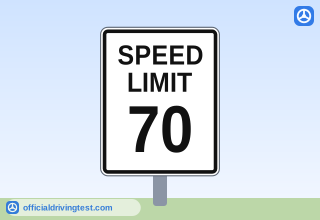
A white rectangular sign reads SPEED LIMIT 70. What does it mean?
- The minimum speed allowed on this section of the road
- The speed limit that applies during bad weather only
- The recommended speed for the next curve ahead
- The speed limit as posted under normal conditions
Show answer
Correct answer: The speed limit as posted under normal conditions
The manual says this sign shows the speed limit as posted under normal conditions.
Source: Alabama Driver Manual (November 2024), page 43 · Open this page in the manual (Manual page 43)
-
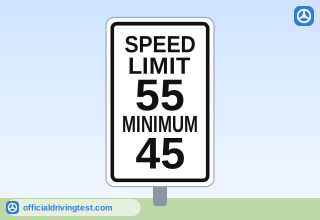
A sign reads SPEED LIMIT 55 with MINIMUM 45 below it. What do the two numbers show?
- The speed limits for day and for night on that section of the highway
- The speed limits for cars and for trucks on that section of the highway
- The maximum and minimum speeds allowed on that section of highway
- The speed limits for dry and for wet roads on that section of highway
Show answer
Correct answer: The maximum and minimum speeds allowed on that section of highway
The manual says these are the maximum and minimum speeds permitted on this section of the highway.
Source: Alabama Driver Manual (November 2024), page 43 · Open this page in the manual (Manual page 43)
-
Where are minimum speed limits usually posted?
- On freeways and other controlled access highways
- In school zones, residential areas, and parking lots
- On gravel roads, rural roads, and two-lane roads
- On bridges, in work zones, and on detours
Show answer
Correct answer: On freeways and other controlled access highways
The manual says minimum limits are usually posted on freeways and other controlled access highways.
Source: Alabama Driver Manual (November 2024), page 43 · Open this page in the manual (Manual page 43)
-
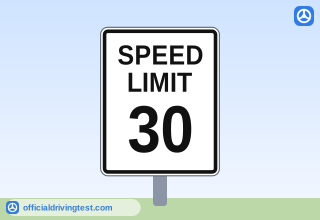
A white sign reads SPEED LIMIT 30. What does it mean?
- 30 miles an hour is the minimum speed in this area
- 30 miles an hour is the advised speed for curves
- 30 miles an hour applies only during school hours
- 30 miles an hour is the top speed permitted in this area
Show answer
Correct answer: 30 miles an hour is the top speed permitted in this area
The manual says 30 miles an hour is the top speed permitted in this area.
Source: Alabama Driver Manual (November 2024), page 43 · Open this page in the manual (Manual page 43)
-
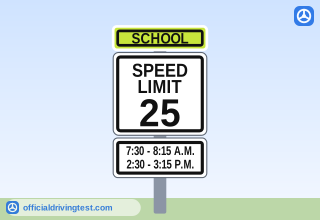
A sign shows SCHOOL above SPEED LIMIT 25 with times listed below. What does it mean?
- The minimum speed in the school zone at all hours
- The speed limit in the school zone during the hours indicated
- The speed limit for school buses only during the hours shown
- The advised speed for the road after school hours
Show answer
Correct answer: The speed limit in the school zone during the hours indicated
The manual says this sign shows the speed limit in the school zone during the hours indicated.
Source: Alabama Driver Manual (November 2024), page 44 · Open this page in the manual (Manual page 44)
-
Besides a posted sign, how may a school zone speed limit also be displayed?
- On a lighted sign with flashing amber lights
- On a lighted sign with flashing red lights
- On a number painted on the pavement
- By a crossing guard holding a stop sign
Show answer
Correct answer: On a lighted sign with flashing amber lights
The manual says the school zone speed limit may also be displayed on a lighted sign with flashing amber lights.
Source: Alabama Driver Manual (November 2024), page 44 · Open this page in the manual (Manual page 44)
-
What does Alabama's basic speed law say you must never do?
- Drive faster than the statutory limit in any weather
- Drive faster than is reasonable under existing conditions
- Drive faster than the average speed of other vehicles
- Drive faster than 55 miles per hour on any road
Show answer
Correct answer: Drive faster than is reasonable under existing conditions
The basic speed law prohibits driving at a speed faster than reasonable under existing conditions.
Source: Alabama Driver Manual (November 2024), page 59 · Open this page in the manual (Manual page 59)
-
Which of these should you consider when deciding what speed is reasonable?
- The color of your vehicle
- The number of passengers you carry
- The brand of your tires
- Your own physical condition
Show answer
Correct answer: Your own physical condition
The manual lists road, weather, vehicle condition and your own physical condition as the factors to consider.
Source: Alabama Driver Manual (November 2024), page 59 · Open this page in the manual (Manual page 59)
-
According to the manual, what is the greatest danger of excessive speed?
- It makes collisions more severe
- It makes collisions happen twice as often
- It wears out the vehicle's brakes
- It causes drivers to miss their exits
Show answer
Correct answer: It makes collisions more severe
The manual says the greatest danger of excessive speed is the increased severity of collisions rather than their frequency.
Source: Alabama Driver Manual (November 2024), page 59 · Open this page in the manual (Manual page 59)
-
What does the manual say about driving faster than the speed limit set by traffic laws for normal driving conditions?
- It is lawful as long as no other vehicle is nearby on the road
- It is lawful if you are passing another vehicle
- It is prima facie evidence of unlawful speed, and you may be arrested
- It is only a warning offense the first time
Show answer
Correct answer: It is prima facie evidence of unlawful speed, and you may be arrested
Speeds in excess of the limits are prima facie evidence that they are unlawful, and a driver may be arrested.
Source: Alabama Driver Manual (November 2024), page 59 · Open this page in the manual (Manual page 59)
-
How does the manual describe speed limits in municipalities?
- They are minimum speeds
- They are maximum speeds
- They are suggested speeds only
- They are average speeds for the area
Show answer
Correct answer: They are maximum speeds
The manual states that all speed limits in municipalities are maximum speeds.
Source: Alabama Driver Manual (November 2024), page 59 · Open this page in the manual (Manual page 59)
-
When do statutory speed limits apply?
- Only on roads that have no signs at all along them
- Only during daylight hours
- Only on roads outside a municipality
- Unless other speed zones are posted on regulatory signs
Show answer
Correct answer: Unless other speed zones are posted on regulatory signs
Statutory limits apply unless other speed zones have been established and posted on regulatory signs.
Source: Alabama Driver Manual (November 2024), page 59 · Open this page in the manual (Manual page 59)
-
What is the statutory speed limit in an urban district?
- 30 miles per hour
- 25 miles per hour
- 35 miles per hour
- 45 miles per hour
Show answer
Correct answer: 30 miles per hour
The statutory list gives 30 miles per hour in an urban district.
Source: Alabama Driver Manual (November 2024), page 60 · Open this page in the manual (Manual page 60)
-
What is the statutory speed limit on an unpaved road?
- 30 miles per hour
- 45 miles per hour
- 35 miles per hour
- 55 miles per hour
Show answer
Correct answer: 35 miles per hour
The statutory list gives 35 miles per hour on an unpaved road.
Source: Alabama Driver Manual (November 2024), page 60 · Open this page in the manual (Manual page 60)
-
What is the statutory speed limit on a county paved road, unless posted otherwise?
- 35 miles per hour
- 45 miles per hour
- 55 miles per hour
- 65 miles per hour
Show answer
Correct answer: 45 miles per hour
The statutory list gives 45 miles per hour on a county paved road unless posted.
Source: Alabama Driver Manual (November 2024), page 60 · Open this page in the manual (Manual page 60)
-
What statutory speed limit applies in other locations not covered by a specific limit in the list?
- 45 miles per hour
- 65 miles per hour
- 70 miles per hour
- 55 miles per hour
Show answer
Correct answer: 55 miles per hour
The statutory list gives 55 miles per hour in other locations.
Source: Alabama Driver Manual (November 2024), page 60 · Open this page in the manual (Manual page 60)
-
In the manual's list of statutory limits, where does the 65 miles per hour limit apply?
- Where posted
- In an urban district
- On an unpaved road
- On a county paved road
Show answer
Correct answer: Where posted
The list gives 65 miles per hour where posted.
Source: Alabama Driver Manual (November 2024), page 60 · Open this page in the manual (Manual page 60)
-
What is the statutory speed limit where posted on an interstate?
- 55 miles per hour
- 60 miles per hour
- 70 miles per hour
- 65 miles per hour
Show answer
Correct answer: 70 miles per hour
The list gives 70 miles per hour where posted on an interstate.
Source: Alabama Driver Manual (November 2024), page 60 · Open this page in the manual (Manual page 60)
-
Where a minimum speed limit is posted, how is a speed below it considered under normal weather, road, and traffic conditions?
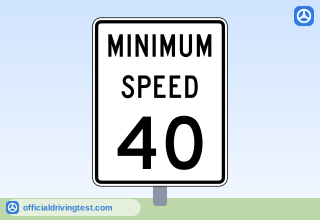
- Lawful if you use your hazard lights
- Unlawful
- Lawful in the right lane
- Lawful if you follow a slower vehicle
Show answer
Correct answer: Unlawful
Where minimum limits are posted, any speed below the minimum is unlawful under normal conditions.
Source: Alabama Driver Manual (November 2024), page 60 · Open this page in the manual (Manual page 60)
-
What does the manual say about driving too slowly?
- Driving slowly is always the safest choice on any road
- Slow driving is allowed only in the left lane
- Slow driving is unlawful only on interstate highways
- Never drive so slowly that you interfere with other traffic
Show answer
Correct answer: Never drive so slowly that you interfere with other traffic
The manual says many accidents are caused by drivers who block or hinder other traffic by driving too slowly.
Source: Alabama Driver Manual (November 2024), page 60 · Open this page in the manual (Manual page 60)
-
When does the manual say slower speeds are necessary?
- When approaching a street, highway, or railroad crossing
- Only when you approach an interstate entrance ramp
- Only when the road surface is wet or icy
- Only when you drive through a school zone
Show answer
Correct answer: When approaching a street, highway, or railroad crossing
The manual says slower speeds are necessary when approaching or crossing a street, highway, or railroad crossing.
Source: Alabama Driver Manual (November 2024), page 60 · Open this page in the manual (Manual page 60)
-
Besides approaching a street, highway or railroad crossing, when does the manual say slower speeds are necessary?
- When you drive on a straight, empty road
- When you drive in a school zone only
- When approaching flags, flares, or fuses on roads
- When the vehicle behind you is following closely
Show answer
Correct answer: When approaching flags, flares, or fuses on roads
Slower speeds are necessary when approaching flags, flares, or fuses on roads.
Source: Alabama Driver Manual (November 2024), page 60 · Open this page in the manual (Manual page 60)
-
When does the manual say you should slow down?
- When approaching a long straight stretch
- When approaching crests of hills and curves
- When driving on a freshly paved road
- When another driver passes you
Show answer
Correct answer: When approaching crests of hills and curves
The manual says to slow down when approaching crests of hills and curves.
Source: Alabama Driver Manual (November 2024), page 60 · Open this page in the manual (Manual page 60)
-
About what share of the fatal motor vehicle crashes in Alabama occur during the hours of darkness?
- About half
- About one-tenth
- About one-fourth
- About three-fourths
Show answer
Correct answer: About half
The manual says approximately half of Alabama's fatal motor vehicle crashes happen in the dark.
Source: Alabama Driver Manual (November 2024), page 69 · Open this page in the manual (Manual page 69)
-
At night, you should never drive so fast that you cannot stop within what distance?
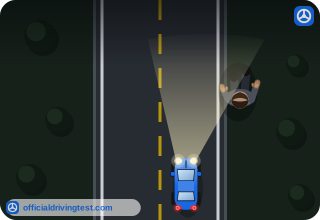
- 200 feet, the distance for dimming when following
- The distance lit by your parking lights
- The distance you can see ahead with your lights
- The distance to the next road sign
Show answer
Correct answer: The distance you can see ahead with your lights
Overdriving your headlights is a common and dangerous practice, so you must be able to stop within the lit distance.
Source: Alabama Driver Manual (November 2024), page 69 · Open this page in the manual (Manual page 69)
-
Why is excessive speed more dangerous at night?
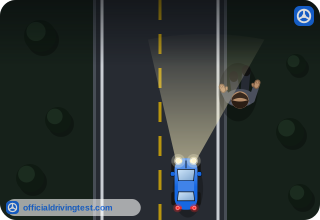
- Speed limits no longer apply to drivers after dark
- You can see only as far as your headlights carry
- Headlights make other vehicles look slower than they are
- Roads are always narrower at night than in daytime
Show answer
Correct answer: You can see only as far as your headlights carry
At night you can see only as far as your headlights carry, which does not give enough stopping distance at high speed.
Source: Alabama Driver Manual (November 2024), page 70 · Open this page in the manual (Manual page 70)
-
According to the manual, why are speed limits imposed on highways?
- Principally to raise money from fines
- Principally to keep all traffic at one speed
- Principally to reduce noise near homes
- Principally to protect you from the unexpected
Show answer
Correct answer: Principally to protect you from the unexpected
Limits exist principally to protect you from the unexpected, such as a deer or damaged road.
Source: Alabama Driver Manual (November 2024), page 70 · Open this page in the manual (Manual page 70)
-
How can you find out how slippery the road is?

- Try your brakes while driving slowly
- Brake hard at highway speed
- Turn the wheel sharply at a high speed
- Watch the taillights ahead
Show answer
Correct answer: Try your brakes while driving slowly
Try the brakes while driving slowly, then adjust your speed.
Source: Alabama Driver Manual (November 2024), page 70 · Open this page in the manual (Manual page 70)
-
Even with snow treads on the drive wheels, how must you drive on snow?

- At normal speed, with the usual amount of room to stop
- At less than normal speed, allowing more room for stopping
- Slightly faster than normal to keep traction
- At normal speed with less room for stopping
Show answer
Correct answer: At less than normal speed, allowing more room for stopping
Snow treads do not remove the need for lower speed and extra stopping room.
Source: Alabama Driver Manual (November 2024), page 71 · Open this page in the manual (Manual page 71)
-
On snow or ice, how much distance does it take to stop your car compared with dry pavement?

- Twice as much
- Four to six times as much
- Fifteen to twenty times as much
- Three to twelve times as much
Show answer
Correct answer: Three to twelve times as much
Stopping on snow or ice takes three to twelve times the distance needed on dry pavement.
Source: Alabama Driver Manual (November 2024), page 71 · Open this page in the manual (Manual page 71)
-
To start on snow and ice, how should you set your engine speed?

- Lower it to its very minimum
- Rev it to the maximum for traction
- Hold it at a steady medium speed
- Rev it high and then drop it quickly
Show answer
Correct answer: Lower it to its very minimum
Starting with minimum engine speed helps avoid spinning or sliding the wheels.
Source: Alabama Driver Manual (November 2024), page 71 · Open this page in the manual (Manual page 71)
-
If your wheels spin when starting on snow in a car with a clutch, in which gear should you start?

- Reverse
- Neutral
- Second or high gear
- Low gear
Show answer
Correct answer: Second or high gear
Starting in second or high gear permits smoother acceleration.
Source: Alabama Driver Manual (November 2024), page 71 · Open this page in the manual (Manual page 71)
-
How should you start on snow or ice in a car with an automatic transmission?

- Accelerate quickly to avoid getting stuck
- Accelerate slowly and smoothly
- Rev the engine in neutral first
- Floor the accelerator in low gear
Show answer
Correct answer: Accelerate slowly and smoothly
With an automatic transmission, accelerating slowly and smoothly helps avoid wheel spin.
Source: Alabama Driver Manual (November 2024), page 71 · Open this page in the manual (Manual page 71)
-
How should you apply the brakes when stopping on packed snow or ice?

- Hard and fast
- As late as possible
- Only with the parking brake
- Gently
Show answer
Correct answer: Gently
The manual says to apply the brakes gently on packed snow or ice.
Source: Alabama Driver Manual (November 2024), page 71 · Open this page in the manual (Manual page 71)
-
If you must stop suddenly on a slippery surface, what should you do?

- Pump your brakes
- Hold the brake pedal hard to the floor
- Shift into reverse
- Depress the clutch to take the car out of gear
Show answer
Correct answer: Pump your brakes
Pumping the brakes slows the vehicle gradually instead of causing a skid.
Source: Alabama Driver Manual (November 2024), page 71 · Open this page in the manual (Manual page 71)
-
On a slippery surface, your wheels lock while you are braking. What should you do?
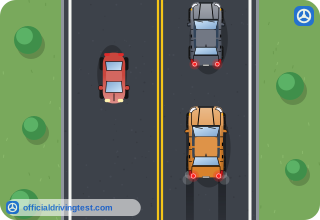
- Press the brake harder until the vehicle comes to a stop
- Take your foot off the brake and do not brake again
- Release the brake so the wheels roll, then squeeze down again
- Shift into neutral and let the vehicle coast to a stop
Show answer
Correct answer: Release the brake so the wheels roll, then squeeze down again
You release the brake so the wheels roll, then squeeze again, repeating until stopped.
Source: Alabama Driver Manual (November 2024), page 71 · Open this page in the manual (Manual page 71)
-
When stopping on a slippery surface, what should you do about the clutch?

- Depress it fully before you brake
- Do not depress it to take the vehicle out of gear
- Depress it only at the first hint of slipping
- Release it and shift to neutral
Show answer
Correct answer: Do not depress it to take the vehicle out of gear
The manual says not to depress the clutch to take the vehicle out of gear while stopping.
Source: Alabama Driver Manual (November 2024), page 71 · Open this page in the manual (Manual page 71)
-
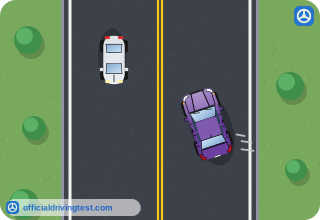
When does a vehicle skid?
- When the engine overheats
- When the brakes run low on fluid
- When the steering wheel is turned too slowly
- When its tires lose their grip on the roadway
Show answer
Correct answer: When its tires lose their grip on the roadway
A skid happens when the tires lose their grip on the roadway.
Source: Alabama Driver Manual (November 2024), page 71 · Open this page in the manual (Manual page 71)
-
Which is true when your car begins to skid?

- The brakes lose their effectiveness
- The engine pulls harder
- The steering becomes more responsive
- The tires gain extra grip
Show answer
Correct answer: The brakes lose their effectiveness
In a skid the engine loses its pulling effect and the brakes lose their effectiveness.
Source: Alabama Driver Manual (November 2024), page 71 · Open this page in the manual (Manual page 71)
-
What should you do about braking when your car begins to skid?

- Brake hard right away to stop the skid
- Pump the brake pedal quickly until the skid ends
- Do not brake until you regain control of your direction
- Apply the parking brake to slow the rear wheels
Show answer
Correct answer: Do not brake until you regain control of your direction
Braking only increases the velocity of the skid and can cause loss of steering control.
Source: Alabama Driver Manual (November 2024), page 71 · Open this page in the manual (Manual page 71)
-
With any vehicle skid, what is the main idea?
- Keep the front end from outrunning the rear
- Keep the rear end from outrunning the front
- Lock all four wheels until the car stops
- Brake hard until the tires regain grip
Show answer
Correct answer: Keep the rear end from outrunning the front
The goal is to keep the rear of the vehicle from outrunning the front.
Source: Alabama Driver Manual (November 2024), page 71 · Open this page in the manual (Manual page 71)
-
To overcome a skid, what must you do?

- Speed up the rear wheels or slow the front wheels
- Lock all four wheels at once
- Slow the front wheels and the rear wheels equally
- Slow the rear wheels somewhat or speed up the front wheels
Show answer
Correct answer: Slow the rear wheels somewhat or speed up the front wheels
The manual says to slow the rear wheels somewhat or speed the front wheels.
Source: Alabama Driver Manual (November 2024), page 71 · Open this page in the manual (Manual page 71)
-
In a rear-wheel drive vehicle, how does easing off the gas help in a skid?

- The engine acts as a brake and slows the rear wheels
- The engine pulls harder on the front wheels and speeds them up
- It speeds up the rear wheels so they catch up
- It locks the front wheels so the rear can catch up
Show answer
Correct answer: The engine acts as a brake and slows the rear wheels
Easing off the gas lets the engine slow the rear wheels, so the front end can catch up.
Source: Alabama Driver Manual (November 2024), page 71 · Open this page in the manual (Manual page 71)
-
To correct a skid in a front-wheel drive vehicle, what should you do?

- Ease completely off the gas
- Brake firmly
- Step lightly on the gas
- Shift into reverse
Show answer
Correct answer: Step lightly on the gas
Stepping lightly on the gas increases front wheel speed so the front end catches up with the sliding rear.
Source: Alabama Driver Manual (November 2024), page 72 · Open this page in the manual (Manual page 72)
-
In a skid, if there is not enough room to step on the gas, what is the next best action?

- Brake hard and steer away from the direction of the skid
- Disengage the transmission and steer the way the rear is skidding
- Turn off the ignition and let the car coast to a stop
- Shift into reverse and steer straight until the skid ends
Show answer
Correct answer: Disengage the transmission and steer the way the rear is skidding
You disengage the transmission (clutch or neutral) and steer in the direction the rear is skidding.
Source: Alabama Driver Manual (November 2024), page 72 · Open this page in the manual (Manual page 72)
-
Why do many safety experts hesitate to recommend shifting into neutral in a skid?

- It can damage the transmission when the car is moving fast
- The engine stalls and locks the steering wheel in place
- It increases the speed of the skid and the front wheels lock
- Drivers may look away from the road or shift past neutral into reverse
Show answer
Correct answer: Drivers may look away from the road or shift past neutral into reverse
In a panic, a driver may look away from the road or shift past neutral into reverse, which can be disastrous.
Source: Alabama Driver Manual (November 2024), page 72 · Open this page in the manual (Manual page 72)
-
What happens during hydroplaning?
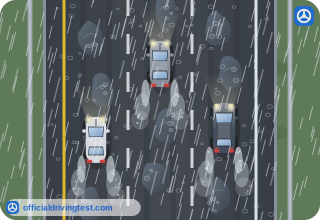
- The tires ride on a film of water instead of the road
- The tires sink into soft mud along the roadside
- The brakes overheat in the rain and stop working
- Fog forms on the windshield and blocks your view
Show answer
Correct answer: The tires ride on a film of water instead of the road
At higher speeds tires cannot wipe the road and ride on a film of water, like water skis.
Source: Alabama Driver Manual (November 2024), page 72 · Open this page in the manual (Manual page 72)
-
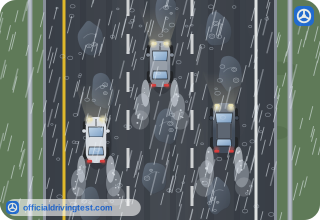
In a standard passenger car, at about what speed does partial hydroplaning start?
- 25 mph
- 45 mph
- 35 mph
- 65 mph
Show answer
Correct answer: 35 mph
Partial hydroplaning starts at about 35 mph and increases with speed.
Source: Alabama Driver Manual (November 2024), page 72 · Open this page in the manual (Manual page 72)
-
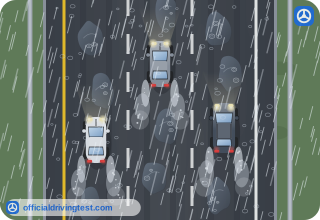
In a standard passenger car, at about what speed may the tires be totally on the water?
- 45 mph
- 55 mph
- 65 mph
- 75 mph
Show answer
Correct answer: 55 mph
Partial hydroplaning increases to about 55 mph, where the tires may be totally on the water.
Source: Alabama Driver Manual (November 2024), page 72 · Open this page in the manual (Manual page 72)
-
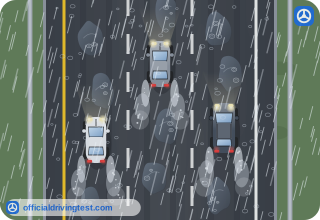
When the tires lose all contact with the road in a severe rainstorm, what is available to brake, accelerate or corner?
- Full friction on curves only
- Friction for braking only
- Half of the normal friction
- No friction
Show answer
Correct answer: No friction
With no contact there is no friction to brake, accelerate or corner.
Source: Alabama Driver Manual (November 2024), page 72 · Open this page in the manual (Manual page 72)
-
What is the best thing to do when your car is hydroplaning?
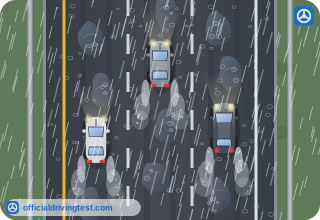
- Release the accelerator and let the car slow down
- Brake hard to stop the car as quickly as you can
- Accelerate to push through the water quickly
- Turn the steering wheel sharply to the left
Show answer
Correct answer: Release the accelerator and let the car slow down
The manual says the best thing is to release the accelerator and let the car slow.
Source: Alabama Driver Manual (November 2024), page 72 · Open this page in the manual (Manual page 72)
-
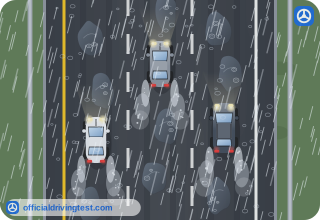
If you skid while your car is only partially hydroplaning, how should you be able to regain control?
- By braking hard until the car stops skidding at once
- By accelerating hard to power out of the skid
- By correcting the particular type of skid that occurs
- By turning off the ignition and coasting
Show answer
Correct answer: By correcting the particular type of skid that occurs
In partial hydroplaning you correct the type of skid that occurs.
Source: Alabama Driver Manual (November 2024), page 72 · Open this page in the manual (Manual page 72)
-
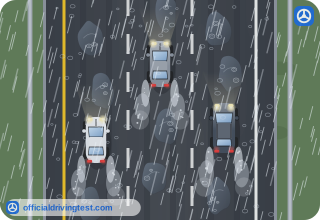
What is most helpful to prevent hydroplaning?
- Worn tires with smooth surfaces
- Good tires with deep treads
- Low tire pressure
- A heavier load in the car
Show answer
Correct answer: Good tires with deep treads
Deep treads let water escape from under the tires.
Source: Alabama Driver Manual (November 2024), page 72 · Open this page in the manual (Manual page 72)
-
When the depth of the water exceeds the depth of the tire treads, complete hydroplaning can be expected at speeds above what?
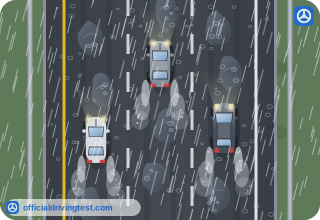
- 30 mph
- 40 mph
- 65 mph
- 50 mph
Show answer
Correct answer: 50 mph
Complete hydroplaning can be expected above 50 mph when water is deeper than the treads.
Source: Alabama Driver Manual (November 2024), page 72 · Open this page in the manual (Manual page 72)
-
What does the manual advise about driving in fog or a snowstorm?

- Avoid it unless it is absolutely necessary
- Drive as usual with extra caution
- Drive faster to get out of it sooner
- Use your high beams to see farther
Show answer
Correct answer: Avoid it unless it is absolutely necessary
The manual says to avoid driving in fog or a snowstorm unless absolutely necessary.
Source: Alabama Driver Manual (November 2024), page 73 · Open this page in the manual (Manual page 73)
-
When visibility is limited, what must you do?

- Keep your normal speed and rely on your horn to warn others
- Speed up to leave the limited-visibility area quickly
- Slow down and be able to stop within your range of vision
- Follow the taillights ahead of you very closely
Show answer
Correct answer: Slow down and be able to stop within your range of vision
Speed must be reduced so you can stop within what you can see.
Source: Alabama Driver Manual (November 2024), page 73 · Open this page in the manual (Manual page 73)
-
What should you do as you round hazardous curves on narrow, hilly roads?
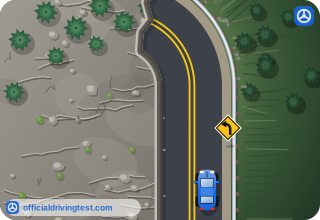
- Use your horn to let others know they are not alone
- Stay close to the center line to see farther ahead
- Turn off your headlights so you do not blind others
- Increase your speed to clear the curve quickly
Show answer
Correct answer: Use your horn to let others know they are not alone
Use your horn on hazardous curves because there are blind pockets in hilly country.
Source: Alabama Driver Manual (November 2024), page 73 · Open this page in the manual (Manual page 73)
-
What does the law forbid when you drive downhill?
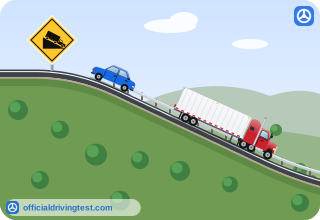
- Using a lower gear to hold your speed
- Using your horn on curves
- Coasting with the transmission in neutral
- Driving with your headlights on low beam
Show answer
Correct answer: Coasting with the transmission in neutral
The law forbids coasting downhill with the transmission in neutral.
Source: Alabama Driver Manual (November 2024), page 73 · Open this page in the manual (Manual page 73)