Alabama: Speed and following distance — Part 4 Practice Test
Questions in this part include: “According to the manual, why are speed limits imposed on highways?” · “With any vehicle skid, what is the main idea?”
Independent educational site · not affiliated with any government agency or DMV
Ready? Test yourself
- Instant feedback with an explanation
- Every answer cites its source in the manual
- Your best score is saved on this device
Questions are original and based on the official manual "Alabama Driver Manual" (November 2024), Alabama Law Enforcement Agency (ALEA), Driver License Division.
All 17 questions in this practice test
Take the test above first, then use this list to study. Tap “Show answer” to see the correct answer and explanation.
Show the questions and answersHide the questions
-
At night, you should never drive so fast that you cannot stop within what distance?
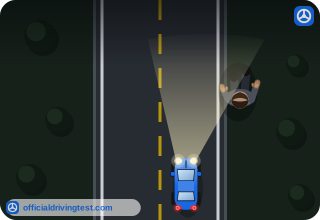
- 200 feet, the distance for dimming when following
- The distance lit by your parking lights
- The distance you can see ahead with your lights
- The distance to the next road sign
Show answer
Correct answer: The distance you can see ahead with your lights
Overdriving your headlights is a common and dangerous practice, so you must be able to stop within the lit distance.
Source: Alabama Driver Manual (November 2024), page 69 · Open this page in the manual (Manual page 69)
-
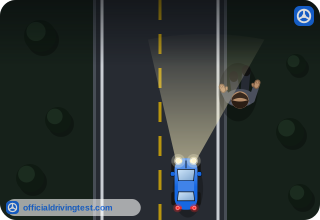
Why is excessive speed more dangerous at night?
- Speed limits no longer apply to drivers after dark
- You can see only as far as your headlights carry
- Headlights make other vehicles look slower than they are
- Roads are always narrower at night than in daytime
Show answer
Correct answer: You can see only as far as your headlights carry
At night you can see only as far as your headlights carry, which does not give enough stopping distance at high speed.
Source: Alabama Driver Manual (November 2024), page 70 · Open this page in the manual (Manual page 70)
-
According to the manual, why are speed limits imposed on highways?
- Principally to raise money from fines
- Principally to keep all traffic at one speed
- Principally to reduce noise near homes
- Principally to protect you from the unexpected
Show answer
Correct answer: Principally to protect you from the unexpected
Limits exist principally to protect you from the unexpected, such as a deer or damaged road.
Source: Alabama Driver Manual (November 2024), page 70 · Open this page in the manual (Manual page 70)
-
How can you find out how slippery the road is?
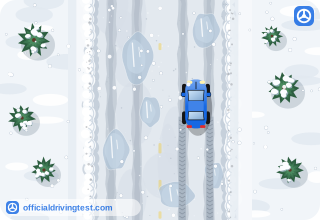
- Try your brakes while driving slowly
- Brake hard at highway speed
- Turn the wheel sharply at a high speed
- Watch the taillights ahead
Show answer
Correct answer: Try your brakes while driving slowly
Try the brakes while driving slowly, then adjust your speed.
Source: Alabama Driver Manual (November 2024), page 70 · Open this page in the manual (Manual page 70)
-
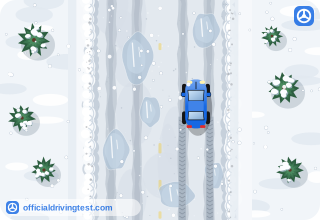
Even with snow treads on the drive wheels, how must you drive on snow?
- At normal speed, with the usual amount of room to stop
- At less than normal speed, allowing more room for stopping
- Slightly faster than normal to keep traction
- At normal speed with less room for stopping
Show answer
Correct answer: At less than normal speed, allowing more room for stopping
Snow treads do not remove the need for lower speed and extra stopping room.
Source: Alabama Driver Manual (November 2024), page 71 · Open this page in the manual (Manual page 71)
-
On snow or ice, how much distance does it take to stop your car compared with dry pavement?
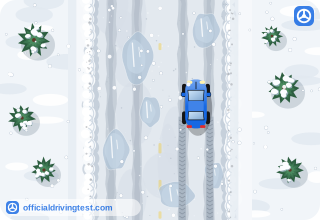
- Twice as much
- Four to six times as much
- Fifteen to twenty times as much
- Three to twelve times as much
Show answer
Correct answer: Three to twelve times as much
Stopping on snow or ice takes three to twelve times the distance needed on dry pavement.
Source: Alabama Driver Manual (November 2024), page 71 · Open this page in the manual (Manual page 71)
-
To start on snow and ice, how should you set your engine speed?
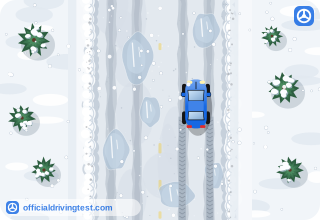
- Lower it to its very minimum
- Rev it to the maximum for traction
- Hold it at a steady medium speed
- Rev it high and then drop it quickly
Show answer
Correct answer: Lower it to its very minimum
Starting with minimum engine speed helps avoid spinning or sliding the wheels.
Source: Alabama Driver Manual (November 2024), page 71 · Open this page in the manual (Manual page 71)
-
If your wheels spin when starting on snow in a car with a clutch, in which gear should you start?
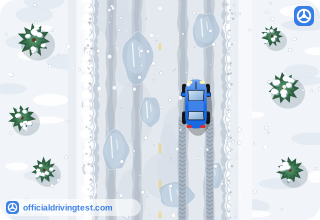
- Reverse
- Neutral
- Second or high gear
- Low gear
Show answer
Correct answer: Second or high gear
Starting in second or high gear permits smoother acceleration.
Source: Alabama Driver Manual (November 2024), page 71 · Open this page in the manual (Manual page 71)
-
How should you start on snow or ice in a car with an automatic transmission?
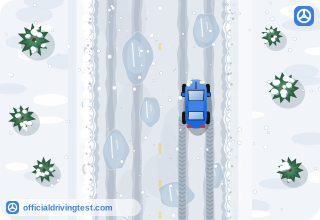
- Accelerate quickly to avoid getting stuck
- Accelerate slowly and smoothly
- Rev the engine in neutral first
- Floor the accelerator in low gear
Show answer
Correct answer: Accelerate slowly and smoothly
With an automatic transmission, accelerating slowly and smoothly helps avoid wheel spin.
Source: Alabama Driver Manual (November 2024), page 71 · Open this page in the manual (Manual page 71)
-
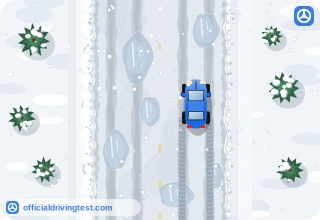
How should you apply the brakes when stopping on packed snow or ice?
- Hard and fast
- As late as possible
- Only with the parking brake
- Gently
Show answer
Correct answer: Gently
The manual says to apply the brakes gently on packed snow or ice.
Source: Alabama Driver Manual (November 2024), page 71 · Open this page in the manual (Manual page 71)
-
If you must stop suddenly on a slippery surface, what should you do?
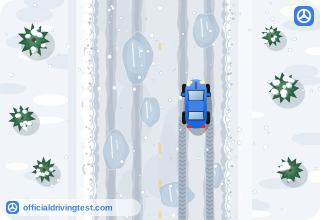
- Pump your brakes
- Hold the brake pedal hard to the floor
- Shift into reverse
- Depress the clutch to take the car out of gear
Show answer
Correct answer: Pump your brakes
Pumping the brakes slows the vehicle gradually instead of causing a skid.
Source: Alabama Driver Manual (November 2024), page 71 · Open this page in the manual (Manual page 71)
-
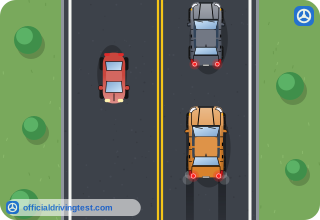
On a slippery surface, your wheels lock while you are braking. What should you do?
- Press the brake harder until the vehicle comes to a stop
- Take your foot off the brake and do not brake again
- Release the brake so the wheels roll, then squeeze down again
- Shift into neutral and let the vehicle coast to a stop
Show answer
Correct answer: Release the brake so the wheels roll, then squeeze down again
You release the brake so the wheels roll, then squeeze again, repeating until stopped.
Source: Alabama Driver Manual (November 2024), page 71 · Open this page in the manual (Manual page 71)
-
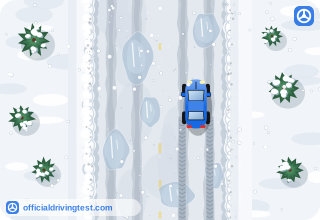
When stopping on a slippery surface, what should you do about the clutch?
- Depress it fully before you brake
- Do not depress it to take the vehicle out of gear
- Depress it only at the first hint of slipping
- Release it and shift to neutral
Show answer
Correct answer: Do not depress it to take the vehicle out of gear
The manual says not to depress the clutch to take the vehicle out of gear while stopping.
Source: Alabama Driver Manual (November 2024), page 71 · Open this page in the manual (Manual page 71)
-
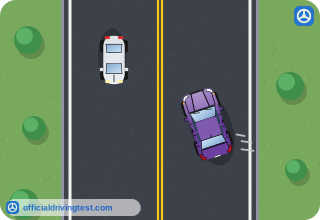
When does a vehicle skid?
- When the engine overheats
- When the brakes run low on fluid
- When the steering wheel is turned too slowly
- When its tires lose their grip on the roadway
Show answer
Correct answer: When its tires lose their grip on the roadway
A skid happens when the tires lose their grip on the roadway.
Source: Alabama Driver Manual (November 2024), page 71 · Open this page in the manual (Manual page 71)
-
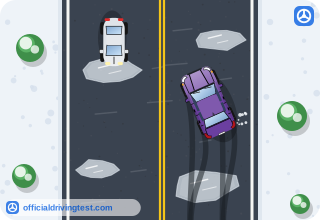
Which is true when your car begins to skid?
- The brakes lose their effectiveness
- The engine pulls harder
- The steering becomes more responsive
- The tires gain extra grip
Show answer
Correct answer: The brakes lose their effectiveness
In a skid the engine loses its pulling effect and the brakes lose their effectiveness.
Source: Alabama Driver Manual (November 2024), page 71 · Open this page in the manual (Manual page 71)
-
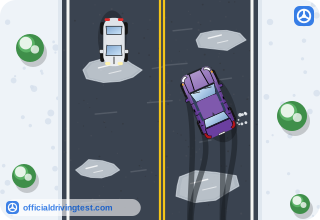
What should you do about braking when your car begins to skid?
- Brake hard right away to stop the skid
- Pump the brake pedal quickly until the skid ends
- Do not brake until you regain control of your direction
- Apply the parking brake to slow the rear wheels
Show answer
Correct answer: Do not brake until you regain control of your direction
Braking only increases the velocity of the skid and can cause loss of steering control.
Source: Alabama Driver Manual (November 2024), page 71 · Open this page in the manual (Manual page 71)
-
With any vehicle skid, what is the main idea?
- Keep the front end from outrunning the rear
- Keep the rear end from outrunning the front
- Lock all four wheels until the car stops
- Brake hard until the tires regain grip
Show answer
Correct answer: Keep the rear end from outrunning the front
The goal is to keep the rear of the vehicle from outrunning the front.
Source: Alabama Driver Manual (November 2024), page 71 · Open this page in the manual (Manual page 71)