Alabama: Speed and following distance — Part 1 Practice Test
Questions in this part include: “According to the manual, what causes most rear-end collisions?” · “Which of these is listed as a factor that affects stopping distance?”
Independent educational site · not affiliated with any government agency or DMV
Ready? Test yourself
- Instant feedback with an explanation
- Every answer cites its source in the manual
- Your best score is saved on this device
Questions are original and based on the official manual "Alabama Driver Manual" (November 2024), Alabama Law Enforcement Agency (ALEA), Driver License Division.
All 18 questions in this practice test
Take the test above first, then use this list to study. Tap “Show answer” to see the correct answer and explanation.
Show the questions and answersHide the questions
-
Why should you slow down before entering a curve?
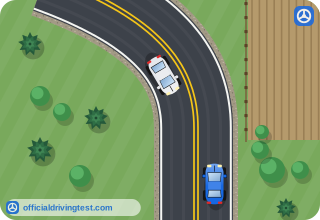
- Because the road surface is always wet on curves in the road
- Because of the danger of running over the center line or leaving the road
- Because passing other vehicles is required on all curves
- Because other drivers cannot see curves in the daylight hours
Show answer
Correct answer: Because of the danger of running over the center line or leaving the road
The manual says to slow down before entering curves because of the danger of running over the center line or leaving the roadway.
Source: Alabama Driver Manual (November 2024), page 23 · Open this page in the manual (Manual page 23)
-
How slowly should you enter a curve?
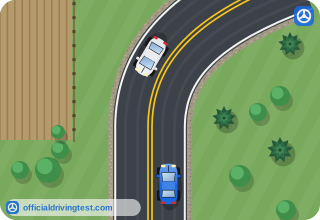
- Slowly enough to brake firmly in the middle of the curve itself
- At a speed that lets you coast through the entire curve
- At the posted speed limit, however sharp the curve may be
- Slowly enough to accelerate slightly while actually rounding the curve
Show answer
Correct answer: Slowly enough to accelerate slightly while actually rounding the curve
The manual says to enter a curve slow enough to accelerate slightly when actually rounding it.
Source: Alabama Driver Manual (November 2024), page 23 · Open this page in the manual (Manual page 23)
-
According to the manual, what causes most rear-end collisions?
- Following too closely
- Driving faster than the posted speed limit
- Sudden stops by the vehicle ahead
- Failing to signal before a lane change
Show answer
Correct answer: Following too closely
The manual states that most rear-end collisions are caused by following too closely.
Source: Alabama Driver Manual (November 2024), page 36 · Open this page in the manual (Manual page 36)
-
Which space around your vehicle is the easiest to control?
- The space behind your vehicle
- The space to the left of your vehicle
- The space ahead of your vehicle
- The space to the right of your vehicle
Show answer
Correct answer: The space ahead of your vehicle
The manual says the space ahead of your vehicle is the space easiest to control.
Source: Alabama Driver Manual (November 2024), page 36 · Open this page in the manual (Manual page 36)
-
What is the space cushion ahead of your vehicle called?
- Braking distance
- Following distance
- Reaction distance
- Safety margin
Show answer
Correct answer: Following distance
The manual calls the space cushion ahead of your vehicle "following distance."
Source: Alabama Driver Manual (November 2024), page 36 · Open this page in the manual (Manual page 36)
-
What was the old rule-of-thumb formula for following distance?
- One car length for every five miles per hour
- Two car lengths for every ten miles per hour
- One car length for every twenty miles per hour
- One car length for every ten miles per hour
Show answer
Correct answer: One car length for every ten miles per hour
The older formula was one car length for every ten miles per hour, replaced by the two-second rule.
Source: Alabama Driver Manual (November 2024), page 36 · Open this page in the manual (Manual page 36)
-
Which newer formula does the manual describe as more positive and easier to apply for following distance?
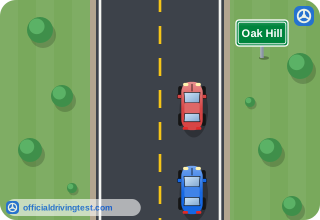
- The two-second rule
- The three-second rule
- The half-speed rule
- The one-car-length rule
Show answer
Correct answer: The two-second rule
The manual introduces the "two-second rule" as the newer formula for following distance.
Source: Alabama Driver Manual (November 2024), page 36 · Open this page in the manual (Manual page 36)
-
To use the two-second rule, what do you choose on the road ahead?
- The brake lights of the vehicle ahead
- A vehicle traveling in the next lane
- A fixed object
- The edge line of the road
Show answer
Correct answer: A fixed object
You choose a fixed object, such as a sign post, tree, overpass or bridge abutment.
Source: Alabama Driver Manual (November 2024), page 36 · Open this page in the manual (Manual page 36)
-
When do you begin counting “One thousand one, one thousand two” in the two-second rule?
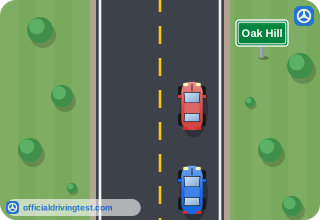
- When your own vehicle reaches the fixed object
- When the vehicle ahead passes the fixed object
- When the vehicle ahead first shows its brake lights
- When the vehicle ahead begins to slow down
Show answer
Correct answer: When the vehicle ahead passes the fixed object
You begin counting when the vehicle ahead passes the chosen fixed object.
Source: Alabama Driver Manual (November 2024), page 36 · Open this page in the manual (Manual page 36)
-
You reach the fixed object before you finish saying “one thousand two.” What does the manual say you should do?
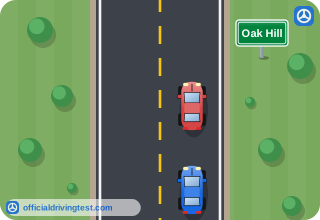
- Brake hard at once to open a larger gap quickly
- Keep your speed, because the two-second rule has been met
- Change lanes immediately to get away from the vehicle ahead
- Slow down gradually until you reach a safe following distance
Show answer
Correct answer: Slow down gradually until you reach a safe following distance
You are following too closely and should gradually slow down until you reach a safe following distance.
Source: Alabama Driver Manual (November 2024), page 36 · Open this page in the manual (Manual page 36)
-
If road and weather conditions are not good, to what count should you increase your following distance?
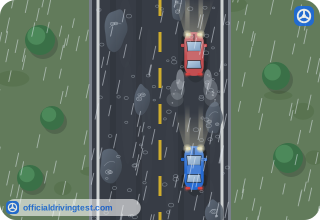
- A four or five second count
- A six or seven second count
- A three second count
- A ten second count
Show answer
Correct answer: A four or five second count
In poor road or weather conditions the manual says to increase following distance to a four or five second count.
Source: Alabama Driver Manual (November 2024), page 36 · Open this page in the manual (Manual page 36)
-
What does the manual say about following distance when you drive a vehicle longer than a car?
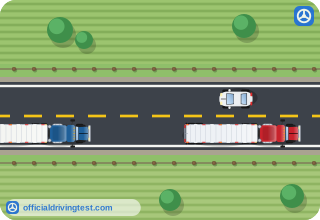
- It can be shorter because longer vehicles are heavier
- It stays the same as for a car in good weather
- The increased following distance also applies
- It only needs to be increased when on a freeway
Show answer
Correct answer: The increased following distance also applies
The manual says the increased following limit also applies to vehicles with longer lengths than cars.
Source: Alabama Driver Manual (November 2024), page 36 · Open this page in the manual (Manual page 36)
-
What should you do if you see brake lights ahead or notice the following distance getting less?
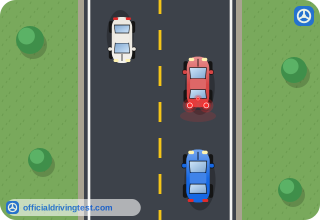
- Flash your headlights at the driver ahead
- Shift your foot to the brake pedal promptly
- Sound your horn to warn the driver ahead
- Move to the next lane at once
Show answer
Correct answer: Shift your foot to the brake pedal promptly
The manual says to shift your foot to the brake pedal promptly so you are ready to stop.
Source: Alabama Driver Manual (November 2024), page 36 · Open this page in the manual (Manual page 36)
-
Which of these is listed as a factor that affects stopping distance?
- The number of passengers riding in the vehicle
- The age of the driver’s license at the time
- The color and make of the vehicle
- Mental and physical reaction time of the driver
Show answer
Correct answer: Mental and physical reaction time of the driver
The manual lists the mental and physical reaction time of the driver as the first factor.
Source: Alabama Driver Manual (November 2024), page 36 · Open this page in the manual (Manual page 36)
-
According to the manual, which pavements differ greatly in stopping from rough, dry concrete?
- Slippery brick or smooth asphalt
- Packed gravel or loose sand
- Fresh snow or thin ice
- Wet grass or packed dirt
Show answer
Correct answer: Slippery brick or smooth asphalt
The manual notes a great difference between rough, dry concrete and slippery brick or smooth asphalt.
Source: Alabama Driver Manual (November 2024), page 36 · Open this page in the manual (Manual page 36)
-
According to the manual, what can happen with large, wide tires on slippery or wet surfaces?
- They cut through standing water better
- They always stop quicker than narrow tires
- They skid or hydroplane more easily
- They gain traction as the tread wears down
Show answer
Correct answer: They skid or hydroplane more easily
Large, wide tires may stop quicker on smooth, dry surfaces but skid or hydroplane easier on slippery or wet ones.
Source: Alabama Driver Manual (November 2024), page 37 · Open this page in the manual (Manual page 37)
-
Why can small, narrow tires lose stopping power overall?
- More weight is shifted to the front axle
- Less rubber on the road and poorer traction
- They overheat quickly on smooth, dry surfaces
- Their tread wears out much faster than wide tires
Show answer
Correct answer: Less rubber on the road and poorer traction
Small narrow tires may cut through standing water but lose stopping power because of less rubber on the road and poorer traction.
Source: Alabama Driver Manual (November 2024), page 37 · Open this page in the manual (Manual page 37)
-
What can put you in serious trouble in an emergency stop, according to the stopping-distance factors?
- All four brakes taking hold at the very same moment
- Brake lights that stay on for a few seconds after you stop
- Pressing the brake pedal too lightly at low speed
- One or more brakes locking the wheels before the others take hold
Show answer
Correct answer: One or more brakes locking the wheels before the others take hold
The manual warns that you can be in serious trouble if one or more brakes lock the wheels before the others fully take hold.
Source: Alabama Driver Manual (November 2024), page 37 · Open this page in the manual (Manual page 37)