Alabama: Speed and following distance — Part 5 Practice Test
Speed limits, the two-second rule, stopping distance and driving in bad weather or at night. — Part 5
Independent educational site · not affiliated with any government agency or DMV
Ready? Test yourself
- Instant feedback with an explanation
- Every answer cites its source in the manual
- Your best score is saved on this device
Questions are original and based on the official manual "Alabama Driver Manual" (November 2024), Alabama Law Enforcement Agency (ALEA), Driver License Division.
All 17 questions in this practice test
Take the test above first, then use this list to study. Tap “Show answer” to see the correct answer and explanation.
Show the questions and answersHide the questions
-
To overcome a skid, what must you do?

- Speed up the rear wheels or slow the front wheels
- Lock all four wheels at once
- Slow the front wheels and the rear wheels equally
- Slow the rear wheels somewhat or speed up the front wheels
Show answer
Correct answer: Slow the rear wheels somewhat or speed up the front wheels
The manual says to slow the rear wheels somewhat or speed the front wheels.
Source: Alabama Driver Manual (November 2024), page 71 · Open this page in the manual (Manual page 71)
-
In a rear-wheel drive vehicle, how does easing off the gas help in a skid?

- The engine acts as a brake and slows the rear wheels
- The engine pulls harder on the front wheels and speeds them up
- It speeds up the rear wheels so they catch up
- It locks the front wheels so the rear can catch up
Show answer
Correct answer: The engine acts as a brake and slows the rear wheels
Easing off the gas lets the engine slow the rear wheels, so the front end can catch up.
Source: Alabama Driver Manual (November 2024), page 71 · Open this page in the manual (Manual page 71)
-
To correct a skid in a front-wheel drive vehicle, what should you do?

- Ease completely off the gas
- Brake firmly
- Step lightly on the gas
- Shift into reverse
Show answer
Correct answer: Step lightly on the gas
Stepping lightly on the gas increases front wheel speed so the front end catches up with the sliding rear.
Source: Alabama Driver Manual (November 2024), page 72 · Open this page in the manual (Manual page 72)
-
In a skid, if there is not enough room to step on the gas, what is the next best action?

- Brake hard and steer away from the direction of the skid
- Disengage the transmission and steer the way the rear is skidding
- Turn off the ignition and let the car coast to a stop
- Shift into reverse and steer straight until the skid ends
Show answer
Correct answer: Disengage the transmission and steer the way the rear is skidding
You disengage the transmission (clutch or neutral) and steer in the direction the rear is skidding.
Source: Alabama Driver Manual (November 2024), page 72 · Open this page in the manual (Manual page 72)
-
Why do many safety experts hesitate to recommend shifting into neutral in a skid?

- It can damage the transmission when the car is moving fast
- The engine stalls and locks the steering wheel in place
- It increases the speed of the skid and the front wheels lock
- Drivers may look away from the road or shift past neutral into reverse
Show answer
Correct answer: Drivers may look away from the road or shift past neutral into reverse
In a panic, a driver may look away from the road or shift past neutral into reverse, which can be disastrous.
Source: Alabama Driver Manual (November 2024), page 72 · Open this page in the manual (Manual page 72)
-
What happens during hydroplaning?
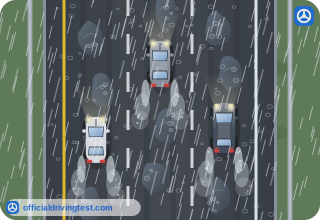
- The tires ride on a film of water instead of the road
- The tires sink into soft mud along the roadside
- The brakes overheat in the rain and stop working
- Fog forms on the windshield and blocks your view
Show answer
Correct answer: The tires ride on a film of water instead of the road
At higher speeds tires cannot wipe the road and ride on a film of water, like water skis.
Source: Alabama Driver Manual (November 2024), page 72 · Open this page in the manual (Manual page 72)
-
In a standard passenger car, at about what speed does partial hydroplaning start?
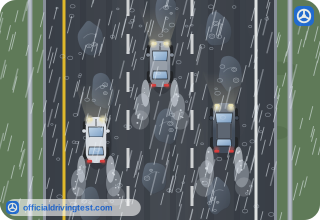
- 25 mph
- 45 mph
- 35 mph
- 65 mph
Show answer
Correct answer: 35 mph
Partial hydroplaning starts at about 35 mph and increases with speed.
Source: Alabama Driver Manual (November 2024), page 72 · Open this page in the manual (Manual page 72)
-
In a standard passenger car, at about what speed may the tires be totally on the water?
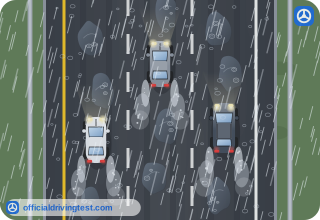
- 45 mph
- 55 mph
- 65 mph
- 75 mph
Show answer
Correct answer: 55 mph
Partial hydroplaning increases to about 55 mph, where the tires may be totally on the water.
Source: Alabama Driver Manual (November 2024), page 72 · Open this page in the manual (Manual page 72)
-
When the tires lose all contact with the road in a severe rainstorm, what is available to brake, accelerate or corner?
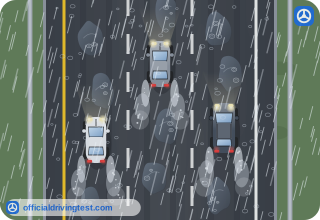
- Full friction on curves only
- Friction for braking only
- Half of the normal friction
- No friction
Show answer
Correct answer: No friction
With no contact there is no friction to brake, accelerate or corner.
Source: Alabama Driver Manual (November 2024), page 72 · Open this page in the manual (Manual page 72)
-
What is the best thing to do when your car is hydroplaning?
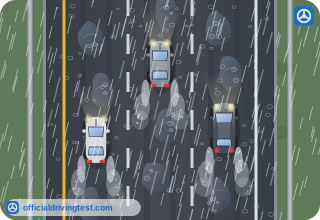
- Release the accelerator and let the car slow down
- Brake hard to stop the car as quickly as you can
- Accelerate to push through the water quickly
- Turn the steering wheel sharply to the left
Show answer
Correct answer: Release the accelerator and let the car slow down
The manual says the best thing is to release the accelerator and let the car slow.
Source: Alabama Driver Manual (November 2024), page 72 · Open this page in the manual (Manual page 72)
-
If you skid while your car is only partially hydroplaning, how should you be able to regain control?
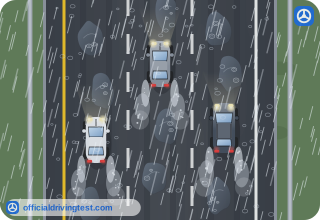
- By braking hard until the car stops skidding at once
- By accelerating hard to power out of the skid
- By correcting the particular type of skid that occurs
- By turning off the ignition and coasting
Show answer
Correct answer: By correcting the particular type of skid that occurs
In partial hydroplaning you correct the type of skid that occurs.
Source: Alabama Driver Manual (November 2024), page 72 · Open this page in the manual (Manual page 72)
-
What is most helpful to prevent hydroplaning?
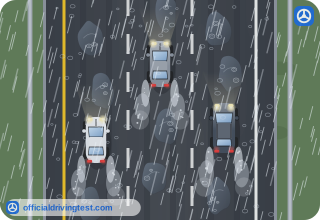
- Worn tires with smooth surfaces
- Good tires with deep treads
- Low tire pressure
- A heavier load in the car
Show answer
Correct answer: Good tires with deep treads
Deep treads let water escape from under the tires.
Source: Alabama Driver Manual (November 2024), page 72 · Open this page in the manual (Manual page 72)
-
When the depth of the water exceeds the depth of the tire treads, complete hydroplaning can be expected at speeds above what?
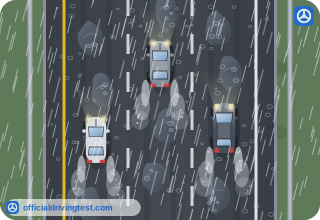
- 30 mph
- 40 mph
- 65 mph
- 50 mph
Show answer
Correct answer: 50 mph
Complete hydroplaning can be expected above 50 mph when water is deeper than the treads.
Source: Alabama Driver Manual (November 2024), page 72 · Open this page in the manual (Manual page 72)
-
What does the manual advise about driving in fog or a snowstorm?

- Avoid it unless it is absolutely necessary
- Drive as usual with extra caution
- Drive faster to get out of it sooner
- Use your high beams to see farther
Show answer
Correct answer: Avoid it unless it is absolutely necessary
The manual says to avoid driving in fog or a snowstorm unless absolutely necessary.
Source: Alabama Driver Manual (November 2024), page 73 · Open this page in the manual (Manual page 73)
-
When visibility is limited, what must you do?

- Keep your normal speed and rely on your horn to warn others
- Speed up to leave the limited-visibility area quickly
- Slow down and be able to stop within your range of vision
- Follow the taillights ahead of you very closely
Show answer
Correct answer: Slow down and be able to stop within your range of vision
Speed must be reduced so you can stop within what you can see.
Source: Alabama Driver Manual (November 2024), page 73 · Open this page in the manual (Manual page 73)
-
What should you do as you round hazardous curves on narrow, hilly roads?
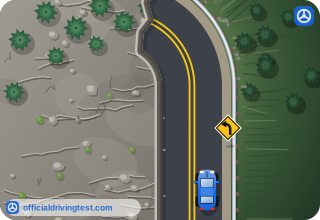
- Use your horn to let others know they are not alone
- Stay close to the center line to see farther ahead
- Turn off your headlights so you do not blind others
- Increase your speed to clear the curve quickly
Show answer
Correct answer: Use your horn to let others know they are not alone
Use your horn on hazardous curves because there are blind pockets in hilly country.
Source: Alabama Driver Manual (November 2024), page 73 · Open this page in the manual (Manual page 73)
-
What does the law forbid when you drive downhill?
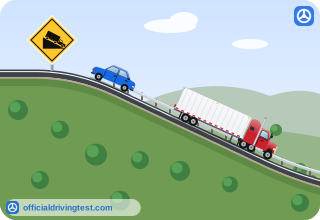
- Using a lower gear to hold your speed
- Using your horn on curves
- Coasting with the transmission in neutral
- Driving with your headlights on low beam
Show answer
Correct answer: Coasting with the transmission in neutral
The law forbids coasting downhill with the transmission in neutral.
Source: Alabama Driver Manual (November 2024), page 73 · Open this page in the manual (Manual page 73)