Alabama: Signals and vehicle controls
Turn and hand signals, lights, horn, tires, brakes, loads and keeping your vehicle in safe condition. Split into 5 shorter tests so you're not stuck in one long quiz.
Independent educational site · not affiliated with any government agency or DMV
Choose a part
Signals and vehicle controls — Part 1
Questions in this part include: “In the penny test for tread depth, how do you place the penny?”
StartSignals and vehicle controls — Part 2
Questions in this part include: “Does a street with no painted lane markings still have traffic lanes?”
StartSignals and vehicle controls — Part 3
Questions in this part include: “On all vehicles, how much of the front windshield may be tinted with a transparent material?”
StartSignals and vehicle controls — Part 4
Questions in this part include: “Why should you be cautious about using the windshield washer and wipers at high speeds on extremely cold days?”
StartSignals and vehicle controls — Part 5
Questions in this part include: “What does the manual permit to indicate a vehicular hazard?”
StartAll 92 Signals and vehicle controls questions with answers
Choose a part above to take a practice test, or study every question and answer here.
Show the questions and answersHide the questions
-
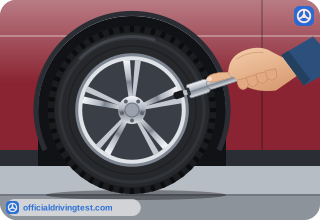
How often should you check your tire pressure with a gauge?
- Every day
- Once a year
- Only when a tire looks flat
- Monthly
Show answer
Correct answer: Monthly
The manual says to check tire pressure with a pressure gauge monthly.
Source: Alabama Driver Manual (November 2024), page 12 · Open this page in the manual (Manual page 12)
-
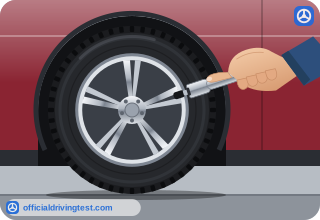
Where in the car can you find the tire pressure (PSI) number to compare with your gauge?
- On a sticker on the inside of the car door jamb
- On the underside of the hood near the battery
- Stamped on the valve cap of every single tire
- On the dashboard next to the warning lights
Show answer
Correct answer: On a sticker on the inside of the car door jamb
The manual says to open the car door and look for a sticker on the inside jamb showing the PSI.
Source: Alabama Driver Manual (November 2024), page 12 · Open this page in the manual (Manual page 12)
-
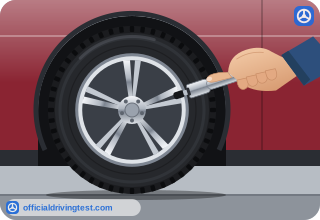
When should you check the pressure of your tires?
- Right after a long highway drive
- Only after the tires are warm
- When the tires are cold
- While the engine is running at high speed
Show answer
Correct answer: When the tires are cold
The manual notes to check the tire pressure when the tires are cold.
Source: Alabama Driver Manual (November 2024), page 12 · Open this page in the manual (Manual page 12)
-
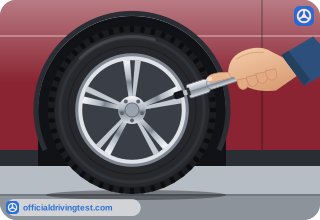
If the number on your gauge is too high compared with the number on the sticker, what should you do?
- Inflate the tires further
- Let air out of your tires
- Drive until the tires wear down
- Replace the valve cap only
Show answer
Correct answer: Let air out of your tires
If the gauge number is too high, you let air out of the tires.
Source: Alabama Driver Manual (November 2024), page 12 · Open this page in the manual (Manual page 12)
-
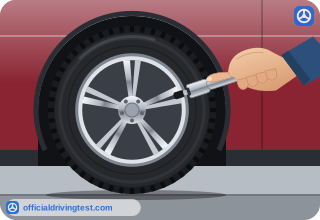
If the number on your gauge is too low compared with the number on the sticker, what should you do?
- Let some air out of your tires and recheck
- Ignore it if the tread depth still looks good
- Drive faster to warm up the tires first
- Inflate your tires until the numbers match
Show answer
Correct answer: Inflate your tires until the numbers match
If the number is too low, inflate the tires until the numbers match.
Source: Alabama Driver Manual (November 2024), page 12 · Open this page in the manual (Manual page 12)
-
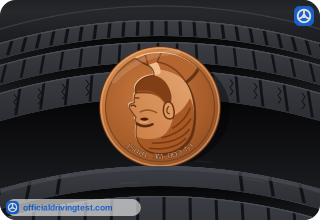
In the penny test for tread depth, how do you place the penny?
- Lincoln's head first into the deepest-looking groove
- Lincoln's body first into the shallowest groove
- Flat on the sidewall of the tire
- Lincoln's head first against the tire's outer edge
Show answer
Correct answer: Lincoln's head first into the deepest-looking groove
The manual says to place Lincoln's head first into the deepest looking groove.
Source: Alabama Driver Manual (November 2024), page 12 · Open this page in the manual (Manual page 12)
-
In the penny test, what does it mean if you can see all of Lincoln's head?
- Your tires are at the ideal tread depth
- Your tires need more air
- Your tires are too worn and should be replaced
- Your tires are fine for another year
Show answer
Correct answer: Your tires are too worn and should be replaced
If all of his head is visible, the tires are too worn and should be replaced.
Source: Alabama Driver Manual (November 2024), page 12 · Open this page in the manual (Manual page 12)
-
How should you be seated when you drive?
- Reclined, with one hand on the top of the steering wheel
- Upright, with your back against the seat and feet on the floor
- Slouched, with your arms fully extended to the wheel
- Leaning forward, with your chin close to the steering wheel
Show answer
Correct answer: Upright, with your back against the seat and feet on the floor
The manual says to sit upright with your back against the seat and feet on the floor.
Source: Alabama Driver Manual (November 2024), page 12 · Open this page in the manual (Manual page 12)
-
What can improper seating positions, such as slouching, result in?
- Faster wear on the tires and the brake pads of the car
- Improved airbag deployment and quicker braking
- Less glare from the sun and from oncoming headlights
- Reduced effectiveness of the vehicle's restraint system
Show answer
Correct answer: Reduced effectiveness of the vehicle's restraint system
Improper seating can reduce the effectiveness of the vehicle's restraint system.
Source: Alabama Driver Manual (November 2024), page 12 · Open this page in the manual (Manual page 12)
-
When should you adjust your seat and mirrors?
- Before you start to drive
- After you reach highway speed
- Only when another driver complains
- At the first red light
Show answer
Correct answer: Before you start to drive
The manual says to adjust the seat and mirrors before you start to drive.
Source: Alabama Driver Manual (November 2024), page 12 · Open this page in the manual (Manual page 12)
-
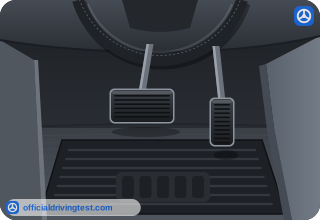
How should your foot be able to move between the pedals when the seat is adjusted correctly?
- Lift completely off the floor to reach the brake pedal
- Slide sideways between pedals with the heel raised up
- Pivot smoothly from brake to accelerator, heel on the floor
- Press the brake and accelerator pedals at the same time
Show answer
Correct answer: Pivot smoothly from brake to accelerator, heel on the floor
Your foot should pivot smoothly from brake to accelerator while your heel stays on the floor.
Source: Alabama Driver Manual (November 2024), page 12 · Open this page in the manual (Manual page 12)
-
Where should the top of the steering wheel be positioned?
- Level with the top of your head and above your eyes
- No higher than the top of your shoulders and below chin level
- Above your eyes so that it does not block the gauges
- Exactly at the height of your elbows when you sit upright
Show answer
Correct answer: No higher than the top of your shoulders and below chin level
The top of the steering wheel should be no higher than the top of your shoulders and below chin level.
Source: Alabama Driver Manual (November 2024), page 12 · Open this page in the manual (Manual page 12)
-
Besides adjusting the seat and mirrors, what should you do as part of your routine for entering the car?
- Check that the engine is warm and the fuel tank is at least half full
- Check that passengers have chosen their seats and have set the mirrors
- Check that passengers are properly seated and do not interfere with your driving
- Check that the windows are open and the heater is turned to its lowest
Show answer
Correct answer: Check that passengers are properly seated and do not interfere with your driving
The manual says to adjust the seat and mirrors and check passengers to be sure they are properly seated and do not interfere with your driving.
Source: Alabama Driver Manual (November 2024), page 20 · Open this page in the manual (Manual page 20)
-
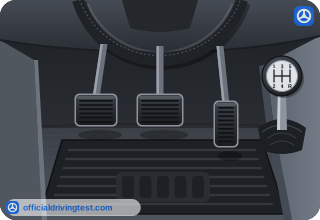
In a vehicle with a manual transmission, what should you do before turning the ignition key?
- Set the parking brake and release the clutch
- Push in the clutch
- Shift into first gear and release the clutch
- Press the accelerator pedal halfway down
Show answer
Correct answer: Push in the clutch
The manual says to push in the clutch before turning the ignition key in a hand-shift vehicle.
Source: Alabama Driver Manual (November 2024), page 20 · Open this page in the manual (Manual page 20)
-
In a vehicle with an automatic transmission, what should you do as you turn the ignition key?
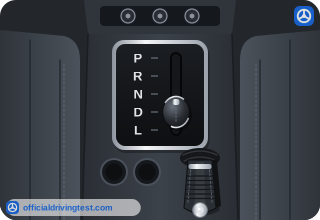
- Shift into drive and press the accelerator pedal
- Be sure the indicator is in reverse and release the brake pedal
- Push in the clutch and keep the indicator in low gear
- Be sure the indicator is in park or neutral and depress the brake pedal
Show answer
Correct answer: Be sure the indicator is in park or neutral and depress the brake pedal
The manual says to have the indicator in park or neutral and depress the brake pedal as you turn the key.
Source: Alabama Driver Manual (November 2024), page 20 · Open this page in the manual (Manual page 20)
-
What does good posture at the steering wheel result in?
- Less need to check your mirrors
- A shorter stopping distance at any speed
- Less tiredness on long trips, with no effect on control
- Better vision, control, and ability to maneuver in an emergency
Show answer
Correct answer: Better vision, control, and ability to maneuver in an emergency
The manual states that good posture results in better vision, control, and ability to maneuver in an emergency.
Source: Alabama Driver Manual (November 2024), page 20 · Open this page in the manual (Manual page 20)
-
How firmly should you grip the steering wheel?
- As tightly as you can, so that the wheel cannot move in your hands
- Firmly enough to keep control, without restricting your reflexes
- Loosely, so that the wheel can move freely and absorb road bumps
- Tightly at first, then more loosely once you reach full speed
Show answer
Correct answer: Firmly enough to keep control, without restricting your reflexes
The manual says not to grip the wheel so tightly as to restrict reflexes, but to keep a firm grip to maintain control.
Source: Alabama Driver Manual (November 2024), page 20 · Open this page in the manual (Manual page 20)
-
When is it acceptable to take one hand off the steering wheel?
- Whenever the road ahead is straight and clear of other traffic
- Whenever you are driving below the speed limit on a quiet street
- When necessary for signaling or another purpose needed to drive
- Whenever a front seat passenger offers to help you steer the car
Show answer
Correct answer: When necessary for signaling or another purpose needed to drive
The manual says to always keep both hands on the wheel except when one must be removed for signaling or another necessary purpose.
Source: Alabama Driver Manual (November 2024), page 20 · Open this page in the manual (Manual page 20)
-
How should you drive with respect to the lane you are in?
- Within a single traffic lane, without weaving or straddling the lane marking
- Along the lane marking, so you can change lanes quickly if needed
- In whichever lane has the least traffic, moving between lanes freely
- Close to the lane marking whenever the lane itself is not marked
Show answer
Correct answer: Within a single traffic lane, without weaving or straddling the lane marking
The manual says you must drive within a single lane without weaving or straddling the lane marking.
Source: Alabama Driver Manual (November 2024), page 20 · Open this page in the manual (Manual page 20)
-
Does a street with no painted lane markings still have traffic lanes?
- No, lanes exist only where they are painted
- No, lanes exist only on divided highways
- Yes, but only on streets with more than two lanes
- Yes, lanes are there whether marked or not
Show answer
Correct answer: Yes, lanes are there whether marked or not
The manual says lanes are often not marked, but they are there whether marked or not.
Source: Alabama Driver Manual (November 2024), page 21 · Open this page in the manual (Manual page 21)
-
When should you discontinue your turn signal?
- Only when the driver behind you flashes the lights
- After completing the maneuver
- When the car behind you slows down
- Only when you pass the next intersection
Show answer
Correct answer: After completing the maneuver
The manual says to be certain your signals are discontinued after completing a maneuver.
Source: Alabama Driver Manual (November 2024), page 21 · Open this page in the manual (Manual page 21)
-
During the daytime, how may hand and arm signals be used?
- Only when your signal lights fail
- Only when you are turning left
- In addition to signal lights
- Only when you are slowing for a stop sign
Show answer
Correct answer: In addition to signal lights
The manual says hand and arm signals may be used during the daytime in addition to signal lights.
Source: Alabama Driver Manual (November 2024), page 21 · Open this page in the manual (Manual page 21)
-
Why might hand and arm signals be used during the daytime?
- Bright sunlight may make flashing signal lights hard for others to see
- Signal lights cannot be used during the daytime hours at all
- Other motorists cannot hear signal lights during the daytime
- Signal lights are meant to be used only at night or in fog
Show answer
Correct answer: Bright sunlight may make flashing signal lights hard for others to see
The manual notes that reflection of bright sunlight may make a flashing signal light difficult to see.
Source: Alabama Driver Manual (November 2024), page 21 · Open this page in the manual (Manual page 21)
-
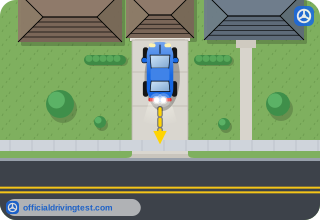
If you are going to back the vehicle, what is a good practice before you begin?
- Sound the horn several times
- Turn on the hazard lights first
- Roll down all of the windows
- Walk completely around the vehicle
Show answer
Correct answer: Walk completely around the vehicle
The manual says it is good practice to walk completely around the vehicle to be sure no person or obstacle is behind it.
Source: Alabama Driver Manual (November 2024), page 66 · Open this page in the manual (Manual page 66)
-
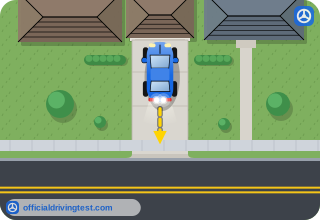
While backing, what should you continue to do?
- Rely only on your rearview mirror
- Look over your right shoulder to the rear
- Look only at the side mirrors
- Look straight ahead through the windshield
Show answer
Correct answer: Look over your right shoulder to the rear
The manual says to continue to look over your right shoulder to the rear while backing and not to depend on your mirror.
Source: Alabama Driver Manual (November 2024), page 66 · Open this page in the manual (Manual page 66)
-
How should you back the vehicle into the proper traffic lane?
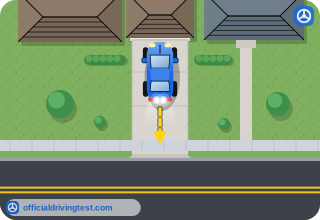
- Slowly, with a minimum of movement
- Quickly, to clear the lane sooner
- In a wide curve across all lanes
- With short bursts of speed
Show answer
Correct answer: Slowly, with a minimum of movement
The manual says to back slowly into the proper traffic lane with a minimum of movement.
Source: Alabama Driver Manual (November 2024), page 66 · Open this page in the manual (Manual page 66)
-
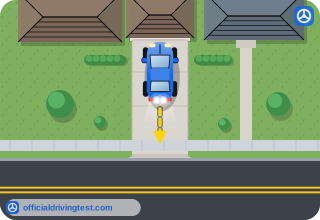
Except for backing into a parking place, what does the manual say about backing on a public street or road?
- It is allowed in any lane at low speed
- It is never advisable
- It is advisable when you miss a turn
- It is required when leaving a parking place
Show answer
Correct answer: It is never advisable
The manual says that except for backing into a parking place, it is never advisable to back on a public street or road.
Source: Alabama Driver Manual (November 2024), page 66 · Open this page in the manual (Manual page 66)
-
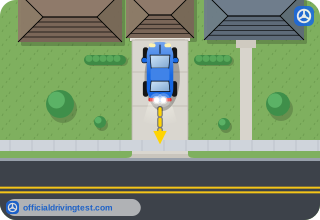
If you back out of a driveway, which lane should you back into?
- The farthest lane
- The center of the road
- Any lane that is empty
- The nearest lane
Show answer
Correct answer: The nearest lane
The manual says to always back into the nearest lane and never back across other traffic lanes.
Source: Alabama Driver Manual (November 2024), page 66 · Open this page in the manual (Manual page 66)
-
What does state law say about signs, posters, or other materials placed on a vehicle's windows?
- They are allowed if they are smaller than a postcard
- They are allowed on the rear window only
- They are prohibited if they obstruct
- They are allowed if they are removed at night
Show answer
Correct answer: They are prohibited if they obstruct
State law prohibits obstructions on windows; no sign, poster, or other material may be placed on a window if it obstructs.
Source: Alabama Driver Manual (November 2024), page 66 · Open this page in the manual (Manual page 66)
-
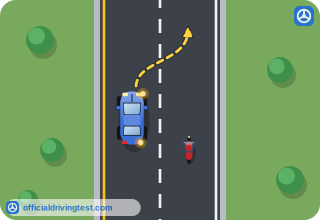
Before changing lanes, which areas must you watch for safe clearance?
- To the side, ahead and behind your vehicle
- Only the area ahead of your vehicle
- Only the area behind your vehicle
- Only the area to the left of your vehicle
Show answer
Correct answer: To the side, ahead and behind your vehicle
Changing lanes safely means watching for clearance to the side, ahead and behind.
Source: Alabama Driver Manual (November 2024), page 66 · Open this page in the manual (Manual page 66)
-
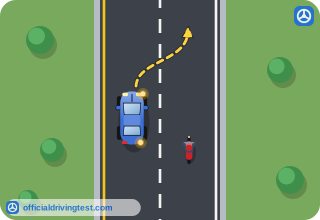
What should you do when checking for clearance before changing lanes, besides using your mirror?
- Slow down to about 10 mph first
- Tap the horn twice to warn drivers
- Move halfway into the next lane first
- Glance over your shoulder to the blind spot
Show answer
Correct answer: Glance over your shoulder to the blind spot
The manual says not to rely solely on your mirror and to glance over your shoulder to check the blind spot.
Source: Alabama Driver Manual (November 2024), page 66 · Open this page in the manual (Manual page 66)
-
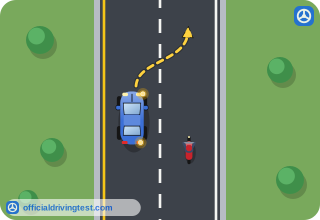
What does using a turn signal or hand signal grant you when changing lanes?
- The right to cross lane lines freely
- It does not grant the right to change lanes
- The right of way over all other traffic
- Permission to change lanes right away
Show answer
Correct answer: It does not grant the right to change lanes
A signal shows your intentions but does not grant the right to change lanes; you must wait until it is safe.
Source: Alabama Driver Manual (November 2024), page 66 · Open this page in the manual (Manual page 66)
-
What hand signal indicates that you are stopping or decreasing speed?
- Hand and arm extended upward
- Hand and arm extended straight out
- Hand and arm extended downward
- Hand waved in a circle
Show answer
Correct answer: Hand and arm extended downward
The manual lists hand and arm extended downward as the stop or decrease speed signal.
Source: Alabama Driver Manual (November 2024), page 66 · Open this page in the manual (Manual page 66)
-
What hand signal indicates a left turn?
- Hand and arm extended downward
- Hand and arm extended out
- Hand and arm extended upward
- Hand pointed toward the rear
Show answer
Correct answer: Hand and arm extended out
The manual lists hand and arm extended out as the left turn signal.
Source: Alabama Driver Manual (November 2024), page 66 · Open this page in the manual (Manual page 66)
-
What hand signal indicates a right turn?
- Hand and arm extended downward
- Hand and arm extended straight out
- Hand and arm held across the chest
- Hand and arm extended upward
Show answer
Correct answer: Hand and arm extended upward
The manual lists hand and arm extended upward as the right turn signal.
Source: Alabama Driver Manual (November 2024), page 66 · Open this page in the manual (Manual page 66)
-
It is unlawful to drive with persons in excess of how many in the front seat if they obstruct the driver's view or hinder control of the vehicle?
- Two
- Four
- Three
- Five
Show answer
Correct answer: Three
The manual makes it unlawful to drive with more than three persons in the front seat if they obstruct the view or hinder control.
Source: Alabama Driver Manual (November 2024), page 67 · Open this page in the manual (Manual page 67)
-
How far may a load extend beyond the front and rear of the vehicle?
- Not more than 5 feet beyond the front and rear, inclusive
- Not more than 1 foot beyond the front and rear, inclusive
- Not more than 10 feet beyond the rear only
- Not more than 15 feet beyond the front and rear, inclusive
Show answer
Correct answer: Not more than 5 feet beyond the front and rear, inclusive
The manual says a load must not extend more than 5 feet beyond both the front and rear, inclusive, of the vehicle.
Source: Alabama Driver Manual (November 2024), page 67 · Open this page in the manual (Manual page 67)
-
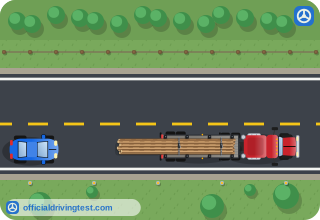
A load projects 4 feet or more from the rear of a vehicle. What must be attached to its end in daytime?
- A white flag at least 6 inches square
- A yellow flag at least 24 inches square
- A red light visible for 100 feet
- A red flag at least 12 inches square
Show answer
Correct answer: A red flag at least 12 inches square
Loads projecting 4 feet or more from the rear need a red flag at least 12 inches square in daytime.
Source: Alabama Driver Manual (November 2024), page 67 · Open this page in the manual (Manual page 67)
-
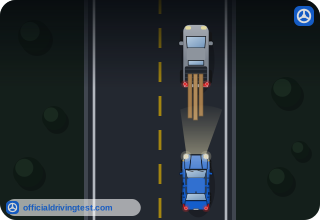
At night, a load projects 4 feet or more from the rear of a vehicle. What must be attached to its end?
- A white light visible for at least 200 feet
- A red light visible for at least 200 feet
- A red light visible for at least 50 feet
- A red flag only
Show answer
Correct answer: A red light visible for at least 200 feet
At night a red light visible for at least 200 feet must be attached to the end of the load.
Source: Alabama Driver Manual (November 2024), page 67 · Open this page in the manual (Manual page 67)
-
On all vehicles, how much of the front windshield may be tinted with a transparent material?
- Only the upper 2 inches
- The upper half
- Only the upper 6 inches
- The entire windshield
Show answer
Correct answer: Only the upper 6 inches
Only the upper 6 inches of the front windshield may be tinted.
Source: Alabama Driver Manual (November 2024), page 68 · Open this page in the manual (Manual page 68)
-
On passenger cars such as sedans, coupes and station wagons, how much light transmission must side and rear window tinting allow?
- At least 12 percent
- At least 32 percent
- At least 50 percent
- At least 70 percent
Show answer
Correct answer: At least 32 percent
All side and rear windows on passenger cars must allow at least 32 percent light transmission.
Source: Alabama Driver Manual (November 2024), page 68 · Open this page in the manual (Manual page 68)
-
On SUVs, trucks, vans and RVs, which windows are subject to the 32 percent light transmission restriction?
- Only the rear window
- No windows
- Only the windows behind the driver
- The front-seat side windows
Show answer
Correct answer: The front-seat side windows
On these vehicles front-seat side windows are subject to the 32 percent restriction, and darker tinting is permitted behind the driver.
Source: Alabama Driver Manual (November 2024), page 68 · Open this page in the manual (Manual page 68)
-
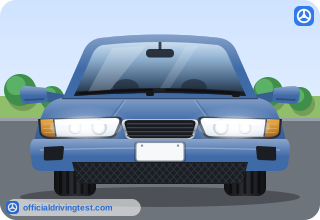
Under normal conditions, about how far ahead do headlights on high beam illuminate the roadway?
- 150 feet
- 350 feet
- 200 feet
- 500 feet
Show answer
Correct answer: 350 feet
The manual states high beams normally light the road about 350 feet ahead under normal conditions.
Source: Alabama Driver Manual (November 2024), page 69 · Open this page in the manual (Manual page 69)
-
You must dim your headlights when you are within what distance of an oncoming vehicle?
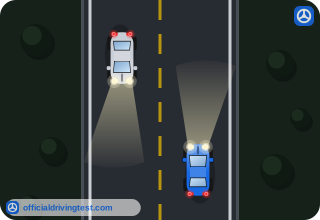
- 100 feet
- 200 feet
- 1,000 feet
- 500 feet
Show answer
Correct answer: 500 feet
The law requires dimmed headlights within 500 feet of an oncoming vehicle.
Source: Alabama Driver Manual (November 2024), page 69 · Open this page in the manual (Manual page 69)
-
You must dim your headlights when you are within what distance of a vehicle you are following?
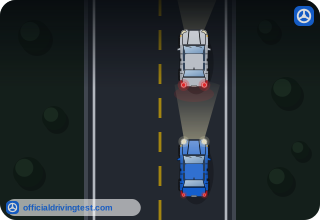
- 200 feet
- 100 feet
- 350 feet
- 500 feet
Show answer
Correct answer: 200 feet
The law requires dimmed headlights within 200 feet when following another vehicle.
Source: Alabama Driver Manual (November 2024), page 69 · Open this page in the manual (Manual page 69)
-
You have dimmed your headlights for an oncoming driver, but that driver does not dim his or hers. What should you do?
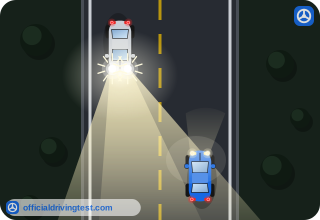
- Switch to high beam in return
- Flash your high beams repeatedly
- Keep yours dimmed anyway
- Turn your headlights off briefly
Show answer
Correct answer: Keep yours dimmed anyway
Blinding the approaching driver with your high beam proves nothing and endangers you.
Source: Alabama Driver Manual (November 2024), page 69 · Open this page in the manual (Manual page 69)
-
Which glass on your vehicle should be kept free of defects and clean, including free of frost and steam?
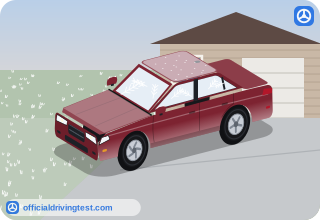
- Only the windshield
- All glass on the vehicle
- Only the windshield and the rear window
- Only the windshield and driver's side window
Show answer
Correct answer: All glass on the vehicle
The manual says to keep all glass free of defects, frost and steam.
Source: Alabama Driver Manual (November 2024), page 69 · Open this page in the manual (Manual page 69)
-
According to state law, when must headlights (not parking lights only) be turned on?
- From sunset to sunrise only
- From one hour after sunset to one hour before sunrise
- Only when it is fully dark
- From a half-hour after sunset to a half-hour before sunrise
Show answer
Correct answer: From a half-hour after sunset to a half-hour before sunrise
State law requires headlights from a half-hour after sunset to a half-hour before sunrise, and parking lights alone are not enough.
Source: Alabama Driver Manual (November 2024), page 69 · Open this page in the manual (Manual page 69)
-
Besides the period around sunset and sunrise, headlights must be on during periods of limited visibility when you cannot see clearly for at least what distance?

- 500 feet
- 100 feet
- 200 feet
- 350 feet
Show answer
Correct answer: 500 feet
Headlights are required during other periods of limited visibility when you cannot see clearly for at least 500 feet.
Source: Alabama Driver Manual (November 2024), page 69 · Open this page in the manual (Manual page 69)
-
If you are in doubt as to when lights are needed, what does the manual say as a general rule?
- Turn on your parking lights only
- Wait until it is fully dark
- Turn them on low beam
- Turn on your high beams
Show answer
Correct answer: Turn them on low beam
Low beams improve your own vision and help others see you.
Source: Alabama Driver Manual (November 2024), page 69 · Open this page in the manual (Manual page 69)
-
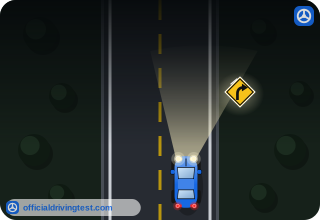
How can eye fatigue in night driving be relieved?
- By staring steadily at the center line of the road ahead
- By moving your eyes from the road to the sides and from near to far
- By keeping your eyes fixed on the taillights of the vehicle ahead
- By looking only at the road directly in front of the car
Show answer
Correct answer: By moving your eyes from the road to the sides and from near to far
Moving your eyes around, from the road to the sides and from near to far, relieves eye fatigue.
Source: Alabama Driver Manual (November 2024), page 70 · Open this page in the manual (Manual page 70)
-
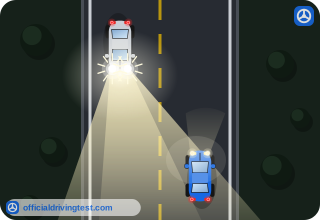
How can you reduce glare from oncoming headlights at night?
- Look straight into the oncoming lights until they pass
- Look toward the left edge of the road, at the center line
- Flash your high beams at the other driver to warn him
- Look to the right edge of the pavement, at the white striped line
Show answer
Correct answer: Look to the right edge of the pavement, at the white striped line
Directing your vision away from oncoming lights, to the right edge and the white line, reduces glare.
Source: Alabama Driver Manual (November 2024), page 70 · Open this page in the manual (Manual page 70)
-
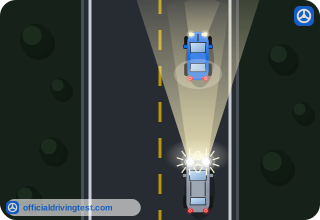
Which is a way to reduce glare from the lights of a vehicle following you at night?
- Use a day-night mirror
- Switch your headlights to high beam
- Turn on your four-way flashers
- Roll down your window
Show answer
Correct answer: Use a day-night mirror
A day-night mirror, or an adjusted mirror, cuts out most of the strong light from behind.
Source: Alabama Driver Manual (November 2024), page 70 · Open this page in the manual (Manual page 70)
-
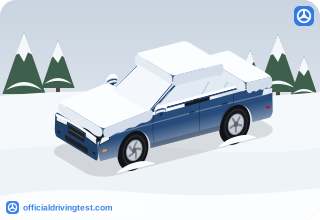
Which part of the car should you especially clear of snow and ice, along with the windows, before winter driving?
- The hood
- The trunk
- The bumpers
- The wheel wells
Show answer
Correct answer: The hood
The manual says to remove snow and ice from the car, especially the hood, and from the windows.
Source: Alabama Driver Manual (November 2024), page 70 · Open this page in the manual (Manual page 70)
-
In winter, how long should you continue to warm the engine at a fast idle?
- For exactly five minutes in all conditions
- Until the engine reaches full operating speed
- Until the heater and defroster are warm
- Until the snow on the hood melts
Show answer
Correct answer: Until the heater and defroster are warm
The engine is warmed at a fast idle until the heater and defroster are warm.
Source: Alabama Driver Manual (November 2024), page 70 · Open this page in the manual (Manual page 70)
-
What should the windshield-washing fluid contain for winter driving?
- Plain water only
- An anti-freeze solution
- A small amount of motor oil
- Extra salt
Show answer
Correct answer: An anti-freeze solution
The manual says to make sure the washing fluid contains an anti-freeze solution.
Source: Alabama Driver Manual (November 2024), page 70 · Open this page in the manual (Manual page 70)
-
Why should you be cautious about using the windshield washer and wipers at high speeds on extremely cold days?
- The wiper blades can tear off the glass at high speed
- The fluid can damage the paint on the hood and fenders
- The wiper motor can overheat and start a fire in the dash
- The solution can freeze on the windshield and block your vision
Show answer
Correct answer: The solution can freeze on the windshield and block your vision
Even with antifreeze, high speed and extreme cold can freeze the solution and block your view.
Source: Alabama Driver Manual (November 2024), page 70 · Open this page in the manual (Manual page 70)
-
What is recommended on the drive wheels for general driving during snow?

- Smooth racing tires
- Slightly under-inflated tires
- Snow treads
- Bald tires
Show answer
Correct answer: Snow treads
Snow treads on the drive wheels greatly improve traction, including starting and stopping.
Source: Alabama Driver Manual (November 2024), page 71 · Open this page in the manual (Manual page 71)
-
Which statement about snow treads on ice is correct?

- They give the best traction on ice
- They give proper traction on ice only at low speeds
- They make tire chains unnecessary on ice
- They do not give proper traction on ice
Show answer
Correct answer: They do not give proper traction on ice
The manual says snow treads do not give proper traction on ice.
Source: Alabama Driver Manual (November 2024), page 71 · Open this page in the manual (Manual page 71)
-
Which is best for extremely icy conditions, hard packed snow and very deep snow?

- Reinforced tire chains
- Snow treads
- Slightly deflated tires
- Wider tires
Show answer
Correct answer: Reinforced tire chains
Reinforced tire chains are the best choice for those extreme conditions.
Source: Alabama Driver Manual (November 2024), page 71 · Open this page in the manual (Manual page 71)
-
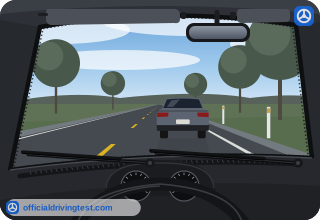
When does Alabama law require headlights to be turned on, in terms of windshield wipers?
- Whenever the sky is overcast, even without precipitation
- Only when the temperature is below freezing outside
- When the wipers are in use because of rain, sleet, or snow
- Only when the wipers are on their highest speed setting
Show answer
Correct answer: When the wipers are in use because of rain, sleet, or snow
Headlights are required whenever wipers are in use because of rain, sleet, or snow.
Source: Alabama Driver Manual (November 2024), page 71 · Open this page in the manual (Manual page 71)
-
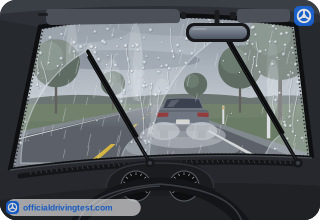
If you use your windshield wipers only intermittently, Alabama law:
- Requires headlights to be used
- Does not require headlight usage
- Requires parking lights to be used
- Requires four-way flashers to be used
Show answer
Correct answer: Does not require headlight usage
Intermittent wiper use does not require headlights.
Source: Alabama Driver Manual (November 2024), page 71 · Open this page in the manual (Manual page 71)
-
In fog or heavy snow, which lights should you keep on?

- Headlights on high beam
- Headlights on low beam
- Parking lights only
- No lights, to avoid glare
Show answer
Correct answer: Headlights on low beam
Low beams reduce the glaring reflection on fog or snow.
Source: Alabama Driver Manual (November 2024), page 73 · Open this page in the manual (Manual page 73)
-
Which two separate methods of applying brakes must all automobiles have?
- A regular foot brake and an engine brake
- A hydraulic brake and a power brake
- A front-wheel brake and a rear-wheel brake
- A regular foot brake and a parking brake
Show answer
Correct answer: A regular foot brake and a parking brake
Automobiles must have a regular foot brake and a parking brake.
Source: Alabama Driver Manual (November 2024), page 79 · Open this page in the manual (Manual page 79)
-
What must every vehicle be equipped with to eliminate excessive or unusual noise?
- A muffler cutout in good working order
- A muffler in good working order
- A bypass device in good working order
- A horn silencer in good working order
Show answer
Correct answer: A muffler in good working order
Every vehicle must have a muffler in good working order.
Source: Alabama Driver Manual (November 2024), page 79 · Open this page in the manual (Manual page 79)
-
Which muffler-related devices does the manual say are forbidden?
- Muffler cutouts, bypasses or similar devices
- Mufflers made of steel or aluminum
- Mufflers that are more than one year old
- Mufflers that are fitted with a long tailpipe
Show answer
Correct answer: Muffler cutouts, bypasses or similar devices
Muffler cutouts, bypasses or similar devices are forbidden.
Source: Alabama Driver Manual (November 2024), page 79 · Open this page in the manual (Manual page 79)
-
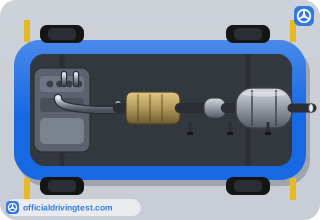
What must a vehicle exhaust system never do?
- Produce any visible vapor when the engine is still cold
- Make any sound at all when the vehicle is idling
- Leak carbon monoxide fumes into the interior of the vehicle
- Extend past the rear bumper of the vehicle at the back
Show answer
Correct answer: Leak carbon monoxide fumes into the interior of the vehicle
The exhaust system must not leak carbon monoxide fumes into the vehicle, so it should be checked periodically.
Source: Alabama Driver Manual (November 2024), page 79 · Open this page in the manual (Manual page 79)
-
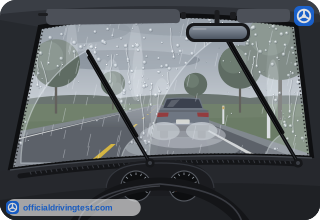
Which vehicles must be equipped with windshield wipers in good working order?
- Only vehicles driven at night or in rain
- Every motor vehicle having a windshield
- Only passenger cars, not trucks
- Only vehicles driven in winter weather
Show answer
Correct answer: Every motor vehicle having a windshield
Every motor vehicle having a windshield must have wipers in good working order.
Source: Alabama Driver Manual (November 2024), page 79 · Open this page in the manual (Manual page 79)
-
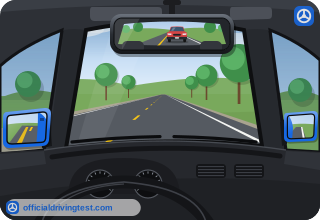
Rear view mirrors are required on all vehicles to let the driver see how far to the rear?
- 100 feet
- 300 feet
- 500 feet
- 200 feet
Show answer
Correct answer: 200 feet
Required rear view mirrors must let the driver see 200 feet to the rear.
Source: Alabama Driver Manual (November 2024), page 79 · Open this page in the manual (Manual page 79)
-
What is the minimum number of headlights a motor vehicle must have?
- One
- Three
- Two
- Four
Show answer
Correct answer: Two
Motor vehicles must have at least two headlights.
Source: Alabama Driver Manual (November 2024), page 79 · Open this page in the manual (Manual page 79)
-
What color must the required headlights be?
- White
- Yellow
- Blue
- Amber
Show answer
Correct answer: White
The required headlights are white lights.
Source: Alabama Driver Manual (November 2024), page 79 · Open this page in the manual (Manual page 79)
-
A motor vehicle must have at least how many red taillights?
- Two
- Three
- Four
- One
Show answer
Correct answer: One
The manual requires at least one red taillight.
Source: Alabama Driver Manual (November 2024), page 79 · Open this page in the manual (Manual page 79)
-
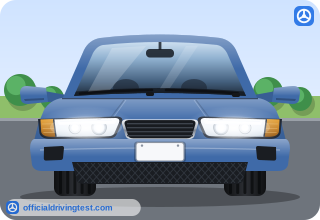
All lights on a motor vehicle must be visible from a distance of at least how far?
- 100 feet
- 500 feet
- 350 feet
- 1,000 feet
Show answer
Correct answer: 500 feet
All lights must be visible from at least 500 feet.
Source: Alabama Driver Manual (November 2024), page 79 · Open this page in the manual (Manual page 79)
-
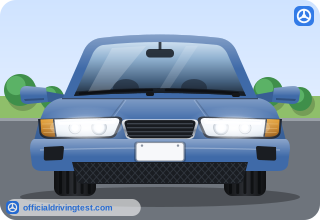
At a minimum, how far must the high beam of the headlight illuminate objects?
- 350 feet
- 200 feet
- 500 feet
- 1,000 feet
Show answer
Correct answer: 350 feet
The high beam must illuminate objects at a minimum of 350 feet.
Source: Alabama Driver Manual (November 2024), page 79 · Open this page in the manual (Manual page 79)
-
What does the manual permit to indicate a vehicular hazard?
- Flashing the high beams and the brake light alternately
- Flashing one turn signal while the other stays steady
- Flashing both turn signals or other pairs of lights simultaneously
- Flashing the headlights while sounding the horn repeatedly
Show answer
Correct answer: Flashing both turn signals or other pairs of lights simultaneously
Both turn signals, or other pairs of lights, flashing simultaneously may indicate a hazard.
Source: Alabama Driver Manual (November 2024), page 79 · Open this page in the manual (Manual page 79)
-
Which of these must be on all motor vehicles?
- A bell in good working order
- A horn in good working order
- A siren in good working order
- An exhaust whistle in good working order
Show answer
Correct answer: A horn in good working order
A horn in good working order is required on all motor vehicles.
Source: Alabama Driver Manual (November 2024), page 80 · Open this page in the manual (Manual page 80)
-
Whom does the manual say to warn by using your horn?
- Children, bicyclists, pedestrians and motorists you are passing
- Only drivers who are following too closely behind you
- Passengers who are waiting at the curb to be picked up
- Only other drivers stopped at a red light ahead of you
Show answer
Correct answer: Children, bicyclists, pedestrians and motorists you are passing
The horn is used to warn children, bicyclists, pedestrians and motorists you are passing.
Source: Alabama Driver Manual (November 2024), page 80 · Open this page in the manual (Manual page 80)
-
Which devices may not be used except on emergency vehicles?
- Horns that are in good working order
- Flashing hazard lights
- Bells, sirens or exhaust whistles
- High beam headlights
Show answer
Correct answer: Bells, sirens or exhaust whistles
Bells, sirens and exhaust whistles are reserved for emergency vehicles.
Source: Alabama Driver Manual (November 2024), page 80 · Open this page in the manual (Manual page 80)
-
What may result from needless use of your horn?
- A mandatory equipment inspection
- An arrest
- Automatic suspension of your license
- A required driver improvement course
Show answer
Correct answer: An arrest
The manual says needless use of your horn may result in an arrest.
Source: Alabama Driver Manual (November 2024), page 80 · Open this page in the manual (Manual page 80)
-
For what purpose is it lawful to use a motor vehicle horn?
- Letting passengers know you have arrived to pick them up
- Telling slower drivers ahead of you to move to the right
- Greeting friends and other people you know along the road
- Giving warning when reasonably necessary to ensure safe operation
Show answer
Correct answer: Giving warning when reasonably necessary to ensure safe operation
The horn may be used only to give warning when reasonably necessary for safe operation.
Source: Alabama Driver Manual (November 2024), page 80 · Open this page in the manual (Manual page 80)
-
Which use of the horn does the manual say you should never make?
- Warning a pedestrian crossing in front of you
- Warning a bicyclist you are about to pass
- Announcing your arrival or calling your passengers
- Warning a motorist you are passing
Show answer
Correct answer: Announcing your arrival or calling your passengers
The manual says never to use the horn to announce arrival or call your passengers.
Source: Alabama Driver Manual (November 2024), page 80 · Open this page in the manual (Manual page 80)
-
Why should you buy the proper tires for your particular car?
- To be sure they will carry the weight
- To be sure they stay cool in summer
- To be sure they never need alignment
- To be sure you never need a spare
Show answer
Correct answer: To be sure they will carry the weight
Proper tires for your car are needed to be sure they will carry the weight.
Source: Alabama Driver Manual (November 2024), page 80 · Open this page in the manual (Manual page 80)
-
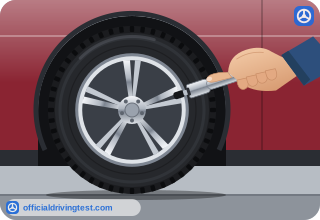
What does the manual say about driving with under-inflated tires?
- It is acceptable on short trips
- It is safe if the tread is deep
- It is fine in cold weather
- It is something you should never do
Show answer
Correct answer: It is something you should never do
The manual says to check tire pressure often and never drive with under-inflated tires.
Source: Alabama Driver Manual (November 2024), page 80 · Open this page in the manual (Manual page 80)
-
When your car is being serviced, what should you check your tires for?
- Rust, fading and loose valve stem caps
- Cuts, bruises, foreign objects or other faults
- Brand markings and the date of purchase
- Weight rating and the manufacturer logo
Show answer
Correct answer: Cuts, bruises, foreign objects or other faults
During service you check tires for cuts, bruises, foreign objects or other faults.
Source: Alabama Driver Manual (November 2024), page 80 · Open this page in the manual (Manual page 80)
-
If tire wear is uneven, what should you have inspected?
- The wheels and/or alignment
- The muffler and exhaust
- The headlight aim
- The windshield wipers
Show answer
Correct answer: The wheels and/or alignment
The manual says uneven wear calls for inspecting the wheels and/or alignment.
Source: Alabama Driver Manual (November 2024), page 80 · Open this page in the manual (Manual page 80)
-
A tire is illegal if its tread is less than how deep?
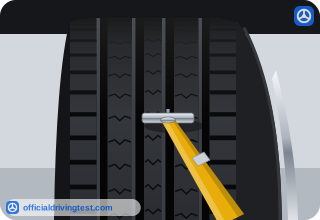
- 1/8 inch
- 1/4 inch
- 1/16 inch
- 1/32 inch
Show answer
Correct answer: 1/16 inch
A tire is illegal if the tread is less than 1/16 inch deep.
Source: Alabama Driver Manual (November 2024), page 80 · Open this page in the manual (Manual page 80)
-
Which driving habits does the manual say to avoid, unless absolutely necessary, to treat your tires kindly?
- Checking your tire pressure often
- “Jack-rabbit” starts and screeching halts
- Checking your spare tire periodically
- Taking it easy on corners
Show answer
Correct answer: “Jack-rabbit” starts and screeching halts
The manual says not to make jack-rabbit starts or screeching halts unless absolutely necessary.
Source: Alabama Driver Manual (November 2024), page 80 · Open this page in the manual (Manual page 80)
-
What should you do for your tires during long trips in warm weather?
- Add extra air pressure before leaving
- Switch to the spare tire every hour
- Drive faster to reduce heat build-up
- Take a break and let them cool
Show answer
Correct answer: Take a break and let them cool
The manual says to take a break and let tires cool during long warm-weather trips.
Source: Alabama Driver Manual (November 2024), page 80 · Open this page in the manual (Manual page 80)
-
How often does the manual say your spare tire should be checked?
- Only after a flat
- Only when you buy the car
- Once a year at registration
- Periodically
Show answer
Correct answer: Periodically
The spare tire should be checked periodically.
Source: Alabama Driver Manual (November 2024), page 80 · Open this page in the manual (Manual page 80)
-
According to the manual, which is the only efficient, safe vehicle?
- One that has been driven fewer miles
- One that is properly maintained
- One that is under five years old
- One that has extra lights installed
Show answer
Correct answer: One that is properly maintained
The only efficient, safe vehicle is one that is properly maintained.
Source: Alabama Driver Manual (November 2024), page 81 · Open this page in the manual (Manual page 81)
-
Which of these items does the manual list as becoming worn and needing maintenance from time to time?
- The cooling system
- The seat upholstery
- The radio
- The sun visors
Show answer
Correct answer: The cooling system
Brakes, exhaust and cooling systems, lights, wipers and tires become worn and need maintenance.
Source: Alabama Driver Manual (November 2024), page 81 · Open this page in the manual (Manual page 81)
-
As a safety measure, what does the manual advise you to do?
- Replace your car every few years before it wears out
- Drive only short trips in daylight whenever possible
- Have your car checked so defective equipment will be repaired
- Avoid heavy traffic whenever you possibly can do so
Show answer
Correct answer: Have your car checked so defective equipment will be repaired
It is advisable to have your car checked so defective equipment is repaired.
Source: Alabama Driver Manual (November 2024), page 81 · Open this page in the manual (Manual page 81)