Alabama: Signals and vehicle controls — Part 3 Practice Test
Questions in this part include: “On all vehicles, how much of the front windshield may be tinted with a transparent material?” · “If you are in doubt as to when lights are needed, what does the manual say as a general rule?”
Independent educational site · not affiliated with any government agency or DMV
Ready? Test yourself
- Instant feedback with an explanation
- Every answer cites its source in the manual
- Your best score is saved on this device
Questions are original and based on the official manual "Alabama Driver Manual" (November 2024), Alabama Law Enforcement Agency (ALEA), Driver License Division.
All 18 questions in this practice test
Take the test above first, then use this list to study. Tap “Show answer” to see the correct answer and explanation.
Show the questions and answersHide the questions
-
At night, a load projects 4 feet or more from the rear of a vehicle. What must be attached to its end?
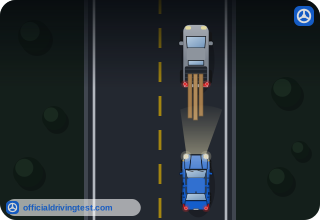
- A white light visible for at least 200 feet
- A red light visible for at least 200 feet
- A red light visible for at least 50 feet
- A red flag only
Show answer
Correct answer: A red light visible for at least 200 feet
At night a red light visible for at least 200 feet must be attached to the end of the load.
Source: Alabama Driver Manual (November 2024), page 67 · Open this page in the manual (Manual page 67)
-
On all vehicles, how much of the front windshield may be tinted with a transparent material?
- Only the upper 2 inches
- The upper half
- Only the upper 6 inches
- The entire windshield
Show answer
Correct answer: Only the upper 6 inches
Only the upper 6 inches of the front windshield may be tinted.
Source: Alabama Driver Manual (November 2024), page 68 · Open this page in the manual (Manual page 68)
-
On passenger cars such as sedans, coupes and station wagons, how much light transmission must side and rear window tinting allow?
- At least 12 percent
- At least 32 percent
- At least 50 percent
- At least 70 percent
Show answer
Correct answer: At least 32 percent
All side and rear windows on passenger cars must allow at least 32 percent light transmission.
Source: Alabama Driver Manual (November 2024), page 68 · Open this page in the manual (Manual page 68)
-
On SUVs, trucks, vans and RVs, which windows are subject to the 32 percent light transmission restriction?
- Only the rear window
- No windows
- Only the windows behind the driver
- The front-seat side windows
Show answer
Correct answer: The front-seat side windows
On these vehicles front-seat side windows are subject to the 32 percent restriction, and darker tinting is permitted behind the driver.
Source: Alabama Driver Manual (November 2024), page 68 · Open this page in the manual (Manual page 68)
-
Under normal conditions, about how far ahead do headlights on high beam illuminate the roadway?
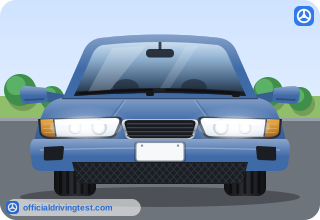
- 150 feet
- 350 feet
- 200 feet
- 500 feet
Show answer
Correct answer: 350 feet
The manual states high beams normally light the road about 350 feet ahead under normal conditions.
Source: Alabama Driver Manual (November 2024), page 69 · Open this page in the manual (Manual page 69)
-
You must dim your headlights when you are within what distance of an oncoming vehicle?
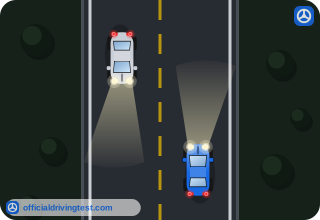
- 100 feet
- 200 feet
- 1,000 feet
- 500 feet
Show answer
Correct answer: 500 feet
The law requires dimmed headlights within 500 feet of an oncoming vehicle.
Source: Alabama Driver Manual (November 2024), page 69 · Open this page in the manual (Manual page 69)
-
You must dim your headlights when you are within what distance of a vehicle you are following?
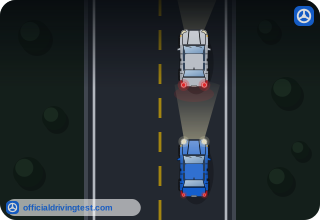
- 200 feet
- 100 feet
- 350 feet
- 500 feet
Show answer
Correct answer: 200 feet
The law requires dimmed headlights within 200 feet when following another vehicle.
Source: Alabama Driver Manual (November 2024), page 69 · Open this page in the manual (Manual page 69)
-
You have dimmed your headlights for an oncoming driver, but that driver does not dim his or hers. What should you do?
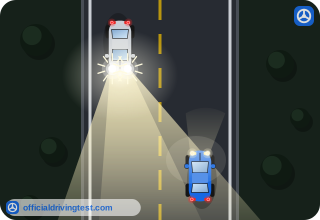
- Switch to high beam in return
- Flash your high beams repeatedly
- Keep yours dimmed anyway
- Turn your headlights off briefly
Show answer
Correct answer: Keep yours dimmed anyway
Blinding the approaching driver with your high beam proves nothing and endangers you.
Source: Alabama Driver Manual (November 2024), page 69 · Open this page in the manual (Manual page 69)
-
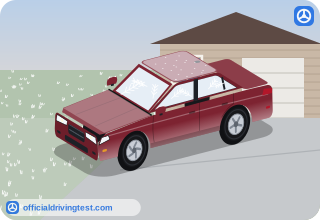
Which glass on your vehicle should be kept free of defects and clean, including free of frost and steam?
- Only the windshield
- All glass on the vehicle
- Only the windshield and the rear window
- Only the windshield and driver's side window
Show answer
Correct answer: All glass on the vehicle
The manual says to keep all glass free of defects, frost and steam.
Source: Alabama Driver Manual (November 2024), page 69 · Open this page in the manual (Manual page 69)
-
According to state law, when must headlights (not parking lights only) be turned on?
- From sunset to sunrise only
- From one hour after sunset to one hour before sunrise
- Only when it is fully dark
- From a half-hour after sunset to a half-hour before sunrise
Show answer
Correct answer: From a half-hour after sunset to a half-hour before sunrise
State law requires headlights from a half-hour after sunset to a half-hour before sunrise, and parking lights alone are not enough.
Source: Alabama Driver Manual (November 2024), page 69 · Open this page in the manual (Manual page 69)
-
Besides the period around sunset and sunrise, headlights must be on during periods of limited visibility when you cannot see clearly for at least what distance?
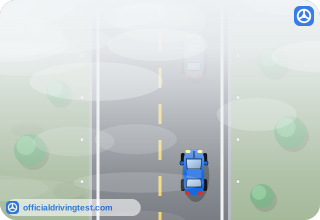
- 500 feet
- 100 feet
- 200 feet
- 350 feet
Show answer
Correct answer: 500 feet
Headlights are required during other periods of limited visibility when you cannot see clearly for at least 500 feet.
Source: Alabama Driver Manual (November 2024), page 69 · Open this page in the manual (Manual page 69)
-
If you are in doubt as to when lights are needed, what does the manual say as a general rule?
- Turn on your parking lights only
- Wait until it is fully dark
- Turn them on low beam
- Turn on your high beams
Show answer
Correct answer: Turn them on low beam
Low beams improve your own vision and help others see you.
Source: Alabama Driver Manual (November 2024), page 69 · Open this page in the manual (Manual page 69)
-
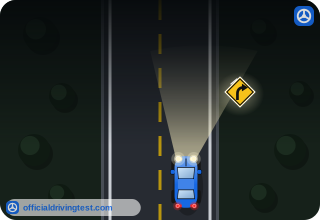
How can eye fatigue in night driving be relieved?
- By staring steadily at the center line of the road ahead
- By moving your eyes from the road to the sides and from near to far
- By keeping your eyes fixed on the taillights of the vehicle ahead
- By looking only at the road directly in front of the car
Show answer
Correct answer: By moving your eyes from the road to the sides and from near to far
Moving your eyes around, from the road to the sides and from near to far, relieves eye fatigue.
Source: Alabama Driver Manual (November 2024), page 70 · Open this page in the manual (Manual page 70)
-
How can you reduce glare from oncoming headlights at night?
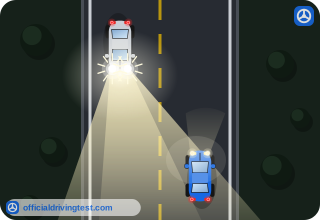
- Look straight into the oncoming lights until they pass
- Look toward the left edge of the road, at the center line
- Flash your high beams at the other driver to warn him
- Look to the right edge of the pavement, at the white striped line
Show answer
Correct answer: Look to the right edge of the pavement, at the white striped line
Directing your vision away from oncoming lights, to the right edge and the white line, reduces glare.
Source: Alabama Driver Manual (November 2024), page 70 · Open this page in the manual (Manual page 70)
-
Which is a way to reduce glare from the lights of a vehicle following you at night?
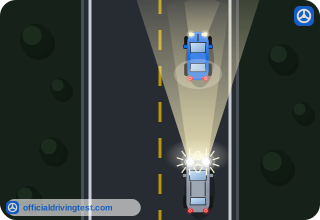
- Use a day-night mirror
- Switch your headlights to high beam
- Turn on your four-way flashers
- Roll down your window
Show answer
Correct answer: Use a day-night mirror
A day-night mirror, or an adjusted mirror, cuts out most of the strong light from behind.
Source: Alabama Driver Manual (November 2024), page 70 · Open this page in the manual (Manual page 70)
-
Which part of the car should you especially clear of snow and ice, along with the windows, before winter driving?
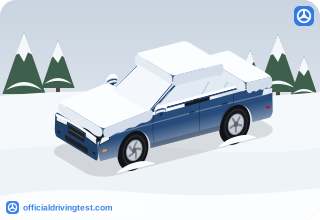
- The hood
- The trunk
- The bumpers
- The wheel wells
Show answer
Correct answer: The hood
The manual says to remove snow and ice from the car, especially the hood, and from the windows.
Source: Alabama Driver Manual (November 2024), page 70 · Open this page in the manual (Manual page 70)
-
In winter, how long should you continue to warm the engine at a fast idle?
- For exactly five minutes in all conditions
- Until the engine reaches full operating speed
- Until the heater and defroster are warm
- Until the snow on the hood melts
Show answer
Correct answer: Until the heater and defroster are warm
The engine is warmed at a fast idle until the heater and defroster are warm.
Source: Alabama Driver Manual (November 2024), page 70 · Open this page in the manual (Manual page 70)
-
What should the windshield-washing fluid contain for winter driving?
- Plain water only
- An anti-freeze solution
- A small amount of motor oil
- Extra salt
Show answer
Correct answer: An anti-freeze solution
The manual says to make sure the washing fluid contains an anti-freeze solution.
Source: Alabama Driver Manual (November 2024), page 70 · Open this page in the manual (Manual page 70)