Alabama: Signals and vehicle controls — Part 2 Practice Test
Questions in this part include: “Does a street with no painted lane markings still have traffic lanes?” · “What does state law say about signs, posters, or other materials placed on a vehicle's windows?”
Independent educational site · not affiliated with any government agency or DMV
Ready? Test yourself
- Instant feedback with an explanation
- Every answer cites its source in the manual
- Your best score is saved on this device
Questions are original and based on the official manual "Alabama Driver Manual" (November 2024), Alabama Law Enforcement Agency (ALEA), Driver License Division.
All 19 questions in this practice test
Take the test above first, then use this list to study. Tap “Show answer” to see the correct answer and explanation.
Show the questions and answersHide the questions
-
Does a street with no painted lane markings still have traffic lanes?
- No, lanes exist only where they are painted
- No, lanes exist only on divided highways
- Yes, but only on streets with more than two lanes
- Yes, lanes are there whether marked or not
Show answer
Correct answer: Yes, lanes are there whether marked or not
The manual says lanes are often not marked, but they are there whether marked or not.
Source: Alabama Driver Manual (November 2024), page 21 · Open this page in the manual (Manual page 21)
-
When should you discontinue your turn signal?
- Only when the driver behind you flashes the lights
- After completing the maneuver
- When the car behind you slows down
- Only when you pass the next intersection
Show answer
Correct answer: After completing the maneuver
The manual says to be certain your signals are discontinued after completing a maneuver.
Source: Alabama Driver Manual (November 2024), page 21 · Open this page in the manual (Manual page 21)
-
During the daytime, how may hand and arm signals be used?
- Only when your signal lights fail
- Only when you are turning left
- In addition to signal lights
- Only when you are slowing for a stop sign
Show answer
Correct answer: In addition to signal lights
The manual says hand and arm signals may be used during the daytime in addition to signal lights.
Source: Alabama Driver Manual (November 2024), page 21 · Open this page in the manual (Manual page 21)
-
Why might hand and arm signals be used during the daytime?
- Bright sunlight may make flashing signal lights hard for others to see
- Signal lights cannot be used during the daytime hours at all
- Other motorists cannot hear signal lights during the daytime
- Signal lights are meant to be used only at night or in fog
Show answer
Correct answer: Bright sunlight may make flashing signal lights hard for others to see
The manual notes that reflection of bright sunlight may make a flashing signal light difficult to see.
Source: Alabama Driver Manual (November 2024), page 21 · Open this page in the manual (Manual page 21)
-
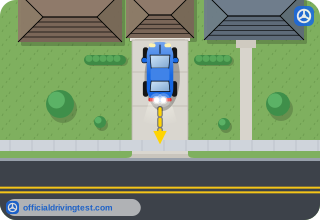
If you are going to back the vehicle, what is a good practice before you begin?
- Sound the horn several times
- Turn on the hazard lights first
- Roll down all of the windows
- Walk completely around the vehicle
Show answer
Correct answer: Walk completely around the vehicle
The manual says it is good practice to walk completely around the vehicle to be sure no person or obstacle is behind it.
Source: Alabama Driver Manual (November 2024), page 66 · Open this page in the manual (Manual page 66)
-
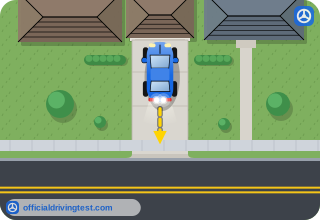
While backing, what should you continue to do?
- Rely only on your rearview mirror
- Look over your right shoulder to the rear
- Look only at the side mirrors
- Look straight ahead through the windshield
Show answer
Correct answer: Look over your right shoulder to the rear
The manual says to continue to look over your right shoulder to the rear while backing and not to depend on your mirror.
Source: Alabama Driver Manual (November 2024), page 66 · Open this page in the manual (Manual page 66)
-
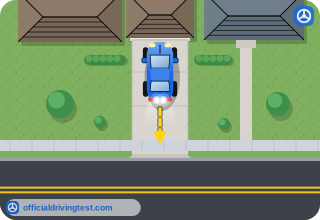
How should you back the vehicle into the proper traffic lane?
- Slowly, with a minimum of movement
- Quickly, to clear the lane sooner
- In a wide curve across all lanes
- With short bursts of speed
Show answer
Correct answer: Slowly, with a minimum of movement
The manual says to back slowly into the proper traffic lane with a minimum of movement.
Source: Alabama Driver Manual (November 2024), page 66 · Open this page in the manual (Manual page 66)
-
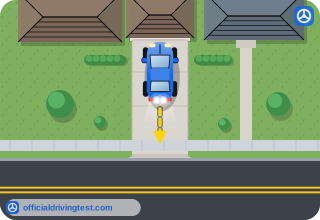
Except for backing into a parking place, what does the manual say about backing on a public street or road?
- It is allowed in any lane at low speed
- It is never advisable
- It is advisable when you miss a turn
- It is required when leaving a parking place
Show answer
Correct answer: It is never advisable
The manual says that except for backing into a parking place, it is never advisable to back on a public street or road.
Source: Alabama Driver Manual (November 2024), page 66 · Open this page in the manual (Manual page 66)
-
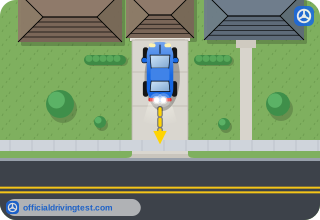
If you back out of a driveway, which lane should you back into?
- The farthest lane
- The center of the road
- Any lane that is empty
- The nearest lane
Show answer
Correct answer: The nearest lane
The manual says to always back into the nearest lane and never back across other traffic lanes.
Source: Alabama Driver Manual (November 2024), page 66 · Open this page in the manual (Manual page 66)
-
What does state law say about signs, posters, or other materials placed on a vehicle's windows?
- They are allowed if they are smaller than a postcard
- They are allowed on the rear window only
- They are prohibited if they obstruct
- They are allowed if they are removed at night
Show answer
Correct answer: They are prohibited if they obstruct
State law prohibits obstructions on windows; no sign, poster, or other material may be placed on a window if it obstructs.
Source: Alabama Driver Manual (November 2024), page 66 · Open this page in the manual (Manual page 66)
-
Before changing lanes, which areas must you watch for safe clearance?
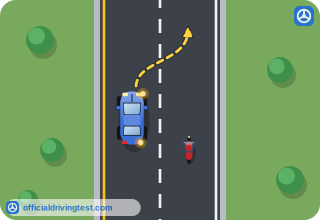
- To the side, ahead and behind your vehicle
- Only the area ahead of your vehicle
- Only the area behind your vehicle
- Only the area to the left of your vehicle
Show answer
Correct answer: To the side, ahead and behind your vehicle
Changing lanes safely means watching for clearance to the side, ahead and behind.
Source: Alabama Driver Manual (November 2024), page 66 · Open this page in the manual (Manual page 66)
-
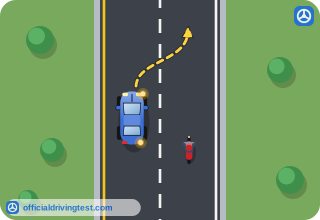
What should you do when checking for clearance before changing lanes, besides using your mirror?
- Slow down to about 10 mph first
- Tap the horn twice to warn drivers
- Move halfway into the next lane first
- Glance over your shoulder to the blind spot
Show answer
Correct answer: Glance over your shoulder to the blind spot
The manual says not to rely solely on your mirror and to glance over your shoulder to check the blind spot.
Source: Alabama Driver Manual (November 2024), page 66 · Open this page in the manual (Manual page 66)
-
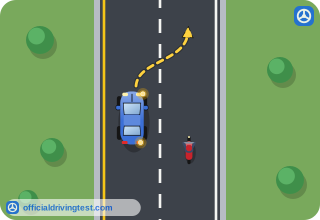
What does using a turn signal or hand signal grant you when changing lanes?
- The right to cross lane lines freely
- It does not grant the right to change lanes
- The right of way over all other traffic
- Permission to change lanes right away
Show answer
Correct answer: It does not grant the right to change lanes
A signal shows your intentions but does not grant the right to change lanes; you must wait until it is safe.
Source: Alabama Driver Manual (November 2024), page 66 · Open this page in the manual (Manual page 66)
-
What hand signal indicates that you are stopping or decreasing speed?
- Hand and arm extended upward
- Hand and arm extended straight out
- Hand and arm extended downward
- Hand waved in a circle
Show answer
Correct answer: Hand and arm extended downward
The manual lists hand and arm extended downward as the stop or decrease speed signal.
Source: Alabama Driver Manual (November 2024), page 66 · Open this page in the manual (Manual page 66)
-
What hand signal indicates a left turn?
- Hand and arm extended downward
- Hand and arm extended out
- Hand and arm extended upward
- Hand pointed toward the rear
Show answer
Correct answer: Hand and arm extended out
The manual lists hand and arm extended out as the left turn signal.
Source: Alabama Driver Manual (November 2024), page 66 · Open this page in the manual (Manual page 66)
-
What hand signal indicates a right turn?
- Hand and arm extended downward
- Hand and arm extended straight out
- Hand and arm held across the chest
- Hand and arm extended upward
Show answer
Correct answer: Hand and arm extended upward
The manual lists hand and arm extended upward as the right turn signal.
Source: Alabama Driver Manual (November 2024), page 66 · Open this page in the manual (Manual page 66)
-
It is unlawful to drive with persons in excess of how many in the front seat if they obstruct the driver's view or hinder control of the vehicle?
- Two
- Four
- Three
- Five
Show answer
Correct answer: Three
The manual makes it unlawful to drive with more than three persons in the front seat if they obstruct the view or hinder control.
Source: Alabama Driver Manual (November 2024), page 67 · Open this page in the manual (Manual page 67)
-
How far may a load extend beyond the front and rear of the vehicle?
- Not more than 5 feet beyond the front and rear, inclusive
- Not more than 1 foot beyond the front and rear, inclusive
- Not more than 10 feet beyond the rear only
- Not more than 15 feet beyond the front and rear, inclusive
Show answer
Correct answer: Not more than 5 feet beyond the front and rear, inclusive
The manual says a load must not extend more than 5 feet beyond both the front and rear, inclusive, of the vehicle.
Source: Alabama Driver Manual (November 2024), page 67 · Open this page in the manual (Manual page 67)
-
A load projects 4 feet or more from the rear of a vehicle. What must be attached to its end in daytime?
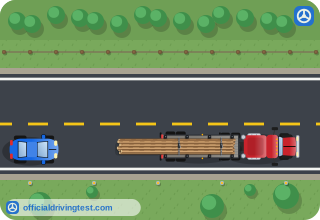
- A white flag at least 6 inches square
- A yellow flag at least 24 inches square
- A red light visible for 100 feet
- A red flag at least 12 inches square
Show answer
Correct answer: A red flag at least 12 inches square
Loads projecting 4 feet or more from the rear need a red flag at least 12 inches square in daytime.
Source: Alabama Driver Manual (November 2024), page 67 · Open this page in the manual (Manual page 67)