Alabama: Signals and vehicle controls — Part 1 Practice Test
Questions in this part include: “In the penny test for tread depth, how do you place the penny?” · “Besides adjusting the seat and mirrors, what should you do as part of your routine for entering the car?”
Independent educational site · not affiliated with any government agency or DMV
Ready? Test yourself
- Instant feedback with an explanation
- Every answer cites its source in the manual
- Your best score is saved on this device
Questions are original and based on the official manual "Alabama Driver Manual" (November 2024), Alabama Law Enforcement Agency (ALEA), Driver License Division.
All 19 questions in this practice test
Take the test above first, then use this list to study. Tap “Show answer” to see the correct answer and explanation.
Show the questions and answersHide the questions
-
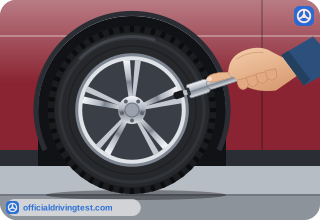
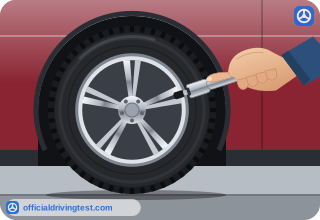
How often should you check your tire pressure with a gauge?
- Every day
- Once a year
- Only when a tire looks flat
- Monthly
Show answer
Correct answer: Monthly
The manual says to check tire pressure with a pressure gauge monthly.
Source: Alabama Driver Manual (November 2024), page 12 · Open this page in the manual (Manual page 12)
-
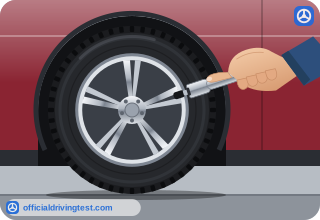
Where in the car can you find the tire pressure (PSI) number to compare with your gauge?
- On a sticker on the inside of the car door jamb
- On the underside of the hood near the battery
- Stamped on the valve cap of every single tire
- On the dashboard next to the warning lights
Show answer
Correct answer: On a sticker on the inside of the car door jamb
The manual says to open the car door and look for a sticker on the inside jamb showing the PSI.
Source: Alabama Driver Manual (November 2024), page 12 · Open this page in the manual (Manual page 12)
-
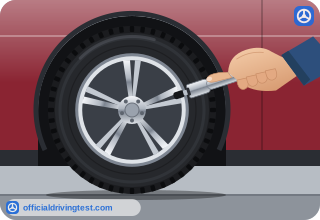
When should you check the pressure of your tires?
- Right after a long highway drive
- Only after the tires are warm
- When the tires are cold
- While the engine is running at high speed
Show answer
Correct answer: When the tires are cold
The manual notes to check the tire pressure when the tires are cold.
Source: Alabama Driver Manual (November 2024), page 12 · Open this page in the manual (Manual page 12)
-
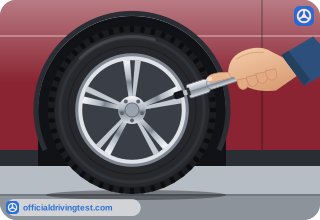
If the number on your gauge is too high compared with the number on the sticker, what should you do?
- Inflate the tires further
- Let air out of your tires
- Drive until the tires wear down
- Replace the valve cap only
Show answer
Correct answer: Let air out of your tires
If the gauge number is too high, you let air out of the tires.
Source: Alabama Driver Manual (November 2024), page 12 · Open this page in the manual (Manual page 12)
-
If the number on your gauge is too low compared with the number on the sticker, what should you do?
- Let some air out of your tires and recheck
- Ignore it if the tread depth still looks good
- Drive faster to warm up the tires first
- Inflate your tires until the numbers match
Show answer
Correct answer: Inflate your tires until the numbers match
If the number is too low, inflate the tires until the numbers match.
Source: Alabama Driver Manual (November 2024), page 12 · Open this page in the manual (Manual page 12)
-
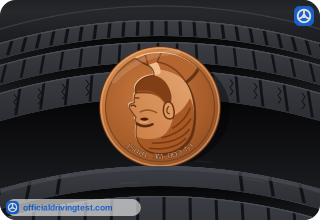
In the penny test for tread depth, how do you place the penny?
- Lincoln's head first into the deepest-looking groove
- Lincoln's body first into the shallowest groove
- Flat on the sidewall of the tire
- Lincoln's head first against the tire's outer edge
Show answer
Correct answer: Lincoln's head first into the deepest-looking groove
The manual says to place Lincoln's head first into the deepest looking groove.
Source: Alabama Driver Manual (November 2024), page 12 · Open this page in the manual (Manual page 12)
-
In the penny test, what does it mean if you can see all of Lincoln's head?
- Your tires are at the ideal tread depth
- Your tires need more air
- Your tires are too worn and should be replaced
- Your tires are fine for another year
Show answer
Correct answer: Your tires are too worn and should be replaced
If all of his head is visible, the tires are too worn and should be replaced.
Source: Alabama Driver Manual (November 2024), page 12 · Open this page in the manual (Manual page 12)
-
How should you be seated when you drive?
- Reclined, with one hand on the top of the steering wheel
- Upright, with your back against the seat and feet on the floor
- Slouched, with your arms fully extended to the wheel
- Leaning forward, with your chin close to the steering wheel
Show answer
Correct answer: Upright, with your back against the seat and feet on the floor
The manual says to sit upright with your back against the seat and feet on the floor.
Source: Alabama Driver Manual (November 2024), page 12 · Open this page in the manual (Manual page 12)
-
What can improper seating positions, such as slouching, result in?
- Faster wear on the tires and the brake pads of the car
- Improved airbag deployment and quicker braking
- Less glare from the sun and from oncoming headlights
- Reduced effectiveness of the vehicle's restraint system
Show answer
Correct answer: Reduced effectiveness of the vehicle's restraint system
Improper seating can reduce the effectiveness of the vehicle's restraint system.
Source: Alabama Driver Manual (November 2024), page 12 · Open this page in the manual (Manual page 12)
-
When should you adjust your seat and mirrors?
- Before you start to drive
- After you reach highway speed
- Only when another driver complains
- At the first red light
Show answer
Correct answer: Before you start to drive
The manual says to adjust the seat and mirrors before you start to drive.
Source: Alabama Driver Manual (November 2024), page 12 · Open this page in the manual (Manual page 12)
-
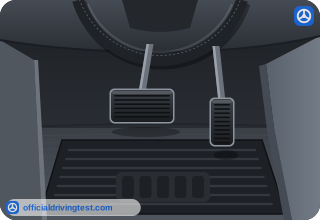
How should your foot be able to move between the pedals when the seat is adjusted correctly?
- Lift completely off the floor to reach the brake pedal
- Slide sideways between pedals with the heel raised up
- Pivot smoothly from brake to accelerator, heel on the floor
- Press the brake and accelerator pedals at the same time
Show answer
Correct answer: Pivot smoothly from brake to accelerator, heel on the floor
Your foot should pivot smoothly from brake to accelerator while your heel stays on the floor.
Source: Alabama Driver Manual (November 2024), page 12 · Open this page in the manual (Manual page 12)
-
Where should the top of the steering wheel be positioned?
- Level with the top of your head and above your eyes
- No higher than the top of your shoulders and below chin level
- Above your eyes so that it does not block the gauges
- Exactly at the height of your elbows when you sit upright
Show answer
Correct answer: No higher than the top of your shoulders and below chin level
The top of the steering wheel should be no higher than the top of your shoulders and below chin level.
Source: Alabama Driver Manual (November 2024), page 12 · Open this page in the manual (Manual page 12)
-
Besides adjusting the seat and mirrors, what should you do as part of your routine for entering the car?
- Check that the engine is warm and the fuel tank is at least half full
- Check that passengers have chosen their seats and have set the mirrors
- Check that passengers are properly seated and do not interfere with your driving
- Check that the windows are open and the heater is turned to its lowest
Show answer
Correct answer: Check that passengers are properly seated and do not interfere with your driving
The manual says to adjust the seat and mirrors and check passengers to be sure they are properly seated and do not interfere with your driving.
Source: Alabama Driver Manual (November 2024), page 20 · Open this page in the manual (Manual page 20)
-
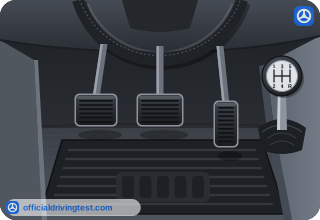
In a vehicle with a manual transmission, what should you do before turning the ignition key?
- Set the parking brake and release the clutch
- Push in the clutch
- Shift into first gear and release the clutch
- Press the accelerator pedal halfway down
Show answer
Correct answer: Push in the clutch
The manual says to push in the clutch before turning the ignition key in a hand-shift vehicle.
Source: Alabama Driver Manual (November 2024), page 20 · Open this page in the manual (Manual page 20)
-
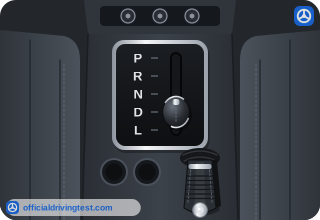
In a vehicle with an automatic transmission, what should you do as you turn the ignition key?
- Shift into drive and press the accelerator pedal
- Be sure the indicator is in reverse and release the brake pedal
- Push in the clutch and keep the indicator in low gear
- Be sure the indicator is in park or neutral and depress the brake pedal
Show answer
Correct answer: Be sure the indicator is in park or neutral and depress the brake pedal
The manual says to have the indicator in park or neutral and depress the brake pedal as you turn the key.
Source: Alabama Driver Manual (November 2024), page 20 · Open this page in the manual (Manual page 20)
-
What does good posture at the steering wheel result in?
- Less need to check your mirrors
- A shorter stopping distance at any speed
- Less tiredness on long trips, with no effect on control
- Better vision, control, and ability to maneuver in an emergency
Show answer
Correct answer: Better vision, control, and ability to maneuver in an emergency
The manual states that good posture results in better vision, control, and ability to maneuver in an emergency.
Source: Alabama Driver Manual (November 2024), page 20 · Open this page in the manual (Manual page 20)
-
How firmly should you grip the steering wheel?
- As tightly as you can, so that the wheel cannot move in your hands
- Firmly enough to keep control, without restricting your reflexes
- Loosely, so that the wheel can move freely and absorb road bumps
- Tightly at first, then more loosely once you reach full speed
Show answer
Correct answer: Firmly enough to keep control, without restricting your reflexes
The manual says not to grip the wheel so tightly as to restrict reflexes, but to keep a firm grip to maintain control.
Source: Alabama Driver Manual (November 2024), page 20 · Open this page in the manual (Manual page 20)
-
When is it acceptable to take one hand off the steering wheel?
- Whenever the road ahead is straight and clear of other traffic
- Whenever you are driving below the speed limit on a quiet street
- When necessary for signaling or another purpose needed to drive
- Whenever a front seat passenger offers to help you steer the car
Show answer
Correct answer: When necessary for signaling or another purpose needed to drive
The manual says to always keep both hands on the wheel except when one must be removed for signaling or another necessary purpose.
Source: Alabama Driver Manual (November 2024), page 20 · Open this page in the manual (Manual page 20)
-
How should you drive with respect to the lane you are in?
- Within a single traffic lane, without weaving or straddling the lane marking
- Along the lane marking, so you can change lanes quickly if needed
- In whichever lane has the least traffic, moving between lanes freely
- Close to the lane marking whenever the lane itself is not marked
Show answer
Correct answer: Within a single traffic lane, without weaving or straddling the lane marking
The manual says you must drive within a single lane without weaving or straddling the lane marking.
Source: Alabama Driver Manual (November 2024), page 20 · Open this page in the manual (Manual page 20)