Vermont: Speed and space
Vermont speed limits, adjusting speed to conditions, the four-second following distance, and space around your vehicle. Split into 2 shorter tests so you're not stuck in one long quiz.
Independent educational site · not affiliated with any government agency or DMV
All 32 Speed and space questions with answers
Choose a part above to take a practice test, or study every question and answer here.
Show the questions and answersHide the questions
-
How many things must happen to stop your vehicle?
- Two
- Four
- Three
- Five
Show answer
Correct answer: Four
The manual lists four things that must happen to stop: seeing the danger, the brain telling the foot to brake, the foot operating the brake, and working brakes.
Source: Vermont Driver's Manual (2025 edition (VN-007 07/2024)), page 25 · Open this page in the manual (Manual page 25)
-
What is the distance your vehicle travels from the moment you see danger until you step on the brake called?
- Braking distance
- Following distance
- Warning distance
- Reaction distance
Show answer
Correct answer: Reaction distance
This distance, covered between seeing the danger and stepping on the brake, is called reaction distance.
Source: Vermont Driver's Manual (2025 edition (VN-007 07/2024)), page 26 · Open this page in the manual (Manual page 26)
-
What is the distance your vehicle travels from the time the brakes are applied until it is brought to a stop called?
- Braking distance
- Reaction distance
- Following distance
- Warning distance
Show answer
Correct answer: Braking distance
The distance traveled while the brakes are working until the vehicle stops is called braking distance.
Source: Vermont Driver's Manual (2025 edition (VN-007 07/2024)), page 26 · Open this page in the manual (Manual page 26)
-
About how long does it take the average driver to apply the brakes after seeing danger?
- About 1/4 of a second
- About 1 1/2 seconds
- About 3/4 of a second
- About 2 seconds
Show answer
Correct answer: About 3/4 of a second
The manual says the average driver needs about 3/4 of a second to apply the brakes after seeing danger.
Source: Vermont Driver's Manual (2025 edition (VN-007 07/2024)), page 26 · Open this page in the manual (Manual page 26)
-
How does driving speed affect how far your vehicle travels before you are able to apply the brakes?
- The higher the speed, the shorter the distance
- The higher the speed, the further it travels
- Speed has no effect on that distance
- Only the weight of the vehicle changes it
Show answer
Correct answer: The higher the speed, the further it travels
At higher speeds the vehicle covers more ground before the driver gets the brakes applied.
Source: Vermont Driver's Manual (2025 edition (VN-007 07/2024)), page 26 · Open this page in the manual (Manual page 26)
-
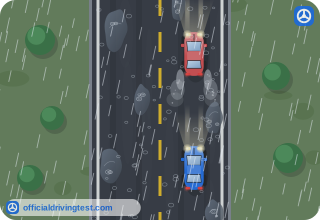
How does braking distance change on wet, icy or gravel roads?
- It becomes slightly shorter
- It stays the same
- It becomes longer only on gravel
- It becomes much longer
Show answer
Correct answer: It becomes much longer
On wet, icy or gravel roads the braking distance is much longer than on good roads.
Source: Vermont Driver's Manual (2025 edition (VN-007 07/2024)), page 26 · Open this page in the manual (Manual page 26)
-
When is the road especially slippery, which increases your braking distance?
- When it first starts to rain
- After it has rained for several hours
- Just after the rain has stopped
- Only when the temperature is below freezing
Show answer
Correct answer: When it first starts to rain
At the start of a rain, oil, rubber, dirt and water combine to make the road especially slippery.
Source: Vermont Driver's Manual (2025 edition (VN-007 07/2024)), page 26 · Open this page in the manual (Manual page 26)
-
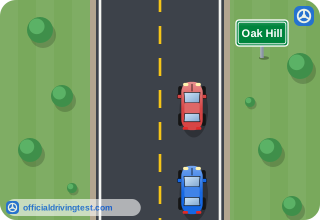
When should you allow more than four seconds of following distance?
- Only when driving on an interstate or other high-speed road
- Only when you are carrying several passengers in the vehicle
- In poor road conditions, poor visibility, or at higher speeds
- Only at night when the road surface is dry and clear
Show answer
Correct answer: In poor road conditions, poor visibility, or at higher speeds
The 4-second method is a minimum: poor road conditions, poor visibility or higher speeds call for more space.
Source: Vermont Driver's Manual (2025 edition (VN-007 07/2024)), page 27 · Open this page in the manual (Manual page 27)
-
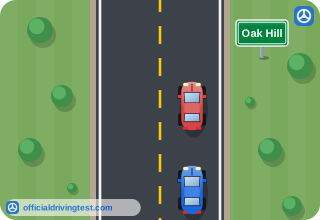
When counting your following distance, when do you start counting seconds?
- When the front of the vehicle ahead passes a checkpoint
- When the rear of the vehicle ahead passes a checkpoint
- When your front bumper passes a checkpoint
- When the vehicle ahead brakes
Show answer
Correct answer: When the rear of the vehicle ahead passes a checkpoint
You start counting as the rear of the vehicle ahead passes a fixed checkpoint such as a sign or pole, then stop when you reach it.
Source: Vermont Driver's Manual (2025 edition (VN-007 07/2024)), page 28 · Open this page in the manual (Manual page 28)
-
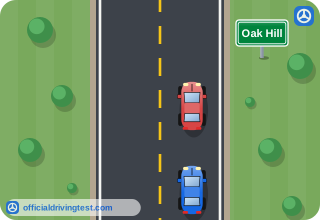
With the four-second method, what does it mean if it takes less than four seconds for your vehicle to reach the checkpoint?
- You are following at a safe distance for the conditions
- You may safely move up closer to the vehicle ahead now
- You should keep the same following distance as before
- You are following too closely and must increase your distance
Show answer
Correct answer: You are following too closely and must increase your distance
Less than four seconds means you are too close and must increase your following distance.
Source: Vermont Driver's Manual (2025 edition (VN-007 07/2024)), page 28 · Open this page in the manual (Manual page 28)
-
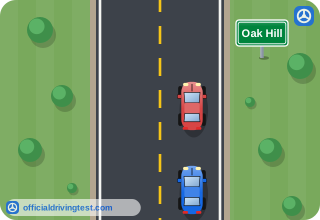
With the four-second method, how many seconds to pass the checkpoint show a safe following distance?
- Four or more seconds
- Two or more seconds
- Three seconds only
- Fewer than four seconds
Show answer
Correct answer: Four or more seconds
If it takes four or more seconds to pass the checkpoint, the following distance is safe.
Source: Vermont Driver's Manual (2025 edition (VN-007 07/2024)), page 28 · Open this page in the manual (Manual page 28)
-
What easy method does the manual give for counting seconds?
- Count "one, two, three, four" at a fast pace
- Count the lane markings you pass
- Count "one thousand one, one thousand two"
- Tap the steering wheel once per second
Show answer
Correct answer: Count "one thousand one, one thousand two"
The manual suggests counting "one thousand one, one thousand two" to measure seconds.
Source: Vermont Driver's Manual (2025 edition (VN-007 07/2024)), page 28 · Open this page in the manual (Manual page 28)
-
What is the maximum speed for any vehicle on all Vermont roads?
- 45 miles per hour or as posted
- 50 miles per hour or as posted
- 55 miles per hour or as posted
- 65 miles per hour or as posted
Show answer
Correct answer: 50 miles per hour or as posted
The manual gives 50 miles per hour, or the posted limit, as the maximum on Vermont roads.
Source: Vermont Driver's Manual (2025 edition (VN-007 07/2024)), page 28 · Open this page in the manual (Manual page 28)
-
What is the maximum speed for any vehicle on an Interstate in Vermont?
- 55 miles per hour or as posted
- 60 miles per hour or as posted
- 70 miles per hour or as posted
- 65 miles per hour or as posted
Show answer
Correct answer: 65 miles per hour or as posted
The manual gives 65 miles per hour, or the posted limit, as the maximum on an Interstate in Vermont.
Source: Vermont Driver's Manual (2025 edition (VN-007 07/2024)), page 28 · Open this page in the manual (Manual page 28)
-
According to the law, how must a motor vehicle be driven at all times?
- So that it is under control
- At the maximum posted speed
- At the same speed as the traffic around it
- At a steady speed with cruise control
Show answer
Correct answer: So that it is under control
The law says a motor vehicle must be driven at all times so that it is under control, at a speed reasonable for the dangers on the road.
Source: Vermont Driver's Manual (2025 edition (VN-007 07/2024)), page 28 · Open this page in the manual (Manual page 28)
-
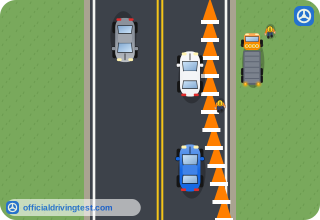
What following distance does the manual tell drivers to maintain in a work zone?
- 2 seconds
- 4 seconds
- 3 seconds
- 6 seconds
Show answer
Correct answer: 4 seconds
The work zone tips say to maintain a 4 second following distance.
Source: Vermont Driver's Manual (2025 edition (VN-007 07/2024)), page 35 · Open this page in the manual (Manual page 35)
-
According to the manual, how far does it take a passenger car to come to a complete stop on dry pavement when traveling at 60 MPH?
- 120 feet
- 180 feet
- 300 feet
- 240 feet
Show answer
Correct answer: 240 feet
On dry pavement a passenger car needs 240 feet to stop completely from 60 MPH.
Source: Vermont Driver's Manual (2025 edition (VN-007 07/2024)), page 35 · Open this page in the manual (Manual page 35)
-
According to the manual, how far does it take a passenger car to come to a stop on dry pavement when traveling at 30 MPH?
- 75 feet
- 45 feet
- 100 feet
- 150 feet
Show answer
Correct answer: 75 feet
The same car needs only 75 feet to stop from 30 MPH, compared with 240 feet from 60 MPH.
Source: Vermont Driver's Manual (2025 edition (VN-007 07/2024)), page 35 · Open this page in the manual (Manual page 35)
-
The speed limit signs in many school zones carry which words to show when the limit is in effect?
- "when school is open" or "weekdays only"
- "7 a.m. to 5 p.m." or "school days"
- "when flashing" or "when children are present"
- "when buses are loading" or "daylight only"
Show answer
Correct answer: "when flashing" or "when children are present"
These words tell drivers when the lower school-zone speed limit applies.
Source: Vermont Driver's Manual (2025 edition (VN-007 07/2024)), page 38 · Open this page in the manual (Manual page 38)
-
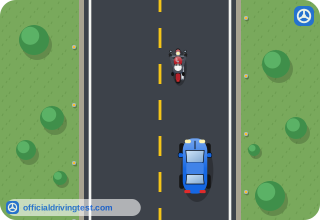
Why can a motorcyclist slow down without warning the driver behind?
- Motorcyclists slow down only by sounding the horn first
- By downshifting or rolling off the throttle, the brake light is not activated
- Motorcycle brake lights come on only after dark and only in rain
- Motorcyclists always use a hand signal for every slowdown they make
Show answer
Correct answer: By downshifting or rolling off the throttle, the brake light is not activated
Slowing by downshifting or easing the throttle does not turn on the brake light.
Source: Vermont Driver's Manual (2025 edition (VN-007 07/2024)), page 42 · Open this page in the manual (Manual page 42)
-
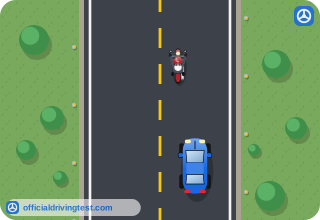
How does the stopping distance of a motorcycle compare with that of a car?
- It is nearly the same, but slippery pavement makes quick stops difficult
- It is much shorter than a car’s stopping distance in all conditions
- It is double that of a car in all road conditions
- It is shorter than a car’s on slippery pavement
Show answer
Correct answer: It is nearly the same, but slippery pavement makes quick stops difficult
Because a motorcycle cannot always stop on a dime, allow more following distance behind it.
Source: Vermont Driver's Manual (2025 edition (VN-007 07/2024)), page 42 · Open this page in the manual (Manual page 42)
-
If you are caught out in a storm, how much space should you keep between you and the vehicle in front of you?
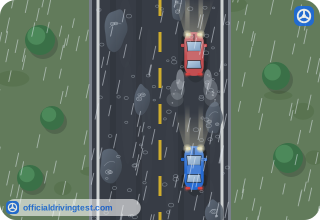
- Exactly two seconds
- More than four seconds
- About three seconds
- One car length
Show answer
Correct answer: More than four seconds
The manual says to keep more than four seconds of space from the vehicle ahead in a storm.
Source: Vermont Driver's Manual (2025 edition (VN-007 07/2024)), page 46 · Open this page in the manual (Manual page 46)
-
On winter roads, how much should you increase your following distance?
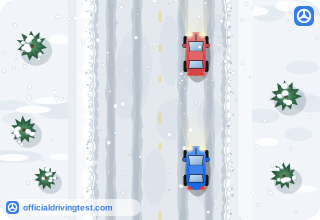
- To exactly 2 seconds
- To about 3 seconds
- To no more than 1 second
- To more than 4 seconds
Show answer
Correct answer: To more than 4 seconds
Because you need to drive more slowly in winter, the manual says to increase following distance to more than 4 seconds.
Source: Vermont Driver's Manual (2025 edition (VN-007 07/2024)), page 47 · Open this page in the manual (Manual page 47)
-
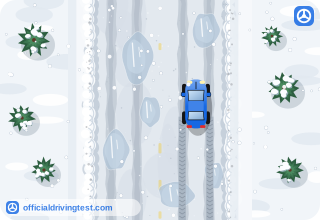
How should you drive on a road that may be slippery?
- At the posted speed, braking firmly to keep control
- At your normal speed, changing lanes early to stay clear
- Faster than usual, so the wheels do not lock up
- At a slower speed, with no sudden changes in speed or direction
Show answer
Correct answer: At a slower speed, with no sudden changes in speed or direction
The manual says to drive slower on roads that may be slippery and not to make sudden changes in speed or direction.
Source: Vermont Driver's Manual (2025 edition (VN-007 07/2024)), page 48 · Open this page in the manual (Manual page 48)
-
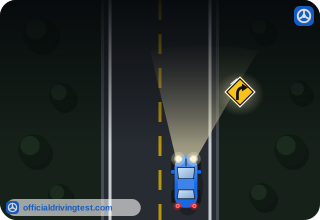
Why is it more dangerous to drive at night than in the daytime?
- Other drivers do not use turn signals
- You cannot see as far ahead
- Roads are always icy at night
- Traffic is always heavier at night
Show answer
Correct answer: You cannot see as far ahead
At night you cannot see as far ahead, which makes night driving more dangerous.
Source: Vermont Driver's Manual (2025 edition (VN-007 07/2024)), page 49 · Open this page in the manual (Manual page 49)
-
How far ahead, measured in time, do you always need to be able to see?
- 2 seconds
- 6 seconds
- 10 seconds
- 4 seconds
Show answer
Correct answer: 4 seconds
The manual says you always need to be able to see 4 seconds ahead.
Source: Vermont Driver's Manual (2025 edition (VN-007 07/2024)), page 49 · Open this page in the manual (Manual page 49)
-
What does “overdriving your headlights” mean?
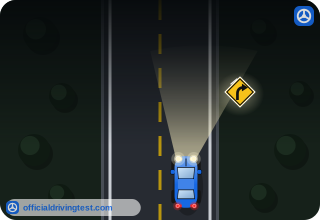
- Your headlights are brighter than those of other vehicles
- You are driving with high beams on in traffic
- Your headlights are aimed too high for the road
- You cannot see far enough ahead to stop in the space you can see
Show answer
Correct answer: You cannot see far enough ahead to stop in the space you can see
Overdriving your headlights means your stopping distance is longer than the distance your lights show you.
Source: Vermont Driver's Manual (2025 edition (VN-007 07/2024)), page 49 · Open this page in the manual (Manual page 49)
-
Driving at night at what speed with low beam headlights is the manual’s example of “overdriving your headlights”?
- 20 miles an hour
- 40 miles an hour
- 25 miles an hour
- 55 miles an hour
Show answer
Correct answer: 40 miles an hour
The manual gives 40 miles an hour with low beams as an example of overdriving your headlights.
Source: Vermont Driver's Manual (2025 edition (VN-007 07/2024)), page 49 · Open this page in the manual (Manual page 49)
-
Even with high beams on at night, how must your speed compare with your speed by day?
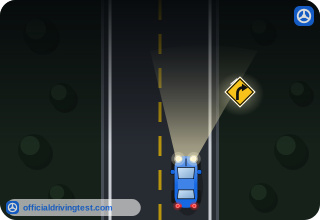
- Lower than by day
- The same as by day
- Higher than by day
- No speed limit applies at night
Show answer
Correct answer: Lower than by day
The manual says that even with high beams, speed must be lower than by day.
Source: Vermont Driver's Manual (2025 edition (VN-007 07/2024)), page 49 · Open this page in the manual (Manual page 49)
-
What is the easiest way to tell whether you are a safe distance from the vehicle ahead on the interstate?
- Use the 2-second distance rule
- Use the 4-second distance rule
- Use the 6-second distance rule
- Use the 10-second distance rule
Show answer
Correct answer: Use the 4-second distance rule
The manual says the easiest way to judge a safe distance from the vehicle ahead is the 4-second distance rule.
Source: Vermont Driver's Manual (2025 edition (VN-007 07/2024)), page 50 · Open this page in the manual (Manual page 50)
-
How much following distance do you need on the interstate if the road is wet or slippery?
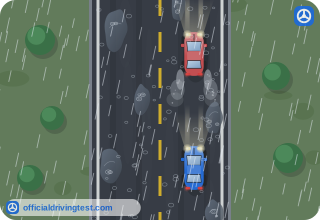
- Less space than on a dry road
- The same space as on a dry road
- Additional space
- Space only for large trucks
Show answer
Correct answer: Additional space
A wet or slippery road means you need additional space from the vehicle ahead.
Source: Vermont Driver's Manual (2025 edition (VN-007 07/2024)), page 50 · Open this page in the manual (Manual page 50)
-
To save fuel on the interstate, what does the manual suggest?
- Drive 55 or 60 miles per hour instead of 65
- Drive 70 miles per hour instead of 65
- Drive 45 miles per hour instead of 65
- Drive 65 miles per hour but brake more often
Show answer
Correct answer: Drive 55 or 60 miles per hour instead of 65
The manual's fuel-saving tip is to drive 55 or 60 miles per hour on the interstate instead of 65.
Source: Vermont Driver's Manual (2025 edition (VN-007 07/2024)), page 68 · Open this page in the manual (Manual page 68)