Pavement markings in Vermont
The Vermont Driver's Manual shows or names everything on this page: 12 in all, on pages 29–30, 34, 36, 38, 51.
Independent educational site · not affiliated with any government agency or DMV
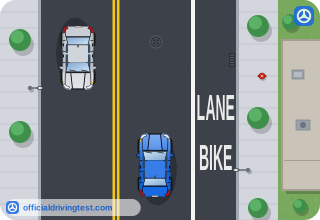
Bicycle Lane Marking
Where You May Not Park ... On a marked bicycle lane.
Manual page 29 · Open this page in the manual (Manual page 29)
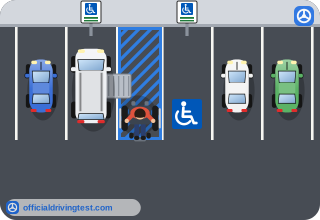
Disabled Parking Area
Where You May Not Park ... In a marked disabled parking area
Manual page 29 · Open this page in the manual (Manual page 29)
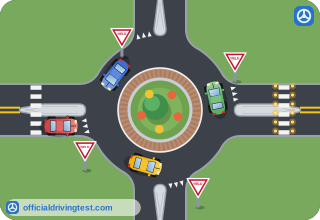
Roundabout Markings
A roundabout is an intersection control feature where traffic enters and exits only through right turns and proceeds in a counter clockwise direction. ... Drivers must yield the right of way to traffic in the roundabout. Enter the roundabout only when there is a safe gap in traffic. Like all intersections, you must also yield to pedestrians and bicyclists when entering or exiting a roundabout. Always use your signal to show your intention to exit the roundabout.
Manual page 30 · Open this page in the manual (Manual page 30)
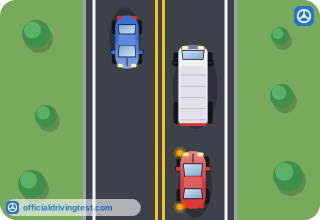
Double Solid Yellow Center Lines
Highway markings provide important information to drivers. They help a driver correctly position their vehicle, help direct them through various situations, let them know when passing is allowed and warn drivers of upcoming conditions. Major highways are marked with yellow center lines which serve two purposes: Center lines divide a highway into travel lanes. Multi-lane highways without a median have double solid lines to indicate the two opposing lanes of travel.
Manual page 34 · Open this page in the manual (Manual page 34)
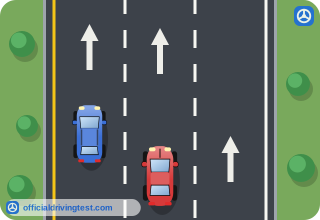
Broken White Lane Lines
When two or more lanes of travel are permitted in the same direction, a broken white line is used to divide each side of the highway into separate lanes for vehicles traveling in the same direction.
Manual page 34 · Open this page in the manual (Manual page 34)
Passing Rules for Center Lines
The lines show if you may or may not pass. If there is a solid line or two solid lines, it is recommended that you do not pass. If there is a solid line but a broken line in your lane, you may pass if it is clear ahead. If there is a solid line in your lane but a broken line in the other lane, you should not pass, but the motor vehicle in the other lane may pass.
Manual page 34 · Open this page in the manual (Manual page 34)
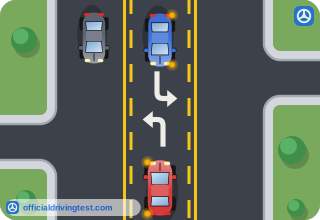
CENTER TURN LANE
Continuous two-way left turn lanes are not designed to be used as travel lanes since traffic moving in both directions may want to use the lane to make a left-hand turn. A short distance prior to your left turn, you should signal and carefully move into the turning lane. So that you don't block traffic, all of your vehicle should be in the turn lane. When the way is clear, proceed with your turn.
Manual page 34 · Open this page in the manual (Manual page 34)
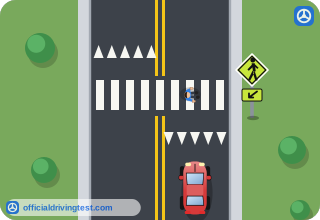
Yield Line (Triangles)
For example, at a yield intersection, there may be a yield sign beside the highway and there may also be a yield line painted on the highway. This series of white triangles, pointing toward approaching cars, shows drivers where they should stop, if they are required to yield to pedestrians or other vehicles.
Manual page 34 · Open this page in the manual (Manual page 34)
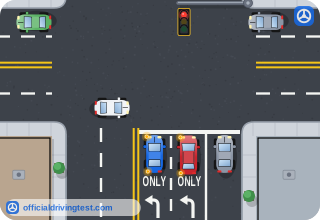
Two Lanes Turning Left
When driving from one road onto a multiple lane road where there is a choice of lanes, right turning drivers must turn into the right lane. Left turning drivers must first turn into the left lane. When there are two lanes turning in the same direction each turning lane must stay in their own turning path throughout the turn.
Manual page 34 · Open this page in the manual (Manual page 34)
Temporary Work Zone Pavement Markings
Work zones may have temporary pavement markings. White markers or lines separate lanes going in the same direction. Yellow markers or lines separate lanes going in opposite directions. The yellow markings will be on your left-- if they are not, you are in the wrong lane.
Manual page 36 · Open this page in the manual (Manual page 36)
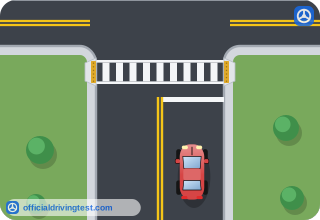
Marked Crosswalk
REMEMBER: You are required to stop before the stop line, crosswalk (marked or unmarked) or the intersecting road, whichever comes first. (p32) / Do not block a crosswalk when stopped or waiting to make a turn. (p38) / At marked crosswalks, a pedestrian sign may be placed on the road to remind drivers that they are required to yield to pedestrians within crosswalks. (p38)
Manual page 38 · Open this page in the manual (Manual page 38)
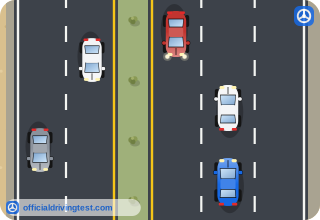
Wrong-Way Car on Divided Highway
What does it indicate if, while driving on a divided highway, the edge of the highway to your right is painted yellow? You are going the WRONG WAY on a divided highway or Interstate. On a divided highway the line to your right should be white.
Manual page 51 · Open this page in the manual (Manual page 51)