Vermont: Parking rules
Where you may not park and the distances to keep, parallel parking, parking on hills, and disabled parking. Split into 2 shorter tests so you're not stuck in one long quiz.
Independent educational site · not affiliated with any government agency or DMV
Choose a part
Parking rules — Part 1
Questions in this part include: “When you park on a 2-lane road in Vermont, how close must the right wheels be to the right side of the road or curb?”
StartParking rules — Part 2
Questions in this part include: “Which of these is on the manual’s list of places where you may not park?”
StartAll 40 Parking rules questions with answers
Choose a part above to take a practice test, or study every question and answer here.
Show the questions and answersHide the questions
-
When you park on a 2-lane road in Vermont, how close must the right wheels be to the right side of the road or curb?
- Within 12 inches
- Within 6 inches
- Within 18 inches
- Within 24 inches
Show answer
Correct answer: Within 12 inches
A vehicle parked on a 2-lane road must have its right wheels within 12 inches of the right side of the road or the curb.
Source: Vermont Driver's Manual (2025 edition (VN-007 07/2024)), page 29 · Open this page in the manual (Manual page 29)
-
On a one-way road, how close to the side of the road must a parked vehicle be positioned?
- Within 6 inches
- Within 24 inches
- Within 12 inches
- Within 3 feet
Show answer
Correct answer: Within 12 inches
On a one-way road the parked vehicle must be positioned within 12 inches of the side of the road.
Source: Vermont Driver's Manual (2025 edition (VN-007 07/2024)), page 29 · Open this page in the manual (Manual page 29)
-
In which direction must your parked vehicle face?
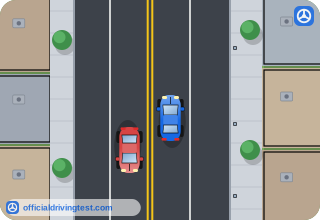
- Toward oncoming traffic
- The same direction as traffic flow
- Either direction, whichever is easier
- Whichever way leaves the most room to pull out
Show answer
Correct answer: The same direction as traffic flow
The manual says a vehicle must be parked in the same direction as traffic flow.
Source: Vermont Driver's Manual (2025 edition (VN-007 07/2024)), page 29 · Open this page in the manual (Manual page 29)
-
Parking can be parallel, angle or perpendicular. Which of these must you NOT do in order to park?
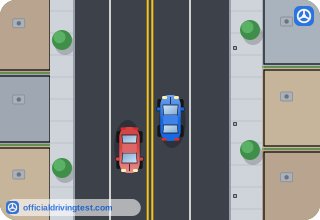
- Park at an angle to the curb
- Park perpendicular to the curb
- Park parallel to the curb
- Cross the center line
Show answer
Correct answer: Cross the center line
The manual lists several parking options but says not to cross the center line to park.
Source: Vermont Driver's Manual (2025 edition (VN-007 07/2024)), page 29 · Open this page in the manual (Manual page 29)
-
If you must park on a highway in a rural area, where must your wheels be?
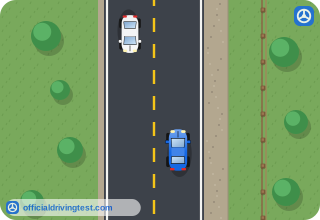
- All wheels off the traveled portion of the road
- Two wheels on the traveled portion, near the edge
- All wheels in the left lane of the road
- Straddling the edge line of the road
Show answer
Correct answer: All wheels off the traveled portion of the road
On a rural highway you must have all wheels off the traveled portion of the road.
Source: Vermont Driver's Manual (2025 edition (VN-007 07/2024)), page 29 · Open this page in the manual (Manual page 29)
-
Be careful not to stop where your vehicle cannot be seen for at least how far in either direction?
- 100 feet
- 200 feet
- 150 feet
- 300 feet
Show answer
Correct answer: 150 feet
The manual warns against stopping where your vehicle cannot be seen for at least 150 feet in either direction.
Source: Vermont Driver's Manual (2025 edition (VN-007 07/2024)), page 29 · Open this page in the manual (Manual page 29)
-
When parking on a hill, what must you always do to keep the vehicle from rolling into traffic?
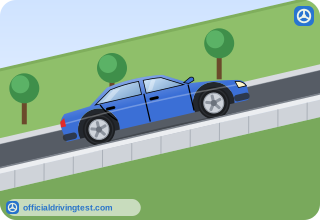
- Shift to neutral and turn off the engine
- Turn the front wheels and set the parking brake
- Leave the engine running with the vehicle in neutral
- Turn on the hazard lights and leave the brake off
Show answer
Correct answer: Turn the front wheels and set the parking brake
Always turn the front wheels and set the parking brake so the vehicle cannot roll into traffic.
Source: Vermont Driver's Manual (2025 edition (VN-007 07/2024)), page 29 · Open this page in the manual (Manual page 29)
-
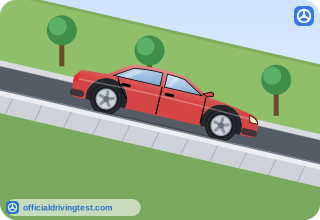
You park downhill on the right side of the street. Which way should you turn the front wheels?
- To the left
- Straight ahead
- It does not matter if the parking brake is set
- To the right
Show answer
Correct answer: To the right
When parking downhill on the right side of the street, turn the front wheels to the right.
Source: Vermont Driver's Manual (2025 edition (VN-007 07/2024)), page 29 · Open this page in the manual (Manual page 29)
-
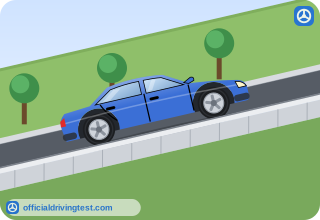
You park uphill on the right side of the street, and there is a curb. Which way should you turn the front wheels?
- To the left
- To the right
- Straight ahead
- It does not matter if the parking brake is set
Show answer
Correct answer: To the left
When parking uphill on the right side of the street with a curb, turn the front wheels to the left.
Source: Vermont Driver's Manual (2025 edition (VN-007 07/2024)), page 29 · Open this page in the manual (Manual page 29)
-
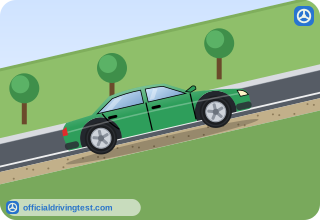
You park uphill on the right side of the road, and there is no curb. Which way should you turn the front wheels?
- To the left
- Straight ahead
- To the right
- It does not matter if the parking brake is set
Show answer
Correct answer: To the right
When parking uphill on the right side of the road with no curb, turn the front wheels to the right.
Source: Vermont Driver's Manual (2025 edition (VN-007 07/2024)), page 29 · Open this page in the manual (Manual page 29)
-
How close to a fire hydrant may you park?
- Not within 3 feet
- Not within 6 feet
- Not within 10 feet
- Not within 15 feet
Show answer
Correct answer: Not within 6 feet
The manual says you may not park within 6 feet of a fire hydrant.
Source: Vermont Driver's Manual (2025 edition (VN-007 07/2024)), page 29 · Open this page in the manual (Manual page 29)
-
You may not park within how many feet of a crosswalk at an intersection?
- 6 feet
- 10 feet
- 50 feet
- 20 feet
Show answer
Correct answer: 20 feet
Parking within 20 feet of a crosswalk at an intersection is not allowed.
Source: Vermont Driver's Manual (2025 edition (VN-007 07/2024)), page 29 · Open this page in the manual (Manual page 29)
-
You may not park within how many feet of a flashing red or yellow light, a stop sign or a traffic light?
- 30 feet
- 6 feet
- 20 feet
- 75 feet
Show answer
Correct answer: 30 feet
Parking within 30 feet of a flashing red or yellow light, stop sign or traffic light is not allowed.
Source: Vermont Driver's Manual (2025 edition (VN-007 07/2024)), page 29 · Open this page in the manual (Manual page 29)
-
You may not park within how many feet of the nearest rail of a railroad crossing?
- 20 feet
- 30 feet
- 50 feet
- 75 feet
Show answer
Correct answer: 50 feet
The manual lists parking on railroad tracks or within 50 feet of the nearest rail of a crossing as not allowed.
Source: Vermont Driver's Manual (2025 edition (VN-007 07/2024)), page 29 · Open this page in the manual (Manual page 29)
-
You may not park within how many feet of the driveway of a fire station?
- 6 feet
- 20 feet
- 30 feet
- 50 feet
Show answer
Correct answer: 20 feet
The manual says not to park within 20 feet of a fire station driveway.
Source: Vermont Driver's Manual (2025 edition (VN-007 07/2024)), page 29 · Open this page in the manual (Manual page 29)
-
When there are signs, you may not park across the street from a fire station driveway within how many feet of the driveway?
- 20 feet
- 30 feet
- 50 feet
- 75 feet
Show answer
Correct answer: 75 feet
When signs are posted, parking is not allowed across the street within 75 feet of a fire station driveway.
Source: Vermont Driver's Manual (2025 edition (VN-007 07/2024)), page 29 · Open this page in the manual (Manual page 29)
-
Which of these is a place where you may not park?
- On a bridge or in a tunnel
- On a one-way road, within 12 inches of the side of the road
- On a 2-lane road, with the right wheels within 12 inches of the curb
- Facing the same direction as traffic flow
Show answer
Correct answer: On a bridge or in a tunnel
Parking on a bridge or in a tunnel is on the list of places where you may not park.
Source: Vermont Driver's Manual (2025 edition (VN-007 07/2024)), page 29 · Open this page in the manual (Manual page 29)
-
Which of these is NOT a legal place to park?
- On a one-way road, within 12 inches of the side of the road
- On a 2-lane road, with the right wheels within 12 inches of the curb
- In front of any driveway
- On a rural highway, with all wheels off the traveled portion
Show answer
Correct answer: In front of any driveway
Parking in front of any driveway is on the list of places where you may not park.
Source: Vermont Driver's Manual (2025 edition (VN-007 07/2024)), page 29 · Open this page in the manual (Manual page 29)
-
Where is parking prohibited?
- Facing the same direction as traffic flow
- On a marked bicycle lane
- On a 2-lane road, with the right wheels within 12 inches of the curb
- On a rural highway, with all wheels off the traveled portion
Show answer
Correct answer: On a marked bicycle lane
A marked bicycle lane is on the list of places where you may not park.
Source: Vermont Driver's Manual (2025 edition (VN-007 07/2024)), page 29 · Open this page in the manual (Manual page 29)
-
Which of these may you NOT do?
- Park facing the same direction as traffic flow
- Park on a one-way road, within 12 inches of the side of the road
- Turn the front wheels and set the parking brake on a hill
- Park beside a vehicle stopped or parked at the side of a street
Show answer
Correct answer: Park beside a vehicle stopped or parked at the side of a street
Parking beside a vehicle that is stopped or parked at the side of a street is not allowed.
Source: Vermont Driver's Manual (2025 edition (VN-007 07/2024)), page 29 · Open this page in the manual (Manual page 29)
-
Which of these is on the manual’s list of places where you may not park?
- In a marked disabled parking area
- Facing the same direction as traffic flow
- On a one-way road, within 12 inches of the side of the road
- On a rural highway, with all wheels off the traveled portion
Show answer
Correct answer: In a marked disabled parking area
The manual lists a marked disabled parking area among the places where you may not park.
Source: Vermont Driver's Manual (2025 edition (VN-007 07/2024)), page 29 · Open this page in the manual (Manual page 29)
-
Which parking maneuver will you also be required to do during your road test?
- Parking inside a garage
- Parking in a driveway
- Parking on a bridge
- Parallel parking
Show answer
Correct answer: Parallel parking
The manual says you will be required to parallel park during your road test.
Source: Vermont Driver's Manual (2025 edition (VN-007 07/2024)), page 57 · Open this page in the manual (Manual page 57)
-
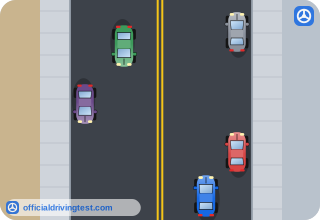
When approaching the parking space for parallel parking, which signal do you give?
- Signal left
- Signal right
- Turn on your hazard lights
- Give no signal
Show answer
Correct answer: Signal right
The manual says to check your rearview mirror and signal right when approaching the space.
Source: Vermont Driver's Manual (2025 edition (VN-007 07/2024)), page 57 · Open this page in the manual (Manual page 57)
-
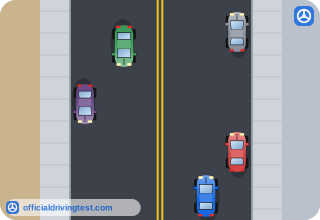
When entering a parallel parking space, how far from the front vehicle do you stop alongside it?
- Six to eight feet away
- About 18 inches away
- Two to three feet away
- Directly touching its bumper
Show answer
Correct answer: Two to three feet away
You stop alongside the front vehicle, two to three feet away, before shifting to reverse.
Source: Vermont Driver's Manual (2025 edition (VN-007 07/2024)), page 57 · Open this page in the manual (Manual page 57)
-
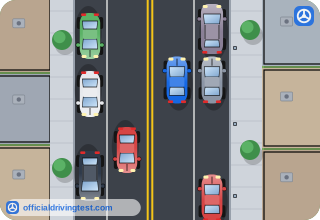
Before backing into a parallel parking space, over which shoulder do you look to check the blind spot?
- Your left shoulder
- Your right shoulder
- Neither shoulder; use the mirrors only
- Both shoulders at the same time
Show answer
Correct answer: Your left shoulder
The manual says to look over your left shoulder to check the blind spot before backing.
Source: Vermont Driver's Manual (2025 edition (VN-007 07/2024)), page 57 · Open this page in the manual (Manual page 57)
-
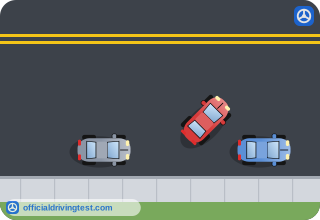
What do all methods of parallel parking require, according to the manual?
- Steering fully right to fully left while backing slowly
- Backing at a steady medium speed with only the mirrors
- Turning the wheels only to the right while backing
- Pulling forward twice before backing into the space
Show answer
Correct answer: Steering fully right to fully left while backing slowly
The manual says every method requires steering fully right to fully left and looking through the rear window while backing slowly.
Source: Vermont Driver's Manual (2025 edition (VN-007 07/2024)), page 57 · Open this page in the manual (Manual page 57)
-
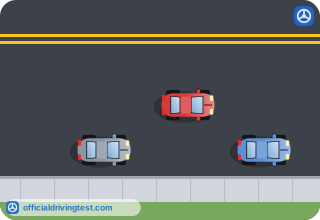
What do you do at the end of entering a parallel parking space, to finish centering your vehicle?
- Back up quickly until you touch the rear vehicle
- Turn off the engine immediately
- Slowly pull forward to center the vehicle in the space
- Sound your horn once
Show answer
Correct answer: Slowly pull forward to center the vehicle in the space
The last step is to pull forward slowly to center the vehicle in the space.
Source: Vermont Driver's Manual (2025 edition (VN-007 07/2024)), page 57 · Open this page in the manual (Manual page 57)
-
When leaving a parallel parking space, what does the manual say to do first if necessary?
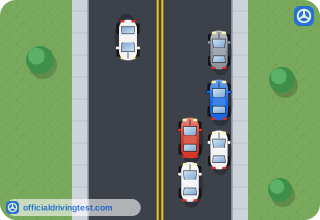
- Pull forward until your bumper touches the front vehicle
- Back up to where you can re-enter the lane in one motion
- Turn your wheels fully right and wait for traffic to clear
- Flash your headlights to alert the traffic behind you
Show answer
Correct answer: Back up to where you can re-enter the lane in one motion
If necessary, back up so that you can re-enter the traffic lane in one motion.
Source: Vermont Driver's Manual (2025 edition (VN-007 07/2024)), page 57 · Open this page in the manual (Manual page 57)
-
When leaving a parallel parking space, which signal do you give?
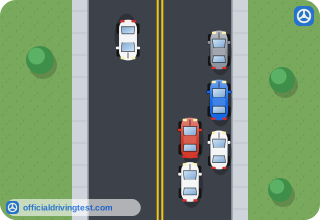
- Signal right
- Turn on your hazard lights
- Give no signal
- Signal left
Show answer
Correct answer: Signal left
The manual says to signal left and look all around for vehicles, bicyclists and pedestrians before leaving the space.
Source: Vermont Driver's Manual (2025 edition (VN-007 07/2024)), page 57 · Open this page in the manual (Manual page 57)
-
When you leave a parallel parking space and enter the roadway, how should you do it?
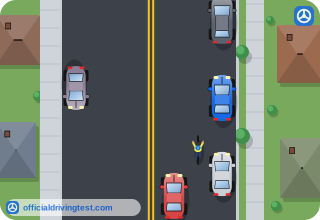
- Quickly, to merge with traffic
- Slowly, staying on your own side
- In the center of the road
- Using a wide turn into the far lane
Show answer
Correct answer: Slowly, staying on your own side
The manual says to enter the roadway slowly and stay on your own side.
Source: Vermont Driver's Manual (2025 edition (VN-007 07/2024)), page 58 · Open this page in the manual (Manual page 58)
-
What does the manual say about the parallel parking procedures if only a front vehicle is available on the road test?
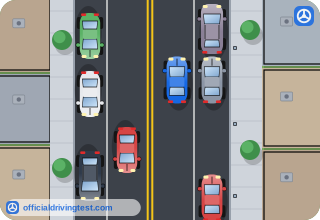
- Skip the parking maneuver
- Park as far from the curb as possible
- Use a different set of steps
- Still follow the same procedures
Show answer
Correct answer: Still follow the same procedures
The manual says you may have to parallel park with only a front vehicle, and the same procedures apply.
Source: Vermont Driver's Manual (2025 edition (VN-007 07/2024)), page 58 · Open this page in the manual (Manual page 58)
-
Under Vermont's unattended motor vehicle law, what must you do if you leave your vehicle?
- Leave it idling for no more than 10 minutes
- Leave the key in the ignition
- Shut it off
- Leave a note with your name inside
Show answer
Correct answer: Shut it off
Letting a vehicle idle while unattended in public violates the law, so you must shut the engine off when you leave.
Source: Vermont Driver's Manual (2025 edition (VN-007 07/2024)), page 68 · Open this page in the manual (Manual page 68)
-
A person who has trouble walking and has the special plate or placard may park without a fee in which kind of parking place?
- A parking place where other drivers can only park for a set time
- A place where stopping or parking vehicles is not allowed
- A parking place saved for certain vehicles only
- Anywhere that parking is banned, including no-parking zones
Show answer
Correct answer: A parking place where other drivers can only park for a set time
Such a person may park without a fee where others can park only for a set time, but not where stopping or parking is banned or the space is saved for certain vehicles.
Source: Vermont Driver's Manual (2025 edition (VN-007 07/2024)), page 71 · Open this page in the manual (Manual page 71)
-
What must a person have in order to use the special parking privilege for people who have trouble walking?
- A signed letter from a doctor that must be carried in the vehicle
- A parking permit stamped by the Town Clerk in the town of residence
- A special plate or placard from the Vermont DMV, or one issued by another state
- A Driver Privilege Card issued by the Vermont DMV for this purpose
Show answer
Correct answer: A special plate or placard from the Vermont DMV, or one issued by another state
The person needs a special registration plate or placard from the Vermont DMV, or a special plate or device issued by another state for disabled parking.
Source: Vermont Driver's Manual (2025 edition (VN-007 07/2024)), page 71 · Open this page in the manual (Manual page 71)
-
How many sets of Disabled Registration Plates can a disabled person get?
- One set only, for one vehicle in total
- Two sets for each household
- A set for every licensed driver in the household
- A set for each vehicle registered in that person's name
Show answer
Correct answer: A set for each vehicle registered in that person's name
A disabled person can get a set of Disabled Registration Plates for each vehicle registered in his or her name.
Source: Vermont Driver's Manual (2025 edition (VN-007 07/2024)), page 71 · Open this page in the manual (Manual page 71)
-
A disabled person does not own a vehicle or does not want Disabled Registration Plates. What may that person get?
- A second set of Disabled Registration Plates
- A Disabled Parking Placard
- A Non-Driver ID with a disability mark
- A medical evaluation form
Show answer
Correct answer: A Disabled Parking Placard
A person who owns no vehicle or does not want the plates may get a Disabled Parking Placard.
Source: Vermont Driver's Manual (2025 edition (VN-007 07/2024)), page 71 · Open this page in the manual (Manual page 71)
-
The Disabled Parking Placard is also available to whom?
- Passengers over age 65
- Passengers with a Learner's Permit
- Blind passengers
- Passengers with a temporary injury
Show answer
Correct answer: Blind passengers
The manual says the Disabled Parking Placard is also available to blind passengers.
Source: Vermont Driver's Manual (2025 edition (VN-007 07/2024)), page 71 · Open this page in the manual (Manual page 71)
-
Besides a disabled person, who may apply for a Disabled Parking Placard?
- An organization that furnishes its Federal ID Number
- Any employer of a disabled person who drives for work
- A doctor, on behalf of a patient who cannot apply
- A Town Clerk's office that serves the person's town
Show answer
Correct answer: An organization that furnishes its Federal ID Number
A disabled person, or an organization that furnishes its Federal ID Number, may apply for a Disabled Parking Placard.
Source: Vermont Driver's Manual (2025 edition (VN-007 07/2024)), page 71 · Open this page in the manual (Manual page 71)
-
What may cause a disabled person's plates or placard to be revoked?
- Allowing people who are not disabled to abuse its privileges
- Moving to a new address within Vermont
- Parking in a place with a set time limit
- Registering a second vehicle in that person's name
Show answer
Correct answer: Allowing people who are not disabled to abuse its privileges
The plates or placard may be revoked if the disabled person lets people who are not disabled abuse the parking privileges.
Source: Vermont Driver's Manual (2025 edition (VN-007 07/2024)), page 71 · Open this page in the manual (Manual page 71)
-
What may happen to a person who parks in a disabled parking spot illegally?
- Points added to the driving record
- Loss of the driver's license for 30 days
- A fine and towing charges
- A warning letter only, with no towing
Show answer
Correct answer: A fine and towing charges
A person who parks illegally in a disabled parking spot may be subject to a fine and towing charges.
Source: Vermont Driver's Manual (2025 edition (VN-007 07/2024)), page 71 · Open this page in the manual (Manual page 71)