Utah: Railroad and light rail crossings — Part 2 Practice Test
Questions in this part include: “What does the handbook say about the schedules of freight trains?” · “Which statement about the movement of trains is correct?”
Independent educational site · not affiliated with any government agency or DMV
Ready? Test yourself
- Instant feedback with an explanation
- Every answer cites its source in the manual
- Your best score is saved on this device
- Keyboard: press 1 to 4 to answer and Enter for the next question
Questions are original and based on the official manual "Utah Driver Handbook" (2026 edition (new 2026 laws effective May 6, 2026)), Utah Department of Public Safety, Driver License Division.
All 23 questions in this practice test
Take the test above first, then use this list to study. Tap “Show answer” to see the correct answer and explanation.
Show the questions and answersHide the questions
-
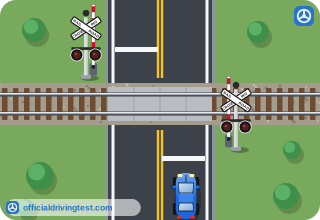
Which statement about trains does the handbook make?
- Trains run only on tracks that have signals
- Trains run only at posted times
- Expect a train on any track at any time
- Trains stay off tracks that look unused
Show answer
Correct answer: Expect a train on any track at any time
You should expect a train on any track at any time.
Source: Utah Driver Handbook (2026 edition (new 2026 laws effective May 6, 2026)), page 87 · Open this page in the manual (Manual page 87)
-
What does the handbook say about the schedules of freight trains?
- They do not travel on a predictable schedule
- They follow a posted timetable for each day of the week
- They run only during daylight hours on weekdays
- They never run at night or on weekends
Show answer
Correct answer: They do not travel on a predictable schedule
Freight trains have no predictable schedule, so a train could come at any time.
Source: Utah Driver Handbook (2026 edition (new 2026 laws effective May 6, 2026)), page 87 · Open this page in the manual (Manual page 87)
-
Train tracks are what kind of property, no matter which railroad owns them?
- Private property
- Public property
- State-owned property
- Shared roadway
Show answer
Correct answer: Private property
Tracks are private property whichever railroad owns them.
Source: Utah Driver Handbook (2026 edition (new 2026 laws effective May 6, 2026)), page 88 · Open this page in the manual (Manual page 88)
-
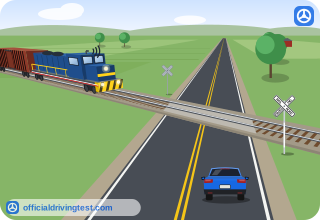
How much of the time do trains have the right-of-way?
- Only when the lights are flashing
- Only at crossings with gates
- 100% of the time
- Only when a passenger train is involved
Show answer
Correct answer: 100% of the time
Trains always have the right-of-way, even over ambulances, fire engines, cars, police, and pedestrians.
Source: Utah Driver Handbook (2026 edition (new 2026 laws effective May 6, 2026)), page 88 · Open this page in the manual (Manual page 88)
-
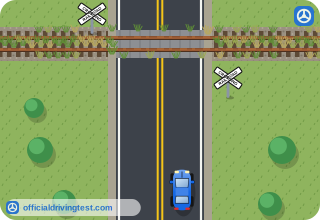
If there are rails on the railroad ties but there are weeds or the track looks rusty, what should you assume?
- That the track has been abandoned
- That the track is in use
- That trains on it move slowly
- That it is used only at night
Show answer
Correct answer: That the track is in use
Rails on the ties mean you should treat the track as in use, however neglected it looks.
Source: Utah Driver Handbook (2026 edition (new 2026 laws effective May 6, 2026)), page 88 · Open this page in the manual (Manual page 88)
-
How far outside the steel rail may a train extend?
- Six inches
- One foot
- Two feet
- Three feet or more
Show answer
Correct answer: Three feet or more
A train can reach three feet or more beyond the rail, so the safe zone for pedestrians is well beyond the rails.
Source: Utah Driver Handbook (2026 edition (new 2026 laws effective May 6, 2026)), page 88 · Open this page in the manual (Manual page 88)
-
Once in emergency braking, how far does a 100-car freight train traveling at 55 mph need to stop?
- About 500 feet
- About 1,000 feet
- About half a mile
- More than a mile
Show answer
Correct answer: More than a mile
Because of its weight, such a train needs more than a mile to stop even in emergency braking.
Source: Utah Driver Handbook (2026 edition (new 2026 laws effective May 6, 2026)), page 88 · Open this page in the manual (Manual page 88)
-
Which statement about the movement of trains is correct?
- Trains always travel the same direction on a given track
- Trains can move in either direction at any time
- Trains are always pulled and never pushed by locomotives
- Trains move in both directions only on tracks with gates
Show answer
Correct answer: Trains can move in either direction at any time
A train can come from either direction on a track at any time.
Source: Utah Driver Handbook (2026 edition (new 2026 laws effective May 6, 2026)), page 88 · Open this page in the manual (Manual page 88)
-
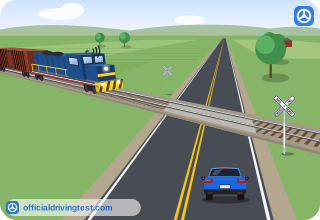
How does an approaching train compare with what you think?
- It is farther away and moving slower than you think
- It is exactly where its sound suggests
- It is closer and moving faster than you think
- It is moving at the speed limit of the road
Show answer
Correct answer: It is closer and moving faster than you think
An approaching train is always closer and faster than it seems.
Source: Utah Driver Handbook (2026 edition (new 2026 laws effective May 6, 2026)), page 88 · Open this page in the manual (Manual page 88)
-
How do modern trains compare with older ones?
- They are quieter than ever, with no telltale “clackety-clack”
- They are louder than ever and easy to hear from far away
- They are slower than older trains and easier to stop
- They always run on a fixed schedule posted at crossings
Show answer
Correct answer: They are quieter than ever, with no telltale “clackety-clack”
Modern trains are quieter, so you cannot count on hearing the old clackety-clack.
Source: Utah Driver Handbook (2026 edition (new 2026 laws effective May 6, 2026)), page 88 · Open this page in the manual (Manual page 88)
-
If your vehicle stalls on a railroad crossing, what should you do first?
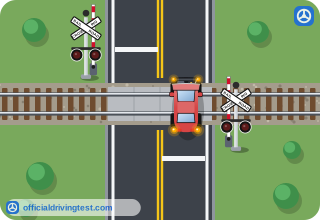
- Try to restart the engine while everyone stays inside
- Immediately get everyone out of the car and off the tracks
- Stay in the car and sound the horn
- Set the parking brake and wait for the train to pass
Show answer
Correct answer: Immediately get everyone out of the car and off the tracks
Everyone must leave the car and get off the tracks right away.
Source: Utah Driver Handbook (2026 edition (new 2026 laws effective May 6, 2026)), page 88 · Open this page in the manual (Manual page 88)
-
After everyone is out of a stalled vehicle and off the tracks, what should you do immediately?
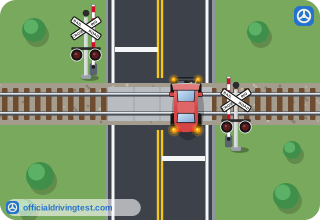
- Wait ten minutes to see whether a train comes
- Flag down passing vehicles to push yours
- Return to the car for your belongings
- Notify local authorities
Show answer
Correct answer: Notify local authorities
Once everyone is clear of the tracks, local authorities must be notified immediately.
Source: Utah Driver Handbook (2026 edition (new 2026 laws effective May 6, 2026)), page 88 · Open this page in the manual (Manual page 88)
-
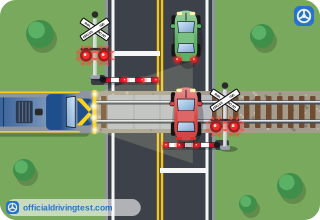
Your vehicle has stalled on a crossing and a train is coming. How should you run once clear of the tracks?
- In the direction the train is traveling, along the tracks
- Straight along the tracks, away from the train
- Back toward the stalled vehicle
- Toward the approaching train, at an angle away from the train
Show answer
Correct answer: Toward the approaching train, at an angle away from the train
The handbook says to run toward the approaching train at an angle away from the train.
Source: Utah Driver Handbook (2026 edition (new 2026 laws effective May 6, 2026)), page 88 · Open this page in the manual (Manual page 88)
-
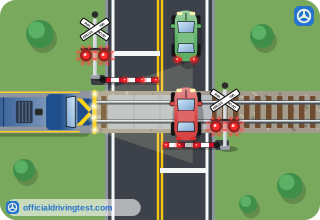
Why does the handbook advise running toward the approaching train (at an angle away from it) after a stall on the tracks?
- The engineer is more likely to see you in time
- You are less likely to be hit by flying debris
- The train will brake sooner when it sees you
- The ground beside the tracks is firmer there
Show answer
Correct answer: You are less likely to be hit by flying debris
Moving toward the train lowers the chance of being struck by debris thrown in a collision.
Source: Utah Driver Handbook (2026 edition (new 2026 laws effective May 6, 2026)), page 88 · Open this page in the manual (Manual page 88)
-
If your vehicle stalls on a crossing and no train is in sight, what does the handbook say to do?
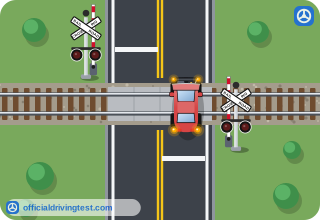
- Leave it on the tracks and wait for a tow truck
- Wait inside with the doors locked
- Post lookouts and try to start or move the vehicle
- Push the vehicle alone without watching for trains
Show answer
Correct answer: Post lookouts and try to start or move the vehicle
With no train in sight, you may try to start or move the vehicle while lookouts watch for trains.
Source: Utah Driver Handbook (2026 edition (new 2026 laws effective May 6, 2026)), page 88 · Open this page in the manual (Manual page 88)
-
Which agency operates the TRAX light rail system throughout the Salt Lake Valley?
- Utah Transit Authority
- Utah Department of Transportation
- Driver License Division
- Salt Lake City Police Department
Show answer
Correct answer: Utah Transit Authority
The Utah Transit Authority runs the light rail system in the Salt Lake Valley.
Source: Utah Driver Handbook (2026 edition (new 2026 laws effective May 6, 2026)), page 88 · Open this page in the manual (Manual page 88)
-
What powers light rail cars?
- Overhead electrical lines
- Diesel engines
- A third rail on the ground
- Batteries carried on board
Show answer
Correct answer: Overhead electrical lines
Light rail cars are powered by electrical lines overhead.
Source: Utah Driver Handbook (2026 edition (new 2026 laws effective May 6, 2026)), page 88 · Open this page in the manual (Manual page 88)
-
What should you never try to do with a light rail train?
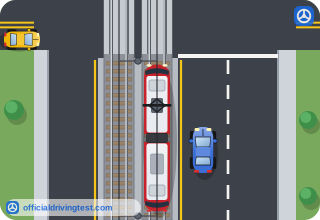
- Wait for it at a railroad crossing
- Stop for it when the gates lower
- Beat it through a railroad crossing
- Watch for it at a railroad crossing
Show answer
Correct answer: Beat it through a railroad crossing
Light rail vehicles accelerate quickly, so you should never try to beat one through a crossing.
Source: Utah Driver Handbook (2026 edition (new 2026 laws effective May 6, 2026)), page 88 · Open this page in the manual (Manual page 88)
-
How must light rail grade crossings be treated?
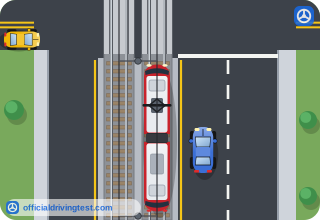
- As ordinary intersections when no train is visible
- In the same manner as all train crossings
- As crossings where you may go if the gates are up
- With fewer stopping requirements than other crossings
Show answer
Correct answer: In the same manner as all train crossings
The same rules apply at light rail crossings as at any other train crossing.
Source: Utah Driver Handbook (2026 edition (new 2026 laws effective May 6, 2026)), page 88 · Open this page in the manual (Manual page 88)
-
Before entering a crossing, what else must you make sure of regarding the space on the other side?
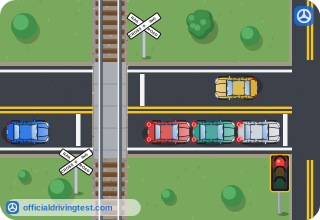
- The vehicle ahead is moving at least 15 miles per hour
- The gates are painted a visible color
- Your hazard lights are turned on
- There is enough room to completely clear the tracks
Show answer
Correct answer: There is enough room to completely clear the tracks
You need room to clear the tracks completely before you enter, so you never stop on them.
Source: Utah Driver Handbook (2026 edition (new 2026 laws effective May 6, 2026)), page 88 · Open this page in the manual (Manual page 88)
-
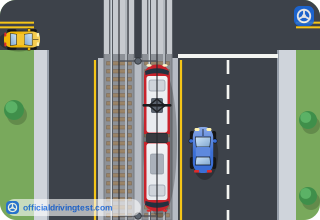
Where light rail trains operate through the same intersections and streets as automobiles, what must drivers pay extra attention to?
- Pedestrian crosswalks only
- Overhead electrical lines only
- Horn signals from the train
- Traffic signals and posted signs
Show answer
Correct answer: Traffic signals and posted signs
In shared intersections and streets, extra attention to traffic signals and posted signs is required.
Source: Utah Driver Handbook (2026 edition (new 2026 laws effective May 6, 2026)), page 89 · Open this page in the manual (Manual page 89)
-
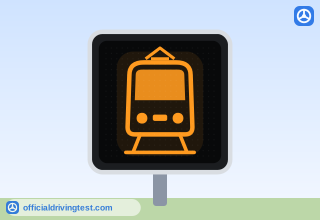
At some locations an overhead sign flashes the logo of a train. What does this mean?
- The crossing is closed to all traffic
- A train is approaching the area
- Light rail service has ended for the day
- The traffic signals at the intersection are off
Show answer
Correct answer: A train is approaching the area
The flashing train logo warns that a train is approaching, so you should pay extra attention to the signals.
Source: Utah Driver Handbook (2026 edition (new 2026 laws effective May 6, 2026)), page 89 · Open this page in the manual (Manual page 89)
-
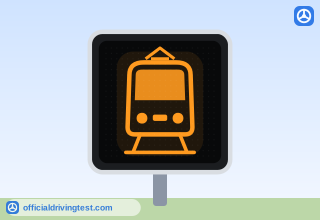
How should you treat an overhead sign that flashes the logo of a train?
- As a signal to stop immediately
- As a signal that you may ignore traffic signals
- As an additional warning device, not an indication to stop
- As a signal to speed up and clear the intersection
Show answer
Correct answer: As an additional warning device, not an indication to stop
The flashing train logo is an extra warning, not a signal to stop.
Source: Utah Driver Handbook (2026 edition (new 2026 laws effective May 6, 2026)), page 89 · Open this page in the manual (Manual page 89)